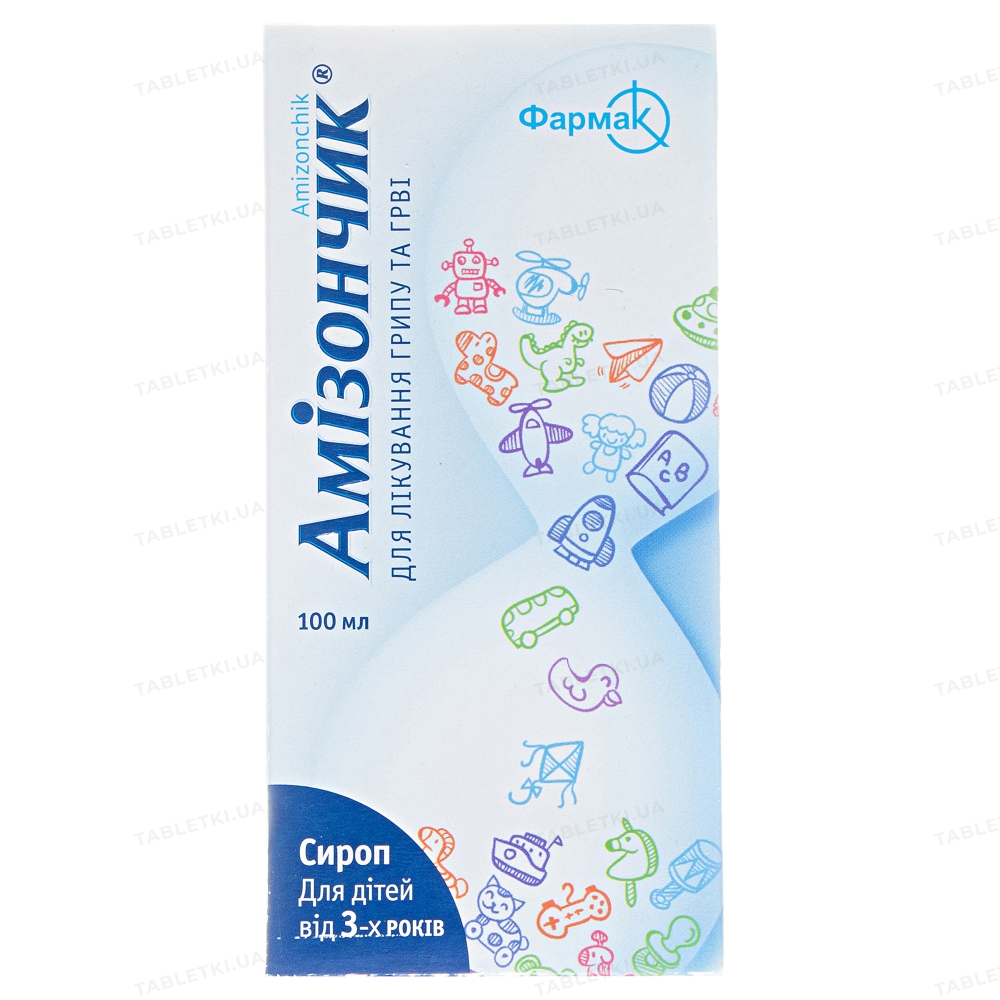
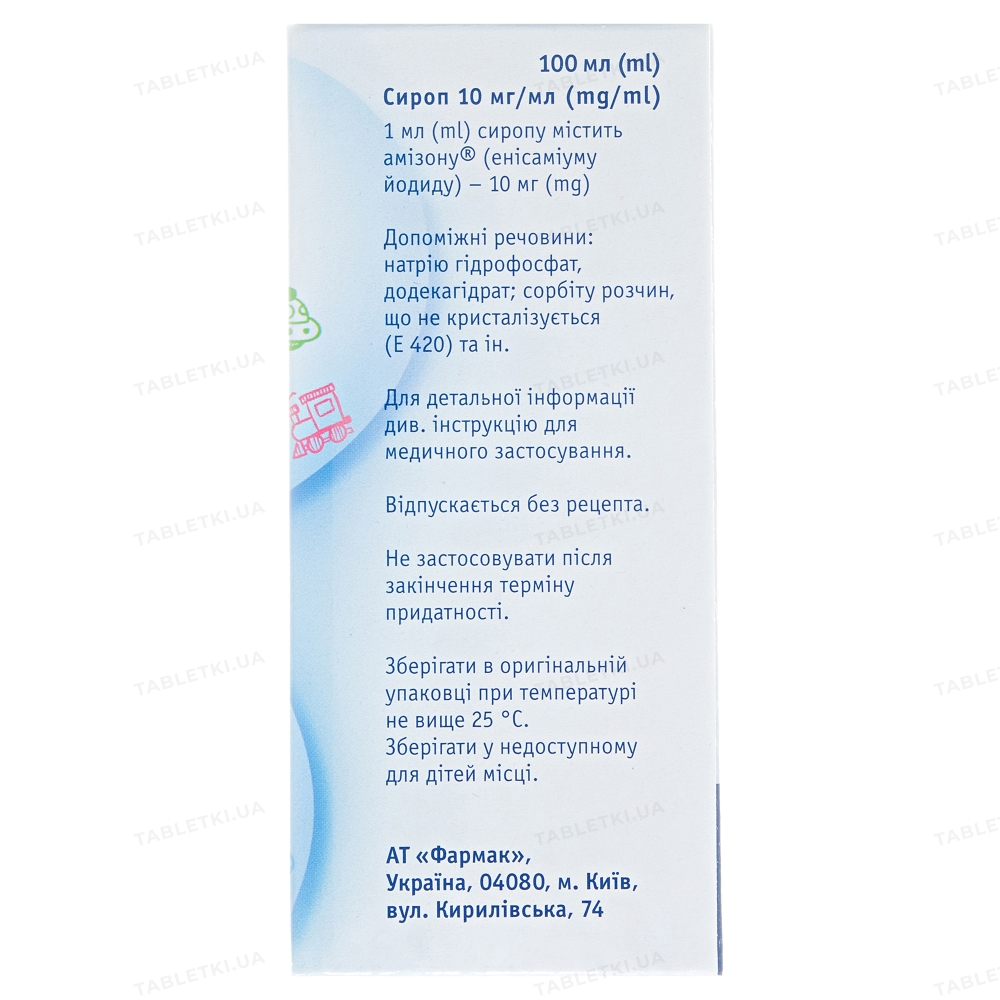
Amizonchik Syrup, 10 mg/mL, 100 mL per bottle.
Ingredients
Active ingredient: Amizon® (enisamium iodide);
1 mL of syrup contains 10 mg of Amizon® (enisaminium iodide);
Inactive ingredients: sodium hydrophosphate, dodecahydrate; citric acid, monohydrate; “Tutti-Frutti” flavoring; “Peach” flavoring; purified water; non-crystallizing sorbitol solution (E 420).
Dosage Form
Syrup.
Main physical and chemical properties: a clear, slightly yellowish-greenish liquid with a characteristic odor.
Pharmacotherapeutic group
Antiviral agents for systemic use.
ATC code J05A X.
Pharmacological properties
Pharmacodynamics.
Enisamium iodide is a derivative of isonicotinic acid. It exerts an inhibitory effect on influenza viruses, possesses interferonogenic properties, enhances the body’s resistance to viral infections, and exerts anti-inflammatory, antipyretic, and analgesic effects.
The antiviral action of Amizonchik® is associated with its direct effect on the hemagglutinins of the influenza virus, as a result of which the virion loses its ability to bind to target cells for further replication.
The anti-inflammatory effect results from the stabilization of cellular and lysosomal membranes, the inhibition of basophil degranulation, antioxidant activity, the normalization of prostaglandin levels, cyclic nucleotides, and energy metabolism at the site of inflammation. The antipyretic properties of this agent are due to its effect on the brain’s thermoregulatory centers. The analgesic effect of the drug is mediated through the reticular formation of the brainstem.
Enisamium iodide enhances persistent immunity by increasing the level of endogenous interferon in blood plasma by 3–4 times, lysozyme, and increasing the titer of antibodies against infectious agents, as well as cellular immunity—by stimulating the functional activity of T-lymphocytes and macrophages. This agent is a potent inducer of endogenous interferon.
Pharmacokinetics.
After oral administration, enisamium iodide is rapidly absorbed into the bloodstream, with peak blood concentrations observed 2–2.5 hours after dosing. The half-life is 13.5–14 hours. The drug is metabolized in the liver but is rapidly cleared from tissues (the half-life is 2–3 hours). It is excreted from the body 90–95% via urine in the form of metabolites.
Indications
Treatment of influenza and acute respiratory viral infections (ARVI).
Contraindications
- Hypersensitivity to the drug’s components or to iodine-containing drugs.
- History of allergic reactions, regardless of the nature of the allergen.
- Severe organic liver and kidney damage.
- Tuberculosis.
- Dühring’s herpetiform dermatitis (Dühring-Broca syndrome).
- Manifest and latent hyperthyroidism.
- Autonomous adenoma, focal and diffuse autonomous foci of the thyroid gland.
- Hemorrhagic diathesis.
Interactions with other medications and other types of interactions
Amizonchik® enhances the effects of antibacterial and immunomodulatory agents. It is advisable to combine this medication with ascorbic acid and other vitamins. Patients with thyroid dysfunction should not use this medication in combination with interferon.
Special Considerations for Use
This medication should be prescribed with caution to patients with thyroid disorders, especially those with nodular or multinodular goiter aged 40 years or older, due to the risk of decompensation of thyroid functional autonomy (with the exception specified in the “Contraindications” section).
The syrup contains sorbitol; therefore, patients with hereditary intolerance to certain sugars should consult a doctor before taking this medication. Patients with a rare hereditary fructose intolerance should not take this medication.
Sorbitol may also have a mild laxative effect. The energy value of 1 g of sorbitol is 2.6 kcal.
This medication contains 1.89 mmol (or 43.5 mg) of sodium in the minimum daily dose (15 mL). Caution should be exercised when administering this medication to patients on a sodium-restricted diet.
Use During Pregnancy or Breastfeeding
Use of this medication is contraindicated during pregnancy or breastfeeding.
Effect on reaction time when driving or operating machinery
This medication is not intended for use in this patient population.
Dosage and Administration
This medication is recommended for the treatment of children aged 3 years and older. Take the syrup orally, preferably after meals, with a small amount of water.
Children aged 3 to 4 years: 5 mL (50 mg) 3 times daily.
Children aged 4 to 5 years: 6 mL (60 mg) 3 times daily.
Children aged 5 to 6 years: 7 mL (70 mg) 3 times a day.
For children aged 6 to 12 years, administer the medication in tablet form. If the child cannot swallow tablets, take 12 mL (120 mg) 2–3 times a day.
Do not exceed the recommended dosage.
A 5-mL measuring spoon with 1-mL graduations is provided for measuring the syrup. If a dose greater than 5 mL is required, first measure the first 5 mL of syrup, then measure the remainder of the dose.
The course of treatment is 5–7 days, depending on the severity of the condition and the therapeutic response.
Children
The drug is indicated for the treatment of children aged 3 years and older (see the “Dosage and Administration” section).
Overdose
In case of overdose, side effects may be exacerbated: brown discoloration of the mucous membranes, vomiting, abdominal pain, and diarrhea. Edema, erythema, acne-like and bullous rashes, and fever may develop.
Treatment: gastric lavage, symptomatic treatment.
Side Effects
Adverse reactions are classified according to MedDRA terminology.
Immune system disorders: hypersensitivity reactions.
Skin and subcutaneous tissue disorders: rash, pruritus, urticaria, erythema, angioedema.
Gastrointestinal system: dry mouth, dysgeusia (bitter taste in the mouth), swelling of the oral mucosa, hypersalivation, discoloration of the tongue (yellowing), nausea, vomiting, diarrhea, dyspepsia, abdominal pain, upper abdominal pain, bloating.
Respiratory, thoracic, and mediastinal disorders: dyspnea, throat irritation.
Nervous system disorders: headache, dizziness.
General disorders and administration site conditions: asthenia, peripheral edema.
Laboratory and instrumental findings: increased blood pressure, decreased blood pressure.
Shelf life
4 years.
Shelf life of the drug after opening the vial: 90 days.
Do not use the product after the expiration date indicated on the packaging.
Storage conditions
Store in the original packaging at a temperature not exceeding 25°C.
Keep out of the reach of children.
Packaging
100 mL per bottle. One bottle and one measuring spoon per package.
Dispensing Category
Available without a prescription.
Manufacturer
JSC “Farmak.”
Manufacturer’s location and business address.
Ukraine, 04080, Kyiv, 74 Kyrylivska St.