
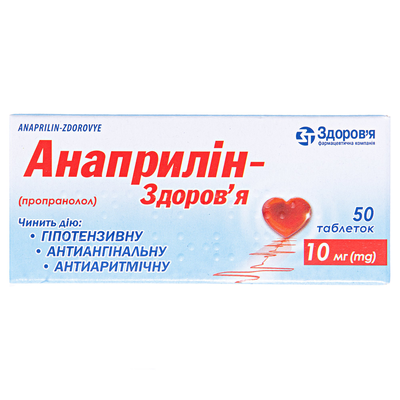
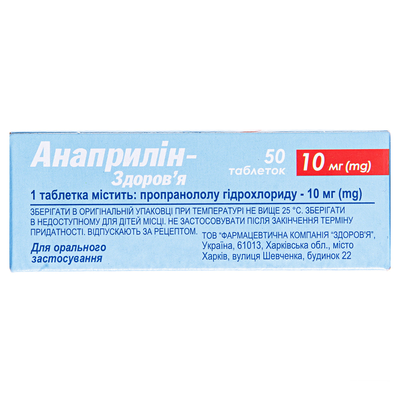
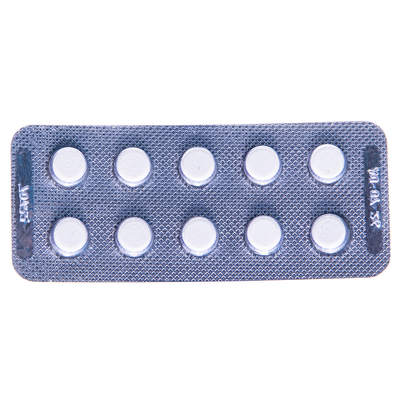
Anaprilin-Zdorovye, 10-mg tablets, No. 50 (10 x 5)
Composition
Active ingredient: propranolol;
1 tablet contains 10 mg or 40 mg of propranolol hydrochloride;
inactive ingredients: talc, corn starch, hypromellose, colloidal anhydrous silicon dioxide, calcium stearate, microcrystalline cellulose.
Dosage Form
Tablets.
Main physical and chemical properties: white or almost white tablets, flat-cylindrical in shape, with a beveled edge.
Pharmacotherapeutic group
Agents affecting the cardiovascular system. Non-selective β-adrenergic receptor blockers. Propranolol. ATC code C07A A05.
Pharmacological Properties
Pharmacodynamics.
Propranolol is an antihypertensive, antianginal, and antiarrhythmic agent.
Propranolol blocks β1- and β2-adrenergic receptors, exerts a membrane-stabilizing effect, and inhibits the automaticity of the sinoatrial node, the formation of ectopic foci in the atria, the atrioventricular node, and, to a lesser extent, in the ventricles. It reduces the speed of impulse conduction in the atrioventricular junction via the bundle of His, primarily in the anterograde direction. It reduces the heart rate and decreases the force of cardiac contractions, as well as myocardial oxygen demand. It reduces cardiac output, blood pressure, renin secretion, renal clearance, and glomerular filtration rate. It inhibits the response of baroreceptors in the aortic arch to a decrease in blood pressure.
It inhibits lipolysis in adipose tissue, preventing an increase in free fatty acid levels (the atherogenic index may increase). It inhibits glycogenolysis, glucagon and insulin secretion, and the conversion of thyroxine to triiodothyronine. It increases bronchial muscle tone and uterine contractility. It enhances the secretory and motor activity of the gastrointestinal tract.
In patients with ischemic heart disease, it reduces the frequency of angina attacks, improves exercise tolerance, and reduces the need for nitroglycerin. It exerts a cardioprotective effect, presumably reducing the risk of recurrent myocardial infarction and sudden cardiac death by 20–50%.
After a single dose of propranolol, a decrease in systolic and diastolic blood pressure is observed in both the supine and standing positions; a sustained hypotensive effect develops by the end of the second week of treatment.
Pharmacokinetics.
When taken orally, it is rapidly and almost completely (90%) absorbed from the gastrointestinal tract. Bioavailability is 30–40% (due to first-pass metabolism in the liver) and depends on the nature of the meal and the intensity of hepatic blood flow; it increases with prolonged use. Cmax in plasma is reached 1–2 hours after oral administration. It binds to plasma proteins by 90–95%, and the volume of distribution is 3–5 L/kg. It exhibits high lipophilicity and accumulates in lung tissue, the brain, the kidneys, and the heart. It crosses the blood-brain and placental barriers and is excreted into breast milk. It is metabolized in the liver by glucuronidation (99%). The half-life (T½) is 3–5 hours; with long-term use, it extends to 12 hours. It is excreted primarily by the kidneys as metabolites (up to 90%); less than 1% is excreted unchanged. It is not removed by hemodialysis.
Indications
Management of essential and renal hypertension, angina pectoris, long-term prophylactic therapy following a myocardial infarction, management of most forms of cardiac arrhythmias, migraine prevention, essential tremor, control of agitation and agitation-related tachycardia; adjunctive therapy for thyrotoxicosis and thyrotoxic crisis; as part of combination therapy—pheochromocytoma (only in combination with α-adrenergic blockers).
Contraindications
Hypersensitivity to any component of the drug; cardiogenic shock, second- and third-degree atrioventricular block, sinoatrial block, sick sinus syndrome, sinus bradycardia (heart rate less than 50 beats per minute), Prinzmetal angina, arterial hypotension, uncontrolled heart failure, a history of bronchial asthma or bronchospasm, severe peripheral circulatory disorders, metabolic acidosis (including diabetic acidosis), following prolonged fasting, untreated pheochromocytoma, diabetes mellitus, chronic liver disease.
Drug Interactions and Other Interactions
Propranolol modifies the tachycardia associated with hypoglycemia. Patients with diabetes mellitus should exercise caution when using propranolol concomitantly with hypoglycemic agents. Propranolol may prolong the hypoglycemic response to insulin.
Class I antiarrhythmic drugs and amiodarone may potentiate the effect of propranolol on atrial conduction time and cause a negative inotropic effect.
Propranolol should be used with particular caution in patients receiving concomitant treatment with cardiodepressants (chloroform, ether, or related anesthetics), antiarrhythmic drugs (quinidine, lidocaine, procainamide), which exacerbate the depressant effects.
Guanyethidine, reserpine, diuretics, and other antihypertensive agents, including vasodilators, may potentiate the antihypertensive effect of propranolol.
Digitalis glycosides, when used concomitantly with beta-blockers, may prolong the atrioventricular conduction time.
Concomitant use of beta-blockers with calcium channel blockers that have a negative inotropic effect (verapamil, diltiazem) may lead to an increase in these effects, particularly in patients with impaired cardiac function and/or impaired sinoatrial or atrioventricular conduction. This may lead to severe hypotension, bradycardia, and heart failure. A beta-blocker or calcium channel blocker must not be administered intravenously within 48 hours after discontinuation of the other.
Concomitant use of dihydropyridine calcium channel blockers (e.g., nifedipine) may increase the risk of hypotension and cause heart failure in patients with latent heart failure.
Concomitant use of sympathomimetics (e.g., epinephrine) may block the effects of beta-blockers. Caution should be exercised when administering adrenalin-containing drugs parenterally to patients taking beta-blockers, as this may, in rare cases, lead to vasoconstriction, hypertension, and bradycardia. Caution should also be exercised when using this medication with drugs such as isoprenaline and norepinephrine.
The use of propranolol during lidocaine infusion may increase the plasma concentration of lidocaine by approximately 30%. Patients who have previously taken propranolol tend to have higher plasma lidocaine concentrations than those who have not taken propranolol. This combination should be avoided.
Concomitant use of cimetidine or hydralazine, as well as alcohol, increases plasma levels of propranolol.
Beta-blockers may exacerbate the “withdrawal syndrome” hypertension caused by clonidine withdrawal. When these two drugs are used concomitantly, the beta-blocker should be discontinued several days before stopping clonidine. When replacing clonidine with a beta-blocker, administration of the beta-blocker should begin several days after discontinuing clonidine.
When propranolol is used concomitantly with ergotamine, dihydroergotamine, or related drugs, caution should be exercised due to the slight possibility of vasospastic reactions.
When used concomitantly, prostaglandin synthesis inhibitors (e.g., ibuprofen and indomethacin) may reduce the hypotensive effect of propranolol.
When propranolol and chlorpromazine are used concomitantly, plasma levels of both drugs may increase. This may lead to an enhancement of the antipsychotic effect of chlorpromazine and an enhancement of the antihypertensive effect of propranolol.
Caution should be exercised when using anesthetics with propranolol. The anesthesiologist should be informed that the patient is taking propranolol, and an anesthetic agent with the least possible negative inotropic effect should be selected. The use of beta-blockers in combination with an anesthetic agent may lead to a reduction in reflex tachycardia and increase the risk of arterial hypotension. Anesthetic agents with a cardiodepressive effect should be avoided.
The following medications may interact with propranolol due to their effects on the hepatic enzyme systems that metabolize both propranolol and these medications: quinidine, propafenone, rifampin, theophylline, warfarin, thioridazine, and dihydropyridine calcium channel blockers (nifedipine). Since the plasma concentrations of each of these drugs may be affected, dosage adjustments are necessary based on clinical evaluation of the therapy.
Special Considerations for Use
Propranolol, like other beta-blockers, is contraindicated in uncontrolled heart failure, but may be used with caution in patients with controlled heart failure. Caution should be exercised when administering this medication to patients with reduced cardiac reserve. Beta-blockers should be discontinued in cases of overt heart failure.
In patients with controlled heart failure or a family history of bronchial asthma, propranolol should be used with caution. If these conditions develop, treatment should be discontinued.
Propranolol is contraindicated in severe peripheral vascular disorders; use in less severe peripheral vascular disorders may lead to a worsening of the condition.
Propranolol should be used with caution in patients with first-degree atrioventricular block due to the drug’s negative effect on conduction time.
Propranolol may mask or alter the signs and symptoms of hypoglycemia (particularly tachycardia). Propranolol may occasionally cause hypoglycemia even in patients without diabetes mellitus, such as newborns, infants, children, the elderly, patients on hemodialysis, patients with chronic liver disease, and in cases of drug overdose. In some patients, propranolol may cause severe hypoglycemia, manifested by seizures and/or coma. In patients with diabetes, propranolol should be used with caution when administered concomitantly with hypoglycemic therapy. Propranolol may prolong the hypoglycemic response to insulin.
Propranolol may mask the symptoms of thyrotoxicosis.
Initial treatment of severe malignant hypertension should be planned to avoid a sharp decrease in diastolic blood pressure that could disrupt autoregulatory mechanisms.
Due to the pharmacological action of propranolol, the heart rate may decrease. In rare cases, if a patient develops symptoms during treatment with propranolol that may be caused by a low heart rate, the dose should be reduced.
Patients with ischemic heart disease should not abruptly discontinue the drug. The drug should be discontinued gradually or replaced with an equivalent dose of another beta-blocker.
In patients with ischemic heart disease, abrupt discontinuation of a beta-blocker may lead to an increase in the frequency of angina attacks or to a worsening of cardiac condition.
In patients with a history of anaphylactoid reactions, propranolol may cause a more severe reaction to these allergens. For such patients, the usual doses of epinephrine used to treat allergic reactions may prove insufficient.
Propranolol should be used with caution in patients with decompensated liver cirrhosis.
In patients with severe hepatic or renal impairment, propranolol should be used with caution, and the initial dose should be titrated.
For patients with renal insufficiency, the dosing interval should be increased or the dose of propranolol reduced to avoid drug accumulation.
Patients with portal hypertension may have impaired liver function and may develop hepatic encephalopathy. The use of propranolol in such cases may increase the risk of developing hepatic encephalopathy.
Caution is required when administering anesthesia while the patient is taking propranolol. The anesthesiologist must be informed, and an anesthetic agent with the least possible negative inotropic effect should be selected.
Use during pregnancy or breastfeeding.
Use during pregnancy is contraindicated unless the expected therapeutic benefit to the pregnant woman outweighs the potential risk to the fetus.
There is no evidence of teratogenicity with propranolol. However, beta-blockers reduce placental perfusion, which may lead to intrauterine fetal death, early labor, and preterm delivery. In addition, adverse reactions may occur, particularly hypoglycemia and bradycardia in newborns and bradycardia in the fetus. There is an increased risk of cardiac and pulmonary complications in newborns during the postnatal period.
Most β-blockers, especially lipophilic compounds, can pass into breast milk, although to varying degrees. Consequently, breastfeeding is not recommended while taking this medication.
Effect on reaction time when operating motor vehicles or other machinery.
Due to the potential for side effects affecting the central nervous and cardiovascular systems during treatment with this medication, caution should be exercised when driving or engaging in other potentially hazardous activities that require increased concentration and rapid psychomotor reactions.
Directions for Use and Dosage
Take orally 10–30 minutes before a meal with a sufficient amount of liquid. The dosing regimen is individualized. The dose and duration of treatment are determined by the physician.
Adults.
Hypertension: The initial dose is 80 mg twice daily. If necessary, the dose should be gradually increased each week depending on the patient’s response to treatment. Usual daily doses range from 160 to 320 mg.
Angina, anxiety, migraine, essential tremor: The initial dose is 40 mg 2–3 times daily. If necessary, the dose should be gradually increased by the same amount at 1-week intervals, depending on the patient’s response to treatment. For angina, the usual daily dose range is 80–320 mg. An adequate response to treatment for agitation, migraine, and essential tremor is observed with doses ranging from 80 to 160 mg per day; for angina pectoris, the range is 120 to 240 mg per day.
Arrhythmias, tachycardia due to excitement, thyrotoxicosis: doses are usually 10–40 mg 3–4 times daily.
Long-term prophylactic therapy following a myocardial infarction: therapy should be initiated 5–21 days after the myocardial infarction. The initial dose is 40 mg 4 times daily for 2–3 days; thereafter, the daily dose may be increased to 80 mg twice daily.
Pheochromocytoma (only in combination with an α-adrenergic blocker): administer 60 mg daily for 3 days prior to surgery; in inoperable cases, 30 mg daily.
| Summary Table of Drug Dosage (Daily Doses) | ||
| Indications | Minimum daily dose | Maximum daily dose |
| Hypertension | 160 mg | 320 mg |
| Angina | 80 mg | 320 mg |
| Arrhythmias | 30 mg | 160 mg |
| Migraine | 80 mg | 160 mg |
| Tremor | 40 mg | 160 mg |
| Agitation | 80 mg | 160 mg |
| Excitatory tachycardia | 30 mg | 160 mg |
| Thyrotoxicosis | 30 mg | 160 mg |
| Pheochromocytoma:
preoperative monitoring in patients who have not undergone surgery |
60 mg 30 mg |
60 mg 30 mg |
| After a myocardial infarction | 160 mg | 160 mg |
Elderly patients. Data regarding the relationship between blood levels of the drug and patient age are inconsistent. Consequently, for elderly patients, the optimal dosage should be determined on an individual basis according to clinical response.
Children. Dosage should be individualized based on the condition of the cardiovascular system and the circumstances necessitating treatment.
Follow these treatment regimens:
Arrhythmia, pheochromocytoma, thyrotoxicosis: Administer the drug to children aged 3 years and older at a dose of 0.25–0.5 mg/kg of body weight 3–4 times daily.
Migraine: children aged 3 to 12 years—20 mg 2–3 times daily; children aged 12 years and older—the same dosage as for adult patients.
Children. The drug should be prescribed to children aged 3 years and older (see the “Dosage and Administration” section).
Overdose
Symptoms: dizziness, severe hypotension, bradycardia, arrhythmia, heart failure, collapse, acrocyanosis, seizures, difficulty breathing, bronchospasm.
Treatment: gastric lavage, administration of adsorbents. In the absence of signs of pulmonary edema, administer infusions of plasma substitutes; if ineffective, administer epinephrine, dopamine, or dobutamine; for heart failure—cardiac glycosides, β-adrenomimetics, diuretics, glucagon; for convulsions—intravenous diazepam; for bronchospasm—β-adrenergic agonists by inhalation or parenterally. In the presence of atrioventricular conduction disturbances—1–2 mg of atropine intravenously (for adults); if ineffective, implant a temporary pacemaker. For ventricular extrasystoles, use lidocaine (Class IA antiarrhythmic drugs are not used). If blood pressure drops, the patient should be placed in the Trendelenburg position. Hemodialysis is ineffective.
Side Effects
The drug is generally well tolerated, but the following adverse reactions may occur.
Cardiac: hypotension, orthostatic hypotension, sinus bradycardia, atrioventricular block, development/progression of heart failure, peripheral circulatory disorders.
Blood system: thrombocytopenia, thrombocytopenic purpura, leukopenia, agranulocytosis.
Nervous system disorders: asthenia, dizziness, headache, insomnia or drowsiness, nightmares, slowed mental and motor reactions, depression, anxiety, confusion or transient amnesia, paresthesias, hallucinations, seizures, psychosis, mood changes.
Ocular disorders: impaired visual acuity, decreased tear production, dry and sore eyes, keratoconjunctivitis.
Respiratory system: pharyngitis, cough, shortness of breath, respiratory distress syndrome, bronchospasm, and laryngospasm.
Gastrointestinal system: nausea, vomiting, epigastric pain, diarrhea or constipation, mesenteric artery thrombosis, ischemic colitis.
Skin and subcutaneous tissue disorders: skin reactions, itching, rash, alopecia, exacerbation of psoriasis, psoriasis-like skin reactions.
Endocrine system: hypoglycemia.
Vascular disorders: cold extremities, exacerbation of intermittent claudication, Raynaud’s syndrome.
Hepatobiliary system: liver dysfunction (including cholestasis).
Other: fever, arthralgia, decreased libido, decreased potency, Peyronie’s disease, myasthenia gravis, increased levels of antinuclear antibodies.
Shelf life
4 years.
Storage conditions
Store in the original packaging at a temperature not exceeding 25 °C.
Keep out of reach of children.
Packaging
Tablets: No. 10 × 5, No. 50 in a blister pack inside a box; No. 50 in a container inside a box.
Dispensing Category
By prescription only.
Manufacturer
Limited Liability Company “Pharmaceutical Company ‘Zdorov’ya’”.
Address
Ukraine, 61013, Kharkiv Oblast, Kharkiv, Shevchenko Street, Building 22.







