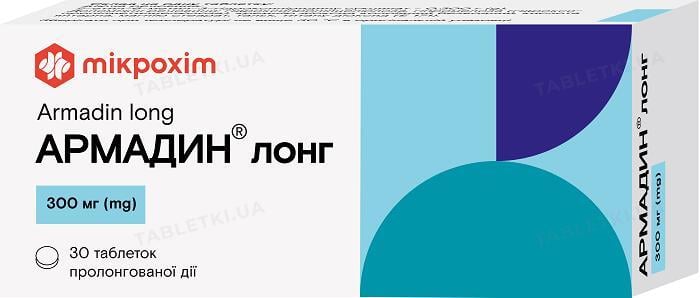
Armadin Long-Acting Tablets, 300 mg, No. 30 (10 x 3)
Composition
Active ingredient: mexidol (synonym);
1 tablet contains 300 mg or 500 mg of armadine (2-ethyl-6-methyl-3-hydroxypyridine succinate);
inactive ingredients: hydroxypropyl cellulose, hypromellose (hydroxypropyl methylcellulose), colloidal anhydrous silicon dioxide, succinic acid, magnesium stearate, talc, titanium dioxide (E 171).
Dosage Form
Extended-release tablets.
Main physical and chemical properties: white or white with a creamy tint tablets with a biconvex, smooth surface, film-coated, possibly with a characteristic odor.
Pharmacotherapeutic group
Agents affecting the nervous system. ATC code N07X X.
Pharmacological Properties
Pharmacodynamics.
Ethylmethylhydroxypyridine succinate belongs to the group of heteroaromatic antioxidants. It has a broad spectrum of pharmacological action: it increases the body’s resistance to stress, exerts an anxiolytic effect that is not accompanied by drowsiness or muscle relaxation; it has nootropic properties, prevents and reduces memory impairments associated with aging and various pathogenic factors, and exerts an anticonvulsant effect; it exhibits antioxidant and antihypoxic properties; It enhances concentration and work capacity; it mitigates the toxic effects of alcohol. The drug improves brain tissue metabolism and blood supply, enhances microcirculation and blood rheological properties, and reduces platelet aggregation. It stabilizes the membrane structures of blood cells (red blood cells and platelets); it reduces total cholesterol and low-density lipoprotein levels.
Its mechanism of action is due to its antioxidant and membrane-protective activity. It inhibits lipid peroxidation, increases the activity of superoxide dismutase, increases the “lipid/protein” ratio, and reduces membrane viscosity. It modulates the activity of membrane-bound enzymes (calcium-dependent phosphodiesterase, adenylate cyclase, acetylcholinesterase) and receptor complexes (benzodiazepine, γ-aminobutyric acid (GABA), acetylcholine receptor complexes), thereby enhancing their ability to bind to ligands, promoting the preservation of the structural and functional organization of biomembranes, the transport of neurotransmitters, and the improvement of synaptic transmission. Ethylmethylhydroxypyridine succinate increases dopamine levels in the brain. Under conditions of tissue ischemia, it enhances the compensatory activation of aerobic glycolysis and reduces the degree of inhibition of oxidative processes in the Krebs cycle.
Pharmacokinetics.
ARMADIN® LONG is a sustained-release dosage form that ensures a uniform release of the active ingredient over 10–12 hours and reduces the likelihood of side effects resulting from a sharp increase in its concentration in blood plasma. The drug’s effect begins to manifest 3–4 hours after administration, when the concentration of the active ingredient in the blood plasma reaches therapeutic levels; a sustained improvement in condition is observed after 2–3 days, once steady-state pharmacokinetic parameters are established. After discontinuation of the drug, its effects persist for another 3–5 days.
Absorption of the drug begins in the stomach and continues in the small and large intestines. The rate of release and absorption of the active ingredient from ARMADIN® LONG tablets is virtually independent of the location in the gastrointestinal tract, pH, and composition of the chyme.
Ethylmethylhydroxypyridine succinate is metabolized in the human body primarily in the liver through extensive conjugation with glucuronic acid and is excreted in the urine both unchanged and as glucuronide conjugates. The rates of renal excretion of the unchanged drug and its conjugated metabolites are characterized by significant individual variability.
Indications
- Consequences of acute cerebrovascular accident;
- neurotic and neurosis-like conditions with symptoms of anxiety;
- neurocirculatory dystonia;
- mild cognitive disorders of various origins (in cases of psychoorganic syndrome and asthenic disorders caused by acute and chronic cerebral circulation disorders, traumatic brain injuries, neuroinfections and intoxication, senile and atrophic processes);
- encephalopathies of various origins (discirculatory, dysmetabolic, post-traumatic, mixed);
- mild traumatic brain injury, sequelae of traumatic brain injury;
- memory impairment and intellectual disability in the elderly;
- asthenic conditions, effects of extreme (stressful) factors;
- ischemic heart disease (as part of complex therapy);
- withdrawal syndrome in alcoholism with a predominance of neurosis-like and neurocirculatory disorders;
- conditions following intoxication with antipsychotic drugs.
Contraindications
Acute liver or kidney failure, hypersensitivity to any component of the drug, pediatric patients, pregnancy, and breastfeeding.
Interactions with Other Medications and Other Types of Interactions
ARMADIN® LONG enhances the effects of benzodiazepine anxiolytics, antiparkinsonian agents, and carbamazepine; it potentiates the effects of anticonvulsants, tranquilizers, and analgesics. ARMADIN® LONG reduces the toxic effects of ethyl alcohol. It enhances the hypotensive activity of angiotensin-converting enzyme (ACE) inhibitors and β-blockers. It enhances the antianginal activity of nitrates. Under the influence of this drug, the effects of sedatives, neuroleptics, antidepressants, hypnotics, and anticonvulsants are intensified, making it possible to reduce their doses and minimize side effects.
Special Considerations for Use
In rare cases, severe hypersensitivity reactions may occur, particularly in patients with bronchial asthma or hypersensitivity to sulfites.
Use with caution in patients with diabetic retinopathy (treatment should not exceed 7–10 days) due to the drug’s potential to potentiate proliferative processes.
Use During Pregnancy or Breastfeeding
No strictly controlled clinical studies on the safety of this medication during pregnancy and breastfeeding have been conducted; therefore, ARMADIN® LONG is contraindicated during these periods.
Effect on reaction time when driving or operating machinery
During treatment, caution is advised when driving or operating complex machinery, given the possibility of side effects that may affect reaction time and the ability to concentrate.
Dosage and Administration
Administer orally to adults, regardless of meals. To ensure a gradual and uniform release of the active ingredient from the tablet, it should be swallowed whole with a glass of water.
Due to the manufacturing technology of the extended-release formulation, a soft, gel-like base that resembles the tablet in shape but does not contain the active ingredient is excreted in the stool.
Dosage and duration of treatment are determined based on the patient’s sensitivity to the drug and medical indications.
During the first 2–3 days, ARMADIN® LONG is prescribed at a dose of 1 tablet of 300 mg or 500 mg; thereafter, the daily dose is increased to 600 mg. The medication is taken as 1 tablet every 12 hours.
For ischemic heart disease, ARMADIN® LONG is used for 2–3 months.
Patients with anxiety disorders, neurocirculatory dysfunction, and cognitive impairments take ARMADIN® LONG for 2–6 weeks.
To relieve alcohol withdrawal syndrome, the drug is used for 5–7 days.
Course therapy with ARMADIN® LONG is discontinued gradually by reducing the dose over 2–3 days.
Children
No strictly controlled clinical studies on the safety of this drug in children have been conducted; therefore, ARMADIN® LONG is contraindicated in this patient population.
Overdose
Overdose may cause drowsiness and sedation.
Treatment consists of detoxification therapy and symptomatic treatment.
Side Effects
Cardiovascular system: increased blood pressure, decreased blood pressure.
Nervous system: drowsiness, difficulty falling asleep, anxiety, emotional reactivity, headache, impaired coordination.
Gastrointestinal system: nausea, dry mouth.
Immune system: allergic reactions, including flushing, skin rash, and itching.
Other: distal hyperhidrosis.
Shelf life
3 years.
Do not use after the expiration date printed on the package.
Storage conditions
Store at a temperature not exceeding 30 °C in the original packaging.
Keep out of reach of children.
Packaging
40 tablets in a plastic jar inside a cardboard box.
Manufacturer
LLC NVP “MIKROCHIM” (responsible for manufacturing and batch control/testing, including batch release)
Manufacturer’s location and address of its place of business.
Ukraine, 93000, Luhansk Oblast, Rubizhne, 33 Lenin Street.
To report an adverse event associated with the use of this medication, please call +38 (050) 309-83-54 (24 hours a day).