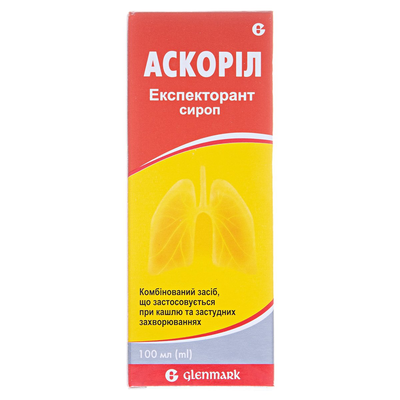
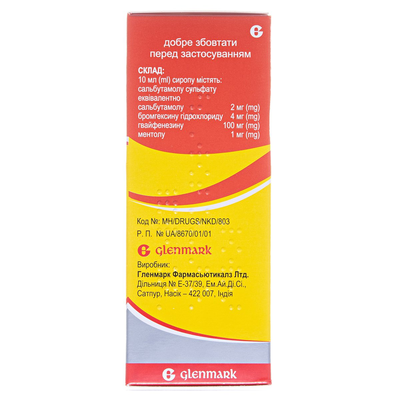
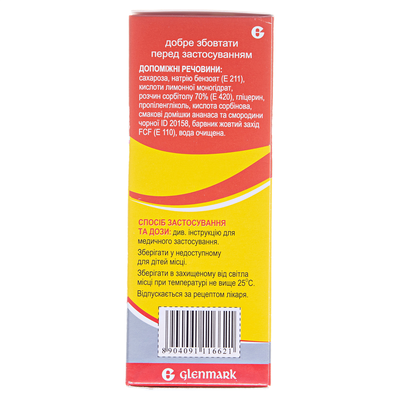
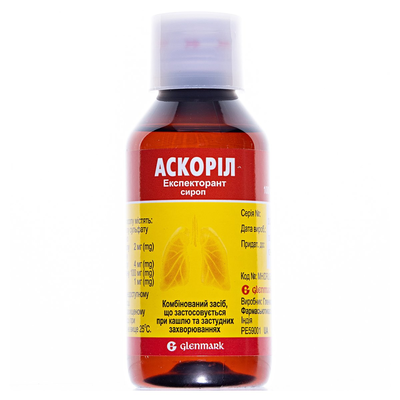
Ascoril Expectorant Syrup, 100 ml per bottle.
Ingredients
Active ingredients: salbutamol sulfate, bromhexine hydrochloride, guaifenesin, menthol;
10 mL of syrup contains salbutamol sulfate equivalent to 2 mg of salbutamol, 4 mg of bromhexine hydrochloride, 100 mg of guaifenesin, and 1 mg of menthol;
excipients: sucrose, sodium benzoate (E 211), citric acid monohydrate, 70% sorbitol solution (E 420), glycerin, propylene glycol, sorbic acid, pineapple and black currant flavorings ID 20158, sunset yellow FCF (E 110), purified water.
Dosage Form
Syrup.
Main physical and chemical properties: a clear, viscous, orange-colored liquid.
Pharmacotherapeutic group
Agents used for coughs and the common cold. Expectorants. Combinations.
ATC code R05C A10.
Pharmacological properties
Pharmacodynamics. Ascoril Expectorant is a combination drug with bronchodilator, mucolytic, and expectorant properties. Thanks to the rational combination of salbutamol, bromhexine hydrochloride, guaifenesin, and menthol, it effectively and rapidly alleviates dysfunction of the bronchopulmonary system.
Salbutamol—a selective β2-adrenoreceptor agonist—effectively and sustainably dilates the bronchi. At therapeutic doses, it does not cause cardiac stimulation. Bromhexine hydrochloride reduces sputum viscosity and promotes its clearance from the bronchi. Guaifenesin relaxes and clears the bronchi of mucus, promoting expectoration. Menthol alleviates symptoms of irritation and inflammation in the mucous membrane of the respiratory tract.
Pharmacokinetics. No specific pharmacokinetic studies of the drug have been conducted.
Indications
Secretolytic therapy for respiratory tract diseases accompanied by bronchospasm and the formation of viscous secretions that are difficult to expel: tracheobronchitis, chronic obstructive pulmonary disease, bronchial asthma, and pulmonary emphysema.
Contraindications
Hypersensitivity to salbutamol, other sympathomimetics, bromhexine, guaifenesin, menthol, or any other component of the drug. Arrhythmia, severe cardiovascular diseases, hyperthyroidism, severe liver dysfunction, and gastric or duodenal ulcers.
Drug Interactions and Other Interactions
Hypokalemia resulting from the use of salbutamol-containing medications may be exacerbated by concomitant use of diuretics. Consequently, the risk of arrhythmias increases when used in combination with cardiac glycosides during such treatment. The effects of salbutamol may be reduced when used concomitantly with β-blockers, especially nonselective ones (such as propranolol), and may be enhanced when used concomitantly with xanthines (e.g., theophylline).
Salbutamol should not be used concomitantly with inhalation anesthetics, epinephrine, tricyclic antidepressants, or corticosteroids.
Bromhexine should not be prescribed concurrently with medications containing codeine. When bromhexine is used concomitantly with drugs that irritate the gastrointestinal tract, there is a risk of a synergistic increase in irritation of the gastric mucosa. Concomitant use with antibiotics (amoxicillin, erythromycin, cefuroxime, doxycycline) and sulfonamide drugs may increase their concentrations in bronchial secretions. When taken concurrently with medications that suppress the cough center, it may become difficult to expel thinned sputum (accumulation of bronchial secretions in the airways). Concomitant use with bronchodilators is possible.
Guaifenesin potentiates the effects of drugs that depress the central nervous system, as well as ethanol. It may also cause false-positive results in diagnostic tests that detect 5-hydroxyindoleacetic acid and vanillylmandelic acid in urine.
There are no data on adverse interactions between menthol and other medications.
Special Instructions for Use
Shake well before use.
This medication should be used with caution in patients with essential or symptomatic hypertension, ischemic heart disease, and other cardiovascular diseases, as well as in patients with subcompensated diabetes mellitus, glaucoma.
Very rarely, severe skin reactions, such as Stevens-Johnson syndrome and Lyell’s syndrome, have been observed during treatment with bromhexine. If changes appear on the skin or mucous membranes, consult a doctor immediately and discontinue use of the medication.
In cases of impaired bronchial motility accompanied by the production of large amounts of bronchial secretions (malignant cilia syndrome), the drug should be used with extreme caution due to the potential for secretion stasis.
In cases of impaired renal function (including severe renal insufficiency) or liver disease (in cases of mild to moderate hepatic insufficiency), the drug should be used with particular caution (by reducing the dose or increasing the interval between doses).
Periodic monitoring of liver function is recommended, especially during long-term use. Propylene glycol, which is a component of the drug, may cause symptoms in children that resemble those associated with alcohol consumption.
The drug contains sucrose; therefore, patients with rare hereditary forms of fructose intolerance, sucrose-isomaltase deficiency, or glucose-galactose malabsorption should not use this drug.
Blood glucose levels must be monitored before and during treatment in these patients.
Isolated cases of myocardial ischemia associated with the use of salbutamol have been reported. Patients with heart disease (such as ischemic heart disease) who are being treated with salbutamol sulfate should seek medical attention if they experience chest pain or other symptoms suggestive of a heart condition flare-up. Attention should be paid to the assessment of symptoms such as shortness of breath and chest pain, which may result from either heart disease or respiratory disorders.
Treatment with β2-agonists may result in severe hypokalemia; therefore, it is recommended to monitor serum potassium levels.
Like other β-adrenergic agonists, salbutamol sulfate may cause reversible metabolic changes, such as an increase in blood glucose levels. In this regard, there have been isolated reports of ketoacidosis developing in patients with diabetes mellitus. Concomitant use of corticosteroids may exacerbate this condition.
Do not administer to patients prior to anesthesia.
This medication should not be used in patients with hypertrophic cardiomyopathy.
If there is a history of gastric bleeding, the syrup should be used under medical supervision. During treatment with this medication, it is necessary to consume an adequate amount of fluid, which enhances the expectorant effect of bromhexine.
The yellow sunset FCF (E 110) dye present in the medication may cause an allergic reaction.
Use during pregnancy or breastfeeding.
Do not use.
Effect on reaction time when driving or operating machinery.
During treatment with this medication, it is best to refrain from driving or performing tasks that require precision, quick reactions, and concentration.
Dosage and Administration
This medication should be used as prescribed and under a doctor’s supervision.
Adults and children 12 years of age and older should take 10 mL 3 times daily. Children 6 to 12 years of age should take 5–10 mL 3 times daily. Children aged 2 to 6 years: 5 mL three times daily. The duration of treatment is determined by the doctor on an individual basis.
Children.
Do not administer this medication to children under 2 years of age due to a lack of experience with its use in this age group.
Overdose
Symptoms: tachycardia, tremor, convulsions, gastrointestinal discomfort, nausea, vomiting, extrasystoles, hypotension, chest pain, hypokalemia, ataxia, diplopia, drowsiness, metabolic acidosis, rapid breathing, headache, palpitations, arrhythmia, hyperglycemia, abdominal pain, exacerbation of gastric ulcer, agitation, confusion, and respiratory depression.
Treatment. Symptomatic therapy.
Side Effects
Immune system disorders: hypersensitivity reactions, including rash, itching, anaphylactic reactions—including drug hypersensitivity syndrome with eosinophilia and systemic symptoms—anaphylactic shock, angioedema, urticaria, oropharyngeal edema, and Lyell’s syndrome; rarely, with oral administration of salbutamol in children, erythema multiforme, Stevens-Johnson syndrome, acute generalized exanthematous pustulosis, and facial edema may occur.
Gastrointestinal system: dyspeptic symptoms, nausea, vomiting, diarrhea, abdominal pain, exacerbation of gastric or intestinal ulcers, gastralgia, unpleasant taste in the mouth.
Nervous system: tremor, myalgia, headache, hyperactivity, dysgeusia, dizziness, restlessness, insomnia.
Cardiovascular system: tachycardia; peripheral vasodilation; cardiac arrhythmias, including ventricular fibrillation, supraventricular tachycardia, and extrasystoles; hypotension or hypertension; palpitations; myocardial ischemia; collapse.
Respiratory system: respiratory disturbances, worsening of cough.
Salbutamol may trigger paradoxical bronchospasm, which is a life-threatening condition. If this occurs, the drug must be discontinued immediately and alternative treatment prescribed.
Other: muscle spasms, a sensation of pressure in the muscles, hyperthermia, chills, mydriasis, bladder atony, increased sweating, thrombocytopenia, metabolic changes, such as hypokalemia.
Some patients may develop a transient increase in blood aminotransferase levels caused by bromhexine.
Shelf life
2 years.
Storage conditions
Store in a place protected from light at a temperature not exceeding 25 °C.
Keep out of reach of children.
Packaging
Available in 100 mL or 200 mL vials; 1 vial with a measuring cap in a cardboard package.
Dispensing Category
By prescription.