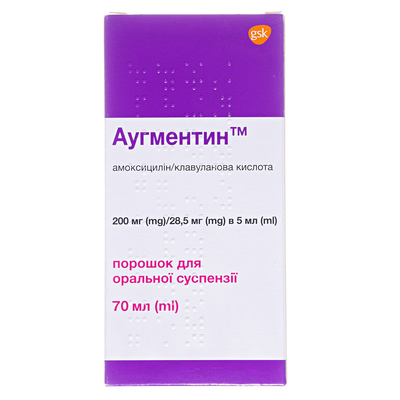
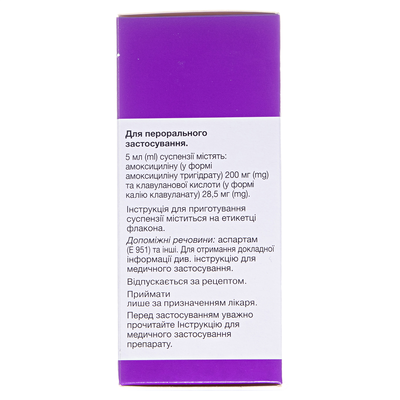
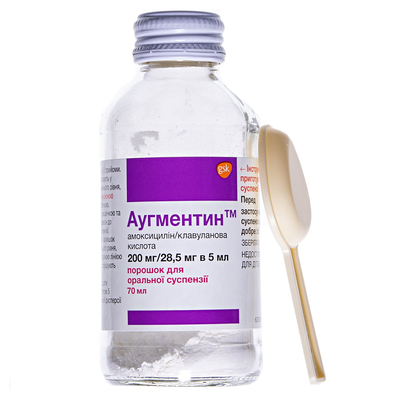
Augmentin powder for oral suspension, 200 mg/28.5 mg/5 mL, 70 mL per bottle.
Composition
Active ingredients: amoxicillin, clavulanic acid;
5 mL of suspension contains 200 mg of amoxicillin (as amoxicillin trihydrate) and 28.5 mg of clavulanic acid (as potassium clavulanate);
Excipients: xanthan gum, aspartame (E 951), succinic acid, colloidal anhydrous silicon dioxide, hydroxypropyl methylcellulose, dry orange flavorings (1 and 2), dry raspberry flavoring, dry “Light Molasses” flavoring, silicon dioxide.
Dosage Form
Powder for oral suspension.
Main physical and chemical properties: white or off-white free-flowing powder.
Pharmacotherapeutic group
Antibacterial agents for systemic use. Beta-lactam antibiotics, penicillins. Combinations of penicillins with beta-lactamase inhibitors. ATC code J01C R02.
Pharmacological properties
Pharmacodynamics.
Mechanism of action
Amoxicillin is a semisynthetic penicillin (beta-lactam antibiotic) that inhibits one or more enzymes (often referred to as penicillin-binding proteins, PBPs) in the biosynthetic metabolism of bacterial peptidoglycan, which is an integral structural component of the bacterial cell wall. Inhibition of peptidoglycan synthesis leads to weakening of the cell wall, resulting in lysis and cell death.
Amoxicillin is susceptible to degradation by beta-lactamases produced by resistant bacteria; therefore, the spectrum of activity of amoxicillin as monotherapy does not include organisms that produce these enzymes.
Clavulanic acid is a beta-lactam structurally related to penicillins. It inactivates certain beta-lactamase enzymes, thereby preventing the inactivation of amoxicillin. Clavulanic acid, when used as monotherapy, does not produce a clinically beneficial antibacterial effect.
PK/PD Ratio
The time exceeding the minimum inhibitory concentration (T > MIC) is considered the primary factor determining the efficacy of amoxicillin.
Mechanisms of Resistance
There are two mechanisms of resistance to amoxicillin/clavulanic acid:
- inactivation by bacterial beta-lactamases, which are not themselves inhibited by clavulanic acid, including classes B, C, and D;
- metabolism of the antibiotic, which reduces the antibiotic’s affinity for its target.
Bacterial impermeability or the efflux pump mechanism may cause or contribute to bacterial resistance, particularly in Gram-negative bacteria.
Breakpoints
MIC breakpoints for amoxicillin/clavulanic acid established by the European Committee on Antimicrobial Susceptibility Testing (EUCAST)
| Microorganisms | Sensitivity breakpoints (μg/mL) | ||
| Susceptible | Moderately susceptible | Resistant | |
| Haemophilus influenzae 1 | ≤1 | - | > 1 |
| Moraxella catarrhalis 1 | ≤1 | - | > 1 |
| Staphylococcus aureus 2 | ≤2 | - | >2 |
| Coagulase-negative staphylococci 2 | ≤ 0.25 | > 0.25 | |
| Enterococcus 1 | ≤4 | 8 | > 8 |
| Streptococcus A, B, C, G5 | ≤ 0.25 | - | > 0.25 |
| Streptococcus pneumoniae 3 | ≤ 0.5 | 1–2 | >2 |
| Enterobacteria 1, 4 | - | - | > 8 |
| Gram-negative anaerobic bacteria 1 | ≤4 | 8 | > 8 |
| Gram-positive anaerobic bacteria 1 | ≤4 | 8 | > 8 |
| Threshold values not specific to individual species 1 | ≤2 | 4–8 | > 8 |
| 1 Reported values for amoxicillin concentrations. For susceptibility testing, the clavulanic acid concentration was set at 2 mg/L.
2 Reported values for oxacillin concentrations. 3 The cut-off values listed in the table are calculated based on the cut-off values for ampicillin. 4 A resistance cutoff value of R > 8 mg/L means that all strains with resistance mechanisms are reported as resistant. 5 The breakpoints listed in the table are calculated based on the breakpoints for benzylpenicillin. |
|||
The prevalence of resistance may vary geographically and over time for individual species; therefore, it is advisable to have local susceptibility data, especially when treating severe infections. If necessary, expert advice should be sought if the local prevalence of resistance is such that the benefit of the drug, at least for certain types of infections, is in doubt.
| Typically susceptible species |
| Gram-positive aerobes: Enterococcus faecalis, Gardnerella vaginalis, Staphylococcus aureus
(methicillin-susceptible)£, coagulase-negative staphylococci (methicillin-susceptible), Streptococcus agalactiae, Streptococcus pneumoniae¹, Streptococcus pyogenes, and other beta-hemolytic streptococci, Streptococcus viridans group. Gram-negative aerobes: Capnocytophaga spp., Eikenella corrodens, Haemophilus influenzae², Moraxella catarrhalis, Pasteurella midtocida. Anaerobes: Bacteroides fragilis, Fusobacterium nucleatum, Prevotella spp. |
| Species for which the development of resistance may be a concern |
| Gram-positive aerobes: Enterococcus faecium$.
Gram-negative aerobes: Escherichia coli, Klebsiella oxytoca, Klebsiella pneumoniae, Proteus mirabilis, Proteus vulgaris. |
| Naturally resistant microorganisms |
| Gram-negative aerobes: Acinetobacter sp., Citrobacter freundii, Enterobacter sp., Legionella pneumophila, Morganella morganii, Providencia spp., Pseudomonas sp., Serratia sp., Stenotrophomonas maltophilia.
Other microorganisms: Chlamydophila pneumoniae, Chlamydophila psittaci, Coxiella burnetti, Mycoplasma pneumoniae |
| $ Naturally moderate susceptibility in the absence of acquired resistance mechanisms.
£ All methicillin-resistant staphylococci are resistant to amoxicillin/clavulanic acid. 1 Penicillin-resistant Streptococcus pneumoniae should not be treated with this formulation of amoxicillin/clavulanic acid (see the “Dosage and Administration” and “Special Precautions for Use” sections). 2 Strains with reduced susceptibility have been reported in some EU countries at a frequency exceeding 10%. |
Pharmacokinetics.
Absorption. Amoxicillin and clavulanic acid are completely dissociated in aqueous solution at physiological pH. Both components are rapidly and well absorbed following oral administration. The bioavailability of amoxicillin and clavulanic acid is approximately 70% following oral administration. The plasma profiles of both components are identical, and the time to reach maximum plasma concentration (Tmax) for each component is approximately one hour.
The serum concentrations of amoxicillin and clavulanic acid achieved with amoxicillin/clavulanic acid are identical to those achieved following oral administration of equivalent doses of amoxicillin or clavulanic acid alone.
Distribution. Approximately 25% of the total plasma volume of clavulanic acid and 18% of the total plasma volume of amoxicillin are bound to proteins. The apparent volume of distribution is approximately 0.3–0.4 L/kg for amoxicillin and approximately 0.2 L/kg for clavulanic acid.
Following intravenous administration, amoxicillin and clavulanic acid were detected in the gallbladder, abdominal tissue, skin, adipose tissue, muscle tissue, synovial and peritoneal fluid, bile, and pus. Amoxicillin is not sufficiently distributed in cerebrospinal fluid.
Animal studies have shown no evidence of significant retention of substances derived from any component of the drug in body tissues. Amoxicillin, like most penicillins, can be detected in breast milk. A small amount of clavulanic acid may also be detected in breast milk (see the section “Use During Pregnancy or Breastfeeding”).
Both amoxicillin and clavulanic acid have been shown to cross the placental barrier (see the section “Use During Pregnancy or Breastfeeding”).
Biotransformation. Amoxicillin is partially excreted in the urine as inactive penicilloic acid in amounts equivalent to 10–25% of the initial dose. Clavulanic acid is extensively metabolized in the human body and is excreted in the urine and feces, as well as in the form of carbon dioxide in exhaled air.
Elimination. The primary route of elimination for amoxicillin is via the kidneys, whereas clavulanic acid is eliminated both by the kidneys and through extrarenal mechanisms.
In healthy volunteers, the mean half-life of amoxicillin/clavulanic acid is approximately one hour, and the mean total clearance is approximately 25 L/h. Various studies have shown that urinary excretion accounts for 50–85% of amoxicillin and 27–60% of clavulanic acid over a 24-hour period. In the case of clavulanic acid, the largest amount of the substance is excreted within the first 2 hours after administration.
Concomitant use of probenecid slows the elimination of amoxicillin but does not delay the renal excretion of clavulanic acid (see the “Drug Interactions and Other Interactions” section).
Age. The half-life of amoxicillin is identical for children aged 3 months to 2 years, older children, and adults. For infants (including premature infants) during the first week of life, the dosing frequency should not exceed twice daily due to the immaturity of the renal excretion pathway. Since elderly patients are more prone to reduced renal function, dosing should be selected with caution; monitoring of renal function is also recommended.
Impaired renal function. The total serum clearance of amoxicillin/clavulanic acid decreases proportionally with reduced renal function. The reduction in drug clearance is more pronounced for amoxicillin than for clavulanic acid, since a larger proportion of amoxicillin is excreted by the kidneys. In patients with renal insufficiency, dosing should prevent excessive accumulation of amoxicillin while maintaining adequate levels of clavulanic acid (see the “Dosage and Administration” section).
Hepatic impairment. Caution is advised when administering the drug to patients with hepatic impairment, and regular monitoring of liver function is recommended.
Indications
Treatment in adults and children of bacterial infections caused by microorganisms susceptible to Augmentin, such as:
- acute bacterial sinusitis (confirmed);
- acute otitis media;
- confirmed exacerbation of chronic bronchitis;
- community-acquired pneumonia;
- cystitis;
- pyelonephritis;
- skin and soft tissue infections, including cellulitis, animal bites, and severe dentoalveolar abscesses with extensive cellulitis;
- bone and joint infections, including osteomyelitis.
When prescribing antibacterial drugs, the guidelines for their proper use should be followed.
Contraindications
Hypersensitivity to any component of the drug or to any antibacterial agents of the penicillin group.
A history of severe hypersensitivity reactions (including anaphylaxis) associated with the use of other beta-lactam agents (including cephalosporins, carbapenems, or monobactams).
A history of jaundice or liver dysfunction associated with the use of amoxicillin/clavulanate.
Drug Interactions and Other Interactions
Oral anticoagulants
Oral anticoagulants and penicillin-class antibiotics are widely used in clinical practice, and there are no reports of interactions. However, there have been reports of increased international normalized ratio (INR) in patients taking acenocoumarol or warfarin who were prescribed a course of amoxicillin. If concomitant use of these drugs is necessary, the prothrombin index or international normalized ratio should be carefully monitored when amoxicillin is initiated or discontinued. In addition, dose adjustment of oral anticoagulants may be necessary (see the sections “Special Considerations for Use” and “Adverse Reactions”).
Methotrexate
Penicillins may reduce the clearance of methotrexate, leading to a potential increase in toxicity.
Probenecid
Concomitant use of probenecid is not recommended. Probenecid reduces the renal tubular secretion of amoxicillin. Concomitant use of probenecid may lead to increased levels and prolonged half-life of amoxicillin (but not clavulanic acid) in the blood.
Mycophenolate mofetil
In patients treated with mycophenolate mofetil, the pre-dose concentration of the active metabolite mycophenolic acid may decrease by approximately 50% following initiation of oral amoxicillin with clavulanic acid. This change in pre-dose levels may not fully reflect the change in total exposure to mycophenolic acid. Therefore, a change in the dosage of mycophenolate mofetil is generally not necessary unless there is clinical evidence of graft dysfunction. However, close monitoring is necessary during concomitant use and for some time following antibiotic therapy.
Special Considerations for Use
Before initiating therapy with amoxicillin/clavulanic acid, a thorough history should be taken regarding previous hypersensitivity reactions to penicillins, cephalosporins, or other beta-lactam agents (see the “Contraindications” and “Adverse Reactions” sections).
Serious and, in isolated cases, fatal hypersensitivity reactions (including anaphylactic reactions and severe cutaneous adverse reactions) have been reported in patients receiving penicillin therapy. Such reactions are more likely to occur in patients with a history of hypersensitivity to penicillin and in patients with atopic conditions. If an allergic reaction occurs, amoxicillin/clavulanic acid should be discontinued and appropriate alternative therapy initiated.
If it has been established that the infection is caused by a microorganism (or microorganisms) susceptible to amoxicillin, consider switching from amoxicillin/clavulanic acid to amoxicillin in accordance with generally accepted guidelines.
This dosage form of Augmentin is not suitable for use when there is a high risk that the likely causative agents are resistant to beta-lactam agents in a manner not mediated by beta-lactamases that are susceptible to inhibition by clavulanic acid. This formulation should not be used to treat penicillin-resistant S. pneumoniae.
In patients with impaired renal function and in patients receiving high doses of the drug, seizures may occur (see the “Adverse Reactions” section).
The use of amoxicillin/clavulanic acid should be avoided if infectious mononucleosis is suspected, as the use of amoxicillin in such cases has been associated with the development of a mottled rash.
Concomitant use of allopurinol during treatment with amoxicillin increases the likelihood of allergic skin reactions.
Prolonged use may, in rare cases, lead to overgrowth of microorganisms that are resistant to the drug.
The onset of febrile generalized erythema associated with pustule formation at the start of treatment may be a symptom of acute generalized exanthematous pustulosis (AGEP) (see the “Adverse Reactions” section). Such a reaction requires discontinuation of Augmentin and is a contraindication for further use of amoxicillin.
Amoxicillin/clavulanic acid should be used with caution in patients with signs of impaired liver function (see the “Dosage and Administration,” “Contraindications,” and “Adverse Reactions” sections).
Hepatic complications have been reported primarily in men and elderly patients and may be associated with prolonged treatment. Such complications have been reported very rarely in children. In all patient groups, symptoms typically occur during or shortly after treatment; however, in isolated cases, they may appear only several weeks after treatment has ended. These events are generally reversible. Hepatic complications can be severe and, in extremely rare cases, fatal. These events have almost always been observed in patients with severe underlying disease or in those who were concurrently taking medications known to have the potential to cause liver complications (see the “Adverse Reactions” section).
Antibiotic-associated colitis has been reported with the use of nearly all antibacterial agents, including amoxicillin; its severity may range from mild to life-threatening (see the “Adverse Reactions” section). Therefore, it is important to consider this diagnosis in patients with diarrhea during or after taking any antibiotics. If antibiotic-associated colitis occurs, Augmentin should be discontinued immediately, medical attention sought, and appropriate treatment initiated. The use of antispasmodic agents is contraindicated in such cases.
During long-term therapy, periodic evaluation of organ system function is recommended, including renal, hepatic, and hematopoietic function.
In patients taking amoxicillin/clavulanic acid, prolongation of the prothrombin time has been reported in rare cases. Appropriate monitoring should be performed when anticoagulants are co-administered. To maintain the desired level of anticoagulation, dose adjustment of oral anticoagulants may be necessary (see sections “Interactions with Other Medications and Other Interactions” and “Adverse Reactions”).
In patients with impaired renal function, the dose should be adjusted according to the degree of impairment (see the “Dosage and Administration” section).
Crystalluria has been observed very rarely in patients with reduced urine output, primarily during parenteral therapy. When taking high doses of amoxicillin, adequate fluid intake and diuresis should be maintained to reduce the likelihood of amoxicillin-associated crystalluria. In patients with urinary catheterization, catheter patency should be checked regularly (see the “Overdose” section).
During treatment with amoxicillin, enzymatic methods for determining glucose oxidase should be used when testing for the presence of glucose in urine, as non-enzymatic methods may yield false-positive results.
The presence of clavulanic acid in Augmentin may lead to nonspecific binding of IgG and albumin to erythrocyte membranes, which may result in false-positive Coombs test results.
Positive results have been reported in enzyme-linked immunosorbent assays (ELISAs) using Platelia Aspergillus manufactured by Bio-Rad Laboratories in patients taking amoxicillin/clavulanic acid who were subsequently found to be free of Aspergillus infection. Cross-reactions with non-Aspergillus polysaccharides and polyfuranoses have been reported when performing enzyme-linked immunosorbent assays (ELISAs) using Platеlia Aspergillus manufactured by Bio-Rad Laboratories. Therefore, positive results in patients being treated with amoxicillin/clavulanic acid should be interpreted with caution and confirmed by other diagnostic methods.
Augmentin 228.5 mg/5 mL suspension contains aspartame (E951) 2.5 mg/mL—a source of phenylalanine— therefore, the drug should be prescribed with caution to patients with phenylketonuria.
This medication contains maltodextrin (glucose). Do not administer this medication to patients with the rare glucose-galactose malabsorption syndrome.
Use During Pregnancy or Breastfeeding
Pregnancy. Reproductive studies in animals with oral and parenteral forms of Augmentin did not reveal any teratogenic effects. In one study involving women with premature rupture of the amniotic membranes, it was reported that prophylactic use of Augmentin may be associated with an increased risk of necrotizing enterocolitis in newborns. As with other medications, use of this drug during pregnancy should be avoided, especially during the first trimester, unless the physician considers such use necessary.
Breastfeeding. Both active ingredients of the drug are excreted into breast milk (there is no information regarding the effect of clavulanic acid on breastfed infants). Consequently, breastfed infants may develop diarrhea and fungal infections of the mucous membranes; therefore, breastfeeding should be discontinued. The possibility of allergic reactions should be taken into account. Augmentin may be used during breastfeeding only if, in the physician’s opinion, the benefits of treatment outweigh the risks.
Effect on reaction time when driving or operating machinery
No studies have been conducted on the drug’s ability to affect reaction time while driving or operating machinery. However, adverse effects (such as allergic reactions, dizziness, or seizures) may occur that could affect the ability to drive or operate machinery (see the “Adverse Reactions” section).
Dosage and Administration
The drug should be used in accordance with official recommendations for antibiotic therapy and local antibiotic susceptibility data, if available. Susceptibility to amoxicillin/clavulanate varies by region and may change over time. If necessary, the microorganism’s susceptibility to the antibiotic should be determined.
The dosage is determined by the physician based on the expected microorganisms and their susceptibility to antibacterial agents, the severity of the disease and the site of infection, as well as the patient’s age, body weight, and renal function.
If necessary, consider using alternative formulations of Augmentin (i.e., those providing higher doses of amoxicillin and/or different ratios of amoxicillin to clavulanic acid) (see the “Special Considerations for Use” and “Pharmacodynamics” sections).
For children weighing <40 kg, this dosage form of Augmentin provides a maximum daily dose of 1,000–2,800 mg of amoxicillin/143–400 mg of clavulanic acid, provided it is taken as recommended below. If a higher dose of amoxicillin is deemed necessary, it is recommended to select a different dosage form of Augmentin to avoid excessively high daily doses of clavulanic acid (see the sections “Special Considerations for Use” and “Pharmacodynamics”).
The duration of treatment is determined by the patient’s clinical response to therapy. Some infections (e.g., osteomyelitis) require longer treatment. Treatment should not exceed 14 days without review (see the “Special Considerations for Use” section regarding long-term therapy).
Adults and children weighing ≥ 40 kg: other formulations of Augmentin should be used.
Children weighing < 40 kg
Recommended daily doses: 25/3.6 mg/kg body weight to 45/6.4 mg/kg body weight, divided into 2 doses.
For children weighing < 40 kg, the drug is prescribed at a maximum daily dose of 1,000–2,800 mg of amoxicillin/143–400 mg of clavulanic acid when administered as described below.
Approximate calculation of Augmentin suspension (mL) per day (based on amoxicillin)
| Child’s body weight, kg | Dose: 25 mg/kg/day | Dose: 45 mg/kg/day |
| 5 kg | 2.5 mL | 5 mL |
| 7 kg | 5 mL | 7.5 mL |
| 10 kg | 7.5 ml | 10 ml |
| 12 kg | 7.5 mL | 12.5 mL |
| 15 kg | 10 ml | 15 ml |
| 17 kg | 10 ml | 20 ml |
| 20 kg | 12.5 mL | 22.5 ml |
| 22 kg | 15 ml | 25 ml |
| 25 kg | 15 ml | 27.5 ml |
| 27 kg | 17.5 ml | 30 ml |
| 30 kg | 20 mL | 32.5 mL |
For the treatment of certain infections, such as otitis media and sinusitis, lower respiratory tract infections, children aged 2 years and older may be given daily doses of up to 70 mg/10 mg per kilogram of body weight, divided into 2 doses.
If higher doses of amoxicillin are required for treatment, other forms of Augmentin should be used to avoid administering excessively high doses of clavulanic acid.
Renal impairment.
For children with a creatinine clearance (CrCl) greater than 30 mL/min, no dose adjustment is necessary. For the treatment of children with a creatinine clearance (CrCl) less than 30 mL/min, the Augmentin 228.5 mg/5 mL suspension is not recommended.
Hepatic impairment. Use with caution and monitor liver function regularly. There are insufficient data to formulate dosage recommendations.
Method of Administration
Augmentin is intended for oral administration.
The drug should be taken with food to minimize potential gastrointestinal intolerance.
Treatment may be initiated with parenteral administration of the drug and continued with the oral formulation.
Instructions for preparing the suspension.
The powder contained in the vial should be reconstituted to form a suspension as described below.
1. Check the vial cap for signs of prior opening.
2. Turn the vial upside down and shake it to loosen the powder inside.
3. Pour boiled water into the vial containing the powder up to the lower level marked by a red line with an arrow.
4. Close the vial with the cap and shake it until a suspension forms.
5. Then add the remaining water up to the upper level marked by a black line with an arrow, and shake again.
6. Allow the suspension to stand for 5 minutes until the powder is completely dispersed.
7. Shake the suspension thoroughly before each dose.
To accurately measure the dose, use a measuring cap, measuring spoon, or measuring syringe, which should be rinsed with water after each use.
Children
Administer to children aged 2 months and older. For children weighing more than 40 kg, the medication is prescribed in a different dosage form.
Overdose
Symptoms
Symptoms of gastrointestinal disorders and fluid and electrolyte imbalances may occur. Crystalluria associated with amoxicillin use has been observed, which in isolated cases has led to renal failure (see the “Special Considerations” section).
Seizures may occur in patients with impaired renal function and in patients receiving high doses of the drug.
Deposition of amoxicillin in urinary catheters has been reported, primarily following intravenous administration of high doses. Catheter patency should be checked regularly (see the “Special Considerations for Use” section).
Treatment
Gastrointestinal disturbances may be treated symptomatically, with attention to fluid and electrolyte balance.
Amoxicillin/clavulanic acid can be removed from the bloodstream by hemodialysis.
Side Effects
The most commonly reported adverse drug reactions (ADRs) were diarrhea, nausea, and vomiting.
A list of adverse drug reactions known from clinical trials of Augmentin and postmarketing surveillance, classified according to the MedDRA system organ class, is provided below.
The following classification of side effect frequency is used:
very common ≥ 1/10;
common: ≥ 1/100 and < 1/10;
uncommon ≥ 1/1,000 and < 1/100;
rare ≥ 1/10,000 and < 1/1,000;
very rare < 1/10,000;
unknown (frequency cannot be estimated from the available data).
Infections and infestations.
Common: candidiasis of the skin and mucous membranes.
Unknown: overgrowth of microorganisms resistant to the drug.
Disorders of the hematopoietic and lymphatic systems.
Rare: reversible leukopenia (including neutropenia) and thrombocytopenia.
Frequency unknown: reversible agranulocytosis and hemolytic anemia; prolonged bleeding time and prothrombin time1.
Immune system disorders10
Frequency unknown: angioedema, anaphylaxis, serum sickness-like syndrome, allergic vasculitis.
Nervous system disorders.
Uncommon: dizziness, headache.
Frequency unknown: reversible hyperactivity and convulsions.²
Unknown: aseptic meningitis.
Gastrointestinal disorders.
Common: diarrhea, nausea³, vomiting.
Uncommon: stomach upset.
Unknown: antibiotic-associated colitis 4, “black hairy tongue,” discoloration of tooth enamel 11.
Hepatobiliary disorders.
Uncommon: elevated AST and/or ALT levels⁵.
Frequency unknown: hepatitis⁶ and cholestatic jaundice⁶.
Skin and subcutaneous tissue disorders 7
Uncommon: skin rash, itching, hives.
Rare: erythema multiforme.
Frequency unknown: Stevens–Johnson syndrome, toxic epidermal necrolysis, bullous exfoliative dermatitis, acute generalized exanthematous pustulosis9, drug reaction with eosinophilia and systemic symptoms (DRESS).
Renal and urinary tract disorders.
Very rare: interstitial nephritis, crystalluria⁸.
1 See the “Special Precautions for Use” section.
2 See the “Special Considerations for Use” section.
3 Nausea is more commonly associated with higher oral doses of the drug. If gastrointestinal reactions occur, their severity can be reduced by taking Augmentin with food.
4 Including pseudomembranous colitis and hemorrhagic colitis (see the “Special Considerations for Use” section).
5 Moderate elevations in AST and/or ALT levels were more commonly observed in patients receiving treatment with beta-lactam antibiotics, but the significance of these findings is unknown.
6 These phenomena have been observed with other antibiotics of the penicillin and cephalosporin classes (see the “Special Considerations for Use” section).
7 If hypersensitivity reactions (dermatitis) occur, treatment with the drug should be discontinued (see the “Special Precautions for Use” section).
8 See the “Overdose” section
9 See the “Special Precautions for Use” section.
10 See the “Contraindications” and “Special Precautions for Use” sections.
11 Discoloration of tooth enamel has been reported very rarely in children. Thorough oral hygiene can prevent such discoloration, as this phenomenon is reversed by brushing the teeth.
Shelf Life
2 years.
Storage Conditions
Store the original packaging unopened at a temperature below 25 °C in a dry place.
Store the prepared suspension in the refrigerator at a temperature between 2 and 8 °C for up to 7 days. Keep out of reach of children.
Packaging
Powder for the preparation of 70 mL of suspension in clear glass vials with a screw-on metal cap (with a tamper-evident seal and a plastic film inside) along with a measuring cap, dosing syringe, or measuring spoon, placed in a cardboard box or in a child-resistant container together with a dosing syringe or measuring spoon, placed in a cardboard box.
Dispensing category
By prescription.