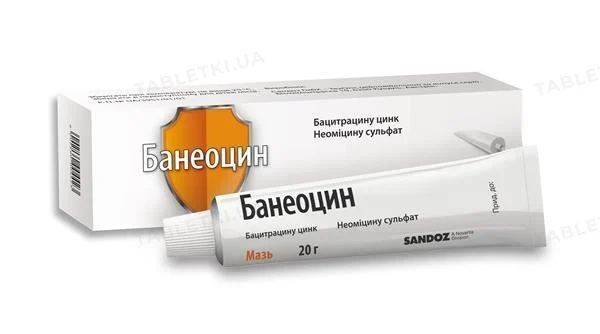
Baneocin ointment, 20 g tubes
Composition
Active ingredients: 1 g of ointment contains 250 IU of zinc bacitracin and 5,000 IU of neomycin sulfate;
Excipients: lanolin, white soft paraffin.
Dosage Form
Ointment.
Main physical and chemical properties: a yellowish, homogeneous ointment with a slight characteristic odor.
Pharmacotherapeutic group
Antibiotics for topical use. ATC code D06A X.
Pharmacological properties
Pharmacodynamics.
Baneocin is a combined antibacterial preparation for external use containing two bactericidal antibiotics with synergistic action. Bacitracin is a polypeptide antibiotic active primarily against Gram-positive microorganisms, such as hemolytic streptococci, staphylococci, Clostridium spp., Corynebacterium diphtheriae, Treponema pallidum, as well as against certain Gram-negative pathogenic microorganisms, such as Neisseria spp. and Haemophilus influenzae. The drug’s spectrum of activity also includes actinomycetes and fusobacteria. Strains resistant to bacitracin are rare.
Neomycin is active against Gram-positive and Gram-negative microorganisms, such as staphylococci, Proteus, Enterobacter aerogenes, Klebsiella pneumoniae, Salmonella, Shigella, Haemophilus influenzae, Pasteurella, Neisseria meningitidis, Vibrio cholerae, Bordetella pertussis, Bacillus anthracis, Corynebacterium diphtheriae, Streptococcus faecalis, Listeria monocytogenes, Escherichia coli, Mycobacterium tuberculosis, Borrelia, and Leptospira icterohaemorrhagiae.
The combined use of bacitracin and neomycin provides a broad antimicrobial spectrum, although the drug is inactive against Pseudomonas, Nocardia spp., fungi, and viruses.
Generally, bacitracin and neomycin should not be administered systemically. Topical application of the ointment significantly reduces the risk of sensitization, which is characteristic of systemic antibiotic administration.
Pharmacokinetics.
Since absorption of bacitracin and neomycin through affected skin is minimal, the maximum concentration of the drug is achieved at the site of application. Tissue tolerance is rated as excellent; no inactivation by biological products, blood, or tissue components has been observed. If the drug is applied to large affected areas of the skin, the possibility of drug absorption and its consequences should be taken into account (see the sections “Adverse Reactions” and “Special Considerations for Use”).
When used correctly, Baneocin ointment exerts a local effect at the application site. If absorption of the active ingredients occurs, the serum half-life of neomycin and bacitracin is approximately 2–3 hours.
Bacitracin is absorbed to a negligible extent through the mucous membranes and skin. However, absorption through the skin may occur in the presence of open wounds.
Neomycin is absorbed in minimal amounts through intact skin. Through inflamed or damaged skin and in the absence of the stratum corneum (ulcers, wounds, burns), neomycin is rapidly absorbed.
Indications
Topical treatment and prevention of bacterial skin infections caused by microorganisms sensitive to the drug:
- furuncles, carbuncles (following surgery), abscesses (following incision), sycosis (including deep sycosis) in the chin area, pyogenic hidradenitis, pseudofurunculosis, paronychia;
- localized bacterial skin infections, including contagious impetigo, infected varicose ulcers, secondary infections associated with eczema, infections associated with burns, following cosmetic surgery and skin grafts (also for prophylactic purposes and when using dressings);
- as adjunctive therapy in the treatment of infected wounds (e.g., in otitis externa, secondary infection of surgical scars).
Contraindications
Hypersensitivity to the components of the drug or to other aminoglycoside antibiotics.
Extensive and severe skin lesions (possible absorption of the drug with the development of ototoxic effects leading to hearing loss).
If uncontrolled absorption of the drug is possible, it should not be used in patients with severe cardiogenic or nephrogenic excretory disorders, or in patients with a history of vestibular or cochlear system disorders. Do not apply to the external auditory canal in cases of tympanic membrane perforation.
Do not apply to the areas around the eyes.
Drug Interactions and Other Interactions
If systemic absorption occurs, the risk of nephrotoxic reactions increases with concomitant use of cephalosporins or aminoglycoside antibiotics.
Concomitant use of diuretics, such as ethacrynic acid or furosemide, may exacerbate signs of ototoxicity or nephrotoxicity.
In cases of systemic absorption, the risk of neuromuscular conduction disturbances increases when used in combination with opioid analgesics, pain relievers, or muscle relaxants.
Special Considerations for Use
When administering the drug to patients with extensive skin lesions, the possibility of absorption of the drug’s active ingredients and, consequently, the development of ototoxic and/or nephrotoxic effects should be taken into account. Since the risk of toxic effects increases in patients with severe liver and/or kidney impairment, such patients should have their urine and blood parameters monitored and undergo audiometric testing before and during intensive therapy with Baneocin.
Precautions should be observed during long-term use of the drug in patients with chronic otitis media due to the potential for ototoxicity.
The combination of systemic and topical aminoglycosides should be avoided due to the risk of cumulative toxicity.
If uncontrolled absorption of Baneocin occurs, the possibility of neuromuscular blockade should be considered, especially in patients with acidosis, a history of myasthenia gravis, or other neuromuscular disorders. Neuromuscular blockade can be reversed with calcium preparations or proserine (neostigmine).
During long-term treatment, excessive growth of resistant microorganisms and fungi is possible. In such cases, appropriate treatment should be prescribed.
Patients who develop an allergy or a superinfection should discontinue the drug.
Exposure to sunlight or UV radiation may cause phototoxic reactions or photosensitivity.
The ointment contains lanolin as an excipient, which may cause local skin reactions (e.g., contact dermatitis).
Use during pregnancy or breastfeeding.
If there is a risk of absorption of the active ingredients during pregnancy or breastfeeding, the ointment may be used only if, in the physician’s opinion, the expected benefit to the mother outweighs the potential risk to the fetus or infant. Like other aminoglycoside antibiotics, neomycin crosses the placental barrier. There have been reports of hearing impairment in the fetus following systemic administration of high doses of aminoglycosides.
Before breastfeeding, any residue of the medication must be removed from the breast using boiled water and sterile cotton swabs.
Effect on reaction time when operating motor vehicles or other machinery.
Unknown.
Dosage and Administration
For adults and children, Baneocin ointment should generally be applied 2–3 times daily for 7 days.
When applied topically for more than 7 days, the neomycin dose should not exceed 1 g per day (equivalent to 200 g of ointment). For a repeat course of treatment, the maximum dose should be halved.
Apply a small amount of ointment to the affected area and rub in gently. If necessary, a gauze bandage may be applied to the affected area after application.
Children.
There is insufficient data on the safety of this dosage form in young children; therefore, the product may be used in children only as prescribed by a physician after a thorough assessment of the benefit-risk ratio.
Overdose
When using doses significantly higher than those recommended, due to the possible absorption of the active ingredients, be alert for symptoms indicative of nephrotoxic and/or ototoxic reactions, especially in patients with trophic ulcers.
Treatment: symptomatic therapy.
Side Effects
The frequency of adverse reactions is defined as follows: very common (≥ 1/10), common (≥ 1/100, < 1/10), uncommon (≥ 1/1,000, < 1/100), rarely (≥ 1/10,000, < 1/1,000), very rarely (< 1/10,000), frequency unknown (cannot be estimated from the available data).
The drug is generally well tolerated when applied topically.
Immune system disorders: rarely—in the presence of allergic reactions to neomycin, cross-allergy to other aminoglycoside antibiotics also occurs in approximately 50% of cases; frequency unknown – hypersensitivity to neomycin and many other substances may occur when the drug is used for chronic dermatoses or chronic otitis media. Under certain circumstances, an allergic reaction may manifest as a failure of the wound to heal properly.
Nervous system: frequency unknown—vestibular nerve damage, neuromuscular blockade.
Ear and labyrinth disorders: frequency unknown – ototoxicity.
Skin and subcutaneous tissue disorders: rare—allergic reactions, manifesting primarily as contact dermatitis. Allergic reactions caused by neomycin occur less frequently than is generally believed; frequency unknown – with prolonged use, allergic reactions such as redness, dryness, and peeling of the skin, rashes, and itching may occur. The spread of lesions or failure to heal may be caused by an allergic reaction. Photosensitization or phototoxic reactions cannot be ruled out following exposure to sunlight or ultraviolet radiation.
Renal and urinary tract disorders: frequency unknown—nephrotoxicity.
Shelf life
3 years.
Storage conditions
Store at a temperature not exceeding 25 °C.
Keep out of reach of children.
Packaging
5 g or 20 g of ointment per tube; 1 tube per cardboard box.
Dispensing Category
Over-the-counter.
Manufacturer
Lek Pharmaceutical Company d.d., Slovenia
(responsible for batch release).
Address
Verovškova 57, Ljubljana 1526, Slovenia.