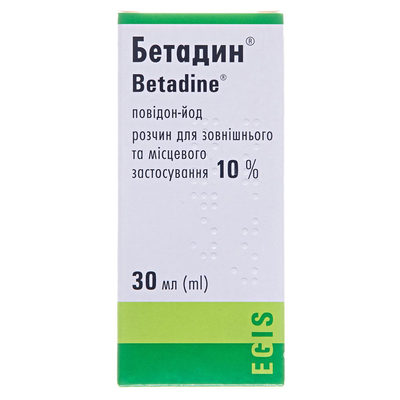
Betadine Solution for External and Topical Use, 10%, 30 ml per bottle
Ingredients
Active ingredient: povidone-iodine;
1 mL of solution contains 100 mg of povidone-iodine;
excipients: glycerin (85%), nonoxynol-9, anhydrous citric acid, anhydrous sodium hydrophosphate, sodium hydroxide, purified water.
Dosage Form
Solution for external and topical use.
Main physical and chemical properties: a dark brown solution with an iodine odor, free of suspended and precipitated particles.
Pharmacotherapeutic group
Antiseptics and disinfectants. Povidone-iodine.
ATX code D08A G02.
Pharmacological properties
Pharmacodynamics.
Povidone-iodine is a complex of iodine and the polymer polyvinylpyrrolidone that releases iodine over a period of time after application to the skin. Elemental iodine exhibits a strong bactericidal effect and has a broad spectrum of antimicrobial activity against bacteria, viruses, fungi, and protozoa.
Mechanism of action: free iodine exerts a rapid bactericidal effect, while the polymer acts as a reservoir for iodine.
Upon contact with the skin and mucous membranes, a significant amount of iodine is released from the polymer.
When forming a complex with PVP, iodine largely loses the local irritant effect characteristic of alcoholic iodine solutions and is therefore well tolerated by the skin, mucous membranes, and affected surfaces.
Iodine reacts with the oxidizing sulfhydryl (SH) and hydroxyl (OH) groups of amino acids that are part of the enzymes and structural proteins of microorganisms, thereby inactivating or destroying these proteins. Most microorganisms are destroyed in vitro in less than a minute, with the primary destructive effect occurring within the first 15–30 seconds. At the same time, the iodine decolorizes; therefore, a change in the intensity of the brown color serves as an indicator of its effectiveness.
The active ingredient in Betadine® topical solution has a broad antimicrobial spectrum of action, specifically: it acts on Gram-positive and Gram-negative bacteria (bactericidal), viruses (virucidal), fungi (fungicidal), and fungal spores (sporicidal), as well as certain protozoa (protozoacidal).
Due to its mechanism of action, resistance to the drug, including secondary resistance with long-term use, is not expected.
The drug dissolves in water and is easily washed off with water.
Prolonged application of the drug to large wound surfaces or severe burns, as well as to mucous membranes, may lead to the absorption of significant amounts of iodine. As a rule, prolonged use of the drug causes a rapid increase in blood iodine levels. Concentrations return to baseline levels 7–14 days after the last application of the drug.
In patients with normal thyroid function, an increase in iodine stores does not cause clinically significant changes in thyroid hormone status.
Pharmacokinetics.
The absorption and renal excretion of povidone-iodine depend on its molecular weight; since this ranges from 35,000 to 50,000, retention of the substance is possible.
The volume of distribution corresponds to approximately 38% of body weight; the biological half-life following vaginal administration is about 2 days. The normal total iodine level in blood plasma is approximately 3.8–6 μg/dL, and the inorganic iodine level is 0.01–0.5 μg/dL.
The drug is excreted from the body primarily via the kidneys with a clearance ranging from 15 to 60 mL/min, depending on the level of iodine in the blood plasma and creatinine clearance (normal range: 100–300 μg of iodine per 1 g of creatinine).
Indications
- Hand disinfection and antiseptic treatment of mucous membranes, for example, prior to surgical procedures, gynecological and obstetric procedures, bladder catheterization, biopsies, injections, punctures, blood draws, as well as first aid in case of accidental skin contamination with infected material.
- Antiseptic treatment of wounds and burns.
- Hygienic and surgical hand disinfection.
Contraindications
- Hypersensitivity to iodine or suspected hypersensitivity to iodine or to other components of the product.
- Patients with thyroid dysfunction (nodular colloid goiter, endemic goiter, and Hashimoto’s thyroiditis).
- Patients with hyperthyroidism or other acute thyroid disorders.
- Before and after treatment and radioactive iodine scintigraphy in patients with thyroid carcinoma.
- Dühring’s herpetiform dermatitis.
- Renal insufficiency.
Interactions with Other Medications and Other Types of Interactions
Povidone-iodine is active against microorganisms at a pH of 2–7.
Warning! Due to its oxidizing properties, povidone-iodine may affect the results of certain diagnostic tests, such as tests for occult blood in stool or urine, or glucose in urine. When povidone-iodine is used, iodine uptake by the thyroid gland may decrease, which may affect the results of certain diagnostic tests (e.g., thyroid scintigraphy, measurement of protein-bound iodine, measurements of radioactive iodine) or may interfere with iodine used for thyroid therapy. Medications containing mercury, silver, hydrogen peroxide, or taurolidine may interact with the povidone-iodine complex; therefore, their concurrent use is not recommended.
The use of povidone-iodine simultaneously with or immediately after the use of antiseptics containing octenidine may lead to the development of dark necrosis at the application sites.
The drug may react with proteins and unsaturated organic compounds; therefore, the effect of povidone-iodine may be offset by increasing its dose.
Prolonged use should be avoided, especially on large areas of the skin in patients receiving lithium-containing medications.
Special Considerations for Use
The use of povidone-iodine may reduce iodine uptake by the thyroid gland, which may affect the results of certain tests and procedures (thyroid scintigraphy, measurement of protein-bound iodine, diagnostic procedures using radioactive iodine); consequently, planning treatment for thyroid disease with iodine-containing medications may not be possible. After discontinuing treatment with povidone-iodine, a break of at least 1–4 weeks is required.
This medication should not be administered to patients before or after treatment of thyroid cancer with radioactive iodine or after undergoing radioactive iodine scintigraphy.
Significant amounts of iodine can cause hyperthyroidism in patients with thyroid dysfunction (e.g., nodular colloid goiter, endemic goiter). Therefore, the use of the ointment in these patients should be limited in terms of duration and the area of skin treated.
Even after treatment is completed, patients should be monitored for early symptoms of hyperthyroidism and their thyroid function should be monitored.
The oxidizing effect of povidone-iodine may lead to false-positive results in diagnostic tests (e.g., toluidine and guaiac tests for hemoglobin and glucose in stool and urine).
The oxidizing effect of povidone-iodine may cause corrosion of metals, whereas plastic and synthetic materials are generally not affected by povidone-iodine. In rare cases, discoloration may occur, which is usually reversible.
Povidone-iodine is easily removed from textiles and other materials with warm soapy water. Stubborn stains should be treated with a solution of ammonia or sodium thiosulfate.
The solution is not intended for internal use.
During preoperative skin disinfection, care should be taken to ensure that no residue of the solution remains on the patient (due to the possibility of skin irritation).
Since the development of hyperthyroidism cannot be ruled out, long-term (more than 14 days) use of povidone-iodine or its use in significant quantities on large areas (more than 10% of the body surface area) in patients (especially the elderly) with latent thyroid dysfunction is permissible only after a careful assessment of the expected benefits versus the potential risks. Such patients should be monitored for early signs of hyperthyroidism and undergo appropriate thyroid function testing, even after discontinuation of the drug (for up to 3 months).
Pneumonitis may occur with oropharyngeal administration.
Use during pregnancy or breastfeeding.
Povidone-iodine should be used only when strictly prescribed by a physician, and then only in the lowest possible doses. Iodine crosses the placental barrier and may pass into breast milk; therefore, there is a risk of hypersensitivity to iodine in the fetus or newborn. Povidone-iodine levels are higher in breast milk than in blood serum. Therefore, the drug may cause hyperthyroidism or elevated levels of thyroid hormone in the fetus or newborn. It is necessary to monitor thyroid function in children.
This medication is contraindicated after the second month of pregnancy and during breastfeeding. Breastfeeding must be discontinued for the duration of treatment.
Effect on the ability to drive or operate machinery.
Unknown.
Dosage and Administration
The drug is intended for external use in both dissolved and undissolved forms.
Do not mix the medication with hot water. Only brief heating to body temperature is permitted.
Dosage.
Undiluted Betadine® solution is used to disinfect the hands and skin prior to surgery, bladder catheterization, injections, punctures, etc.
The solutions may be used 2–3 times daily.
Hand hygiene: 3 mL of undiluted solution twice daily—each 3-mL dose is left on the skin for 30 seconds.
Surgical hand disinfection: 5 mL of undiluted solution twice—each 5 mL dose is left on the skin for 5 minutes.
For skin disinfection, the undiluted solution is left on the skin until it dries after application.
For the indications listed above, the solution may be used after dilution with tap water. For surgical procedures, as well as for the antiseptic treatment of wounds and burns, a 0.9% sodium chloride solution or Ringer’s solution should be used for dilution.
The following dilutions are recommended: Table 1.
| Indications | Dilution | Volume of preparation/
volume of diluent |
| Wet compress | 1:5–1:10 | 200 mL – 100 mL/1 L |
| Immersion and sitz baths | 1:25 | 40 mL/1 L |
| Preoperative bath | 1:100 | 10 mL/1 L |
| Hygienic bath | 1:1,000 | 10 mL/10 L |
| Vaginal douching
IUD insertion Perineal irrigation Irrigation in urology |
1:25 | 4 mL/100 mL |
| Irrigation of chronic and postoperative wounds | 1:2–1:20 | 50 mL – 5 mL/100 mL |
| Irrigation in orthopedics and traumatology
Irrigation during oral surgery |
1:10 | 10 mL/100 mL |
The solution should be diluted immediately before use.
Children.
Povidone-iodine may be used in newborns and children under 1 year of age only when strictly indicated.
High doses of iodine should be avoided in newborns and young children, as their skin is more permeable and they are more likely to be hypersensitive to iodine, which increases the risk of developing hyperthyroidism. Povidone-iodine should be administered in small doses to such patients. If necessary, monitor thyroid function in children.
Overdose
Acute iodine intoxication is characterized by the following symptoms:
– a metallic taste in the mouth, increased salivation, a burning sensation, or pain in the mouth or throat;
– eye irritation and swelling;
– skin reactions;
– gastrointestinal disturbances and diarrhea;
– impaired kidney function and anuria;
– circulatory failure;
– laryngeal edema with secondary asphyxia, pulmonary edema, metabolic acidosis, hypernatremia.
Treatment: Symptomatic and supportive therapy should be provided, with particular attention to electrolyte balance, kidney function, and thyroid function.
Immediate administration of starch- and protein-containing products (e.g., a starch solution in water or milk) is also indicated. Gastric lavage using a 5% sodium thiosulfate solution (or a 10% sodium thiosulfate solution administered intravenously) at 3-hour intervals, as necessary. Clinical monitoring of thyroid function is also required to rule out or detect symptoms of early iodine-induced hyperthyroidism.
Side Effects
Immune system: hypersensitivity, anaphylactic reactions.
Renal and urinary system: renal dysfunction, acute renal failure.
Skin and subcutaneous tissue disorders: local hypersensitivity skin reactions, such as contact dermatitis with the formation of psoriasis-like red, small bullous lesions; allergic reactions, including itching, redness, rash, angioedema, exfoliative dermatitis, dry skin, and chemical and thermal skin burns.
Endocrine system: hyperthyroidism (sometimes with symptoms such as tachycardia or anxiety); hypothyroidism.
Metabolism and nutritional disorders: electrolyte imbalance; metabolic acidosis.
Long-term use of povidone-iodine may lead to the absorption of large amounts of iodine.
In some cases, iodine-induced hyperthyroidism has been reported as a result of prolonged use of the drug, primarily in patients with pre-existing thyroid disease.
In isolated cases, generalized acute reactions with a drop in blood pressure and/or difficulty breathing (anaphylactic reactions) may occur.
Laboratory findings: changes in serum electrolyte levels (hypernatremia) and osmolarity, metabolic acidosis.
Shelf life
3 years.
Storage conditions
Store in the original packaging at a temperature not exceeding 25 °C. Keep out of reach of children.
Packaging
30 mL, 120 mL, or 1,000 mL of solution in a green plastic bottle with a dropper; 1 bottle of 30 mL and 1 bottle of 120 mL in a cardboard box; 1,000-mL bottles are packed in shipping containers.
Dispensing Category
Available without a prescription.