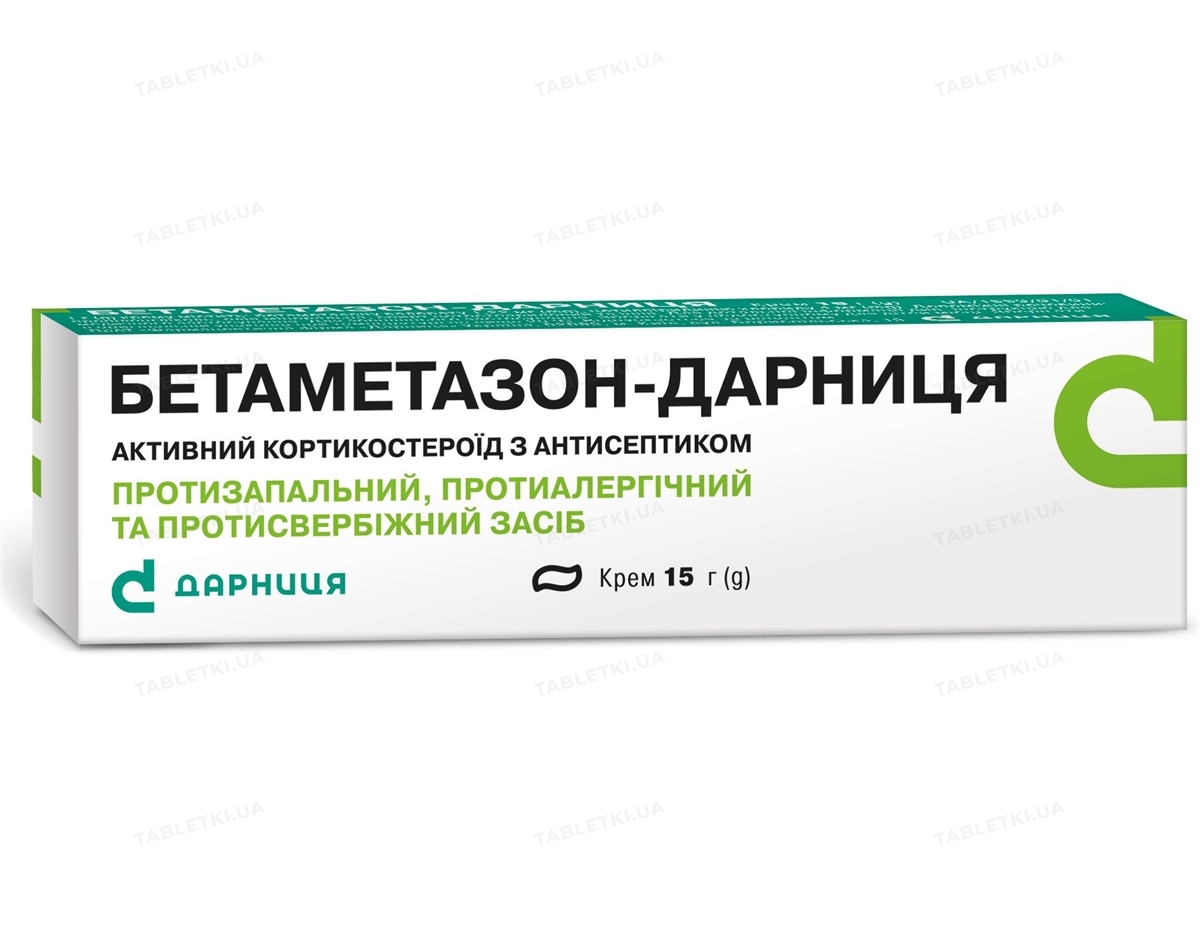
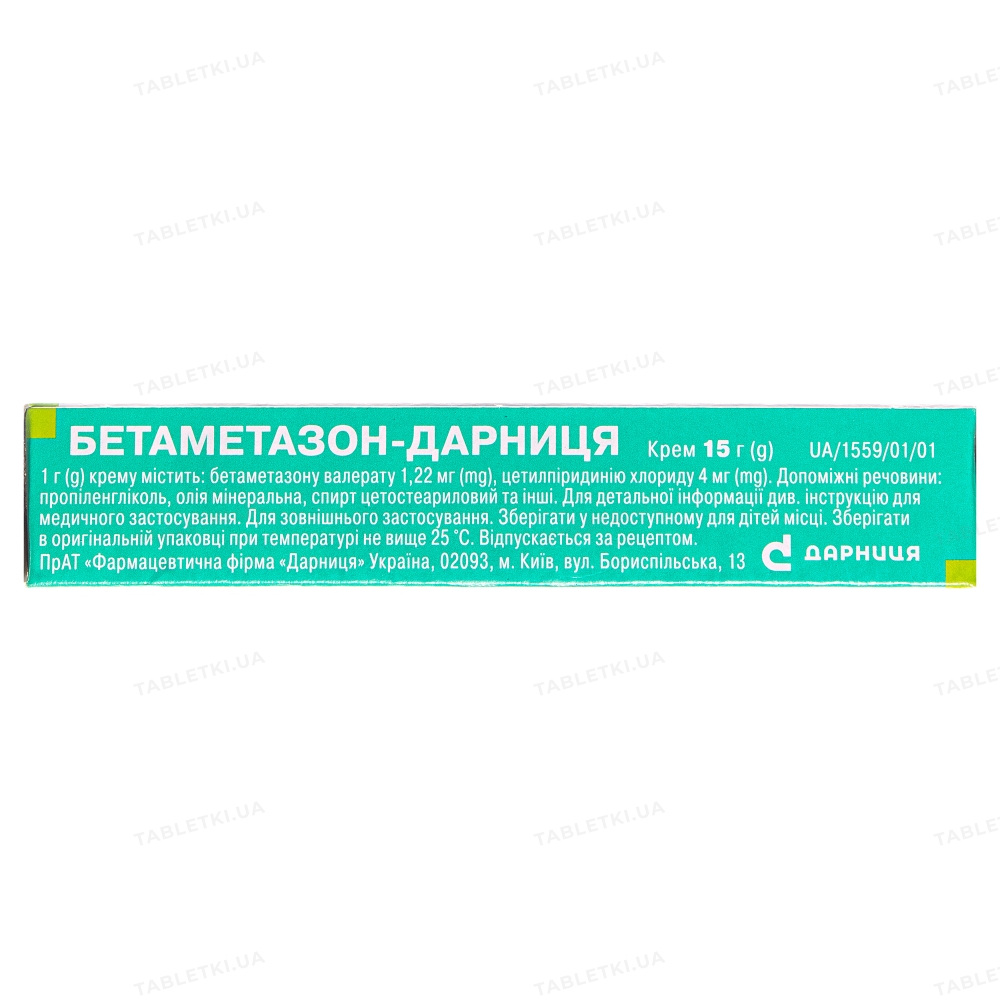
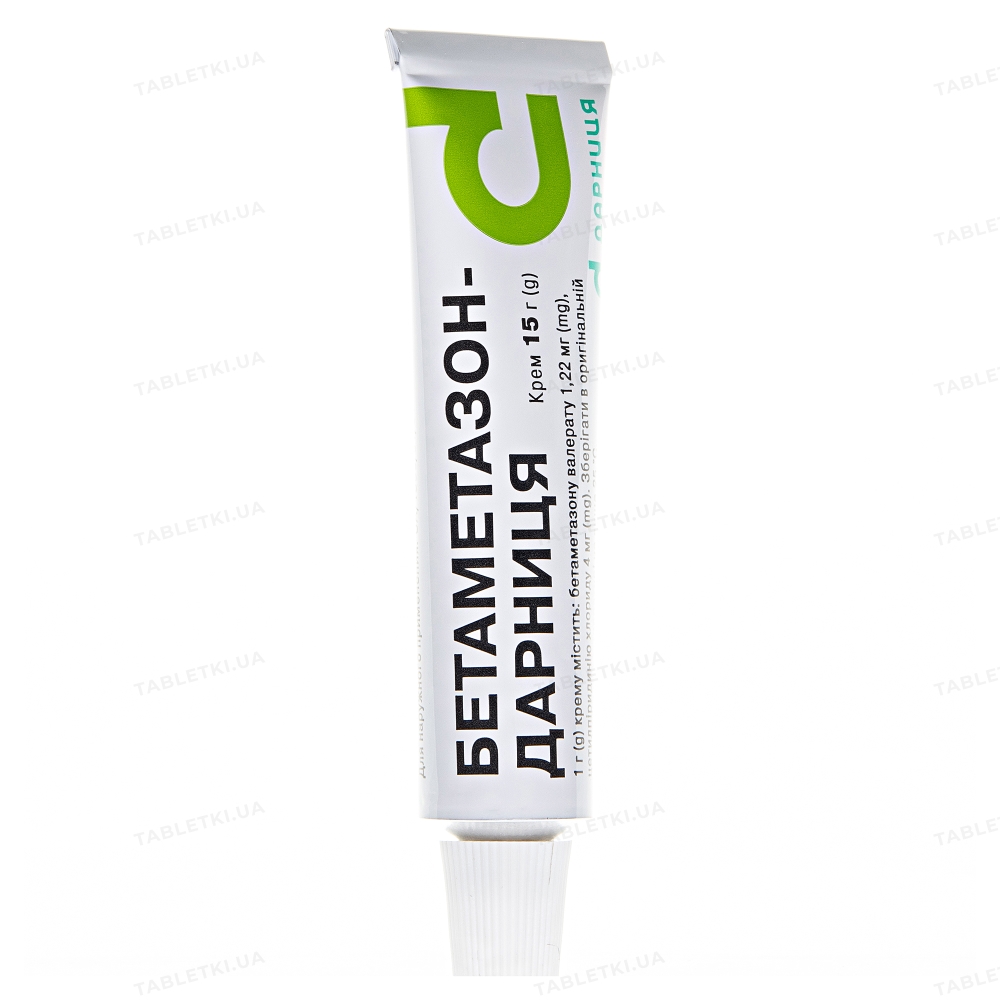
Betamethasone-Darnitsa cream, 15 g in tubes
Ingredients
Active ingredients: betamethasone, cetylpyridinium;
1 g of cream contains: 1.22 mg of betamethasone valerate, 4 mg of cetylpyridinium chloride;
Inactive ingredients: propylene glycol, mineral oil, cetostearyl alcohol, disodium edetate, purified water.
Dosage Form
Cream.
Main physical and chemical properties: a homogeneous, white, odorless cream.
Pharmacotherapeutic group
Active corticosteroids in combination with antiseptics. Betamethasone and antiseptics. ATC code D07B CO1.
Pharmacological properties
Betamethasone valerate, which is part of the drug, has local anti-inflammatory, antiallergic, antipruritic, and antiexudative effects.
Cetylpyridinium chloride has bacteriostatic and fungistatic effects, thereby preventing the development of secondary infections.
Indications
Reduction of inflammatory manifestations of dermatoses responsive to glucocorticosteroid therapy, such as: eczema (atopic, nummular), neurodermatitis, dermatitis (contact, solar, seborrheic, exfoliative, radiation, intertriginous, stasis dermatitis), psoriasis (except for generalized psoriasis), anogenital and senile pruritus.
Contraindications
Hypersensitivity to the active ingredients or to any other components of the medication; bacterial or viral infections (including herpes simplex and herpes zoster, chickenpox, tuberculosis, and cutaneous syphilis), fungal skin infections, post-vaccination skin reactions, rosacea, rosacea-like (perioral) dermatitis, and the first trimester of pregnancy.
This medication is not intended for ophthalmic use.
Interactions with Other Medications and Other Types of Interactions
This medication is not recommended for concurrent use with topical medications, particularly those containing anionic surfactants, which inactivate the action of cetylpyridinium chloride.
During treatment, it is not recommended to receive the smallpox vaccine or undergo other types of immunization (especially during prolonged use on large areas of the skin) due to the possible absence of an adequate immune response in the form of antibody production.
This medication may enhance the effects of immunosuppressive drugs and weaken the effects of immunostimulatory drugs.
Due to the presence of mineral oil as an excipient, application of the drug to the anogenital area may damage the structure of latex condoms and reduce their safety during use.
In cases where systemic absorption of betamethasone is anticipated, the numerous drug interactions with other medications should be taken into account.
Special Considerations for Use
This medication is not intended for ophthalmic use (in or around the eyes).
Caution should be exercised when applying the medication near the face, and contact with the eyes and mucous membranes should be avoided, as this may lead to glaucoma or cataracts.
If symptoms such as blurred vision or other visual disturbances occur, consult an ophthalmologist to evaluate possible causes, which may include cataracts, glaucoma, or rare conditions such as central serous chorioretinopathy, which has been reported with the use of systemic and topical corticosteroids.
Do not apply this medication to the skin of the face due to the risk of side effects (telangiectasia, perioral dermatitis), even after short-term use.
If an infection is present, antifungal or antibacterial agents should be prescribed as appropriate.
Use this medication with caution in patients with psoriasis, as topical application of glucocorticosteroids to areas affected by psoriasis may lead to the spread of a relapse caused by the development of tolerance, generalized pustular psoriasis, and systemic toxicity caused by a reduction in the skin’s protective function.
This medication is not recommended for use under occlusive dressings, on large areas of skin (high doses), and/or for prolonged periods (more than 3–4 weeks) due to systemic absorption of betamethasone.
Systemic absorption of topical corticosteroids increases with higher doses. High-potency corticosteroids applied to large areas of skin should be used under close medical supervision and with periodic monitoring of the patient’s condition, as they may cause suppression of the hypothalamic-pituitary-adrenal axis (HPA axis). HPA axis function usually returns to normal upon discontinuation of the medication. In rare cases, withdrawal symptoms may develop, requiring the addition of a systemic corticosteroid. If HPA axis suppression develops, the frequency of application should be reduced or the drug should be discontinued, and the patient should be switched to a weaker corticosteroid.
If a fungal or bacterial superinfection of the skin develops, additional treatment with an antifungal or antibacterial agent is necessary. If the desired effect does not occur quickly, corticosteroid use should be discontinued until signs of infection have resolved.
Use on the skin of the armpits and in the groin area only when absolutely necessary, as increased absorption and the development of side effects are possible even after short-term use.
Use the medication with caution in patients with pre-existing atrophic conditions of the subcutaneous tissue, especially in the elderly.
Avoid applying the medication to large areas of skin, to damaged skin, in high doses, or to patients with renal or hepatic insufficiency, as well as to children.
Inactive ingredients.
This medication contains propylene glycol, which may cause skin irritation.
This medication contains cetostearyl alcohol, which may cause local skin reactions (e.g., contact dermatitis).
If skin irritation or signs of hypersensitivity occur, discontinue use of the medication and consult a doctor.
Use During Pregnancy or Breastfeeding.
Pregnancy
Do not use this medication during the first trimester of pregnancy.
There are insufficient data on the use of this medication in pregnant women. Animal studies with betamethasone valerate have shown reproductive toxicity.
Prescription of this medication is possible only in later stages of pregnancy and only when the expected benefit to the expectant mother clearly outweighs the potential risk to the fetus. Medications in this class should not be used by pregnant women in high doses, for prolonged periods, or under occlusive dressings.
Breastfeeding
It is currently unknown whether topical application of corticosteroids, due to systemic absorption, can lead to their passage into breast milk; therefore, during breastfeeding, the use of this medication on large areas of skin or for prolonged periods should be avoided. When deciding whether to discontinue breastfeeding or discontinue use of the medication, the importance of treatment for the mother should be considered. The infant should be kept away from areas of the mother’s skin where the ointment is applied.
Effect on reaction time when driving or operating machinery.
This medication generally does not affect the patient’s reaction time when driving or operating machinery.
Directions for Use and Dosage
This medication is for external use only. Apply a thin layer of the cream to the affected skin area 1–3 times daily, depending on the severity of the condition. The frequency of application depends on the severity of the condition: for mild cases, the medication may be applied once daily; for more severe cases, the frequency of application should be increased. In most cases, applying the medication 1–2 times a day is sufficient to achieve the desired effect.
Do not apply the medication under occlusive dressings, as this may increase side effects.
Continuous use of the medication should not exceed 4 weeks. If the patient’s condition does not improve or worsens within 2–4 weeks of therapy, a re-evaluation should be conducted and treatment reviewed.
Close monitoring for the development of signs and symptoms of systemic effects of the drug is recommended.
Specific antibacterial therapy should be used for dermatoses associated with bacterial infection.
Patients with fungal dermatoses require special treatment.
Children.
The safety of this drug in children has not been established; therefore, it is not intended for use in this patient population.
Since children have a higher surface area-to-body-weight ratio than adults, and therefore absorb the drug more rapidly, children are at greater risk of corticosteroid-induced suppression of the hypothalamic-pituitary-adrenal (HPA) axis and the development of exogenous corticosteroid effects.
Overdose
Symptoms. Excessive or prolonged use of topical corticosteroids can cause suppression of pituitary-adrenal function, leading to secondary adrenal insufficiency and the onset of symptoms of hypercortisolism, including Cushing’s syndrome. Acute symptoms of hypercortisolism are usually reversible.
Treatment: symptomatic therapy; correct electrolyte balance if necessary. In cases of chronic toxicity, gradual discontinuation of the drug is recommended.
Side Effects
The following are adverse reactions associated with the topical application of corticosteroids.
The frequency of side effects is classified as follows: very common (≥ 1/10); common (≥ 1/100 – < 1/10); uncommon (≥ 1/1,000 – < 1/100); rare (≥ 1/10,000 – < 1/1,000); very rare (< 1/10,000); unknown (frequency cannot be estimated from the available data).
Eye disorders: frequency unknown—blurred vision, development of glaucoma, or accelerated progression of cataracts have been reported with topical application of corticosteroids to the eyelids.
Endocrine system disorders: frequency unknown—suppression of the hypothalamic-pituitary-adrenal axis leading to secondary adrenal insufficiency, symptoms of hypercortisolism, Cushing’s syndrome.
Any adverse effects associated with systemic use of glucocorticosteroids, including suppression of adrenal cortex function, may also occur with their topical application, especially at high doses, over a prolonged period, under occlusive dressings.
In children receiving topical corticosteroids, cases of adrenal suppression, Cushing’s syndrome, growth retardation, failure to thrive, and intracranial hypertension. Symptoms of adrenal suppression in children include low plasma and urinary cortisol levels and a lack of response to adrenocorticotropic hormone stimulation. Signs of intracranial hypertension include bulging fontanelle, headache, and bilateral optic nerve edema.
Immune system: frequency unknown – hypersensitivity reactions, including hives and maculopapular rash.
Skin and subcutaneous tissue disorders: common—burning sensation, itching, irritation, dry skin, folliculitis, hypertrichosis, acneiform rash, hypopigmentation, steroid-induced acne, rosacea-like (perioral) dermatitis, allergic contact dermatitis; uncommon – skin maceration, skin atrophy, striae, heat rash, especially under an occlusive dressing; frequency unknown – skin tingling, skin thickening, skin cracking, sensation of warmth, lamellar desquamation, focal desquamation, follicular rash, erythema, telangiectasia, skin thickening.
With prolonged continuous use, skin atrophy, stretch marks, and telangiectasias may develop, especially when applied to the face.
Infections and infestations: uncommon—secondary infection, especially under an occlusive dressing.
Shelf life
2 years.
Storage conditions
Store in the original packaging at a temperature not exceeding 25 °C.
Keep out of reach of children.
Packaging
15 g or 30 g per tube; 1 tube per pack.
Manufacturer
PJSC “Darnitsa Pharmaceutical Company.”
Address
Ukraine, 02093, Kyiv, 13 Boryspilskaya St.