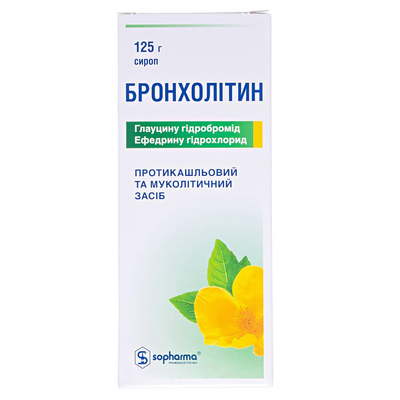
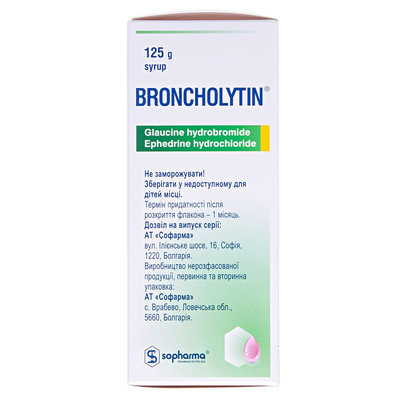
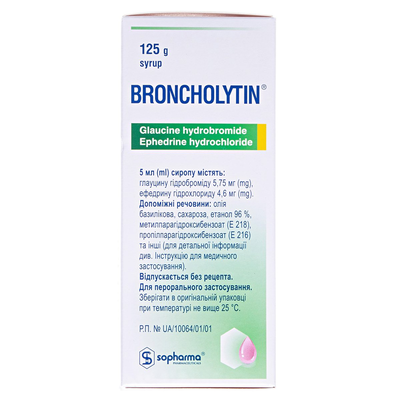
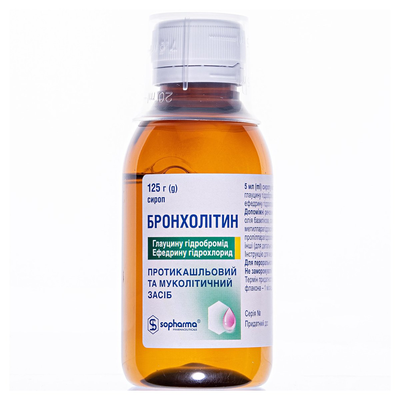
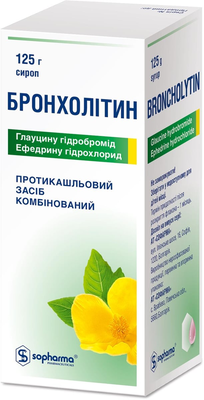
Broncholitin syrup, 125 g per bottle.
Composition
Active ingredients: glaucine hydrobromide, ephedrine hydrochloride;
5 mL of syrup contains 5.75 mg of glaucine hydrobromide; 4.6 mg of ephedrine hydrochloride;
Excipients: basil oil, citric acid monohydrate, sucrose, methyl parahydroxybenzoate (E 218), propyl parahydroxybenzoate (E 216), polysorbate 80, 96% ethanol, purified water.
Dosage Form
Syrup.
Main physical and chemical properties: a syrup-like liquid with the odor of basil oil.
Pharmacotherapeutic group
Agents acting on the respiratory system. Antitussives and mucolytics.
ATC code R05F B01.
Pharmacological properties
Pharmacodynamics.
Broncholitin is a combination drug with pronounced antitussive and bronchodilator effects. The drug’s complex action is due to the properties of its main components: glaucine hydrobromide and ephedrine hydrochloride. The alkaloid glaucine suppresses the cough center without affecting the respiratory center. It has a mild bronchodilatory and adrenergic-blocking effect and does not cause habituation or dependence when used as directed in the “Dosage and Administration” section. Ephedrine is an adrenomimetic with both direct (stimulates alpha- and beta-receptors) and indirect (inhibits amino oxidase activity) effects. It causes the release of norepinephrine and epinephrine from their storage sites. Ephedrine has a spasmolytic effect on the smooth muscles of the bronchi. It relaxes the bronchial muscles over a prolonged period, which is due to its pronounced stimulatory effect on beta-2-adrenoreceptors. Under the influence of ephedrine, edema of the bronchial mucosa decreases and the bronchial lumen widens. Pharmacological studies of the drug Broncholitin syrup show that it reduces the spastic effect of histamine on the bronchi.
The facilitation of sputum clearance and bronchodilation are due to the bronchodilatory effect of ephedrine.
Pharmacokinetics.
Absorption: Following oral administration, glaucine and ephedrine are rapidly and completely absorbed from the gastrointestinal tract.
Distribution: The maximum plasma concentration of glaucine is reached 1.5 hours after administration.
Ephedrine is distributed throughout the body, accumulating primarily in the liver, lungs, kidneys, spleen, and brain.
Metabolism: Glaucine and ephedrine (a small portion) are metabolized in the liver.
Excretion: Glaucine is excreted in the urine as metabolites and in its unchanged form.
The half-life of ephedrine is approximately 3–6 hours. It is eliminated in the urine, mainly in its unchanged form.
Indications
As part of complex therapy for respiratory system diseases accompanied by a dry, nonproductive cough: acute and chronic bronchitis, tracheobronchitis, bronchial asthma, pneumonia, and bronchiectasis.
Contraindications
- Hypersensitivity to the active ingredient or to any excipient in the medication.
- Ischemic heart disease.
- Severe and/or uncontrolled hypertension.
- Acute myocardial infarction.
- Severe organic heart disease with signs of decompensation.
- Thyrotoxicosis.
- Pheochromocytoma.
- Angle-closure glaucoma.
- Prostatic hypertrophy with urinary retention.
- Insomnia.
Interactions with other medications and other types of interactions
Broncholitin may be used concomitantly with antibiotics, antipyretics, and vitamins. It attenuates the effects of narcotic and hypnotic agents due to the presence of ephedrine in the formulation.
When used concurrently with cardiac glycosides, certain sympathomimetics, quinidine, tricyclic antidepressants, halogenated anesthetics (halothane), the risk of developing cardiac arrhythmia increases. Similar effects may also be observed with concomitant use of ergot alkaloids or oxytocin. When used concomitantly with reserpine, a sharp increase in blood pressure is possible.
Since ephedrine possesses both alpha- and beta-agonist properties, it should be used with caution in patients who have undergone anesthesia with cyclopropane, halothane, or other volatile anesthetics.
Ergoalkaloids, monoamine oxidase (MAO) inhibitors, and oxytocin potentiate the pressor effect of ephedrine (risk of a hypertensive crisis with concomitant use). If treatment with Broncholitin is necessary, a two-week interval should be observed after discontinuation of MAO inhibitors.
When used concomitantly with nonselective beta-blockers, the bronchodilator effect of the drug is reduced.
Sympathomimetics have an antagonistic effect on the antihypertensive effect of beta-blockers.
Ephedrine may counteract the neuromuscular blocking effect of guanethidine, leading to a loss of its antihypertensive efficacy.
Ephedrine accelerates the metabolism of dexamethasone.
When Broncholitin is used concomitantly with oral antidiabetic medications, their hypoglycemic effect may be reduced.
This medication should not be used concurrently with cough suppressants, whether those acting centrally (codeine, codterpine) or peripherally (exangit, libexin). Combination with drugs that reduce bronchial secretion (e.g., atropine derivatives) is not recommended.
Concomitant use of ephedrine with theophylline may lead to increased nausea, nervousness, and insomnia.
Other medications that stimulate the central nervous system (CNS) or plant-based stimulants (coffee, tea, Coca-Cola) may enhance the stimulant effects of Broncholitin on the CNS when used concurrently.
In patients with hypertension undergoing concomitant therapy with ephedrine and adrenergic neuron-blocking agents, a loss of blood pressure control has been observed, which may also occur with the use of other antihypertensive agents.
Increased vasoconstriction and pressor effects of ergotamine or methysergide have been observed; concomitant use of ergotamine is not recommended (risk of gangrene).
The effects of ephedrine may be reduced by acidification and increased by alkalization of the urine.
Special Considerations for Use
Due to its stimulating effect on the central nervous system and possible sleep disturbances, Broncholitin syrup is not recommended after 4:00 p.m.
Use with caution in patients with diabetes mellitus and renal insufficiency.
Use with caution in patients prone to drug dependence.
If symptoms persist or the condition worsens 5–7 days after the start of treatment, consult a doctor to assess the appropriateness of continuing treatment.
Cardiovascular effects may occur during treatment with sympathomimetics, including Broncholitin. Data from postmarketing studies, as well as data from the literature, provide evidence of rare cases of myocardial ischemia associated with the use of beta-agonists (ephedrine hydrochloride). Patients with heart disease (coronary artery disease, arrhythmia, or heart failure) who are taking this medication should be advised to seek medical attention immediately if they experience chest pain or other symptoms of worsening heart disease. Particular attention should be paid to the assessment of symptoms such as dyspnea and chest pain, as they may be of either respiratory or cardiac origin.
Glaucine hydrobromide should not be used in cases of productive cough accompanied by sputum production, as there is a risk of bronchial obstruction due to retention of bronchial secretions. In cases of labile blood pressure, a physician’s consultation is required. This medication should be used with particular caution in patients with hypertension and benign prostatic hyperplasia. Use with caution due to the risk of collapse resulting from the sympatholytic effect of glaucine hydrobromide.
Children and the elderly are more sensitive to the effects of ephedrine.
After prolonged use of ephedrine, tolerance develops, leading to dependence.
Broncholitin contains 43.75 g of sucrose. When used at the recommended doses, each dose (5 mL) contains up to 2 g of sucrose. Individuals with a known intolerance to certain sugars should consult a doctor before taking this medication. The medication may be harmful to teeth.
Broncholitin contains up to 1.7% ethanol by volume. Each dose (5 mL) contains up to 0.069 g of alcohol. This is dangerous for patients with liver disease, those with alcoholism or epilepsy, and patients with brain disorders. The alcohol content should be taken into account when administering the medication to pregnant women.
The syrup contains the excipients methyl parahydroxybenzoate (E 218) and propyl parahydroxybenzoate (E 216), which may cause allergic reactions (possibly delayed).
The ephedrine content in the product may result in a positive doping test for athletes.
Use during pregnancy or breastfeeding.
Contraindicated during the first trimester of pregnancy and while breastfeeding.
There are no data on safety during the second trimester; therefore, use is recommended only when the benefit to the mother outweighs the potential risk to the fetus.
If ephedrine is used during the third trimester, it may lead to an increase in the fetal heart rate.
Effect on reaction time when driving or operating machinery.
This medication should be used with caution when driving or operating automated machinery due to the effects of ephedrine. Ephedrine may cause mydriasis and affect reaction time when driving or operating machinery.
Dosage and Administration
Take orally after meals.
Adults and children 10 years of age and older: 10 mL 3–4 times daily.
Children: ages 3 to 5 years—5 mL of the medication, diluted immediately before use in 10 mL of chilled boiled water, 3 times daily;
ages 5 to 10 years—5 mL 3 times a day.
The duration of treatment is 5–7 days.
Children.
Recommended for children aged 3 years and older.
Overdose
In case of overdose, the following may occur: nausea, vomiting, fever, loss of appetite, nervous agitation, tremors in the limbs, dizziness, excessive sweating, difficulty urinating, increased blood pressure, decreased blood pressure, headache, drowsiness, weakness, rapid fatigue, worsening of side effects, paranoid psychosis, delirium, and hallucinations.
Treatment: gastric lavage, administration of activated charcoal, and symptomatic treatment.
Side Effects
When using the medication Broncholitin, the following adverse reactions may occur:
Immune system: hypersensitivity reactions (skin rashes, hives, itching, angioedema, bronchospasm);
Respiratory system and chest: dyspnea;
Cardiovascular system: cardiac rhythm and conduction disturbances, tachycardia, extrasystoles, arrhythmia, palpitations, increased blood pressure, myocardial ischemia, chest pain, circulatory disorders in the extremities;
nervous system: headache, tremor, agitation, anxiety, restlessness, insomnia, sedative effect, dizziness;
Gastrointestinal system: dry mouth, anorexia, nausea, vomiting, constipation;
Urinary system: difficulty urinating; in patients with prostatic hypertrophy, urinary retention is possible;
Skin and mucous membranes: increased sweating;
Sensory system: visual disturbances;
Other: shortness of breath, weakness, increased libido, dysmenorrhea, tachyphylaxis, tolerance with the development of dependence (with prolonged use).
Myocardial infarction is very rare in patients taking ephedrine or pseudoephedrine.
Ephedrine may act as a stimulant in children with nocturnal enuresis and cause insomnia; it may also have a sedative effect on some children.
Shelf life
4 years.
Shelf life after opening the vial: 1 month.
Storage Conditions
Keep out of reach of children. Store in the original packaging at a temperature not exceeding 25 °C. Do not freeze!
Packaging
Syrup in 125 g vials (125 mL capacity) made of glass or polyethylene terephthalate (PET). Glass vials are sealed with aluminum or polyethylene caps; PET vials are sealed with polyethylene caps.
One bottle with a measuring cup per cardboard box.
Dispensing category
Over-the-counter.
Manufacturer
Sofarma JSC.