
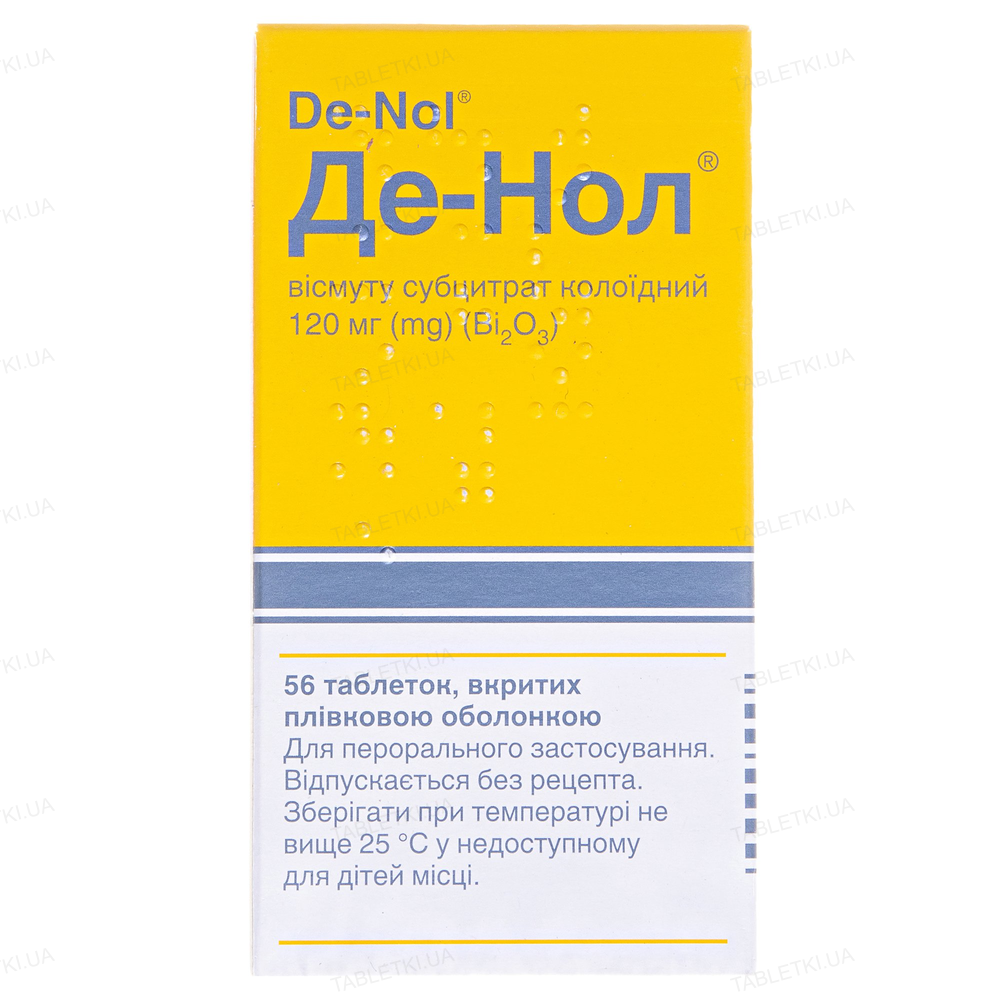
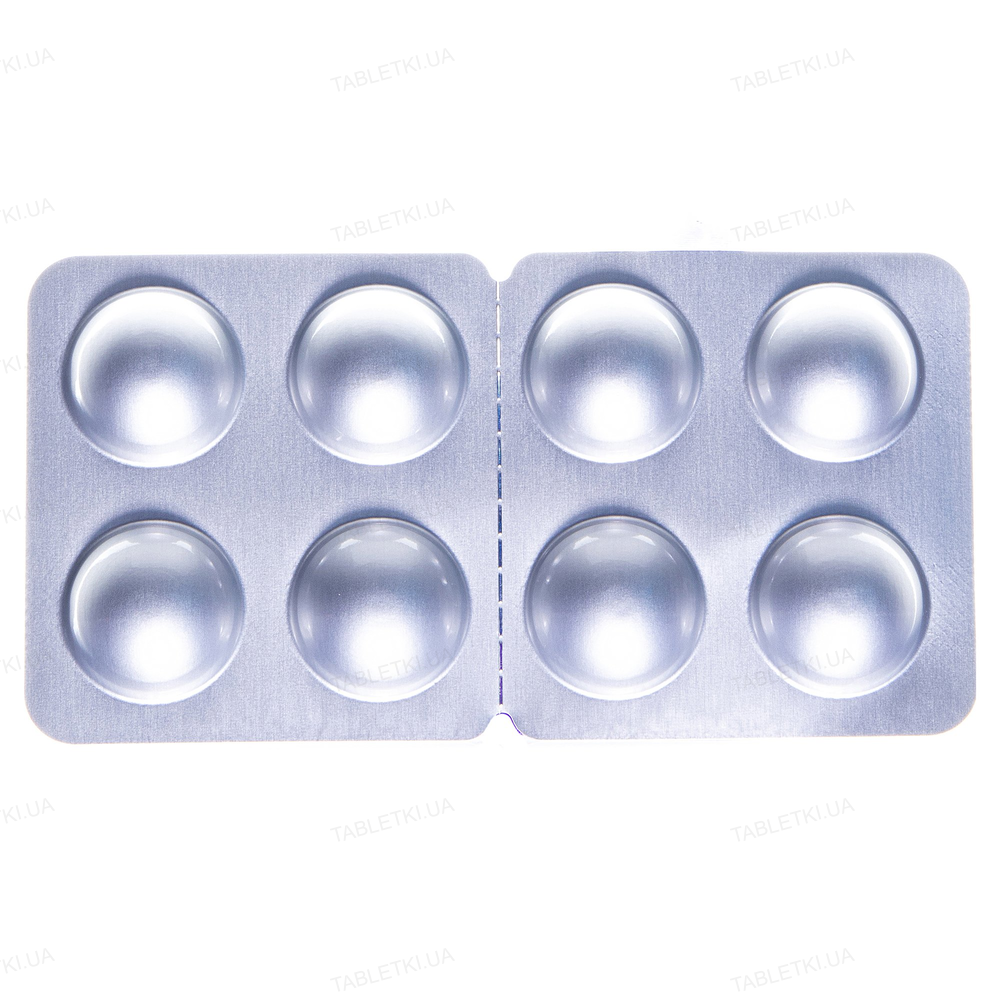
De-Nol tablets, film-coated, 120 mg, No. 56 (8×7)
Ingredients
Active ingredient: colloidal bismuth subcitrate;
1 tablet contains colloidal bismuth subcitrate equivalent to 120 mg of Bi₂O₃, which is present in a solution of dry bismuth subcitrate;
Excipients: corn starch, povidone, potassium polacrilin, macrogol 6000, magnesium stearate, hypromellose.
Dosage Form
Film-coated tablets.
Main physical and chemical properties. The tablets are round, biconvex, white with a cream tint, with the inscription “gbr 152” on one side and the company logo on the other.
Pharmacotherapeutic group
Agents for the treatment of peptic ulcers and gastroesophageal reflux disease. Bismuth subcitrate. ATC code A02B X05.
Pharmacological Properties
Pharmacodynamics.
In the acidic environment of the stomach, the drug forms a protective film on the surface of ulcers and erosions, which promotes their healing and protects against the effects of gastric juice; It increases the synthesis of prostaglandin E2, stimulates the production of mucus and bicarbonates, leads to the accumulation of epidermal growth factor in the affected area, and reduces the activity of pepsin and pepsinogen. The drug has bactericidal activity against Helicobacter pylori.
Pharmacokinetics.
The drug is practically not absorbed from the gastrointestinal tract; only a small amount of the active ingredient enters the bloodstream and is excreted in the urine, while the plasma concentration of bismuth decreases rapidly after the end of treatment. It is excreted primarily in the feces.
Indications
Gastric and duodenal ulcers, chronic gastritis, including those caused by Helicobacter pylori (as part of anti-Helicobacter therapy regimens).
Contraindications
Hypersensitivity to the active ingredient or to any excipient. Severe renal insufficiency.
Drug Interactions and Other Interactions
No other medications, food, or beverages—including antacids, milk, fruit, or fruit juices—should be consumed within half an hour before or after taking De-Nol®, as they may alter its effect.
It reduces the absorption of tetracyclines; concomitant use of bismuth-containing medications (Vicalin, Vicair) increases the risk of excessive bismuth concentrations in the blood.
Special Considerations for Use
Stool may turn black; if this occurs, consult a doctor. Do not take antacids or drink milk half an hour before or half an hour after taking this medication, as gastric juice is needed to form a protective layer.
Long-term use of high doses of bismuth compounds is not recommended due to the rare occurrence of reversible encephalopathy. When the recommended dosage regimen is followed, the risk of this side effect is very low; however, it is not recommended to take other bismuth-containing medications while taking this medication.
Use During Pregnancy or Breastfeeding
Not recommended.
Effect on reaction time when driving or operating machinery
There are no data on the effect of De-Nol® on the ability to drive or operate machinery. However, such an effect of De-Nol® is unlikely.
Dosage and Administration
Adults and children 14 years of age and older should take 1 tablet 4 times daily, 30 minutes before meals and at bedtime, or 2 tablets twice daily.
For children aged 8 to 14 years, administer 1 tablet twice daily, 30 minutes before meals.
For children aged 4 to 8 years, administer a dose of 8 mg/kg/day; divide the daily dose into 2 doses, but do not exceed 2 tablets per day.
Tablets should be taken with a small amount of water. The duration of treatment is 4–8 weeks. Do not take medications containing bismuth for the following 8 weeks.
In the presence of Helicobacter pylori, use in treatment regimens according to national guidelines.
Children
De-Nol® may be used in children 4 years of age and older.
Overdose
Symptoms of intoxication.
Acute massive overdose may lead to renal failure with a delayed onset of up to 10 days.
Treatment of poisoning.
After a single intake of a very high dose, treatment consists of gastric lavage followed by administration of activated charcoal and osmotic laxatives. This therapy generally reduces bismuth absorption, so additional measures are not necessary.
Bismuth concentrations in blood and urine should be measured in cases of acute and chronic poisoning to determine whether any symptoms are related to elevated bismuth levels.
Chelation therapy with dimercaptosuccinic acid (DMSK) and dimercaptopropanesulfonic acid (DMPs) is used if symptoms are caused by acute or chronic bismuth overdose.
In cases of severe renal failure, chelation therapy should be accompanied by hemodialysis.
Side Effects
Very common (>1/10)
Gastrointestinal: Black stools may occur with the use of De-Nol® due to the formation of bismuth sulfide. Such stools can be easily distinguished from melena.
Uncommon (>1/1,000, <1/100)
Gastrointestinal: nausea, vomiting, constipation, diarrhea.
Skin and subcutaneous tissue disorders: mild allergic skin reactions (rash, itching).
Very rare (<1/10,000), frequency unknown (cannot be estimated from the available data):
Immune system disorders: anaphylactic reaction.
Shelf life
4 years.
Do not use this medication after the expiration date printed on the package.
Storage conditions
Store at a temperature not exceeding 25 °C, out of the reach of children.
Packaging
8 tablets per blister; 7 or 14 blisters per cardboard box.
Dispensing Category
Available without a prescription.
Manufacturer
Astellas Pharma Europe B.V.
Address
Sylviusweg 62, 2333 BE Leiden, the Netherlands.
If you experience any side effects, please report them to the Astellas Pharma Europe B.V. representative office at 04050, Kyiv, 13 Pymonenka St., Bldg. 7-B, Office 41, Tel. 044-490-68-25, Fax: 044-490-68-26.
Applicant
CHEPLAFARM Arzneimittel GmbH
Location of the applicant and address of its place of business.
Ziegelhof 24, 17489 Greifswald, Germany







