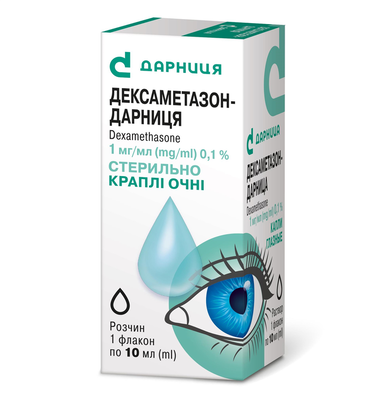
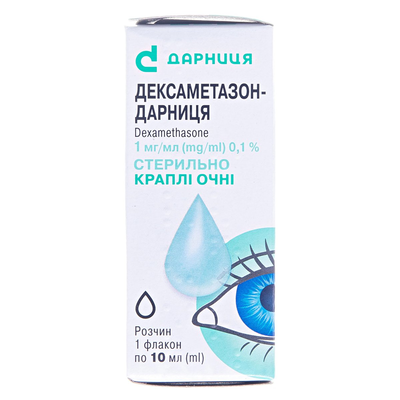
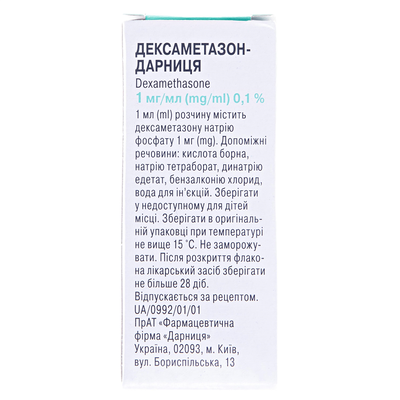
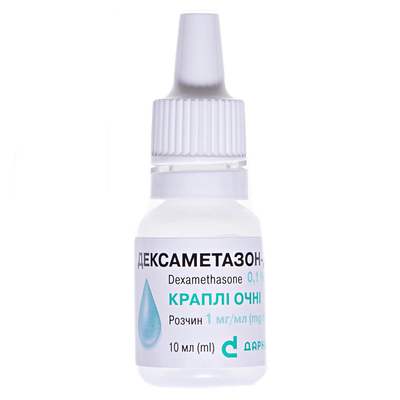
Dexamethasone-Darnitsa Eye Drops, Solution, 1 mg/mL, 10 mL per bottle.
Composition
Active ingredient: dexamethasone;
1 mL of solution contains 1 mg of dexamethasone sodium phosphate;
Excipients: boric acid, sodium tetraborate, disodium edetate, benzalkonium chloride, water for injection.
Dosage Form
Eye drops, solution.
Main physical and chemical properties: a clear, colorless, odorless liquid.
Pharmacotherapeutic group
Products used in ophthalmology. Anti-inflammatory agents. Corticosteroids, simple preparations. Dexamethasone.
ATC code S01B A01.
Pharmacological properties
Pharmacodynamics.
The drug belongs to the class of synthetic fluorinated glucocorticosteroids. It has a pronounced anti-inflammatory effect with reduced mineralocorticoid activity compared to some other steroids and is one of the most potent anti-inflammatory drugs. The drug’s mechanism of action is similar to that of other fluorinated glucocorticosteroids and differs only in its greater potency and duration of action. It exerts its anti-inflammatory effect by inhibiting vascular adhesion molecules on endothelial cells, cyclooxygenase I or II, and the release of cytokines. As a result, the production of inflammatory mediators is reduced and the adhesion of leukocytes to the vascular endothelium is inhibited, thereby preventing their penetration into the inflamed tissues of the eye.
Pharmacokinetics.
After instillation into the conjunctival sac, the maximum concentration of dexamethasone in the intraocular fluid is observed after 2 hours and is 30 ng/mL. Plasma protein binding (to albumin) is 77–84%. The half-life is
3–4 hours. Clearance ranges from 0.111 to 0.225 L/h/kg, and the volume of distribution ranges from 0.576 to 1.15 L/kg. It is metabolized in the liver. Approximately 60% of the dose is excreted in the urine as 6-β-hydroxydexamethasone. The overall resorptive effect of dexamethasone is negligible.
Indications
Treatment of steroid-responsive, noninfectious inflammatory and allergic conditions of the conjunctiva, cornea, and anterior segment of the eye, including inflammatory reactions in the postoperative period.
Contraindications
Hypersensitivity to the active ingredient or to any other components of the medication.
Acute, untreated bacterial eye infections.
Fungal eye infections.
Mycobacterial eye infections.
Viral infections of the cornea and conjunctiva (acute superficial keratitis caused by herpes simplex, cowpox, and chickenpox, except for keratitis caused by herpes zoster).
Drug Interactions and Other Interactions
When using multiple topical eye medications simultaneously, the interval between applications should be at least 15 minutes. Eye ointments should be applied last.
Concomitant use of this medication with atropine, other cholinergic agents, or mydriatics may increase intraocular pressure.
Concomitant use of topical steroids and topical nonsteroidal anti-inflammatory drugs (NSAIDs) may increase the risk of complications during corneal wound healing.
Concomitant use with ophthalmic preparations containing phosphates increases the risk of corneal deposits or opacities, especially in patients with a damaged cornea.
CYP3A4 inhibitors (including ritonavir and cobicistat) may reduce the clearance of dexamethasone, leading to enhanced systemic effects and the development of Cushing’s syndrome and/or adrenal suppression. Such combinations should be avoided unless the benefits of treatment outweigh the increased risk of systemic corticosteroid side effects. In this case, patients must be closely monitored to detect any systemic effects of corticosteroids.
There is no information available regarding drug interactions with other medications.
Special Instructions for Use
This medication is intended for ophthalmic use only.
Side effects observed after instillation of the medication resolve within 5–15 seconds and do not constitute an indication for discontinuation.
To prevent possible systemic absorption after instillation, the tear ducts should be held closed with the fingers for 2–3 minutes.
When using the medication, do not touch the tip of the dropper to prevent contamination of the medication.
Prolonged topical use of corticosteroids may lead to ocular hypertension and/or glaucoma, followed by damage to the optic nerve, deterioration of visual acuity and visual field defects, as well as posterior subcapsular cataracts of the posterior chamber of the eye. Intraocular pressure should be monitored regularly during long-term use of the medication.
This is particularly important for children, as the risk of corticosteroid-induced ocular hypertension may be higher in children and may occur earlier than in adults.
The risk of corticosteroid-induced increased intraocular pressure and/or corticosteroid-induced cataracts is increased in predisposed patients (e.g., patients with diabetes mellitus).
Topical corticosteroids applied to the eye may delay the healing of corneal wounds and, in the presence of conditions characterized by thinning of the cornea or sclera, may lead to perforation. It is also known that topical NSAIDs slow or delay wound healing. Concomitant use of topical NSAIDs and topical steroids may increase the risk of complications during wound healing (see the “Drug Interactions and Other Interactions” section). The condition of the cornea should be monitored during treatment (fluorescein staining should be performed).
Corticosteroids may reduce resistance to bacterial, viral, or fungal infections, interfere with the detection of such infections, and mask their clinical signs, thereby preventing the recognition of antibiotic ineffectiveness.
In acute purulent eye diseases, corticosteroids may mask infections or spread an existing infection. If treatment lasts longer than 10 days, intraocular pressure should be monitored.
In cases of persistent corneal ulceration, the possibility of a fungal infection should be considered in patients who have been treated or are currently being treated with corticosteroids. If a fungal infection is present, treatment with this drug should be discontinued.
The drug should be used with extreme caution and only in combination with antiviral therapy when treating stromal keratitis or uveitis caused by herpes simplex. Periodic biomicroscopy with a slit lamp should be performed.
The drug contains phosphates, which can cause deposits to accumulate in the cornea or lead to corneal opacification when applied topically. It should be used with caution in patients with a compromised cornea and in cases where the patient is simultaneously being treated with other ophthalmic medications containing phosphates.
It is not recommended to wear contact lenses during treatment for eye inflammation. If necessary, soft contact lenses should be removed before using the medication and reinserted no sooner than 15 minutes after instilling the medication.
This medication contains benzalkonium chloride, which may cause eye irritation and is known to discolor soft contact lenses. Contact with soft contact lenses should be avoided.
Following intensive or prolonged continuous therapy in susceptible patients, including children and patients receiving CYP3A4 inhibitors (including ritonavir and cobicistat), Cushing’s syndrome and/or adrenal suppression associated with systemic absorption of dexamethasone may develop. In such cases, treatment should be discontinued.
Pregnancy and lactation.
Pregnancy.
There is only limited data on the use of this drug in pregnant women. Reproductive toxicity has been demonstrated in animal studies—when applied topically, corticosteroids may be absorbed systemically and cause fetal abnormalities in pregnant animals. The potential risk to humans is unknown; therefore, the drug is not recommended for use during pregnancy.
Breastfeeding.
When administered systemically, glucocorticosteroids are excreted into breast milk in amounts that may interfere with breastfeeding. However, systemic exposure is low with topical application. Since it is unknown whether the drug passes into breast milk, it is not possible to rule out a risk to the infant during breastfeeding. Therefore, consideration should be given to temporarily discontinuing breastfeeding for the duration of treatment or to discontinuing or refraining from therapy, taking into account the potential benefit of the drug to the mother and the benefit of breastfeeding to the infant.
Fertility.
No studies have been conducted on the effect of dexamethasone on fertility when instilled into the conjunctival sac. There are limited clinical data on the effect of dexamethasone on male or female fertility.
Effects on the ability to drive and operate machinery.
This medication has no or negligible effect on the ability to drive or operate machinery. As with other eye drops, temporary blurred vision or other visual disturbances may occur. If blurred vision occurs during instillation, the patient should wait until vision clears before operating vehicles or other machinery.
Directions for Use and Dosage
The bottle is equipped with a tamper-evident cap. Before first use, twist the cap to separate it from the protective ring.
The bottle has a special design that allows the solution to be dispensed on a “one-press, one-drop” basis when the bottom is pressed. The rigidity of the vial walls significantly reduces the likelihood of a spray-like release of the medication—a common cause of overdose with eye drops.
Severe or acute eye inflammation:
As initial therapy, instill 1–2 drops of the medication into the conjunctival sac(s) of the affected eye(s) every 30–60 minutes.
If the treatment is effective, the dose should be reduced to 1–2 drops into the conjunctival sac(s) of the affected eye(s) every 2–4 hours.
The dose may then be reduced to 1 drop 3–4 times a day, if this dose is sufficient to control inflammation.
If the desired result is not achieved within 3–4 days, additional systemic or subconjunctival therapy may be prescribed.
Chronic eye inflammation:
Instill 1–2 drops into the conjunctival sac(s) of the affected eye(s) every 3–6 hours, or more frequently if necessary.
Mild inflammation, allergies:
Instill 1–2 drops of the medication into the conjunctival sac(s) of the affected eye(s) every 3–4 hours until the desired effect is achieved.
It is recommended to monitor intraocular pressure regularly.
After instillation, it is recommended to close the eyelids tightly or use nasolacrimal occlusion. This reduces systemic absorption of medications administered to the eye, thereby lowering the likelihood of systemic side effects.
When using multiple topical medications in the eye simultaneously, the interval between applications should be at least 15 minutes. Eye ointments should be applied last.
Elderly patients.
No dose adjustment is necessary.
Patients with impaired liver or kidney function.
Due to the low systemic absorption of dexamethasone following topical application of this medication, no dose adjustment is necessary.
Children.
The safety and efficacy of this medication in children have not been established.
Overdose
The unique design of the bottle makes accidental overdose unlikely. There are no reports of overdose.
In the event of a topical overdose, rinse the excess medication from the eye(s) with warm water.
Side Effects
Eye disorders:
- keratitis, conjunctivitis, Sikkie’s keratoconjunctivitis, ptosis, corneal staining, photophobia, blurred vision, mydriasis, eye pain, eye irritation, foreign body sensation in the eyes, unusual sensations in the eyes, scaling along the eyelid margins;
- corneal calcification (due to the use of phosphate-containing eye drops in some patients with severely damaged corneas);
- Immediately after instillation, the following may occur: a brief sensation of burning, tingling, eye discomfort, itching, eye redness, and increased tearing;
- with prolonged use—increased intraocular pressure followed by damage to the optic nerve, decreased visual acuity, visual field defects, development of posterior subcapsular cataracts, glaucoma, and corneal erosion; in the presence of conditions leading to thinning of the cornea or sclera—an increased risk of perforation (see the “Special Instructions and Precautions for Use” section).
Endocrine disorders: Following prolonged therapy, systemic absorption may occur due to suppression of the adrenal cortex and the development of Cushing’s syndrome.
Nervous system: dysgeusia (impaired sense of taste), headache, dizziness.
Immune system disorders: hypersensitivity reactions; patients with hypersensitivity to benzalkonium chloride may develop allergic blepharitis or conjunctivitis.
Glucocorticosteroids may reduce resistance to infections.
Shelf life
2 years.
Once the vial is opened, store the medication for no longer than 28 days.
Storage conditions
Store in the original packaging at a temperature not exceeding 15 °C. Do not freeze.
Keep out of reach of children.
Packaging
5 mL or 10 mL in a vial; 1 vial per package.
Manufacturer
Darnitsa Pharmaceutical Company, PJSC.