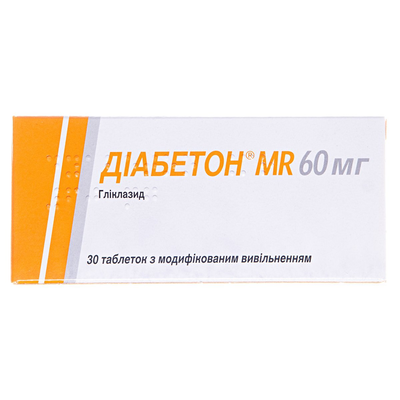
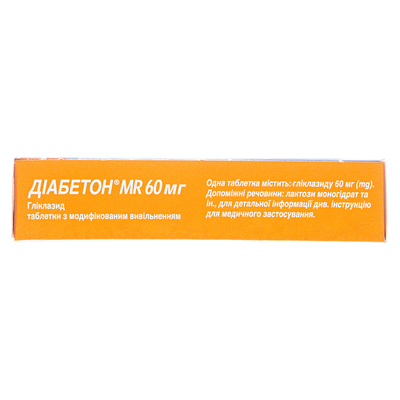
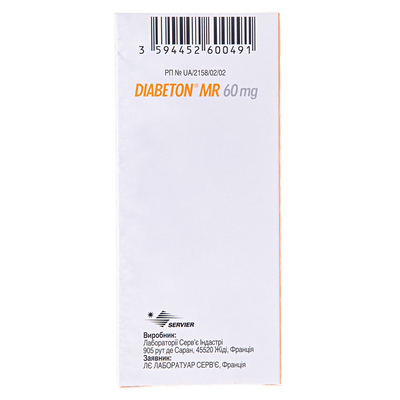
Diabeton MR 60 mg modified-release tablets, 60 mg each, No. 30 (15 x 2)
Composition
Active ingredient: gliclazide;
1 tablet contains 60 mg of gliclazide;
Excipients: lactose monohydrate, hypromellose, magnesium stearate, maltodextrin, colloidal anhydrous silicon dioxide.
Dosage Form
Modified-release tablets.
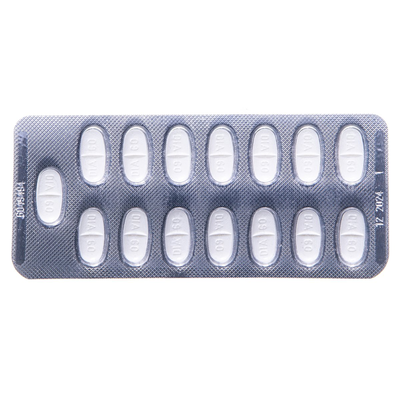
Main physical and chemical properties: white, oblong tablets with a score line and “DIA 60” embossed on both sides. The tablets are divisible.
Pharmacotherapeutic group
Agents affecting the digestive system and metabolism. Antidiabetic agents. Antidiabetic agents, excluding insulins. Sulfonylureas, urea derivatives. Gliclazide. ATC code A10B B09.
Pharmacological Properties
Pharmacodynamics.
Mechanism of action. Diabeton® MR 60 mg is an oral hypoglycemic agent. The active ingredient, gliclazide, is a sulfonylurea derivative and is distinguished by the presence of a heterocyclic ring containing nitrogen and having endocyclic bonds.
Gliclazide lowers blood plasma glucose levels by stimulating insulin secretion by the β-cells of the islets of Langerhans in the pancreas. Increased postprandial insulin levels and C-peptide secretion persist even after 2 years of treatment. In addition to these metabolic properties, gliclazide also has hemovascular effects.
Pharmacodynamic effects.
Effect on insulin secretion. In patients with type 2 diabetes, gliclazide restores the early peak of insulin secretion in response to glucose intake and enhances the second phase of insulin secretion. Increased insulin secretion is observed in response to a meal or glucose loading.
Hemovascular properties. Gliclazide reduces microthrombosis through two mechanisms that may be involved in the development of diabetes complications:
- it partially inhibits platelet aggregation and adhesion and reduces the levels of platelet activation markers (β-thromboglobulin, thromboxane B2);
- it affects the fibrinolytic activity of the vascular endothelium (increases tPA activity).
Pharmacokinetics.
Absorption. The concentration of gliclazide in plasma increases progressively during the first 6 hours after administration and then reaches a steady state (plateau), which is maintained from 6 to 12 hours after administration.
Individual variations are negligible.
Gliclazide is completely absorbed in the gastrointestinal tract. Food intake does not affect the rate or extent of absorption.
Distribution. The plasma protein binding of gliclazide is approximately 95%. The volume of distribution is approximately 30 L.
A single daily dose of Diabeton® MR 60 mg ensures effective plasma concentrations of gliclazide for 24 hours.
Biotransformation. Gliclazide is metabolized primarily in the liver and excreted in the urine; less than 1% of the active ingredient is excreted in the urine unchanged. No active metabolites have been detected in plasma.
Elimination. The half-life of gliclazide is approximately 12–20 hours.
Linearity/Nonlinearity. When the drug is administered at doses up to 120 mg, a linear relationship is observed between the dose administered and the plasma concentration.
Special Patient Populations.
Elderly patients. No clinically significant changes in the pharmacokinetic parameters of the drug were observed in elderly patients.
Indications
Type 2 diabetes mellitus in adults:
- reduction and control of blood glucose levels when it is not possible to normalize glucose levels through diet, exercise, and weight loss alone.
Contraindications
- Hypersensitivity to gliclazide or other sulfonylureas, sulfonamides, or any component of the drug;
- Type 1 diabetes;
- diabetic precoma and coma, diabetic ketoacidosis;
- severe renal or hepatic insufficiency (in such cases, insulin therapy is recommended);
- treatment with miconazole;
- breastfeeding.
Interactions with Other Medications and Other Types of Interactions
Medications that are likely to increase the risk of hypoglycemia.
Concomitant use is contraindicated
Miconazole (for systemic use, oral gel) potentiates the hypoglycemic effect, with the possible development of hypoglycemia symptoms and even coma.
Concomitant use is not recommended
Phenylbutazone (for systemic use) enhances the hypoglycemic effect of sulfonylurea drugs (by displacing their binding to plasma proteins and/or reducing their excretion).
It is advisable to use an alternative anti-inflammatory agent; patients should also be warned and advised of the importance of self-monitoring. If necessary, the dose of the drug should be adjusted during and after anti-inflammatory therapy.
Alcohol increases the risk of hypoglycemic reactions (due to inhibition of compensatory responses), which may lead to hypoglycemic coma. Alcohol consumption and the use of alcohol-containing medications should be avoided.
Combinations Requiring Caution
When used concomitantly with any of the following medications, hypoglycemia may occur in some cases due to an enhanced hypoglycemic effect: other antidiabetic drugs [insulins, acarbose, metformin, thiazolidinediones, dipeptidyl peptidase-4 (DPP-4) inhibitors, glucagon-like peptide-1 (GLP-1) receptor agonists)], β-blockers, fluconazole, angiotensin-converting enzyme (ACE) inhibitors (captopril, enalapril), H2-receptor antagonists, monoamine oxidase (MAO) inhibitors, sulfonamides, clarithromycin, and nonsteroidal anti-inflammatory drugs.
Drugs that may cause hyperglycemia
Concomitant use is not recommended
Danazol has a diabetogenic effect. If use of this active ingredient cannot be avoided, the patient should be warned and advised of the importance of monitoring urine and blood glucose levels. It may be necessary to adjust the dose of the antidiabetic agent during and after treatment with danazol.
Combinations Requiring Caution
Chlorpromazine (a neuroleptic), when used in high doses (more than 100 mg per day), increases blood glucose levels (due to reduced insulin release). Patients should be warned and made aware of the importance of monitoring blood glucose levels. It may be necessary to adjust the dose of the antidiabetic active ingredient during and after treatment with the neuroleptic.
Glucocorticoids (for systemic and topical use: intra-articular, topical, and rectal formulations) and tetracosactide increase blood glucose levels, with the potential for ketoacidosis (they reduce carbohydrate tolerance). Patients should be warned and advised of the importance of monitoring blood glucose levels, especially at the start of treatment. It may be necessary to adjust the dose of the antidiabetic agent during and after treatment with glucocorticoids.
Intravenous agents: ritodrine, salbutamol, and terbutaline increase blood glucose levels due to their β2-agonist effects. Patients should be advised of the importance of monitoring blood glucose levels. If necessary, patients should be switched to insulin.
St. John’s wort (Hypericum perforatum) preparations reduce the concentration of gliclazide. Patients should be advised of the importance of monitoring their blood glucose levels.
Medications that may cause dysglycemia
Combinations Requiring Caution
Fluoroquinolones. When used concomitantly with Diabeton® MR 60 mg, the patient should be warned about the risk of dysglycemia and advised on the importance of monitoring blood glucose levels.
Combinations with cautionary notes
Anticoagulants (e.g., warfarin, etc.). When used concomitantly with anticoagulants, sulfonylurea drugs may potentiate the anticoagulant effect of the latter. If necessary, the dose of anticoagulants may be adjusted.
Special Considerations for Use
Hypoglycemia. This medication should be prescribed only to patients who are able to eat regular meals (including breakfast). It is important to consume carbohydrates regularly, as the risk of hypoglycemia increases if meals are taken late, in insufficient quantities, or if they are low in carbohydrates. Hypoglycemia is more likely to occur with a low-calorie diet, prolonged or intense physical activity, alcohol consumption, or the use of a combination of hypoglycemic medications.
Hypoglycemia may occur when taking sulfonylurea medications (see the “Adverse Reactions” section). Sometimes hypoglycemia can be severe and prolonged. In such cases, hospitalization and administration of glucose for several days may be necessary.
To reduce the risk of hypoglycemic episodes, it is necessary to take into account the individual characteristics of patients, provide them with clear instructions, and carefully adjust the dose.
Factors that increase the risk of hypoglycemia:
- the patient refuses or is unable to follow the doctor’s recommendations (this is especially true for elderly patients);
- poor or irregular nutrition, skipping meals, periods of fasting, or changes in diet;
- an imbalance between physical activity and carbohydrate intake;
- renal failure;
- severe liver failure;
- drug overdose;
- certain endocrine disorders: thyroid dysfunction, hypopituitarism, and adrenal insufficiency;
- concomitant use of certain medications (see the section “Interactions with Other Medications and Other Types of Interactions”).
Renal and hepatic insufficiency. The pharmacokinetics and/or pharmacodynamics of gliclazide may be altered in patients with hepatic or severe renal insufficiency. Episodes of hypoglycemia in such patients may be prolonged and therefore require appropriate treatment.
Patient Information
The patient and their family members should be informed about the risk of hypoglycemia and its symptoms (see the “Adverse Reactions” section), as well as about treatments and conditions that may contribute to its development.
The patient should be informed of the importance of following the doctor’s dietary recommendations, engaging in regular physical activity, and regularly monitoring blood glucose levels.
Worsening of glycemic control in patients receiving antidiabetic medications may be caused by: St. John’s wort (Hypericum perforatum) (see the section “Interactions with Other Medications and Other Types of Interactions”), fever, trauma, infection, or surgery. In some cases, insulin may be required.
The hypoglycemic efficacy of any oral antidiabetic agent, including gliclazide, may diminish over time. This may result from the progression of the disease or from a reduced response to treatment. This phenomenon is known as secondary failure, which differs from primary failure, where medications are ineffective from the very start of treatment. Before concluding that a patient has developed secondary failure, it is necessary to verify that the prescribed dose is correct and that the patient is adhering to their diet.
Dysglycemia. Changes in blood glucose levels, including hypoglycemia and hyperglycemia, have been reported in patients with diabetes receiving concomitant therapy with fluoroquinolones, particularly in elderly patients. For this reason, close monitoring of blood glucose levels is recommended for all patients receiving both Diabeton® MR 60 mg and a fluoroquinolone.
Laboratory parameters. To assess blood glucose control, it is recommended to measure glycated hemoglobin (or fasting blood glucose). Self-monitoring of blood glucose levels by patients may also be helpful.
In patients with glucose-6-phosphate dehydrogenase (G6PD) deficiency, the use of sulfonylurea drugs may cause hemolytic anemia. Since gliclazide belongs to the class of chemically derived sulfonylurea drugs, caution should be exercised, and consideration should be given to prescribing an alternative therapy from a different class for patients with G6PD deficiency.
Patients with porphyria: Cases of acute porphyria have been reported with the use of certain other sulfonylurea drugs in patients with porphyria.
Excipients.
This medication contains lactose; therefore, this drug is not recommended for patients with rare hereditary disorders of galactose intolerance, Lapp lactase deficiency, or glucose-galactose malabsorption syndrome.
Use during pregnancy or breastfeeding
Pregnancy. There are no or limited data on the use of gliclazide during pregnancy (fewer than 300 cases of use in pregnant women); there are also insufficient data on the use of other sulfonylurea drugs. Animal studies have shown that gliclazide has no teratogenic effects.
As a precaution, it is advisable to avoid taking gliclazide during pregnancy.
Glucose control should be achieved before planning a pregnancy to reduce the risk of abnormalities associated with uncontrolled diabetes.
For the treatment of diabetes during pregnancy, insulin is the drug of first choice, and oral hypoglycemic agents are not acceptable.
When planning a pregnancy or immediately after confirmation of pregnancy, the woman should be switched from oral hypoglycemic agents to insulin.
Breastfeeding. There are no data on the excretion of gliclazide or its metabolites into breast milk. Diabeton® MR 60 mg is contraindicated during breastfeeding due to the risk of neonatal hypoglycemia. A risk to newborns and infants cannot be ruled out.
Fertility. Preclinical studies did not reveal any effects on fertility or reproductive performance in male and female rats.
Effect on reaction time when driving or operating machinery
Diabeton® MR 60 mg may have a minor effect on the ability to drive or operate other automated systems. Patients should be aware of the symptoms of hypoglycemia, be able to recognize them, and, if they occur, exercise caution when driving or operating machinery, especially at the start of treatment.
Dosage and Administration
For oral use.
Prescribed for adults only.
The daily dose may range from 0.5 to 2 tablets (30 to 120 mg per day).
The tablet may be divided into equal doses.
The daily dose should be taken as a single dose with breakfast.
Half a tablet or a whole tablet (tablets) should be swallowed whole (do not crush or chew).
If a patient forgets to take a tablet, the dose should not be increased the next day.
Like all antidiabetic agents, Diabeton® MR 60 mg requires individual dose adjustment based on the patient’s response to treatment (blood glucose level, glycated hemoglobin HbA1c).
Initial dose and dose adjustment. The recommended initial dose is 30 mg (0.5 tablet) per day. If blood glucose levels are effectively controlled, treatment may be continued at this dose. If adequate blood glucose control is not achieved, the daily dose may be gradually increased to 60 mg (1 tablet), 90 mg (1.5 tablets), or 120 mg (2 tablets). It is recommended to increase the dose gradually, at 1-month intervals, unless no reduction in blood glucose levels has been observed during the first 2 weeks of treatment. In such cases, the dose may be increased at the end of the second week of treatment.
The maximum recommended daily dose is 120 mg (2 tablets).
One 60-mg modified-release tablet of Diabeton® MR is equivalent to two 30-mg modified-release tablets of gliclazide.
One modified-release tablet of Diabeton® MR 60 mg is divisible, allowing the medication to be administered in doses of 30 mg (0.5 tablet) and 90 mg (1.5 tablets).
Switching a patient from a medication containing 80 mg of gliclazide to Diabeton® MR 60 mg modified-release tablets. 1 tablet containing 80 mg of gliclazide is equivalent to 0.5 tablets of Diabeton® MR 60 mg. Blood glucose levels must be carefully monitored during the switch to Diabeton® MR 60 mg.
Switching a patient from another oral hypoglycemic agent to Diabeton® MR 60 mg. When switching to Diabeton® MR 60 mg, the dosage and half-life of the previous oral antidiabetic medication must be taken into account. A transition period is usually not necessary. Treatment should be initiated at a dose of 30 mg, with subsequent dose adjustment (see “Initial Dose and Dose Adjustment”).
When switching from a sulfonylurea hypoglycemic agent with a long half-life, a treatment interruption of several days may be necessary to avoid the cumulative effect of the two drugs and the development of hypoglycemia. Treatment with Diabeton® MR 60 mg is initiated at a dose of 30 mg per day (0.5 tablet), with subsequent dose adjustment in accordance with the guidelines for initiation of treatment and dose titration (see above).
Concomitant use with other antidiabetic medications. Diabeton® MR 60 mg may be used in combination with biguanides, alpha-glucosidase inhibitors, or insulin. If adequate blood glucose control is not achieved in patients taking Diabeton® MR 60 mg, concomitant insulin therapy may be initiated under close medical supervision.
Special Patient Populations.
Elderly patients. For patients over 65 years of age, the dosing regimen for Diabeton® MR 60 mg is the same as for patients under 65 years of age.
Patients with impaired renal function. For patients with mild to moderate renal impairment, the dosing regimen for Diabeton® MR 60 mg is the same as for patients with normal renal function, but the patient should be closely monitored.
Risk factors for hypoglycemia:
- inadequate or poor nutrition;
- severe or inadequately controlled endocrine disorders (hypothyroidism, hypopituitarism, and adrenocorticotropic insufficiency);
- discontinuation of long-term corticosteroid therapy and/or high-dose corticosteroid therapy;
- severe vascular diseases (severe ischemic heart disease, severe carotid artery disease, diffuse vascular diseases).
A minimum initial dose of 30 mg per day is recommended.
Children
It is not recommended to prescribe Diabeton® MR 60 mg to children due to a lack of data on the use of this medication in this patient population.
Overdose
Overdose with sulfonylurea drugs may cause hypoglycemia.
Symptoms of mild hypoglycemia (without loss of consciousness or neurological symptoms) should be corrected by consuming carbohydrates (sugar), adjusting the dose of the antidiabetic medication, and/or modifying the diet. Close monitoring of the patient should continue until the physician is certain that the patient is safe.
Severe hypoglycemia may occur, leading to coma, convulsions, or other neurological disorders, requiring emergency medical care with immediate hospitalization.
Upon diagnosis of a hypoglycemic coma or if a coma is suspected, the patient must be given a rapid intravenous injection of 50 mL of a concentrated glucose solution (20% to 30%), followed by continuous administration of a less concentrated glucose solution (10%) at a rate that will maintain blood glucose levels above 1 g/L. The patient must be kept under constant observation. Depending on the patient’s condition, the physician will decide on further monitoring.
Gliclazide has a high degree of plasma protein binding; therefore, dialysis is ineffective.
Side Effects
The most common side effect of gliclazide is hypoglycemia. As with other sulfonylurea drugs, taking gliclazide can cause hypoglycemia if meals are irregular, and especially if a meal is skipped. Possible symptoms of hypoglycemia include: headache, intense hunger, nausea, vomiting, fatigue, sleep disturbances, agitation, aggression, impaired concentration and attention, slowed reactions, depression, confusion, visual and speech disturbances, aphasia, tremors, paresis, sensory disturbances, dizziness, a feeling of weakness, loss of self-control, delirium, seizures, shallow breathing, bradycardia, drowsiness, and loss of consciousness, which can lead to a coma and fatal consequences.
In addition, disorders of the adrenergic system may occur: sweating, clammy skin, anxiety, tachycardia, hypertension, palpitations, chest pain, and arrhythmia.
Symptoms of hypoglycemia usually resolve after ingesting carbohydrates (sugar). However, sugar substitutes will not be effective in this case. Experience with other sulfonylurea drugs indicates that even if the measures taken are effective, hypoglycemia may recur.
If an episode of hypoglycemia is severe or prolonged and the patient’s condition is temporarily under control thanks to sugar intake, emergency medical care or even hospitalization is required.
Other adverse reactions.
Gastrointestinal disorders, including abdominal pain, nausea, vomiting, dyspepsia, diarrhea, and constipation. Following the recommendations for taking the medication with breakfast will help prevent or minimize the occurrence of these symptoms.
The following adverse effects are observed less frequently.
Skin and subcutaneous tissue disorders: rash, itching, hives, angioedema, erythema, maculopapular rashes, bullous reactions (such as Stevens-Johnson syndrome, toxic epidermal necrolysis, and autoimmune bullous disorders), and very rarely—drug rash with eosinophilia and systemic symptoms (DRESS).
Blood and lymphatic system disorders: Hematologic disorders occur rarely and may include anemia, leukopenia, thrombocytopenia, and granulocytopenia. These events usually resolve after discontinuation of treatment.
Hepatobiliary system: elevated liver enzyme levels (alanine aminotransferase (ALT), aspartate aminotransferase (AST), alkaline phosphatase), hepatitis (isolated cases). If cholestatic jaundice occurs, treatment with the drug should be discontinued.
These adverse effects usually resolve after discontinuation of the drug.
Ocular: Temporary visual disturbances may occur due to changes in blood glucose levels, especially at the start of treatment.
Reactions characteristic of the sulfonylurea class of drugs.
There have been reports of erythrocytopenia, agranulocytosis, hemolytic anemia, pancytopenia, allergic vasculitis, hyponatremia, elevated liver enzyme levels, and even liver dysfunction (e.g., with cholestasis and jaundice), hepatitis that resolved after discontinuation of sulfonylurea drugs or, in rare cases, with subsequent life-threatening liver failure.
Reporting of Suspected Adverse Reactions. Reporting suspected adverse reactions during the postmarketing period of a drug is important. This allows for monitoring the benefit-risk ratio of the drug’s use. Healthcare professionals are required to report any suspected adverse reactions through the national pharmacovigilance system.
Shelf Life
3 years.
Storage Conditions
No special storage conditions required. Keep out of reach of children.
Packaging
15 tablets per blister pack (PVC/aluminum). 2, 6, or 8 blister packs per cardboard box.
Dispensing Category
Prescription only.
Manufacturer
Servier (Ireland) Industries Ltd./
Servier (Ireland) Industries Ltd.