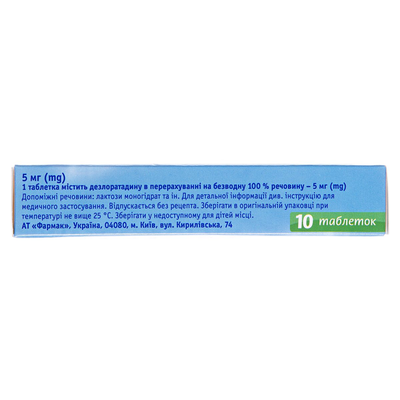
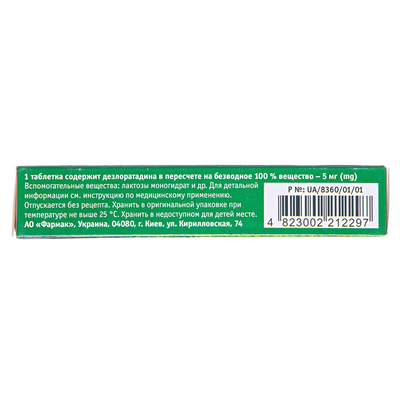
Edem tablets, for oral use, 5 mg each, No. 10
Ingredients
Active ingredient: desloratadine;
1 tablet contains 5 mg of desloratadine, calculated as 100% anhydrous substance;
Excipients: calcium hydrogen phosphate dihydrate, microcrystalline cellulose, lactose monohydrate, corn starch, hypromellose, calcium stearate, Opadry II 85F 30571 Blue (red iron oxide (E 172), polyvinyl alcohol, titanium dioxide (E 171), talc, indigo carmine (E 132), polyethylene glycol).
Dosage Form
Film-coated tablets.
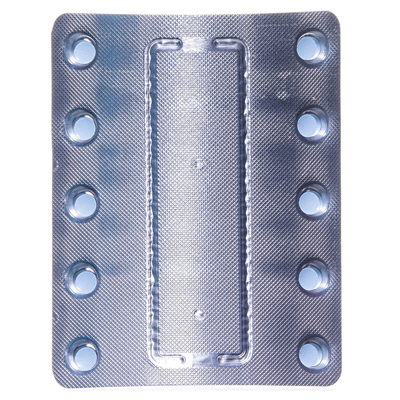
Main physical and chemical properties: round tablets with a biconvex surface, coated with a blue film.
Pharmacotherapeutic group
Antihistamines for systemic use.
ATC code R06A X27.
Pharmacological properties
Pharmacodynamics.
Desloratadine is a non-sedating, long-acting antihistamine that exerts a selective antagonistic effect on peripheral H1 receptors. Following oral administration, desloratadine selectively blocks peripheral histamine H1 receptors.
In in vitro studies, desloratadine demonstrated its antiallergic and anti-inflammatory properties on endothelial cells. This was manifested by the inhibition of the release of pro-inflammatory cytokines, such as IL-4, IL-6, IL-8, and IL-13, from human mast cells/basophils, as well as by inhibiting the expression of adhesion molecules such as P-selectin. The clinical significance of these observations has yet to be confirmed.
In high-dose clinical trials in which desloratadine was administered daily at doses up to 20 mg for 14 days, no statistically significant cardiovascular changes were observed. In a clinical pharmacology study, no QT interval prolongation was observed with a dose of 45 mg per day (10 times the maximum daily clinical dose) administered for 10 days.
In patients with allergic rhinitis, Edem® effectively relieved symptoms such as sneezing, nasal discharge, and itching, as well as eye irritation, tearing, redness, and itching of the palate. The drug effectively controlled symptoms for 24 hours.
Desloratadine has minimal penetration into the central nervous system. In controlled clinical trials, when administered at the recommended dose of 5 mg per day, the incidence of drowsiness did not differ from that in the placebo group. In clinical studies, a single dose of desloratadine at a daily dose of 7.5 mg did not affect psychomotor activity.
The drug effectively alleviates the severity of seasonal allergic rhinitis, as measured by the total score on the quality-of-life questionnaire for rhinoconjunctivitis. The greatest improvement was observed in questionnaire items related to practical problems and daily activities that were limited by symptoms.
Chronic idiopathic urticaria was studied in a clinical model simulating urticaria conditions. Since histamine release is a causative factor in all forms of urticaria, desloratadine is expected to effectively relieve symptoms in forms of urticaria other than chronic idiopathic urticaria.
In two placebo-controlled 6-week studies involving patients with chronic idiopathic urticaria, desloratadine effectively relieved itching and reduced the number and size of wheals by the end of the first dosing interval. In each study, the effect lasted throughout the 24-hour dosing interval. Itch relief of more than 50% was observed in 55% of patients taking desloratadine, compared with 19% of patients taking placebo. Administration of the drug has no significant effect on sleep or daytime activity.
Pharmacokinetics.
Absorption.
Plasma concentrations of desloratadine can be measured 30 minutes after administration. Desloratadine is well absorbed, with peak concentrations reached in approximately 3 hours; the half-life is approximately 27 hours. The degree of desloratadine accumulation was consistent with its half-life (approximately 27 hours) and dosing frequency (once daily). The bioavailability of desloratadine was dose-proportional in the range of 5 to 20 mg.
In a pharmacokinetic study in which patient demographics were comparable to those of the general population with seasonal allergic rhinitis, 4% of participants had higher desloratadine concentrations. This proportion may vary depending on ethnicity. The maximum concentration of desloratadine was approximately 3 times higher after approximately 7 hours, and the terminal half-life was approximately 89 hours. The safety profile in these patients did not differ from that in the overall patient population.
Distribution.
Desloratadine is moderately bound to plasma proteins (83–87%). When desloratadine was administered at doses ranging from 5 to 20 mg once daily for 14 days, no signs of clinically significant drug accumulation were observed.
Biotransformation.
The enzyme responsible for the metabolism of desloratadine has not yet been identified; therefore, some interaction with other drugs cannot be completely ruled out. Desloratadine does not inhibit CYP3A4 in vivo; in vitro studies have shown that the drug does not inhibit CYP2D6, a substrate or inhibitor of P-glycoprotein.
Elimination.
In a study of a single 7.5 mg dose of desloratadine, food intake (a high-calorie, high-fat breakfast) did not affect the pharmacokinetics of desloratadine. It was also established that grapefruit juice does not affect the pharmacokinetics of desloratadine.
Indications
Relief of symptoms associated with:
- allergic rhinitis (see the “Pharmacological Properties” section);
- urticaria (see the “Pharmacological Properties” section).
Contraindications
Hypersensitivity to the active ingredient, to any of the drug’s excipients, or to loratadine.
Drug Interactions and Other Interactions
In clinical studies of desloratadine tablets, no clinically significant interactions were observed when co-administered with erythromycin or ketoconazole.
According to clinical and pharmacological studies, no potentiation of ethanol’s adverse effects on psychomotor function was observed when the drug was used in combination with alcohol. However, during the postmarketing period, cases of alcohol intolerance and alcohol intoxication have been observed while taking this medication. Therefore, caution is advised when consuming alcohol during treatment with Edem®.
Special Considerations for Use
In patients with severe renal insufficiency, Edem® should be administered under medical supervision.
Desloratadine should be used with caution in patients with a history of seizures or a hereditary predisposition to seizures. In patients who experience a seizure during treatment, discontinuation of desloratadine should be considered.
Patients with rare hereditary forms of galactose intolerance, congenital lactase deficiency, or glucose-galactose malabsorption should not take this medication.
Use During Pregnancy or Breastfeeding.
Desloratadine has not shown teratogenicity in animal studies.
The safety of this medication during pregnancy has not been established; therefore, the use of Edem® during this period is not recommended.
Breastfeeding.
Desloratadine passes into breast milk; therefore, the use of Edem® is not recommended for women who are breastfeeding.
Effect on reaction time when driving or operating machinery.
No effect of desloratadine on the ability to drive or operate machinery has been identified. However, patients should be informed that, very rarely, some people may experience drowsiness, which could affect their ability to drive or operate complex machinery.
Dosage and Administration
Adults and children 12 years of age and older: 1 tablet once daily, regardless of meals, to relieve symptoms associated with allergic rhinitis (including intermittent and persistent allergic rhinitis) and hives.
Treatment of intermittent allergic rhinitis (symptoms present for fewer than 4 days per week or for fewer than 4 weeks) should be based on the patient’s medical history: discontinue treatment once symptoms resolve and resume treatment upon their recurrence.
In cases of persistent allergic rhinitis (symptoms present for more than 4 days per week or for more than 4 weeks), treatment should be continued throughout the entire period of exposure to the allergen.
Children.
The efficacy and safety of Edem® tablets in children under 12 years of age have not been established.
Overdose
In case of overdose, standard measures should be taken to remove the unabsorbed active ingredient. Symptomatic and supportive treatment is recommended. In clinical studies in which desloratadine was administered at doses of 45 mg (9 times the recommended dose), no clinically significant adverse reactions were observed. Desloratadine is not removed by hemodialysis. Its removal via peritoneal dialysis has not been established.
Side Effects
In clinical trials for indications including allergic rhinitis and chronic idiopathic urticaria, adverse effects in patients receiving a dose of 5 mg per day were reported 3% more frequently than in patients receiving placebo.
The most commonly reported side effects, compared with placebo, were fatigue (1.2%), dry mouth (0.8%), and headache (0.6%).
Children. In clinical trials involving 578 adolescents aged 12 to 17 years, the most common side effect was headache; it was observed in 5.9% of patients taking desloratadine and in 6.9% of patients receiving a placebo.
There is a risk of psychomotor hyperactivity (abnormal behavior) associated with the use of desloratadine (which may manifest as irritability and aggression, as well as agitation).
Summary table of adverse reaction frequencies.
The frequency of adverse reactions is classified as follows: very common (≥1/10), common (≥1/100, <1/10), uncommon (≥1/1,000, <1/100), rare (≥1/10,000, <1/1,000), very rare (<1/10,000), frequency unknown (cannot be estimated from the available data).
| Classes/Organ Systems | Frequency | Adverse reactions |
| Psychiatric | very rare | Hallucinations |
| Nervous system | Common | headache |
| very rare | dizziness, drowsiness, insomnia, psychomotor hyperactivity, seizures | |
| Cardiac | very rare | tachycardia, palpitations |
| frequency unknown | QT interval prolongation, supraventricular tachyarrhythmia | |
| Gastrointestinal | Common | dry mouth |
| very rare | abdominal pain, nausea, vomiting, dyspepsia, diarrhea | |
| Hepatobiliary system | very rare | elevated liver enzymes, elevated bilirubin, hepatitis |
| frequency unknown | jaundice | |
| Musculoskeletal and connective tissue disorders | very rare | myalgia |
| Skin and subcutaneous tissue disorders | frequency unknown | photosensitivity |
| General disorders | Common | increased fatigue |
| very rare | Hypersensitivity reactions (including anaphylaxis, angioedema, shortness of breath, itching, rash, and hives) | |
| frequency unknown | asthenia |
The following have been observed during the postmarketing period (frequency unknown): QT interval prolongation, arrhythmia, and bradycardia.
Shelf life
3 years.
Do not use this medication after the expiration date printed on the package.
Storage conditions
Store in the original packaging at a temperature not exceeding 25 °C.
Keep out of reach of children.
Packaging
10 or 30 tablets per blister pack. 1 blister pack per package.
Dispensing Category
Over-the-counter.
Manufacturer
Farmak JSC.