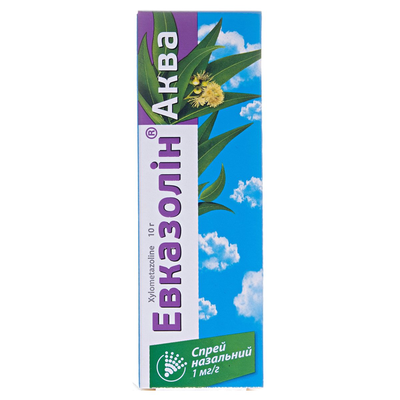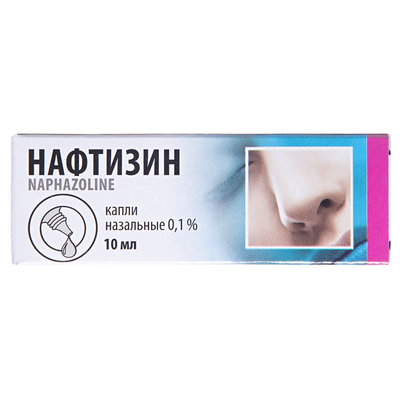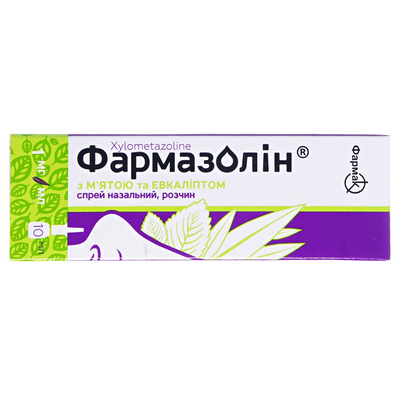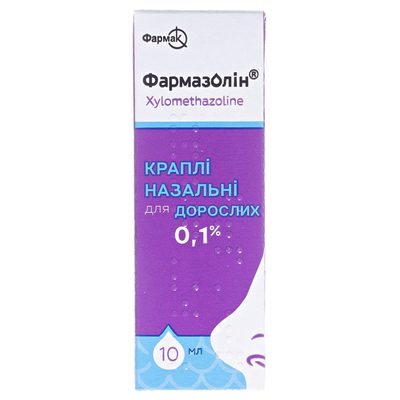
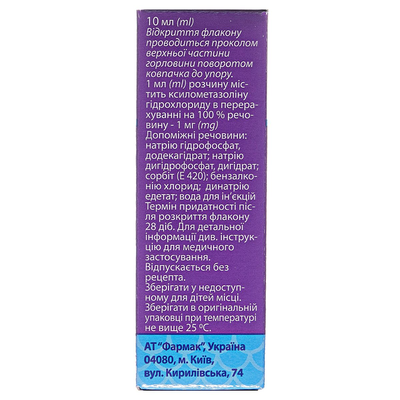
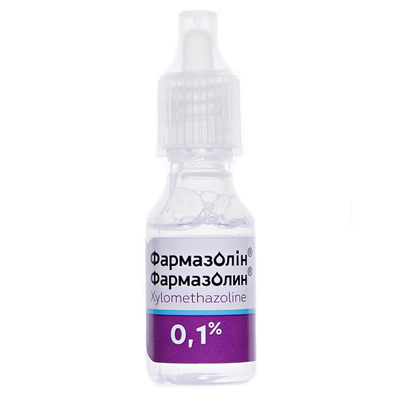
Pharmazolin nasal drops, 0.1%, 10 ml per bottle.
Ingredients
Active ingredient: xylometazoline;
1 mL of solution contains 0.5 mg or 1 mg of xylometazoline hydrochloride, calculated as 100% active ingredient;
Excipients: sodium hydrophosphate, dodecahydrate; sodium dihydrophosphate, dihydrate; sorbitol (E 420); benzalkonium chloride; disodium edetate; water for injection.
Dosage Form
Nasal drops.
Main physical and chemical properties: clear, colorless liquid.
Pharmacotherapeutic group
Agents used in diseases of the nasal cavity. Decongestants and other preparations for topical use in diseases of the nasal cavity. Sympathomimetics, simple preparations. ATC code R01A A07.
Pharmacological properties
Pharmacodynamics.
Xylometazoline is a sympathomimetic agent that acts on α-adrenergic receptors.
Pharmazolin® causes constriction of the nasal blood vessels, reducing swelling of the nasal mucosa and its paranasal sinuses, thereby improving nasal breathing in cases of nasal and paranasal sinus congestion. The medication is well tolerated, even by patients with sensitive mucous membranes. It does not impair mucociliary function. Thanks to its moisturizing component (sorbitol), the medication helps relieve dryness and irritation of the nasal mucosa. Pharmazolin®, nasal drops, has a balanced pH within the range typical of the nasal cavity.
Pharmacokinetics.
The drug’s effect begins within a few minutes after application and lasts up to 12 hours. When applied topically, the drug is practically not absorbed; plasma concentrations of xylometazoline are so low that they cannot be detected by modern analytical methods.
Indications
Symptomatic treatment of nasal congestion associated with the common cold, hay fever, other allergic rhinitis, and sinusitis.
To facilitate the drainage of secretions in diseases of the paranasal sinuses.
Adjuvant therapy in cases of otitis media (to reduce mucosal edema).
To facilitate rhinoscopy.
Contraindications
Hypersensitivity to xylometazoline or any other component of the medication; acute coronary artery disease; coronary asthma; hyperthyroidism, angle-closure glaucoma, transsphenoidal hypophysectomy, and a history of surgical procedures involving exposure of the meninges, rhinitis sicca, or atrophic rhinitis. Concomitant treatment with MAO inhibitors and for 2 weeks after discontinuation of such treatment.
Drug Interactions and Other Interactions
Monoamine oxidase inhibitors (MAOIs): Xylometazoline may potentiate the effects of monoamine oxidase inhibitors and induce a hypertensive crisis. Do not administer xylometazoline to patients who are taking or have taken MAO inhibitors within the past two weeks.
Tricyclic and tetracyclic antidepressants: When tricyclic or tetracyclic antidepressants are used concomitantly with sympathomimetic agents, the sympathomimetic effect of xylometazoline may be potentiated; therefore, the concurrent use of such agents is not recommended.
When used in combination with β-blockers, it may cause bronchospasm or a decrease in blood pressure.
Special Instructions for Use
Pharmazolin®, 0.05% nasal drops, should not be used in children under 1 year of age.
Use in children aged 1 to 11 years is recommended only under adult supervision.
The product should not be used in children for more than 7–10 consecutive days.
Pharmazolin®, 0.1% nasal drops, should not be used in children under 12 years of age.
The medication should not be used for more than 10 consecutive days. Prolonged or excessive use may lead to a recurrence of nasal congestion and/or atrophy of the nasal mucosa.
Like other sympathomimetics, this medication should be prescribed with caution to patients who have severe reactions to adrenergic agents, manifested as insomnia, dizziness, tremors, cardiac arrhythmia, or increased blood pressure.
The recommended dose should not be exceeded, especially when treating children and the elderly.
The drug should be prescribed with caution to patients with cardiovascular diseases, hypertension, diabetes mellitus, thyroid disorders, pheochromocytoma, benign prostatic hyperplasia; it should also not be used in patients who have received concomitant treatment with MAO inhibitors or within 2 weeks after discontinuing such treatment. Patients with long QT syndrome who are receiving xylometazoline may be at increased risk of serious ventricular arrhythmias.
To prevent infection, each vial of the medication should be used by only one person.
The product contains benzalkonium chloride, prolonged use of which may cause swelling of the nasal mucosa.
Use during pregnancy or breastfeeding.
This medication should not be used during pregnancy due to its potential vasoconstrictive effect.
There is no evidence of any adverse effects on the infant. It is unknown whether xylometazoline is excreted into breast milk; therefore, caution is advised, and the medication should be used during breastfeeding only as directed by a doctor.
Fertility.
There are no adequate data regarding the effect of Pharmazolin® on fertility. Since systemic exposure to xylometazoline hydrochloride is very low, the likelihood of an effect on fertility is extremely low.
Effect on reaction time when driving or operating machinery.
The drug usually has no or only a minor effect on the ability to drive or operate machinery.
Directions for Use and Dosage
When using a polyethylene vial, screw the cap on as tightly as possible before first use. This will cause the spike on the inside of the cap to pierce the opening. Unscrew and remove the cap, then, while gently pressing on the vial, instill the solution into the nose.
When using a polyethylene bottle with a tamper-evident seal, hold the bottle in the palm of your hand immediately before use to warm it to body temperature. After instillation, screw the cap back on tightly.
Thoroughly clean the nasal cavity before administering the medication.
Pharmazolin®, 0.05% nasal drops, are indicated for children aged 1 to 11 years.
Pharmazolin®, 0.1% nasal drops, are indicated for adults and children aged 12 years and older.
0.05% nasal drops:
- for children aged 1 to 5 years (under adult supervision), 1–2 drops in each nostril 1–2 times daily, but no more than 3 times daily;
- children aged 6 to 11 years (under adult supervision): 2–4 drops in each nostril 2–3 times a day.
Use no more than 3 times a day.
The duration of treatment depends on the course of the illness and should not exceed 7 days, unless otherwise prescribed by a doctor.
0.1% nasal drops:
- For adults and children aged 12 years and older, 2–4 drops in each nostril 3 times a day.
Use no more than 3 times a day.
The duration of treatment depends on the course of the disease and should not exceed 10 consecutive days.
Children.
Pharmazolin®, 0.05% drops, should not be used in children under 1 year of age.
Pharmazolin®, 0.05% drops, should be used in children aged 1 to 11 years under adult supervision.
Pharmazolin®, 0.1% nasal drops, should not be used in children under 12 years of age.
Overdose
Excessive topical application of xylometazoline hydrochloride or its accidental ingestion may lead to severe dizziness, sweating, a significant drop in body temperature, headache, bradycardia, hypertension, respiratory depression, coma, and seizures. Elevated blood pressure may turn into hypotension. Younger children are more sensitive to toxicity than adults.
All patients with suspected overdose should receive appropriate supportive care and, if necessary, emergency symptomatic treatment under medical supervision. Medical care should include monitoring the patient for several hours. In cases of severe overdose accompanied by cardiac arrest, resuscitation efforts should continue for at least 1 hour.
Side Effects
Immune system:
rare (<1/10,000): hypersensitivity reactions, including angioedema, rash, and itching.
Nervous system:
common (≥ 1/100, <1/10): headache.
Eye disorders:
rare (<1/10,000): temporary visual disturbances.
Cardiovascular system:
rare (<1/10,000): irregular or rapid heartbeat.
Respiratory, thoracic, and mediastinal disorders:
common (≥ 1/100, <1/10): dryness or discomfort of the nasal mucosa;
uncommon (≥ 1/1,000 – < 1/100): nosebleeds.
Gastrointestinal system:
common (≥ 1/100, <1/10): nausea.
General disorders and administration site conditions:
common (≥ 1/100, <1/10): burning sensation at the application site.
Shelf life
3 years.
Once the vial is opened, the product is stable for 28 days.
Do not use the product after the expiration date printed on the packaging.
Storage conditions
Store in the original packaging at a temperature not exceeding 25 °C.
Keep out of the reach of children.
Packaging
10 mL in a polyethylene bottle, sealed with a cap or a dropper stopper and a cap, or in a polyethylene bottle with a dispenser, sealed with a cap featuring a tamper-evident seal (first-opening indicator).
Dispensing Category
Over-the-counter.
Manufacturer
JSC “Farmak.”