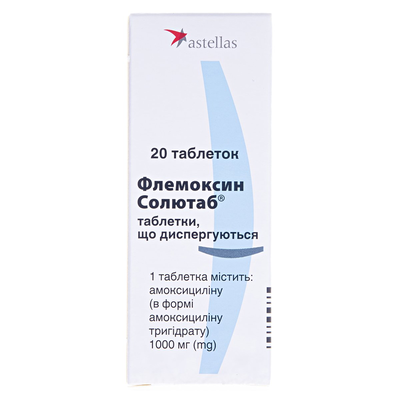
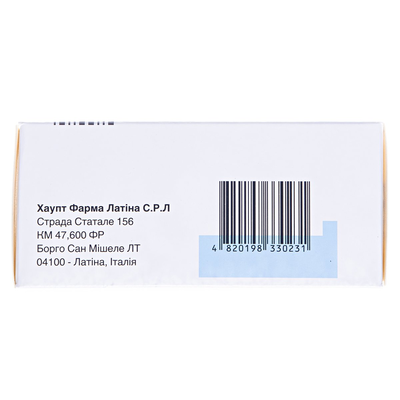
Flemoxin Solutab Dispersible Tablets, 1000 mg, No. 20 (5×4)
Ingredients
Active ingredient: amoxicillin;
1 tablet contains amoxicillin (as amoxicillin trihydrate) – 125 mg, 250 mg, 500 mg, 1000 mg;
Excipients: microcrystalline cellulose, microcrystalline cellulose and sodium carmellose, crospovidone, vanillin, mandarin flavoring, lemon flavoring, saccharin, magnesium stearate.
Dosage Form
Disintegrating tablets.
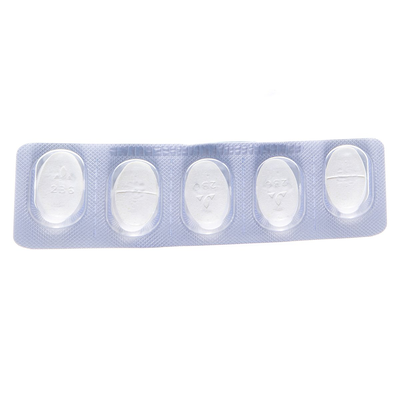
Main physical and chemical properties: white or nearly white tablets (may take on a light yellow tint during storage), oblong in shape, engraved with “231” for Flemoxin Solutab® 125 mg, “232” for Flemoxin Solutab® 250 mg, “234” for Flemoxin Solutab® 500 mg, “236” for Flemoxin Solutab® 1000 mg, with a mark on one side and a score line on the other side.
Pharmacotherapeutic group
Antimicrobials for systemic use. Beta-lactam antibiotics. Broad-spectrum penicillins. Amoxicillin. ATC code J01CA04.
Pharmacological Properties
Pharmacodynamics. Flemoxin Solutab® is a broad-spectrum bactericidal antibiotic belonging to the group of semisynthetic penicillins.
In vitro data on the susceptibility of certain clinically significant microorganisms to amoxicillin.
| Activity
in vitro |
Mean minimum inhibitory concentration (MIC) | ||
| 0.01–0.1 μg/mL | 0.1–1 μg/mL | 1–10 μg/mL | |
| Gram-positive microorganisms | Group A streptococci
Group B streptococci Streptococcus pneumoniae Cl. welchii Cl. tetani |
Staphylococcus aureus (beta-lactamase-negative strains)
B. anthracis L. subtilis L. monocytogenes |
Streptococcus faecalis |
| Gram-negative microorganisms | N. gonorrhoeae
N. meningitidis |
H. influenzae
Bordetella pertussis |
E. coli
P. mirabilis S. typhi Sh. sonnei V. cholerae |
Amoxicillin is inactive against microorganisms that produce beta-lactamases, such as Pseudomonas, Klebsiella, indole-positive strains of Proteus, and strains of Enterobacter. The level of resistance among susceptible microorganisms may vary by region.
Pharmacokinetics.
Absorption. After oral administration of “Flemoxin Solutab®” tablets, amoxicillin is rapidly and almost completely absorbed (85–90%); the drug is acid-stable. Food intake has virtually no effect on the drug’s absorption. The maximum concentration of the active ingredient in blood plasma following administration of “Flemoxin Solutab®” tablets is reached within 1–2 hours. After oral administration of 375 mg of amoxicillin, the maximum concentration of the active ingredient in blood plasma was recorded at 6 μg/L. When the dose is doubled (or halved), the maximum concentration in plasma also changes (increases or decreases) by a factor of 2.
Distribution. Approximately 20% of amoxicillin binds to plasma proteins. Amoxicillin penetrates mucous membranes, bone tissue, intraocular fluid, and sputum in therapeutically effective concentrations. The concentration of amoxicillin in bile is 2–4 times higher than its concentration in blood. In amniotic fluid and umbilical vessels, the concentration of amoxicillin is 25–30% of its level in the blood plasma of a pregnant woman. Amoxicillin penetrates poorly into cerebrospinal fluid; however, in cases of inflammation of the meninges (e.g., meningitis), the concentration in cerebrospinal fluid is approximately 20% of the concentration in blood plasma.
Metabolism. Amoxicillin is partially metabolized; most of its metabolites are inactive against microorganisms but possess allergenic properties.
Excretion. Amoxicillin is eliminated primarily by the kidneys, with approximately 80% excreted via tubular secretion and 20% via glomerular filtration. Approximately 90% of amoxicillin is excreted within 8 hours, with 60–70% excreted unchanged by the kidneys. In the absence of renal impairment, the half-life of amoxicillin is 1–1.5 hours. In preterm infants, newborns, and infants up to 6 months of age, it is 3–4 hours.
In cases of impaired renal function (creatinine clearance equal to or less than 15 mL/min), the half-life of amoxicillin increases, reaching 8.5 hours in cases of anuria.
The half-life of amoxicillin remains unchanged in patients with hepatic impairment.
Indications
Infections caused by microorganisms susceptible to the drug:
- the respiratory tract;
- of the genitourinary system;
- the gastrointestinal tract (GIT);
- skin and soft tissues.
Contraindications
Hypersensitivity to the active ingredient, to other penicillins, or to any of the excipients.
A history of a severe immediate hypersensitivity reaction (e.g., anaphylaxis) to another beta-lactam antibiotic (e.g., a cephalosporin, carbapenem, or monobactam).
Drug Interactions and Other Interactions
Concomitant use of allopurinol and amoxicillin increases the risk of allergic skin reactions.
Isolated cases of increased international normalized ratio (INR) have been reported in patients taking amoxicillin concomitantly with acenocoumarol or warfarin. If such use is necessary, prothrombin time or INR should be carefully monitored when starting or discontinuing amoxicillin therapy. In addition, it may be necessary to adjust the dose of oral anticoagulants.
Penicillins may reduce the clearance of methotrexate, which may lead to increased toxicity of the latter.
During treatment with amoxicillin, non-enzymatic reactions using glucose oxidase should be used to determine urine glucose levels, as enzymatic methods may yield false-positive results.
Probenecid, phenylbutazone, oxyphenbutazone, and to a lesser extent, acetylsalicylic acid, indomethacin, and sulfinpyrazone inhibit the tubular secretion of penicillin-class drugs, leading to an increase in the half-life and plasma concentration of amoxicillin.
Like other antibiotics, amoxicillin may affect the intestinal flora, leading to reduced reabsorption of estrogens and decreased efficacy of combined oral contraceptives.
Drugs with bacteriostatic activity (tetracycline-class antibiotics, macrolides, chloramphenicol) may neutralize the bactericidal effect of amoxicillin. Concomitant use of aminoglycosides is possible (synergistic effect).
Special Considerations for Use
Hypersensitivity.
Before starting treatment with amoxicillin, it is essential to determine whether the patient has a history of hypersensitivity reactions to penicillins, cephalosporins, or other allergens.
Serious, and sometimes even fatal, cases of hypersensitivity (anaphylactoid reactions and severe cutaneous adverse reactions) have been observed in patients during penicillin therapy. Such reactions are more likely to occur in patients with a history of hypersensitivity to penicillins or hypersensitivity to various allergens. If an allergic reaction occurs, amoxicillin therapy should be discontinued and appropriate treatment initiated.
Acute coronary syndrome associated with a hypersensitivity reaction (Kounis syndrome)
In rare cases, hypersensitivity reactions have been reported during treatment with amoxicillin (acute coronary syndrome associated with a hypersensitivity reaction; see the “Adverse Reactions” section); if such reactions occur, appropriate treatment must be administered.
Resistant Microorganisms
Amoxicillin is not suitable for treating certain infections if the causative pathogens are resistant or likely to be resistant to amoxicillin; Before treating with amoxicillin, the susceptibility of the suspected pathogen should be assessed (see the “Pharmacological Properties” section). This applies, in particular, to the treatment of patients with urinary tract infections and serious ear, nose, and throat infections.
Infectious mononucleosis.
In patients with infectious mononucleosis or lymphocytic leukemoid reactions, a rash is frequently (in 60–100% cases) develop a rash that is not due to hypersensitivity to penicillins. Therefore, ampicillin-class antibiotics should not be used in patients with mononucleosis.
Amoxicillin is not recommended for the treatment of patients with acute lymphocytic leukemia due to an increased risk of erythematous skin rashes.
Cross-resistance. Cross-hypersensitivity and cross-resistance may exist between penicillins and cephalosporins.
Resistance.
Prolonged use of the drug may sometimes lead to excessive growth of microflora resistant to the drug. As with other broad-spectrum penicillins, superinfections may occur.
Pseudomembranous colitis.
With the use of virtually all antibacterial agents, including amoxicillin, cases of antibiotic-associated colitis ranging from mild to life-threatening have been reported. If antibiotic-associated colitis occurs, appropriate measures should be taken. Necessary measures should also be taken in the event of hemorrhagic colitis or hypersensitivity reactions.
Medications that inhibit peristalsis are contraindicated in this case.
Renal insufficiency.
In patients with renal insufficiency, the clearance of amoxicillin may be reduced depending on the severity of the renal insufficiency. In cases of severe renal insufficiency, the dose of amoxicillin must be reduced.
Seizures
In patients with impaired renal function, seizures may occur in rare cases. This is particularly true for patients receiving high doses and/or those with risk factors (e.g., a history of epilepsy, a predisposition to seizures, concomitant treatment for epilepsy, or central nervous system disorders) (see the “Adverse Reactions” section).
Crystalluria
When using high doses of the drug, it is necessary to consume an adequate amount of fluid to prevent crystalluria, which may be caused by amoxicillin. High concentrations of amoxicillin in the urine may cause sediment to form in the urinary catheter; therefore, the catheter should be visually inspected at regular intervals (see the “Adverse Reactions” and “Overdose” sections).
Skin Reactions
The onset of generalized erythema with fever associated with pustules at the start of treatment may be a symptom of acute generalized exanthematous pustulosis. In such cases, treatment must be discontinued, and further use of amoxicillin is contraindicated.
Amoxicillin may cause severe skin reactions, such as toxic epidermal necrolysis, Stevens-Johnson syndrome, and drug reaction with eosinophilia and systemic symptoms (DRESS). If severe skin reactions occur, amoxicillin should be discontinued, appropriate treatment should be initiated, and/or appropriate measures should be taken.
Jarisch–Herxheimer reaction
The Jarisch–Herxheimer reaction has been observed following the initiation of amoxicillin therapy for Lyme disease (see the “Adverse Reactions” section). This is directly due to the bactericidal effect of amoxicillin on the bacterium that causes Lyme disease, the spirochete Borrelia burgdorferi. Patients should be informed that this is a common consequence of antibiotic treatment for Lyme disease; symptoms usually resolve upon recovery.
During long-term treatment, it is recommended to periodically assess the function of the body’s systems, including the renal, hepatic, and hematopoietic systems. During high-dose therapy, blood counts should be monitored regularly. Elevated liver enzyme levels and changes in blood cell counts have been reported (see the “Adverse Reactions” section).
Precautions for premature infants and newborns: Renal, hepatic, and hematological function should be monitored.
Anticoagulants
Rarely, prolonged prothrombin time has been reported in patients receiving amoxicillin.
Appropriate monitoring is necessary when anticoagulants are used concomitantly.
Dosage adjustment of oral anticoagulants may be necessary to maintain the desired level of blood coagulation (see the sections “Interactions with Other Medications and Other Types of Interactions” and “Adverse Reactions”).
Combination therapy for the eradication of Helicobacter pylori: When using amoxicillin as part of combination therapy for the eradication of Helicobacter pylori, consult the prescribing information for the other medications used in the combination therapy.
Effect on Diagnostic Test Results
Elevated levels of amoxicillin in serum and urine may affect the results of certain laboratory tests. Due to high concentrations of amoxicillin in urine, chemical methods often yield false-positive results.
When measuring glucose in urine during treatment with amoxicillin, it is recommended to use enzymatic glucose oxidase methods.
The presence of amoxicillin may affect the results of estriol testing in pregnant women.
Use During Pregnancy or Breastfeeding.
Pregnancy
Results of animal studies do not indicate direct or indirect reproductive toxicity. Limited data on the use of amoxicillin during pregnancy in humans do not indicate an increased risk of congenital abnormalities. Amoxicillin may be used during pregnancy if the potential benefit outweighs the possible risks of treatment.
Breastfeeding
Amoxicillin is excreted in breast milk in small amounts, posing a potential risk of sensitization. This may lead to diarrhea or a fungal infection of the mucous membranes in infants and may require discontinuation of breastfeeding. Amoxicillin may be used during breastfeeding only after a physician has assessed the risk-benefit ratio.
Fertility
There are no data on the effect of amoxicillin on human fertility. Reproductive studies in animals have not demonstrated any effect on fertility.
Effect on reaction time when operating motor vehicles or other machinery.
No studies have been conducted on the effect on the ability to drive a car or operate other machinery. However, adverse reactions (e.g., allergic reactions, dizziness, seizures) may occur that could affect the ability to drive or operate machinery (see the “Side Effects” section).
Dosage and Administration
For mild to moderate infections, the following doses are recommended:
Adults (including elderly patients): 500–750 mg orally twice daily or 500 mg three times daily.
Children weighing <40 kg
The daily dose for children is 40–90 mg/kg/day, to be divided into 2–3 doses (do not exceed 3 g/day), depending on the indication, severity of the disease, and susceptibility of the microorganisms (see sections “Special Considerations for Use” and “Pharmacological Properties”).
Pharmacokinetic and pharmacodynamic data indicate that three-times-daily dosing is more effective than twice-daily dosing (recommended when doses are at the upper limit of the recommended range).
Children weighing more than 40 kg should receive the doses recommended for adults.
Special Recommendations.
Tonsillitis: 50 mg/kg/day, divided into 2 doses.
Acute otitis media: In areas with high prevalence of pneumococci with reduced susceptibility to penicillins, the dosing regimen should follow local recommendations.
Early-stage Lyme disease (isolated erythema migrans): 50 mg/kg/day, divided into 3 doses, for 14–21 days.
Prevention of endocarditis: 50 mg of amoxicillin per kg of body weight—a single dose administered 1 hour before a scheduled surgical procedure.
Gonorrhea (acute, uncomplicated): a single dose of 3 g.
When treating infections with hard-to-reach foci, such as acute otitis media, it is preferable to administer the medication three times daily.
For chronic conditions, recurrences, or severe infections, it is recommended to take the medication three times daily in doses of 750–1,000 mg; for children—up to 60 mg/kg/day (divided into 3 doses).
Duration of treatment.
For mild to moderate infections, the medication is taken for 5–7 days. However, for infections caused by streptococcus, the duration of treatment should be at least 10 days.
When treating chronic diseases, localized infectious lesions, or severe infections, the dosage should be determined based on the clinical presentation of the disease.
Treatment should be continued for 48 hours after the symptoms of the disease have resolved.
Patients with impaired renal function.
The dose should be reduced in patients with severe renal insufficiency.
In patients with a creatinine clearance below 30 mL/min, it is recommended to increase the dosing interval and reduce the daily dose (see the “Special Considerations for Use” and “Pharmacological Properties” sections).
Renal impairment in adult patients (including elderly patients)
| Creatinine clearance, mL/min | Dose | Dosage Interval |
| >30 | No dose adjustment is necessary | - |
| 10–30 | 500 mg | 12 hours |
| <10 | 500 mg | 24 hours |
Hemodialysis: At the end of the hemodialysis procedure, 500 mg of amoxicillin should be taken.
Renal insufficiency in children weighing less than 40 kg
| Creatinine clearance, mL/min | Dose | Interval between doses |
| >30 | Usual dose | No adjustment necessary |
| 10–30 | Usual dose | 12 hours (equivalent to 2/3 of the dose) |
| <10 | Usual dose | 24 hours (equivalent to 1/3 of the dose) |
Patients with impaired liver function.
Liver dysfunction does not affect the drug’s half-life.
Directions for use.
Flemoxin Solutab® is intended for oral use.
Food intake does not affect the absorption of Flemoxin Solutab®.
Dissolve the tablet in a glass of water, stir well until a homogeneous suspension is obtained, and drink immediately.
Children.
For children weighing < 40 kg, the daily dose is 40–90 mg/kg/day, divided into 2–3 doses (do not exceed a dose of 3 g/day), depending on the indication, severity of the disease, and susceptibility of the microorganisms.
Pharmacokinetic/pharmacodynamic data indicate that better efficacy is observed when taken 3 times daily; therefore, twice-daily dosing is recommended only if the upper recommended dose limit is used.
Children weighing more than 40 kg should receive the doses recommended for adults.
Overdose
Symptoms: Overdose may cause gastrointestinal disturbances such as nausea, vomiting, and diarrhea; this may result in disturbances of water and electrolyte balance. Cases of crystalluria have been reported, sometimes leading to renal failure.
Treatment: Induce vomiting or perform gastric lavage, followed by administration of activated charcoal and an osmotic laxative (sodium sulfate). Fluid and electrolyte balance should be maintained. Amoxicillin can be removed from the bloodstream by hemodialysis. There is no known specific antidote.
Side Effects
The most commonly reported adverse reactions are diarrhea, nausea, and vomiting.
Adverse reactions observed during clinical trials and postmarketing surveillance of amoxicillin are presented below according to the MEdDRA classification.
Adverse reactions are classified by frequency of occurrence:
very common (≥1/10),
common (≥1/100 and <1/10),
uncommon (≥1/1,000 and <1/100),
rare (≥1/10,000 and <1/1,000),
very rare (<1/10,000),
frequency unknown (cannot be estimated from the available data).
| Infections and infestations
|
|
| Very rare | Candidiasis of the skin and mucous membranes; overgrowth of non-susceptible microorganisms. |
| Blood and lymphatic system disorders
|
|
| Very rare | Leukopenia (including severe, reversible;
neutropenia, or agranulocytosis), reversible thrombocytopenia, and hemolytic anemia. Prolonged bleeding time and prothrombin index (see the “Special Considerations for Use” section). |
| Immune system disorders
|
|
| Very rare | Severe allergic reactions, including anaphylactic shock, angioedema, anaphylaxis, serum sickness, and allergic vasculitis (see the “Special Precautions for Use” section). |
| Frequency unknown | Jarisch–Herxheimer reaction (see the “Special Precautions for Use” section) and acute coronary syndrome associated with a hypersensitivity reaction (Kounis syndrome) (see the “Special Precautions for Use” section). |
| Nervous system disorders | |
| Very rare | Hyperactivity, dizziness, seizures (in cases of renal impairment or overdose). |
| Frequency unknown | Aseptic meningitis. |
| Gastrointestinal disorders
|
|
| Clinical trial data
|
|
| * Common | Diarrhea and nausea
|
| * Uncommon | Vomiting |
| Postmarketing surveillance data
|
|
| Very rare | Antibiotic-associated colitis, including pseudomembranous colitis and hemorrhagic colitis.
Black hairy tongue Discoloration of the tongue #Discoloration of teeth |
| Liver and biliary tract
|
|
| Very rare | Hepatitis, liver disorders, cholestatic jaundice, moderate elevation of liver enzymes (aspartate aminotransferase, alanine aminotransferase). |
| Skin and subcutaneous tissue disorders
|
|
| Clinical trial data
|
|
| * Common | Skin rash |
| * Uncommon | Hives and itching |
| Postmarketing surveillance data
|
|
| Very rare | Skin reactions such as erythema multiforme, Stevens-Johnson syndrome, toxic epidermal necrolysis, acute generalized exanthematous pustulosis, bullous exfoliative dermatitis, bullous dermatitis, photosensitivity reaction, and a drug reaction accompanied by eosinophilia and systemic symptoms (DRESS syndrome). |
| Renal and urinary tract disorders | |
| Very rare | Interstitial nephritis,
Crystalluria (see the “Special Precautions for Use” and “Overdose” sections). |
| * The frequency of these adverse reactions was assessed based on data from clinical studies involving a total of approximately 6,000 adults and children who took amoxicillin.
# Children experienced superficial discoloration of the teeth. Proper dental care can help prevent tooth discoloration: plaque is usually removed by brushing. |
|
Shelf life
3 years.
Storage Conditions
Store at a temperature not exceeding 25 °C in the original packaging.
Keep out of reach of children
Packaging
5 tablets per blister pack; 4 blister packs per cardboard box.
Dispensing Category
By prescription only.