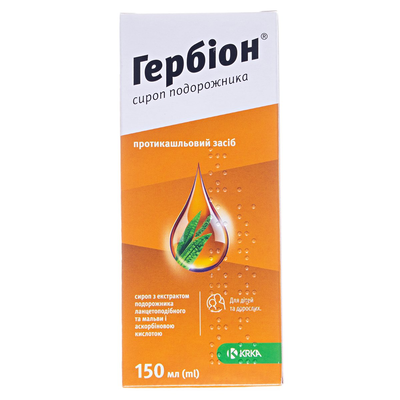
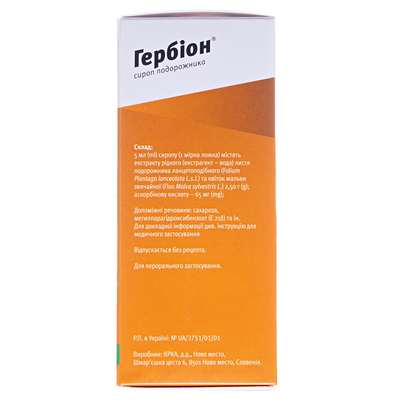
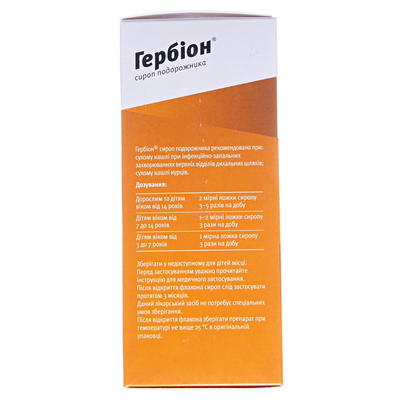
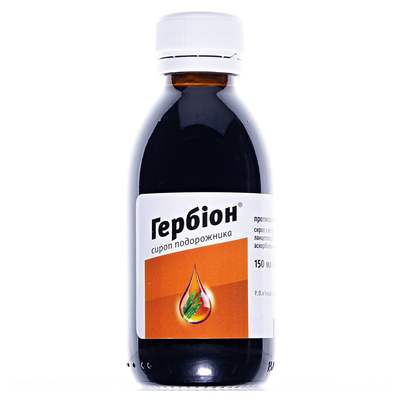
Herbion Plantain Syrup, 150 ml per bottle.
Ingredients
Active ingredients: liquid extract of lanceolate plantain leaves and common mallow flowers, ascorbic acid;
5 mL of syrup (1 measuring spoon) contains liquid extract (extractant—water) of lanceolate plantain leaves (Folium Plantago lanceolata L.s.l.) and common mallow flowers (Flos Malva sylvestris L.) 2.50 g; ascorbic acid – 65 mg;
excipients: sucrose, methyl parahydroxybenzoate (E 218), orange oil flavoring.
Dosage form
Syrup.
Main physical and chemical properties: a brown or reddish-brown syrup with a characteristic odor and taste. A slight sediment, typical of natural substances, may be present.
Pharmacotherapeutic group
Agents used for coughs and the common cold. ATC code R05X.
Pharmacological properties
Pharmacodynamics.
Herbion® Plantain Syrup contains an extract mixture of lanceolate plantain leaves, common mallow flowers, and ascorbic acid.
It is believed that the mucilage from the leaves of lanceolate plantain and the flowers of common mallow, as well as the iridoid glycosides (aucubin) from the lanceolate plantain leaves play an important role in the drug’s action. Since the syrup contains the mucilage from these extracts, it acts as a mucilaginous agent in cases of dry, irritating coughs associated with inflammation of the upper respiratory tract. The mucilaginous substance forms a thin protective layer on the mucous membranes of the oral cavity and throat and mechanically protects the mucous membranes from irritants that trigger the cough reflex. In this way, it alleviates coughing caused by irritation of the respiratory tract mucosa during inflammatory processes triggered by various environmental irritants.
Ascorbic acid is involved in many metabolic processes in the body; it stimulates the body’s immune response and promotes cell regeneration.
Pharmacokinetics.
No studies on the absorption, distribution, and metabolism of both active ingredients in the syrup have been conducted due to a lack of clarity regarding which active ingredient contributes to the effect and to what extent.
The gluten polysaccharides in both preparations are not absorbed or metabolized but act as a protective layer on the mucous membrane.
Absorption of ascorbic acid begins through the mucous membranes of the oral cavity and continues in the duodenum and small intestine. It is distributed to all tissues and cells. In the human body, ascorbic acid is reversibly oxidized to oxalic acid and ascorbate-2-sulfate, which are excreted in the urine. Excess ascorbic acid is excreted in the urine unchanged.
Indications
- Dry cough associated with infectious and inflammatory diseases of the upper respiratory tract;
- Dry cough in smokers.
Contraindications
Hypersensitivity to the active ingredients or to any of the inactive ingredients in the medication. Urolithiasis. Gastroesophageal reflux disease, including reflux esophagitis, hyperacid gastritis, and gastric and duodenal ulcers. Severe kidney disease.
Interactions with other medications and other types of interactions
Leaves of lanceolate plantain and flowers of common mallow.
Unknown.
Ascorbic acid.
Concomitant use with aluminum-containing antacids may increase the excretion of aluminum in the urine. This combination is not recommended, especially in patients with a history of kidney disease.
Ascorbic acid increases iron absorption.
Concomitant use with deferoxamine promotes iron excretion. The use of high doses of ascorbic acid in patients taking deferoxamine may cause heart disease (such as cardiomyopathy and congestive heart failure). In such cases, the daily dose of ascorbic acid should not exceed 200 mg; close monitoring of cardiac function is recommended. Ascorbic acid should not be administered to patients with heart failure who are undergoing treatment with deferoxamine. Do not administer ascorbic acid during the first month of treatment with deferoxamine.
High doses of ascorbic acid (1 g) inhibit the disulfiram-alcohol reaction in patients with alcoholism who are being treated with disulfiram.
Ascorbic acid reduces the absorption of amphetamine by affecting the pH of the stomach.
Ascorbic acid increases the total clearance of ethyl alcohol.
High doses of ascorbic acid impair the renal excretion of mexiletine by altering the pH of urine. Patients should be closely monitored when mexiletine is used concomitantly with high doses of ascorbic acid.
High doses of ascorbic acid may affect urinary pH and increase the risk of crystalluria during treatment with sulfonamides.
Special Considerations for Use
Herbion® Plantain Syrup contains sucrose and is therefore not recommended for patients with diabetes.
If shortness of breath, fever, purulent sputum, or bloody sputum occurs, or if symptoms worsen during treatment, consult a doctor.
Do not exceed the recommended doses.
High doses of ascorbic acid increase the excretion of oxalates in the urine, thereby raising the risk of oxalate stone formation. The risk is extremely low in healthy patients, especially when taking less than 1 g of ascorbic acid per day. In cases of urolithiasis and hyperoxaluria, the daily dose of ascorbic acid should not exceed 1 g, taking into account dietary intake and dietary supplements.
Renal function should be monitored when ascorbic acid is used in high doses. Patients with a history of kidney disease should use this medication with caution, taking into account the vitamin C content in food and dietary supplements.
Use with caution when treating patients with glucose-6-phosphate dehydrogenase deficiency.
High doses of vitamin C should not be prescribed to patients with increased blood clotting, thrombophlebitis, or a tendency toward thrombosis.
Since ascorbic acid increases iron absorption, its use in high doses may be dangerous for patients with hemochromatosis, thalassemia, polycythemia, leukemia, and sideroblastic anemia. Patients with high iron levels in the body should take the medication in the lowest possible doses.
Ascorbic acid may affect the results of laboratory tests, such as those measuring glucose, bilirubin, transaminase activity, and lactate dehydrogenase levels.
Special Information About Excipients
Herbion® Plantain Syrup contains sucrose. Therefore, patients with rare hereditary conditions such as fructose intolerance, glucose-galactose malabsorption, or sucrase-isomaltase deficiency should not take this medication.
Methyl parahydroxybenzoate (E 218) may cause allergic reactions (possibly delayed).
Use During Pregnancy or Breastfeeding.
Since the safety of this medication during pregnancy or breastfeeding has not been established, its use during this period is not recommended.
There are no data on the effect on fertility.
Effect on reaction time when driving or operating machinery.
There are no data on the effect of this medication on the ability to drive or operate machinery.
Dosage and Administration
Adults and children 14 years of age and older should take 2 measuring spoons of syrup 3–5 times daily. Children 7 to 14 years of age should take 1–2 measuring spoons of syrup 3 times daily.
For children aged 3 to 7 years, administer 1 measuring spoon of syrup 3 times a day.
The duration of treatment is determined by the doctor on an individual basis.
If symptoms do not subside after 1 week of use, consult a doctor regarding further treatment.
Patients should not eat or drink immediately after taking the medication, as food and beverages may accelerate the elimination of the medication from the mucous membranes of the mouth and throat.
Shake the syrup well before use.
While taking the syrup, it is recommended to drink plenty of tea or other warm beverages.
Children
The syrup is not recommended for children under 3 years of age without prior consultation with a doctor.
Overdose
No cases of overdose have been reported.
Ascorbic acid is well tolerated. It is a water-soluble vitamin, and any excess is excreted in the urine. Overdose may lead to changes in the renal excretion of ascorbic and uric acids during urine acetylation, with a risk of oxalate stone formation. High doses of ascorbic acid may cause stomach pain, heartburn, vomiting, nausea, or diarrhea, which resolve after discontinuation of the drug. Treatment is symptomatic.
If the recommended doses are significantly exceeded (a vitamin C dose exceeding 1 g per day), the following may occur: renal failure, sleep disturbances, a sensation of heat, fatigue, disturbances in zinc and copper metabolism, increased excitability, erythrocytopenia, neutrophilic leukocytosis. With prolonged use of ascorbic acid in high doses, suppression of pancreatic islet function is possible; therefore, pancreatic function must be monitored. When using ascorbic acid in high doses, blood pressure must be monitored due to its stimulating effect on the production of corticosteroid hormones.
Treatment is symptomatic.
Side Effects
Immune system: hypersensitivity reactions (itching, hives, eczema), angioedema, anaphylactic shock.
Methyl parahydroxybenzoate (E 218) may cause allergic reactions (possibly delayed).
Nervous system: headache.
Renal and urinary system disorders.
When ascorbic acid is used at a dose exceeding 1 g per day—oxaluria, kidney stones, and damage to the renal tubules.
Blood system.
Use of ascorbic acid at a dose exceeding 1 g per day in patients with glucose-6-phosphate dehydrogenase deficiency may cause red blood cell hemolysis (hemolytic anemia).
If severe side effects occur, treatment should be discontinued.
Shelf life
3 years.
Once the bottle is opened, the syrup should be used within 3 months.
Storage conditions
This medication does not require special storage conditions.
After opening the bottle, store the medication at a temperature not exceeding 25 °C in its original packaging.
Keep out of the reach of children.
Packaging
150 mL of syrup in a vial, along with a plastic measuring spoon, in a cardboard box.
Dispensing Category
Over-the-counter.
Manufacturer
KRKA, d.d., Novo mesto, Slovenia.