
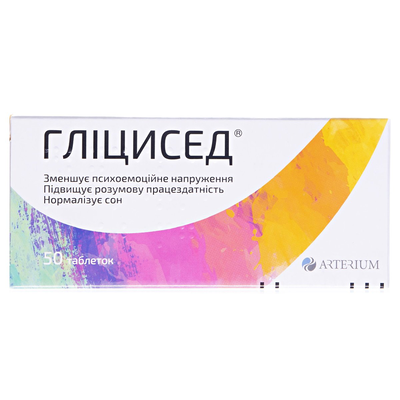
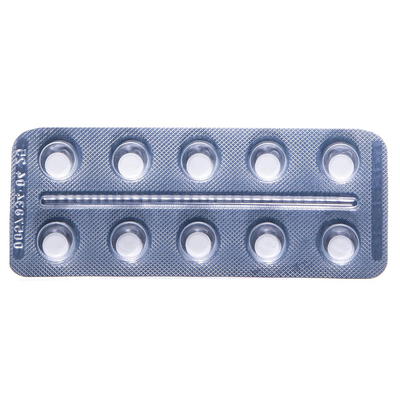
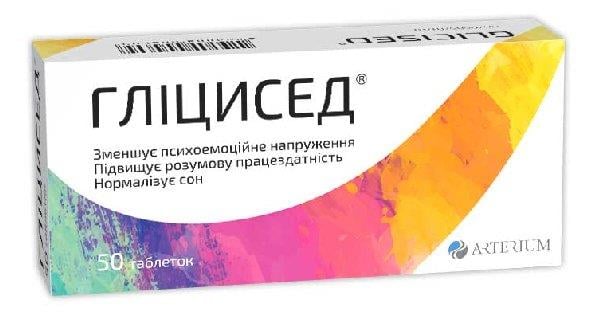
Glycised 100 mg tablets, No. 50 (10 x 5)
Ingredients
Active ingredient: glycine;
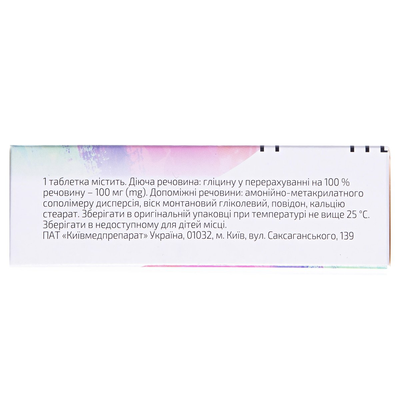
1 tablet contains 100 mg of glycine, calculated as 100% active ingredient;
Excipients: ammonium methacrylate copolymer dispersion, montan glycol wax, povidone, calcium stearate.
Dosage Form
Tablets.
Main physical and chemical properties: The tablets are almost white or white with a creamy tint, round in shape with a flat surface and a beveled edge. The surface of the tablets may have a marbled appearance.
Pharmacotherapeutic group
Agents affecting the nervous system.
ATC code N07X.
Pharmacological properties
Glycine is a non-essential amino acid (a natural metabolite); it acts as an inhibitory neurotransmitter and a regulator of metabolic processes in the central nervous system, reduces psychoemotional stress, enhances mental performance, exhibits neuroprotective, anti-stress, and sedative effects, improves brain metabolism, normalizes sleep, and reduces the toxic effects of alcohol. It is not habit-forming.
It easily penetrates most of the body’s biological fluids and tissues, including the brain. It is rapidly broken down in the liver by glycine oxidase, decomposing into water and carbon dioxide. Glycine does not accumulate in tissues.
Indications
Functional and organic disorders of the nervous system (neuroses, neurosis-like conditions, vegetative-vascular dystonia, sequelae of neuroinfections, traumatic brain injury, perinatal and other forms of encephalopathy, including those of alcoholic origin), accompanied by increased excitability, emotional instability, decreased mental performance, and sleep disturbances.
Ischemic stroke and cerebrovascular disorders.
As an adjunct in the treatment of alcoholism.
Contraindications
Individual intolerance to the drug and hypersensitivity to any of its components; arterial hypotension. Children under 3 years of age.
Special safety precautions
If the patient is prone to hypotension, blood pressure must be monitored and, if necessary, the dose of the drug adjusted: Glycised® should be prescribed in lower doses and under regular blood pressure monitoring. If blood pressure drops below normal levels, discontinue the medication.
Drug Interactions and Other Interactions
Glycised® reduces the toxicity of anticonvulsants, antipsychotics, antidepressants, and anticonvulsants. When combined with hypnotics, tranquilizers, and antipsychotics, the inhibitory effect on the central nervous system is enhanced.
Special Considerations for Use
Use during pregnancy or breastfeeding.
The effects of Glycised on the body during pregnancy or breastfeeding have not been thoroughly studied; therefore, use of the drug is not recommended.
Effect on reaction time when driving or operating machinery.
Caution should be exercised when driving or operating machinery, as well as when engaging in potentially hazardous activities.
Dosage and Administration
Glycised® is administered in tablet form or as a powder after crushing the tablet, either transbuccally (by placing it against the cheek or in the mouth) or sublingually (under the tongue). Hold the tablet in the mouth until it is completely dissolved.
For children aged 3 years and older, adolescents, and adults experiencing reduced mental performance, Glycised® is prescribed at a dose of 1 tablet (100 mg) 2–3 times daily for 14–30 days. The maximum daily dose is 300 mg.
For children aged 3 years and older and adults with increased excitability or emotional lability, the recommended dose is 1 tablet 2–3 times a day; the course of treatment is 7–14 days. If necessary, the course of treatment may be repeated.
For sleep disorders, 50–100 mg is prescribed 20 minutes before bedtime or immediately before sleep.
For ischemic stroke and cerebral circulation disorders, 1 g of the drug is administered transbuccally or sublingually (crush the tablet if necessary) within the first 3–6 hours after the onset of the stroke, followed by 1 g daily for 1–5 days, then 1–2 tablets 3 times daily for 6–30 days.
For the treatment of alcoholism, the drug is prescribed as an adjunctive therapy at a dose of 1 tablet 2–3 times daily for 14–30 days. If necessary, the course of treatment is repeated 4–6 times a year.
Children.
The drug is indicated for children aged 3 years and older.
Side Effects
The drug is generally well tolerated. In cases of individual hypersensitivity, allergic reactions may occur, as well as rash, itching, hives, rhinitis, a scratchy throat, conjunctivitis, and weakness.
Gastrointestinal side effects may include dyspeptic symptoms, such as epigastric pain and nausea.
Regarding the nervous system, isolated cases of impaired concentration, headache, tension, and irritability have been observed.
Overdose
There are no reports of clinical manifestations of overdose.
Shelf Life
3 years. Do not use after the expiration date printed on the package.
Storage Conditions
Store in the original packaging at a temperature not exceeding 25 °C.
Keep out of reach of children.
Packaging
10 tablets per blister pack. 5 blister packs per box.
Dispensing Category
Over-the-counter.
Manufacturer
Kyivmedpreparat PJSC.







