
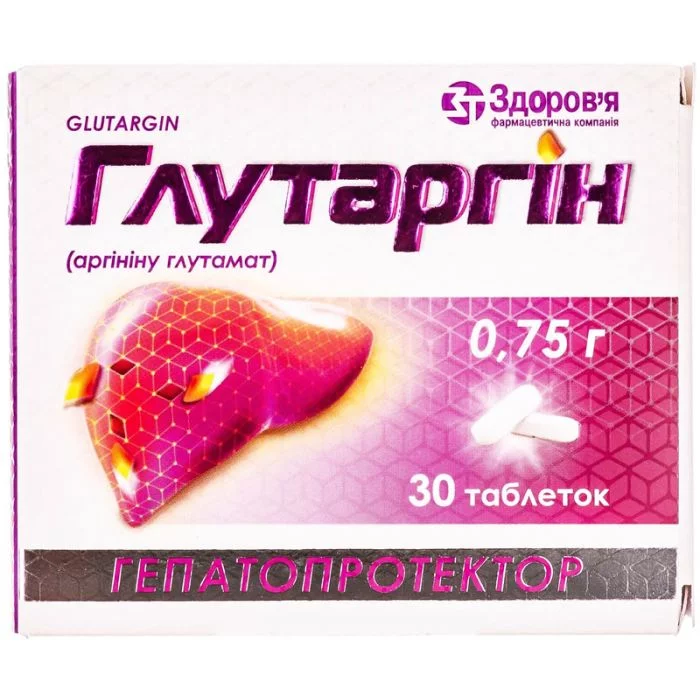
Glutargin 0.75 g, 30 tablets
Glutargin: Instructions for Use
Composition
Active ingredient: arginine glutamate;
- 1 tablet contains 250 mg (0.25 g) or 750 mg (0.75 g) of arginine glutamate;
Excipients: 250 mg dosage – microcrystalline cellulose, crospovidone, croscarmellose sodium, calcium stearate; 750 mg strength—microcrystalline cellulose, crospovidone, calcium stearate.
Dosage Form
Tablets.
Main physical and chemical properties:
- 250 mg strength – white tablets with a flat surface, a score line, and a bevel;
- 750 mg strength – white, oblong tablets with a biconvex surface and a score line.
Pharmacotherapeutic group
Drugs used in liver diseases, lipotropic agents. Hepatotropic drugs. Arginine glutamate. ATC code A05B A01.
Pharmacological Properties
Pharmacodynamics. Glutargin is a salt of arginine and glutamic acid, which play an important role in ensuring the biochemical processes of neutralization and excretion of ammonia—a highly toxic metabolite of nitrogenous substance metabolism—from the body. The drug’s hypoammonemic effects are achieved by activating the detoxification of ammonia in the ornithine urea cycle, converting ammonia into non-toxic glutamine, as well as enhancing the removal of ammonia from the central nervous system and its excretion from the body. Thanks to these properties of Glutargin, the general toxic effects of ammonia, including its neurotoxic effects, are reduced.
Glutargin also exerts a hepatoprotective effect due to its antioxidant, antihypoxic, and membrane-stabilizing properties, and positively influences energy metabolism in hepatocytes.
In cases of alcohol intoxication, Glutargin stimulates the metabolism of alcohol in the liver’s monooxygenase system and prevents the inhibition of the key enzyme involved in ethanol metabolism—alcohol dehydrogenase; accelerates the inactivation and elimination of toxic ethanol metabolites by increasing the formation and oxidation of succinic acid; reduces the inhibitory effect of alcohol on the central nervous system due to the excitatory neurotransmitter properties of glutamic acid. Thanks to these properties, Glutargin exhibits antitoxic and sobering effects.
In cases of pregnancy complications, thanks to its endothelial-protective action, Glutargin reduces impaired vascular permeability and thromboresistance, prevents hypercoagulation, and reduces vascular sensitivity to vasoconstrictors (endothelin, angiotensin, thromboxane), which cause generalized vasospasm. Arginine, after prior biotransformation into nitric oxide, exerts a vasodilatory effect and positively influences blood coagulation and the functional properties of circulating blood cells. As a result of Glutargin’s vasodilatory and antihypoxic effects, maternal-fetal hemodynamics improve, and intrauterine fetal hypoxia is reduced. In cases of pregnancy complications, the drug also exhibits antitoxic and hepatoprotective activity and acts as a nonspecific metabolic regulator of metabolic processes. Thanks to these properties of Glutargin during pregnancy, the level of immune complexes circulating in the blood decreases, the severity of “metabolic” intoxication and immunotoxicity is reduced, and the body’s compensatory and adaptive responses are enhanced.
Glutargin does not exhibit embryotoxic, gonadotoxic, mutagenic, or teratogenic effects, nor does it cause allergic or immunotoxic reactions.
Pharmacokinetics. Not studied.
Clinical characteristics.
Indications
- As part of complex therapy for acute and chronic hepatitis of various etiologies, including poisoning with hepatotoxic substances (pale toadstool, chemicals, and pharmaceuticals), and liver cirrhosis.
- Hepatic encephalopathy accompanied by hyperammonemia.
- Mild to moderate acute alcohol intoxication, hangover syndrome, and post-intoxication disorders caused by alcohol consumption.
- Complications in the third trimester of pregnancy: late gestosis, including its severe forms—preeclampsia and eclampsia; fetoplacental insufficiency; and chronic pathologies of the hepatobiliary system in pregnant women.
Contraindications for Glutarin
- Hypersensitivity to the components of the drug,
- fever,
- increased excitability,
- severe impairment of renal filtration (nitrogen excretion) function.
Interactions with Other Medications and Other Types of Interactions.
The effect of Glutargin on insulin secretion is enhanced when used concomitantly with aminophylline. Glutargin may potentiate the effect of antiplatelet agents (dipyridamole). It prevents and mitigates neurotoxic effects that may occur with the use of isoniazid. It reduces the effect of vinblastine.
Special Considerations for Use
When prescribing to patients with endocrine disorders, it should be noted that the drug stimulates the secretion of insulin and growth hormone. The drug promotes the conversion of ammonia to urea, which may naturally be accompanied by a temporary increase in blood urea levels.
Use during pregnancy or breastfeeding.
The safety of the drug’s clinical use during the first and second trimesters of pregnancy and while breastfeeding has not been studied. If use of the drug is necessary, breastfeeding should be discontinued.
Effect on reaction time when driving or operating machinery.
No effect.
Dosage and Administration of Glutargin
Administer the drug orally to adults.
Hepatitis, hyperammonemia. Administer 750 mg (3 tablets of 250 mg or 1 tablet of 750 mg) 3 times daily for 15 days, regardless of meals. If necessary, the dose and duration of treatment may be extended to 20 days. The maximum single dose is 2 g; the maximum daily dose is 8 g.
Alcohol poisoning. Prescribe 1 g (4 tablets of 250 mg each) 4 times daily at intervals of 1–2.5 hours; for the next 2–3 days, prescribe 500 mg (2 tablets of 250 mg each) 3 times daily. In cases of severe alcohol poisoning, following a course of treatment with Glutargin injections, prescribe Glutargin tablets at a dose of 750 mg (3 tablets of 250 mg each or 1 tablet of 750 mg) twice daily for 20 days. For the prevention of alcohol intoxication—2 g 60–120 minutes before alcohol consumption.
Pregnancy complications (third trimester). Prescribe 250–500 mg (1–2 tablets of 250 mg each) 2–3 times daily for 10–15 days. If necessary, a single dose may be increased to 750 mg (3 tablets of 250 mg each or 1 tablet of 750 mg); the treatment course may last up to 20 days. The maximum single dose is 750 mg; the maximum daily dose is 2.25 g.
Children. The efficacy and safety of this medication in children have not been studied; therefore, it should not be used in this age group.
Overdose
Symptoms: worsening of side effects; possible characteristic effects of glutamic acid: chest pain, atrioventricular block.
Treatment: intravenous administration of corticosteroids.
Side Effects of Glutarin
Rarely possible:
- Gastrointestinal: nausea, epigastric pain immediately after administration of the drug, which resolve spontaneously.
- Immune system: hypersensitivity reactions, including skin rashes, itching, erythema, urticaria, and angioedema.
Shelf life
5 years.
Storage conditions
Store in the original packaging at a temperature not exceeding 25 °C.
Keep out of reach of children.
Packaging
250 mg tablets, No. 10×3 and No. 10×6 in blister packs in a box, or 750 mg tablets, No. 10×3 and No. 10×5 in blister packs in a box.
Pharmacy Dispensing Category
Over-the-counter.







