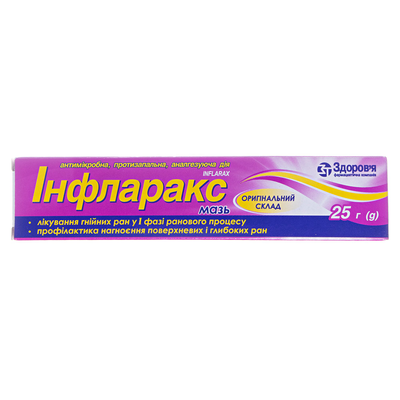
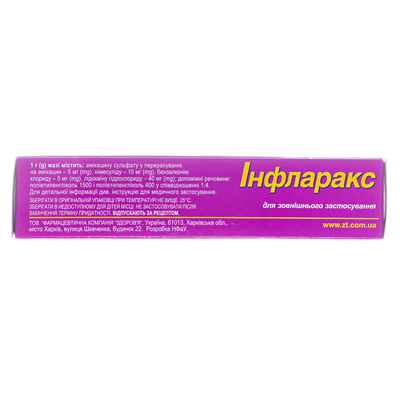
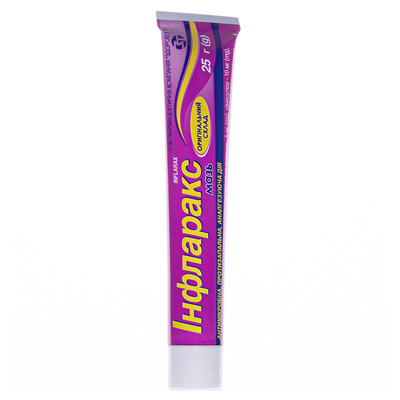
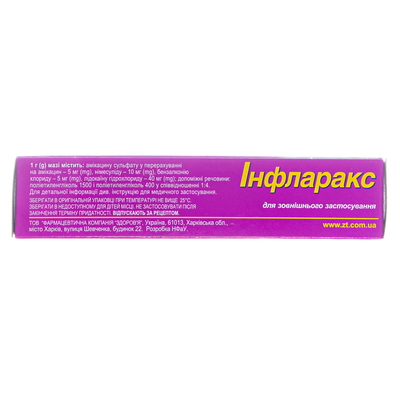
Inflarax ointment, 25 g tubes
Ingredients
active ingredients: amikacin, nimesulide, benzalkonium chloride, lidocaine;
1 g of ointment contains 5 mg of amikacin sulfate (equivalent to 5 mg of amikacin), 10 mg of nimesulide, 5 mg of benzalkonium chloride, and 40 mg of lidocaine hydrochloride;
Excipients: polyethylene glycol 1500 and polyethylene glycol 400 in a 1:4 ratio.
Dosage Form
Ointment.
Main physical and chemical properties: a yellowish-greenish ointment with a uniform consistency.
Pharmacotherapeutic group
Dermatological agents. Antibiotics and chemotherapeutic agents, combinations. ATC code D06C.
Pharmacological properties
Pharmacodynamics. The ointment has anti-inflammatory, analgesic, and antimicrobial effects.
- – A semisynthetic, broad-spectrum aminoglycoside antibiotic. It exerts a bactericidal effect. By actively penetrating the bacterial cell membrane, it irreversibly binds to the 30S subunit of bacterial ribosomes, thereby inhibiting protein synthesis in the pathogen.
- Against aerobic Gram-negative bacteria: Pseudomonas aeruginosa, Escherichia coli, Shigella spp., Salmonella spp., Klebsiella spp., Enterobacter spp., Serratia spp., Providencia stuartii.
- It is also active against certain Gram-positive bacteria: Staphylococcus spp. (including strains resistant to penicillin, methicillin, and certain cephalosporins), and certain strains of Streptococcus spp.
- and against anaerobic bacteria.
Benzalkonium chloride has a broad spectrum of antimicrobial activity against Gram-positive and Gram-negative microorganisms, including staphylococci, Pseudomonas aeruginosa, and Escherichia coli. Its mechanism of action is based on its binding to ribosomes, which leads to irreversible inhibition of protein synthesis; it also binds to the cytoplasmic membranes of bacteria, disrupting their permeability, causing the cell to lose potassium ions, amino acids, and nucleotides.
Nimesulide has anti-inflammatory (it suppresses the inflammatory phase by reducing the activity of inflammatory mediators, which helps decrease the permeability of the vascular wall) and analgesic effects (a reduction in tissue edema is accompanied by a decrease in pain sensations).
- It inhibits sensitive nerve endings in the skin and mucous membranes, that is, it causes reversible inhibition of the conductivity of the tissue components of nerve cells (neurons, axons, synapses). Lidocaine inhibits the stimulus-induced transient increase in sodium ion permeability and, to a lesser extent, reduces the passive permeability of potassium and sodium ions, thereby stabilizing neuronal membranes. Lidocaine reduces the degree of depolarization that occurs in response to a physiological stimulus, as well as the amplitude of the action potential, and inhibits nerve conduction. When absorbed following topical application, lidocaine may cause either excitation or depression of the central nervous system (CNS). Its effects on the cardiovascular system may manifest as conduction disturbances and peripheral vasodilation.
The water-soluble base of the ointment—polyethylene oxide—enhances and prolongs its antibacterial and anti-inflammatory effects and exerts a pronounced and prolonged osmotic effect. Consequently, application of the ointment eliminates perifocal edema and clears the wound of purulent-necrotic contents. Therapeutic activity persists for 20–24 hours.
Pharmacokinetics. Not studied.
There are no data on the topical application of amikacin. In the event of absorption following topical application, it can be expected that amikacin will be evenly distributed in extracellular fluids (abscess contents, pleural effusion, ascitic, pericardial, synovial, lymphatic, and peritoneal fluids); it is found in high concentrations in urine; at low concentrations—in bile, breast milk, aqueous humor, bronchial secretions, sputum, and cerebrospinal fluid. It readily penetrates all body tissues, where it accumulates intracellularly. High concentrations are found in organs with a rich blood supply: the lungs, liver, myocardium, spleen, and especially in the renal cortex; lower concentrations are found in muscles, adipose tissue, and bones. In adults, when administered at average therapeutic doses (within the normal range), amikacin does not cross the blood-brain barrier. Amikacin crosses the placental barrier: it is detected in fetal blood and amniotic fluid. It is not metabolized. It is excreted by the kidneys via glomerular filtration (65–94%), primarily in its unchanged form. It is removed during hemodialysis and peritoneal dialysis.
After topical application, lidocaine penetrates the tissues and exerts a local anesthetic effect. Lidocaine is rapidly absorbed when applied to mucous membranes and affected skin, but is poorly absorbed when applied to healthy skin. The rate of absorption and the amount of active ingredient that enters the bloodstream depend on the dose, the type, size, and condition of the surface to which the drug is applied (skin or mucous membrane), as well as the duration of exposure. It is metabolized in the liver. It is first dealkylated and then hydrolyzed. Both the unchanged drug and its metabolites are excreted primarily by the kidneys.
Indications
In surgical practice, the drug is used to treat purulent wounds in the first (purulent-necrotic) phase of the wound healing process, to prevent suppuration of superficial and deep wounds, for postoperative complications (postoperative wound suppuration, phlegmon, fistula, abscess); in burn care—for the prevention and treatment of suppuration in burn wounds; in dermatology—for the treatment of purulent-inflammatory skin diseases (pyoderma).
Contraindications
Hypersensitivity to any of the drug’s components or amide-type local anesthetics; psoriasis; eczema; fungal skin infections. Do not use in patients in whom acetylsalicylic acid or other drugs that inhibit prostaglandin synthesis cause allergic reactions, such as rhinitis, urticaria, or bronchospasm.
Interactions with Other Medications and Other Types of Interactions
When the drug is applied topically, no interactions with other medications have been established. However, it should be noted that when used in combination, amikacin may potentiate the effects of carbenicillin, benzylpenicillin, and cephalosporins; nimesulide may enhance the effects of sulfonamides and anticoagulants; lidocaine may enhance the effects of novocaine and bupivacaine.
Use caution when prescribing this medication concurrently with anticoagulants, digoxin, phenytoin, lithium preparations, diuretics, antihypertensive drugs, nonsteroidal anti-inflammatory drugs (NSAIDs), cyclosporine, methotrexate, oral hypoglycemic agents, and antiarrhythmic drugs. Concomitant topical use of multiple NSAIDs may lead to local irritation, such as hives, skin redness, or peeling.
Glucocorticoids and antirheumatic agents (gold compounds, aminoquinolones) enhance the anti-inflammatory effect of nimesulide.
Benzalkonium chloride is chemically incompatible with soaps and other anionic surfactants, as well as with iodine-containing preparations. Nonionic surfactants reduce or eliminate the antimicrobial effect of benzalkonium chloride.
Special Instructions for Use
The medication should be applied only to damaged areas of the skin; avoid contact with intact skin, the eyes, and mucous membranes.
- It should not be used in patients with known hypersensitivity to NSAIDs. If hypersensitivity reactions develop, treatment should be discontinued.
- Photosensitivity reactions may develop during treatment with this medication.
- Use the medication with caution and under a doctor’s supervision in elderly patients with impaired kidney or liver function, congestive heart failure, hematopoietic disorders, gastroduodenal bleeding, active peptic ulcers, or severe coagulation disorders.
Use During Pregnancy or Breastfeeding
The safety of this medication during pregnancy or breastfeeding has not been established.
Effect on reaction time when driving or operating machinery
Unknown.
Dosage and Administration
Apply a thin layer of the ointment to the affected areas 1–2 times daily, or soak sterile gauze pads with the ointment and apply them to the wound. The required amount of the drug is determined by the area of the wound surface and the degree of purulent exudation. The ointment should cover the entire affected area.
When treating purulent wounds or purulent-inflammatory skin conditions, apply the ointment daily.
For the treatment of burns—daily or 2–3 times a week, depending on the amount of purulent discharge.
The duration of treatment is determined on an individual basis, depending on the effectiveness of therapy and the size of the lesion. Dressings with the ointment should be applied until the wound is completely cleared of the purulent-necrotic process.
Children
The safety and efficacy of this medication in children have not been established.
Overdose
Due to the minimal absorption of the drug through the mucous membranes and skin, overdose is unlikely; but when the ointment is applied to large areas of the lesion, when the recommended doses are exceeded, or with prolonged use of the ointment, systemic side effects characteristic of amikacin, nimesulide, and lidocaine may occur (see the “Adverse Reactions” section).
In case of overdose, discontinue use of the medication. Treatment is symptomatic.
Side Effects
Allergic and local irritant reactions (including skin rashes, itching, peeling, swelling, burning, and erythema), photosensitivity reactions; rarely, in sensitive patients, anaphylactic reactions may occur, such as angioedema, vasomotor rhinitis, dyspnea, or bronchospasm.
When the drug is used as directed, the incidence of systemic effects is extremely low, since the amount of active ingredient that can enter the bloodstream is very small. When high doses are used, in cases of rapid absorption of lidocaine, or in cases of hypersensitivity, idiosyncrasy, or reduced tolerance, adverse reactions characteristic of amide-type local anesthetics when administered systemically may develop.
Shelf life
2 years.
Storage conditions
Store in the original packaging at a temperature not exceeding 25 °C.
Keep out of reach of children.
Packaging
15 g, 25 g, 50 g, or 100 g in a tube inside a box.
Dispensing Category
By prescription only.