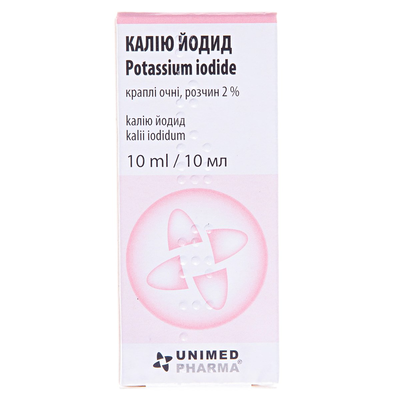
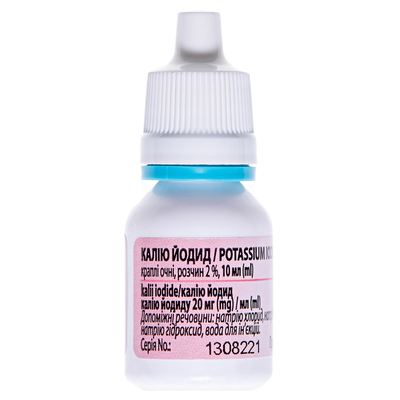
Potassium iodide eye drops, 2% solution, 10 ml per bottle.
Ingredients
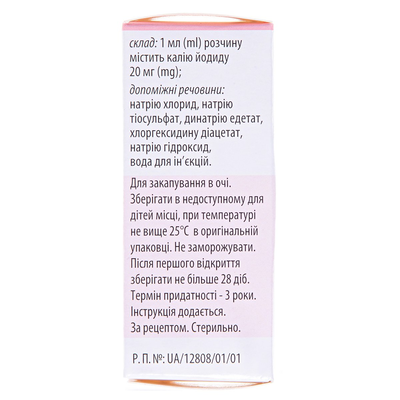
Active ingredient: potassium iodide;
1 mL of solution contains 20 mg of potassium iodide;
excipients: sodium chloride, sodium thiosulfate, disodium edetate, chlorhexidine diacetate, sodium hydroxide, water for injection.
Dosage Form
Eye drops, solution.
Main physical and chemical properties: a clear, colorless solution free of mechanical impurities.
Pharmacotherapeutic group
Agents used in ophthalmology. ATC code S01X A04.
Pharmacological properties
Pharmacodynamics.
Potassium iodide 2% is an ophthalmic, antisclerotic, and resorptive medication. The active ingredient in these iodine drops is iodine, present in microdoses. As a result, the drug activates metabolic processes and affects protein and lipid metabolism, thereby increasing the levels of lipoproteins in the blood and fibrinolytic activity. Iodine ions cause an increase in colloidal dispersibility, which leads to a decrease in blood viscosity. Reduced colloidal dispersibility correlates with signs of aging and atherosclerosis. These results, combined with extensive experience using iodine in clinical practice, indicate that iodine salts prevent the development of atherosclerotic processes or reduce their severity. The effect of iodine ions on colloids is associated with the dilation of blood vessels, which leads to increased tissue perfusion.
The use of eye drops containing iodine is the only treatment option when direct access to the site of the disease is not possible or when the affected area is inaccessible. Iodine compounds have a direct effect on the resorption process, particularly in newly diagnosed cases of the disease. In the case of senile cataracts that have already developed, it is unlikely that the process can be halted; however, its progression (cataract growth, decreased visual acuity) can be slowed through the use of iodides.
Pharmacokinetics.
After instillation into the conjunctival sac, iodides penetrate the structures of the eye; however, detailed information regarding the distribution of iodides within the eye’s structures is not available. When instilled into the conjunctival sac, a portion of the iodides is absorbed into the systemic circulation. They travel to the nose via the nasolacrimal duct and are absorbed into the systemic circulation through the nasal mucosa.
Iodine is excreted from the body very slowly. Potassium iodide (an inorganic ionic compound) is not metabolized. The corresponding ions (K+, I-) are excreted by the kidneys.
Indications
To support resorption processes in the eyes, particularly in cases of inflammatory exudates, hemorrhage, and vitreous opacities of various etiologies (age, high blood pressure, diabetes mellitus), in cases of myopic and atherosclerotic changes in the retinal and choroidal vessels, degenerative processes of the retina, early-stage cataracts, optic nerve atrophy (due to syphilis), as well as an adjunctive treatment for fungal conjunctivitis and keratitis.
Contraindications
- Hypersensitivity to the active ingredient or other components of the drug;
- Chronic facial pyoderma, hemorrhagic diathesis, and thyroid dysfunction.
Interactions with Other Medications and Other Types of Interactions
Since a portion of the iodine and iodides is absorbed into the systemic circulation through the nasal mucosa following topical administration into the conjunctival sac (they enter the nose via the nasolacrimal duct), possible interactions with other medications the patient is taking should be considered.
Long-term use may affect laboratory measurements of protein-bound iodine in serum or the results of tests using radioactive iodine, which are performed for thyroid disorders.
Special Considerations for Use
For fungal infections of the anterior segment of the eye, specific targeted therapy should be used (iodine therapy is only an adjunctive treatment).
Patients should not wear soft contact lenses while using this medication. Also, rigid contact lenses should not be worn during treatment; at the very least, patients must always remove them before using the medication and wait at least 20 minutes after instilling the drops before putting them back in.
Use during pregnancy or breastfeeding.
Contraindicated.
Effect on reaction time when driving or operating machinery.
There is no information regarding the drug’s adverse effects on the ability to perform tasks requiring high attention (driving or operating machinery). However, blurred vision may occur immediately after administration of the medication; therefore, it is recommended to refrain from such activities for 15 minutes after use.
Dosage and Administration
Method of administration: instill into the lower conjunctival sac of the eye.
Recommended dose for adults (including the elderly) and children.
The dose and duration of treatment are determined by the doctor. The usual dose is 1–2 drops 2–4 times a day.
As with any eye drop solution, it is recommended to gently press on the area of the lacrimal sac located at the inner corner of the eye to reduce potential systemic absorption and release the pressure one minute after instillation. This should be done immediately after administering each drop.
Remove contact lenses before using the eye drops; they may be reinserted after 20 minutes.
If more than one topical ophthalmic medication is being used, the interval between applications of different medications should be at least 5 minutes.
Children.
This medication should not be used in newborns.
Overdose
No cases of overdose have been observed when used at the recommended doses. If a child accidentally swallows the medication, provide symptomatic treatment.
Side Effects
The drug is generally well tolerated.
Adverse reactions are classified according to their frequency of occurrence: very common (1/10), common (1/100 to < 1/10), very rare (< 1/10,000).
Very common: In patients with thyroid disorders, an adverse effect on thyroid function may occur.
Common: A mild burning sensation may be felt immediately after administration.
Very rare: Iodine is excreted from the body very slowly; therefore, long-term and uncontrolled use (in excessive doses) may cause a condition known as iodism in susceptible patients. Symptoms of this condition include irritation and hyperemia of the conjunctiva, increased tear production, and swelling of the eyelids (angioedema) and lacrimal gland. Erythema, acne, dermatitis, and purpura may appear on the skin, as well as hypersensitivity reactions, including rashes and itching.
Shelf life
3 years.
The shelf life of the product after the first opening of the vial is 28 days.
Storage Conditions
Store out of the reach of children, at a temperature not exceeding 25 °C, in the original packaging. Do not freeze. Store for no more than 28 days after first opening.
Packaging
10 mL in a plastic dropper container, sealed with a tamper-evident cap.
One dropper container, along with the prescribing information, in a cardboard box.
Dispensing Category
By prescription only.
Manufacturer
UNIMED PHARMA Ltd.