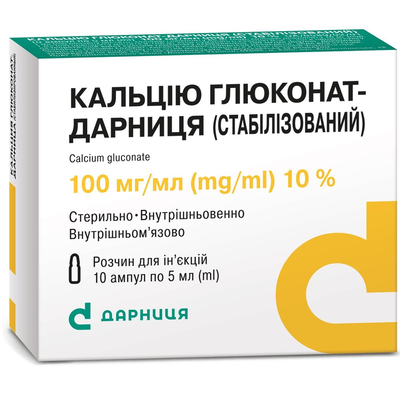
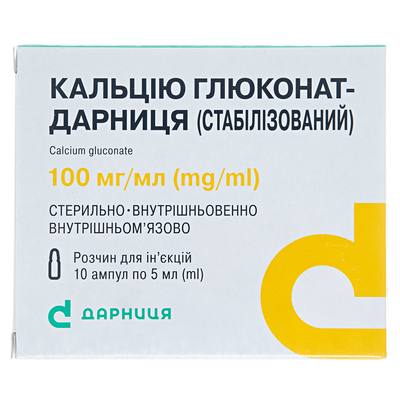
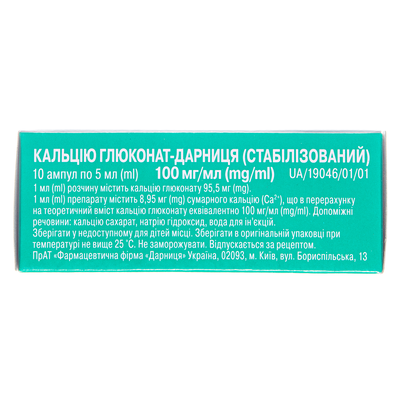
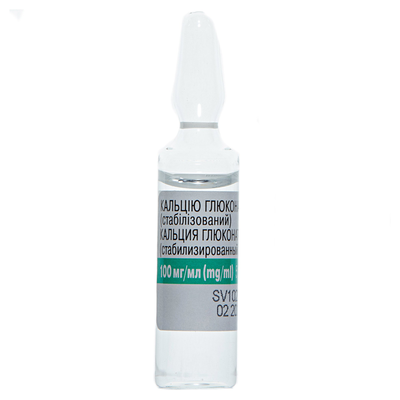
Calcium Gluconate-Darnitsa (stabilized) solution for injection, 100 mg/mL, 5 mL, No. 10 in ampoules
Ingredients
Active ingredient: calcium gluconate;
1 mL of solution contains: 85 mg of calcium gluconate, 10 mg of calcium levulinate;
excipients: calcium saccharate, diluted hydrochloric acid, water for injection.
1 mL of the preparation contains 9.706 mg of total calcium (Ca2+), which, when converted to the theoretical calcium gluconate content, is equivalent to 100 mg/mL.
Dosage Form
Solution for injection.
Main physical and chemical properties: clear, colorless liquid.
Pharmacotherapeutic group
Calcium preparations. ATC code A12A A03.
Pharmacological properties
Pharmacodynamics.
Calcium gluconate (stabilized) is an agent that regulates metabolic processes, replenishes calcium deficiency in the body, exerts hemostatic and antiallergic effects, and reduces capillary permeability.
Calcium ions are involved in the transmission of nerve impulses, the contraction of smooth and striated muscles, myocardial function, and blood clotting; they are essential for bone formation and the functioning of other systems and organs. The concentration of calcium ions in the blood decreases in many pathological processes; severe hypocalcemia contributes to the onset of tetany. In addition to correcting hypocalcemia, calcium compounds reduce vascular permeability and exert antiallergic, anti-inflammatory, and hemostatic effects.
Pharmacokinetics.
After parenteral administration, the drug is evenly distributed throughout all tissues and organs. In blood plasma, calcium is present in an ionized state. It crosses the placental barrier and is excreted into breast milk. It is eliminated from the body primarily by the kidneys.
Indications
Hypoparathyroidism; increased calcium excretion from the body (particularly during prolonged dehydration); as an adjunct in the treatment of allergic diseases (serum sickness, urticaria, angioedema) and allergic complications of drug therapy; to reduce vascular permeability in pathological processes of any origin (exudative phase of the inflammatory process, hemorrhagic vasculitis, radiation sickness); parenchymal hepatitis; toxic liver damage; nephritis; eclampsia; hyperkalemia; the hyperkalemic form of paroxysmal myoplegia; skin diseases (pruritus, eczema, psoriasis); as a hemostatic agent; as an antidote for poisoning with magnesium salts, oxalic acid or its soluble salts, and soluble salts of hydrofluoric acid.
Contraindications
Hypersensitivity to the components of the drug; predisposition to thrombosis; hypercalcemia; severe hypercalciuria; severe atherosclerosis; increased blood clotting; severe renal insufficiency; sarcoidosis; concomitant use with cardiac glycosides or ceftriaxone.
Interactions with Other Medications and Other Types of Interactions
When ethyl alcohol interacts with calcium gluconate, the latter precipitates.
Concomitant use with other calcium-containing medications is not recommended.
Intravenous administration of calcium gluconate before and after verapamil administration reduces its antihypertensive effect but does not affect its antiarrhythmic effect.
Combination with thiazide diuretics may lead to the development of hypercalcemia.
When used concomitantly with quinidine, intraventricular conduction may be slowed and quinidine toxicity may increase.
During treatment with cardiac glycosides, parenteral administration of calcium gluconate is not recommended due to the potential for increased cardiotoxicity.
Calcium gluconate reverses the inhibition of neuromuscular transmission caused by the use of aminoglycoside antibiotics.
When used concomitantly with phenygidine, calcium preparations reduce its efficacy.
Special Considerations for Use
Calcium salts should be used with caution in patients with impaired renal function or heart disease.
When administered to patients receiving cardiac glycosides and/or diuretics, as well as during long-term treatment, blood calcium and creatinine levels should be monitored, especially in children. If these levels rise, the dose of the medication should be reduced or its use temporarily discontinued.
Use with caution and under regular monitoring of urinary calcium excretion in patients with moderate hypercalciuria exceeding 300 mg/day (7.5 mmol/day), mild renal impairment, or a history of urolithiasis. If necessary, the dose of the drug should be reduced or the drug discontinued. Patients prone to the formation of stones in the urinary tract are advised to increase their fluid intake during treatment.
Blood calcium levels and calcium excretion should be monitored, especially in children, patients with chronic renal insufficiency, or nephrolithiasis. If the plasma calcium level exceeds 2.75 mmol/L or daily urinary calcium excretion exceeds 5 mg/kg, treatment must be discontinued immediately due to the risk of cardiac arrhythmias.
Before filling the syringe with calcium gluconate solution, ensure that it contains no residual ethyl alcohol, as calcium gluconate precipitates upon contact with alcohol.
Serious complications, including fatal ones, have occurred following the microcrystallization of insoluble calcium salts in the body after the separate administration of physically incompatible solutions or total parenteral nutrition solutions containing calcium and phosphates.
Cases of fatal reactions due to the formation of ceftriaxone-calcium precipitates in the lungs and kidneys of preterm and full-term newborns up to 1 month of age have been reported.
Scientific publications report cases of intravascular precipitate formation in patients, other than newborns, who were treated with ceftriaxone and calcium-containing solutions or any other calcium-containing products, in patients of any age. In vitro studies have shown that newborns are at increased risk of ceftriaxone-calcium precipitation compared to other age groups.
Ceftriaxone should not be mixed or administered simultaneously with calcium-containing intravenous solutions.
However, in patients 28 days of age or older, ceftriaxone and calcium-containing solutions may be administered sequentially, one after the other, provided that the infusion is administered at different sites or that the infusion set is replaced to prevent precipitation.
Use During Pregnancy or Breastfeeding.
Use of the drug during pregnancy or breastfeeding is possible provided that the benefit to the mother is weighed against the risk to the fetus (infant). Calcium passes into breast milk, which must be taken into account when administering the drug to women who are breastfeeding.
Effect on reaction time when driving or operating machinery.
There are no data on the drug’s adverse effects on reaction time when driving or operating machinery.
Dosage and Administration
Administer intravenously or intramuscularly.
Warm the ampoule containing the solution to body temperature before administration. Administer the solution slowly, over 2–3 minutes.
Adults and children 14 years of age and older are administered 5–10 mL of “Calcium Gluconate-Darnitsa (stabilized)” daily or every 1–2 days, depending on the course of the disease and the patient’s condition.
For children, administration is intravenous only; depending on age, a 10% calcium gluconate solution is administered in the following doses: up to 6 months of age—0.1–1 mL, 6–12 months—1–1.5 mL, 1–3 years—1.5–2 mL, 4–6 years—2–2.5 mL, 7–14 years—3–5 mL.
To administer a solution in a volume of less than 1 mL, the single dose of the drug is diluted to the appropriate volume (syringe volume) with a 0.9% sodium chloride solution or a 5% glucose solution.
Children.
Intramuscular administration of the drug is not recommended for children under 14 years of age due to the risk of necrosis.
Overdose
Symptoms: Hypercalcemia may develop. Symptoms of hypercalcemia may include anorexia, nausea, vomiting, constipation, abdominal pain, muscle weakness, polydipsia, polyuria, mental disorders, nephrocalcinosis, nephrolithiasis, and, in severe cases, cardiac arrhythmias and coma.
Treatment: In cases of mild overdose (serum calcium concentration of 2.6–2.9 mmol/L), administration should be discontinued and other calcium-containing medications withdrawn. In cases of severe overdose (serum calcium concentration > 2.9 mmol/L), calcitonin is administered parenterally at a dose of 5–10 IU/kg of body weight per day (diluted in 500 mL of 0.9% sodium chloride solution) via intravenous infusion over 6 hours. Slow intravenous bolus administration 2–4 times daily is also possible. Non-thiazide diuretics are used; serum potassium and magnesium levels are monitored, and potassium and magnesium supplements are administered as needed; Cardiovascular function is monitored, and beta-blockers are administered to prevent arrhythmias. Hemodialysis is performed if necessary.
Side Effects
Rapid administration may cause nausea, vomiting, sweating, a sensation of heaviness in the head, syncope, general weakness, hypotension, and vasomotor collapse, which can sometimes be fatal. Occasionally, diarrhea, bradycardia, and a sensation of heat in the mouth—and subsequently throughout the body—may occur; these symptoms resolve rapidly on their own. Soft tissue calcification may result from extravasation of the calcium solution. Intramuscular injections of calcium salts may cause local irritation.
Allergic and anaphylactic reactions, including anaphylactic shock, are very rare.
Shelf life
3 years.
Storage conditions
Store in the original packaging at a temperature not exceeding 25 °C. Do not freeze.
Keep out of reach of children.
Incompatibility
Pharmaceutically incompatible with ethyl alcohol, oxidizing agents, citric acid, carbonates, bicarbonates, phosphates, salicylates, sulfates, and tartrates.
Physically incompatible with amphotericin, cephalothin solution, cefamandole, ceftriaxone, novobiocin sodium, dobutamine hydrochloride, prochlorperazine, and tetracycline.
Packaging
5 mL per ampoule; 5 ampoules per blister pack; 2 blister packs per carton; 10 mL per ampoule; 5 ampoules per blister pack; 1 or 2 blister packs per package.
Dispensing Category
By prescription.
Manufacturer
PJSC “Pharmaceutical Company “Darnitsa.”