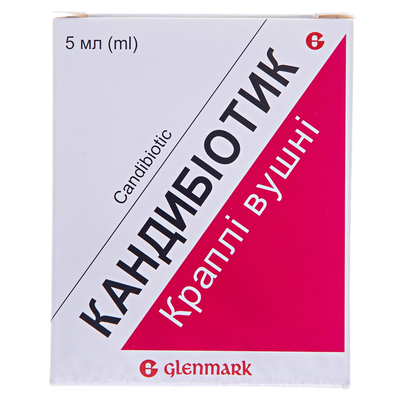
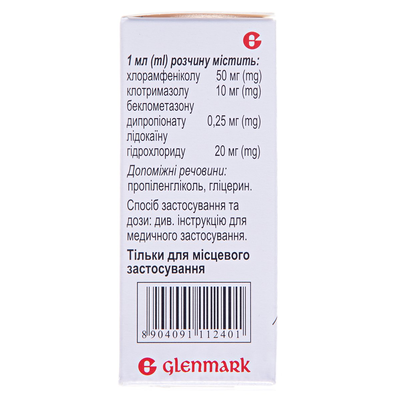
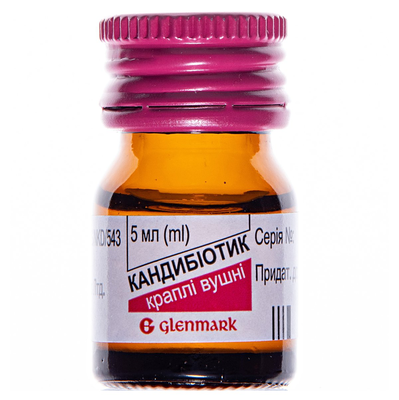
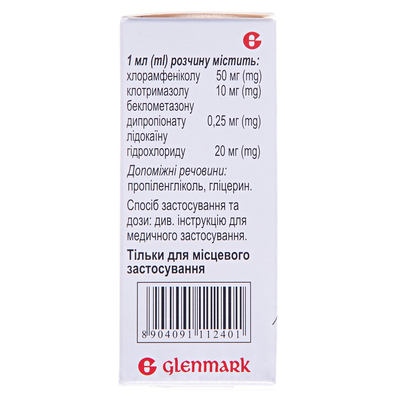
Kandibiotic ear drops, 5 ml per bottle
Composition
Active ingredients: chloramphenicol, clotrimazole, beclomethasone dipropionate, lidocaine hydrochloride;
1 mL of solution contains 50 mg of chloramphenicol, 10 mg of clotrimazole, 0.25 mg of beclomethasone dipropionate, and 20 mg of lidocaine hydrochloride;
Excipients: glycerin, propylene glycol.
Dosage Form
Ear drops.
Main physicochemical properties: a clear, light-yellow liquid.
Pharmacotherapeutic group
Drugs used in otology. Combination drugs containing corticosteroids and antimicrobial agents.
ATC code S02C A.
Pharmacological properties
Pharmacodynamics. A combination drug for external use with antimicrobial, anti-inflammatory, and local anesthetic properties. The pharmacological action of Kandibiotic is due to the properties of levomycetin, clotrimazole, beclomethasone dipropionate, and lidocaine, which are part of its composition. Levomycetin is an amphenicol derivative. It possesses a broad spectrum of antimicrobial activity. The effect of levomycetin on microorganisms is associated with its ability to influence protein synthesis in bacterial cells. As a rule, it acts bacteriostatically against a broad spectrum of Gram-positive and Gram-negative bacteria. Levomycetin is also effective against anaerobic flora.
Clotrimazole is chemically related to imidazole derivatives. Dermatophytes, yeasts (the genus Candida, Torulopsis glabrata, Rhodotorula), molds, as well as the causative agents of pityriasis versicolor and erythrasma. In addition, clotrimazole exerts antimicrobial activity against Gram-positive (staphylococci, streptococci) and Gram-negative bacteria (Bacteroides, Gardnerella vaginalis), as well as against Trichomonas vaginalis, Malassezia furfur, and Corinebacterium minimus. The mechanism of action of clotrimazole is associated with the inhibition of ergosterol synthesis, a component of the fungal cell membrane; this results in changes to the structure and properties of the membranes, leading to cell lysis.
Beclomethasone dipropionate, a synthetic analogue of adrenal hormones, has anti-inflammatory, anti-allergic, anti-exudative, and antipruritic effects.
Lidocaine is a local anesthetic that reduces the perception and transmission of impulses along sensory nerve fibers at the site of action. The effect is reversible.
Pharmacokinetics. No specific pharmacokinetic studies of the drug have been conducted.
Indications
Allergic and inflammatory diseases of the outer and middle ear; otorrhea; infectious diseases of the outer and middle ear caused by microorganisms sensitive to the drug. Surgical procedures on the mastoid process.
Contraindications
Hypersensitivity to the drug’s components or to other amide-type local anesthetics.
Chickenpox, herpes simplex, or herpes zoster; perforation of the eardrum.
Drug Interactions and Other Interactions
None reported. Given the low transdermal absorption of the drug’s individual active ingredients, drug interactions with concomitant systemic medications are considered unlikely.
Special Instructions for Use
This medication is intended for topical use in the ear only.
Use of the drug should be discontinued if signs of hypersensitivity to any of the drug’s components appear.
Candibiotic should not be used for long-term treatment.
To ensure aseptic conditions and prevent bacterial contamination, do not allow the pipette tip to come into contact with any surfaces (including the surface of the ear).
If Candibiotic is accidentally swallowed, consult a doctor.
Ear preparations containing levomycetin are not recommended for patients with a perforated eardrum due to the high risk of ototoxicity.
Candibiotic ear drops should be used with caution in patients with a history of allergic reactions to other topical or oral corticosteroids due to an increased risk of hypersensitivity.
In children, topical corticosteroids may be absorbed in proportionally larger amounts, which increases the likelihood of systemic toxicity.
Systemic absorption of topical corticosteroids results in reversible suppression of the hypothalamic-pituitary-adrenal (HPA) axis. Clinical symptoms include Cushing’s syndrome, hyperglycemia, and glucosuria. Such adverse reactions may occur more frequently with the use of more potent steroids, application to a large body surface area, long-term therapy, concurrent use of occlusive dressings, as well as in patients with hepatic insufficiency. After discontinuation of the drug, HPA axis function recovers rapidly and completely. In rare cases, steroid withdrawal symptoms may occur, which may require the use of additional systemic corticosteroids.
Patients prescribed topical corticosteroids should use the medication strictly as directed by their physician, exclusively for the treatment of the condition for which it was prescribed, and for no longer than the duration prescribed by the physician.
This medication should be used with caution in patients receiving concomitant systemic antifungal therapy; patients with diabetes mellitus; patients with a history of immunosuppression; and immunocompromised patients.
The development of blood dyscrasias, including aplastic anemia, may be associated with the use of chloramphenicol. During long-term or intermittent therapy, appropriate blood tests should be performed on the patient.
Prolonged or frequent intermittent use of topically applied chloramphenicol preparations should be avoided due to the possibility of hypersensitivity reactions, including bone marrow hypoplasia.
Levomycetin is considered unsafe for use in patients with acute porphyria.
In some cases, bacterial resistance to clotrimazole has been observed.
Avoid contact with the eyes.
Visual disturbances may occur with the use of systemic and topical corticosteroids. If a patient experiences symptoms such as blurred vision or other visual disturbances, they should be referred to an ophthalmologist to evaluate possible causes, which may include cataracts, glaucoma, or rare conditions such as central serous chorioretinopathy, which have been reported following the use of systemic and topical corticosteroids.
Pregnancy and lactation.
Although clinical and experimental studies have not shown any adverse effects on the health of the mother or fetus, the drug should not be used during pregnancy or lactation.
Effects on the ability to drive and operate machinery.
It has no effect.
Directions for Use and Dosage
For topical use.
For adults and children over 12 years of age, instill 3–4 drops of the medication into the ear canal 3–4 times a day.
The course of treatment, which is determined on an individual basis depending on the severity and course of the disease, averages 5–7 days.
For children aged 2 to 12 years: 2 drops 4 times a day. The course of treatment is 5 days.
To use the medication, tilt your head, instill the required number of drops into the ear, and keep your head tilted for a short time to ensure the medication penetrates the ear canal.
Children.
The medication is indicated for children over 2 years of age.
Overdose
None reported.
Side Effects
Allergic reactions may occur, including itching, burning, and tingling at the injection site; erythema, urticaria, edema, contact dermatitis, and blurred vision (see the “Special Instructions and Precautions for Use” section).
Shelf Life
2 years.
Storage Conditions
Store out of the reach of children, in a dry place protected from light, at a temperature not exceeding 25 °C.
Packaging
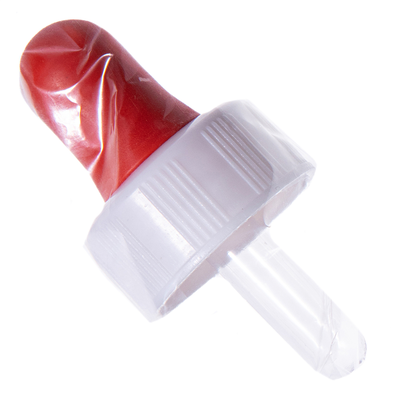
5 mL in a vial with a pipette cap, enclosed in a plastic bag, inside a cardboard box.