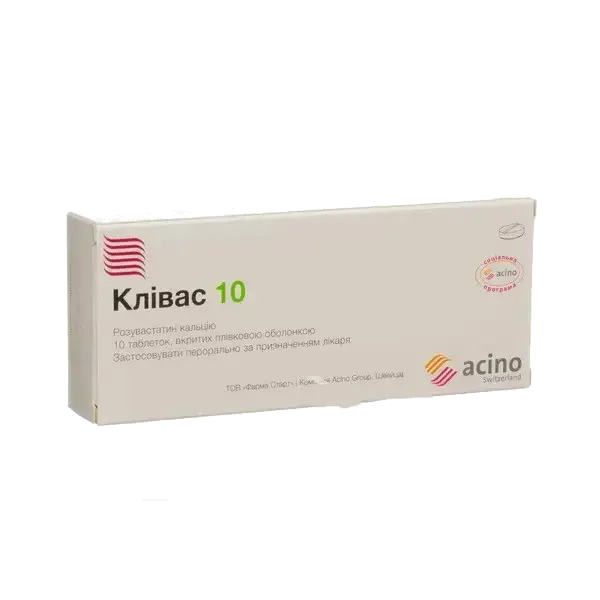
Klivas 10 film-coated tablets, 10 mg, blister pack No. 10
Ingredients:
active ingredient: rosuvastatin;
1 tablet contains 10.4 mg of rosuvastatin calcium (equivalent to 10 mg of rosuvastatin) or 20.8 mg of rosuvastatin calcium (equivalent to 20 mg of rosuvastatin);
excipients: mannitol (E 421), sodium croscarmellose, magnesium hydroxide, calcium carbonate, anhydrous sodium carbonate, silicon dioxide (colloidal hydrophobic), colloidal aqueous silicon dioxide, magnesium stearate; film-coating mixture: red iron oxide (E 172), yellow iron oxide (E 172), black iron oxide (E 172), polyethylene glycol, polyvinyl alcohol, talc, titanium dioxide (E 171).
Dosage form.
Film-coated tablets.
Pharmacotherapeutic group.
Lipid-lowering agents. HMG-CoA reductase inhibitors. ATC code C10A07.
Clinical characteristics.
Indications
.
Adults
Treatment of hypercholesterolemia
Primary hypercholesterolemia (type IIa, including heterozygous familial hypercholesterolemia) or mixed dyslipidemia (type IIb), as an adjunct to diet when the effectiveness of diet or other non-pharmacological measures (such as exercise, weight loss) is insufficient.
Homozygous familial hypercholesterolemia as an adjunct to diet and other lipid-lowering therapies (e.g., LDL apheresis) or in cases where such therapies are not appropriate.
Prevention of cardiovascular events
Clivas is indicated to reduce the risk of serious cardiovascular events in adult patients at increased risk of atherosclerotic cardiovascular disease, as evidenced by the presence of risk factors such as age, hypertension, low HDL-cholesterol levels, elevated C-reactive protein levels, smoking, or a family history of early-onset ischemic heart disease.
Treatment of Atherosclerosis
To slow or delay the progression of the disease in patients for whom lipid-lowering therapy is indicated.
Children and adolescents (ages 10 to 17: boys—Stage II or higher on the Tanner scale; girls—at least one year after the first menstrual period).
Treatment of primary hypercholesterolemia (type IIa) or mixed dyslipidemia (type IIb) resulting from heterozygous familial hypercholesterolemia, as an adjunct to diet, when the effectiveness of diet or other non-pharmacological methods (physical exercise, weight loss) is insufficient.
Contraindications.
- Hypersensitivity to rosuvastatin or any excipient;
- active liver disease, including that of unknown etiology; persistently elevated serum transaminase levels; or an increase in any transaminase level to more than three times the upper limit of normal (ULN);
- Severe renal impairment (creatinine clearance <30 mL/min);
- myopathy;
- concomitant use of cyclosporine;
- pregnancy and breastfeeding;
- Women of childbearing age must use adequate contraception.
The 40-mg dose is contraindicated in patients with risk factors for myopathy or rhabdomyolysis. These risk factors include:
- moderate renal impairment (creatinine clearance <60 mL/min);
- hypothyroidism;
- a personal or family history of hereditary muscle diseases;
- a history of myotoxicity caused by other HMG-CoA reductase inhibitors or fibrates;
- alcohol abuse;
- conditions that may lead to increased plasma levels of the drug;
- patients of Mongoloid descent;
- concomitant use of fibrates.
Dosage and Administration.
Before starting treatment, the patient should be placed on a standard cholesterol-lowering diet, which should be followed throughout the course of treatment. The dose should be individualized based on the treatment goal and response, taking current guidelines into account.
Klivas can be taken at any time of day, regardless of meals.
The tablet should not be chewed but may be split. Take with water.
Treatment of Hypercholesterolemia
The recommended starting dose is 5 or 10 mg orally once daily for both patients who have not previously taken statins and those who have previously taken other HMG-CoA reductase inhibitors. When selecting the starting dose, consider the patient’s individual cholesterol level, potential cardiovascular risk, and the potential risk of adverse reactions (see below). If necessary, the dose may be increased after 4 weeks. Since adverse reactions occur more frequently with a 40-mg dose than with lower doses, the dose should be titrated to the maximum level of 40 mg only in patients with severe hypercholesterolemia and high cardiovascular risk (particularly patients with familial hypercholesterolemia) who have not achieved the desired result with a 20 mg dose and who must be under regular medical supervision. Specialist monitoring is recommended when initiating treatment with a 40 mg dose.
Prevention of cardiovascular events
In the study evaluating the reduction in the risk of cardiovascular complications, the daily dose of the drug was 20 mg. Patients with hypercholesterolemia should undergo standard lipid profile testing and follow the dosing recommendations for the treatment of hypercholesterolemia.
Use in Elderly Patients
The recommended starting dose for patients over 70 years of age is 5 mg. No further dose adjustment based on age is necessary.
Use in Children
The usual dose for children and adolescents with heterozygous familial hypercholesterolemia is 5–20 mg once daily by mouth. The dose should be titrated appropriately to achieve a therapeutic effect. The safety and efficacy of doses exceeding 20 mg in this population have not been studied.
Dosage for patients with impaired renal function
No dose adjustment is necessary for patients with mild to moderate renal impairment. The recommended starting dose for patients with moderate renal impairment (creatinine clearance < 60 mL/min) is 5 mg. The 40 mg dose is contraindicated in patients with moderate renal impairment. The use of Klivas is contraindicated at any dose in patients with severe renal impairment.
Dosage for patients with hepatic impairment
No increase in systemic exposure to rosuvastatin was observed in patients with a Child-Pugh score of 7. However, increased systemic exposure was observed in patients with Child-Pugh scores of 8 and 9. Renal function should be assessed in such patients. Clivas is contraindicated in patients with active liver disease. Increased rosuvastatin exposure has been observed in patients with severe hepatic impairment; therefore, Clivas should be used with caution at doses above 10 mg in these patients.
Race
Increased systemic exposure to rosuvastatin has been observed in patients of Mongoloid descent. The recommended starting dose for such patients is 5 mg. A dose of 40 mg is contraindicated. The maximum daily dose is 20 mg.
Dosage for Patients Prone to Myopathy
The recommended starting dose for patients at risk of developing myopathy is 5 mg. A 40 mg dose is contraindicated in some of these patients. The maximum daily dose is 20 mg.
Adverse reactions.
Adverse reactions observed with the use of Klivas are usually mild and transient.
Adverse reactions are listed below according to frequency of occurrence: common (>1/100, <1/10); uncommon (>1/1,000, <1/100); rare (>1/10,000, <1/1,000); very rare (<1/10,000); frequency unknown (cannot be estimated from the available data).
Immune system disorders
Rare: hypersensitivity reactions, including angioedema.
Nervous system disorders
Common: headache, dizziness.
Gastrointestinal disorders
Common: constipation, nausea, abdominal pain.
Rare: pancreatitis.
Skin and subcutaneous tissue disorders
Uncommon: itching, rash, hives.
Musculoskeletal and connective tissue disorders
Common: myalgia.
Rare: myopathy (including myositis) and rhabdomyolysis.
General disorders
Common: asthenia.
As with other HMG-CoA reductase inhibitors, the frequency of adverse reactions is dose-dependent.
Effects on the kidneys
In patients taking Clivas, cases of proteinuria, predominantly of tubular origin (as determined by a “dipstick test”), have been observed. Changes in urinary protein levels—ranging from absent or trace to ++ or higher—were reported after some time in <1% of patients taking rosuvastatin at doses of 10 mg and 20 mg, and in approximately 3% of patients receiving a 40 mg dose. A slight increase in the incidence of elevated urinary protein levels—from absent or trace to +—was observed with the 20 mg dose. In most cases, the severity of proteinuria decreased or resolved spontaneously with continued use of rosuvastatin. A review of data from clinical trials and postmarketing observations to date has not revealed a causal relationship between proteinuria and acute or progressive kidney disease.
Hematuria has been observed in patients taking rosuvastatin, and data from clinical trials indicate a low incidence.
Effects on Skeletal Muscle
Skeletal muscle disorders, such as myalgia, myopathy (including myositis), and, rarely, rhabdomyolysis, with or without acute renal failure, have been observed with all doses of rosuvastatin, particularly at doses >20 mg.
In patients taking rosuvastatin, a dose-dependent increase in creatine phosphokinase (CPK) levels has been observed; in most cases, this increase was mild, asymptomatic, and transient. If CPK levels are elevated (>5 times the upper limit of normal (ULN)), treatment should be discontinued.
Effects on the Liver
As with other HMG-CoA reductase inhibitors, a dose-dependent increase in transaminase levels was observed in a small number of patients taking rosuvastatin; in most cases, this was mild, asymptomatic, and transient.
Effects on Laboratory Parameters
As with other HMG-CoA reductase inhibitors, a dose-proportional increase in levels of liver transaminases and creatine kinase was observed in a small number of patients taking rosuvastatin. Elevated HbA1c levels were also observed with rosuvastatin use. In a small number of patients taking rosuvastatin and other HMG-CoA reductase inhibitors, abnormal findings were observed in urine analysis (a “test strip” indicated proteinuria). The detected protein was typically of tubular origin. In most cases, proteinuria becomes less pronounced or resolves spontaneously with continued therapy and does not indicate acute or progressive kidney disease.
In addition to the above, the following adverse reactions have been reported during the postmarketing period with the use of rosuvastatin:
Nervous system disorders: very rare: polyneuropathy, memory loss.
Respiratory, thoracic, and mediastinal disorders: frequency unknown: cough, dyspnea.
Gastrointestinal disorders: frequency unknown: diarrhea.
Hepatobiliary disorders: very rare: jaundice, hepatitis; rare: elevated liver transaminases.
Skin and subcutaneous tissue disorders: frequency unknown: Stevens-Johnson syndrome.
Musculoskeletal disorders: very rare: arthralgia.
Renal disorders: very rare: hematuria.
General disorders and administration site conditions: frequency unknown: edema.
The following adverse events have been reported with the use of certain statins:
depression; sleep disturbances, including insomnia and nightmares; sexual dysfunction; isolated cases of interstitial lung disease, particularly with long-term therapy.
The incidence of rhabdomyolysis and serious renal and hepatic disorders (primarily elevated transaminase levels) was higher with a 40 mg dose.
Overdose.
There is no specific treatment for overdose. Treatment is symptomatic; supportive care is recommended. Monitoring of liver function and CPK levels is required. Hemodialysis is unlikely to be effective.
Use During Pregnancy or Breastfeeding.
Clivas is contraindicated during pregnancy and breastfeeding.
Women of childbearing age taking Klivas must use adequate contraception.
Since cholesterol and other products of cholesterol biosynthesis are essential for fetal development, the potential risk of HMG-CoA reductase inhibition outweighs the possible benefits of using the drug during pregnancy. If a patient becomes pregnant while taking this medication, treatment should be discontinued immediately.
Children.
The use of Clivas is not recommended in children under 10 years of age.
After 52 weeks of rosuvastatin treatment, no effects on height, body weight, BMI, or sexual development were observed in children aged 10–17 years.
Special considerations for use.
Effects on the kidneys
In patients taking high doses of rosuvastatin, particularly 40 mg, cases of proteinuria (detected by a “dipstick test”) were observed; these were predominantly of tubular origin and, in most cases, transient or short-lived. Proteinuria did not indicate acute or progressive kidney disease. Adverse renal events were observed more frequently with the 40 mg dose. In patients taking the 40 mg dose, renal function should be monitored regularly.
Effects on Skeletal Muscle
Skeletal muscle disorders, such as myalgia, myopathy, and, rarely, rhabdomyolysis, have been observed in patients receiving any dose of rosuvastatin, particularly at doses > 20 mg. When ezetimibe is used in combination with HMG-CoA reductase inhibitors, cases of rhabdomyolysis have been reported very rarely. The possibility of a pharmacodynamic interaction cannot be ruled out; therefore, this combination should be used with caution.
As with other HMG-CoA reductase inhibitors, cases of rhabdomyolysis associated with rosuvastatin use occurred more frequently at a dose of 40 mg.
Measurement of Creatine Phosphokinase Levels
Creatine phosphokinase levels should not be measured after strenuous physical activity or in the presence of possible alternative causes of elevated creatine phosphokinase, which may interfere with the interpretation of results. If the baseline creatine phosphokinase level is significantly elevated (>5 times the upper limit of normal), a confirmatory test should be performed within 5–7 days. If the repeat test confirms a baseline level >5 times the upper limit of normal, treatment should not be initiated.
Before treatment
Clivas, like other HMG-CoA reductase inhibitors, should be prescribed with caution to patients with risk factors for myopathy or rhabdomyolysis. These risk factors include:
• impaired renal function;
• hypothyroidism;
• a personal or family history of hereditary muscle disorders;
• a history of myotoxicity caused by other HMG-CoA reductase inhibitors or fibrates;
• alcohol abuse;
• age >70 years;
• conditions that may lead to increased plasma levels of the drug;
• Concomitant use of fibrates.
In such patients, the risks and potential benefits of using the drug should be weighed; clinical monitoring is also recommended. Treatment should not be initiated if baseline CK levels are significantly elevated (>5 times the upper limit of normal).
During treatment
Patients should be advised to report unexplained muscle pain, muscle weakness, or cramps immediately, especially if accompanied by malaise or fever. CK levels should be measured in such patients. Treatment should be discontinued if CK levels are significantly elevated (>5 × ULN) or if muscle symptoms are severe and cause discomfort in daily life (even if CK levels are ≤ 5 × ULN). If symptoms resolve and CK levels return to normal, Clivas or an alternative HMG-CoA reductase inhibitor may be tried again, but at the lowest possible dose and under close monitoring. Regular monitoring of CK levels is not necessary in patients without the symptoms mentioned above.
In clinical trials, no increased effects on skeletal muscle were observed in a small number of patients taking rosuvastatin and concomitant medications. However, an increased incidence of myositis and myopathy has been observed in patients taking other HMG-CoA reductase inhibitors derived from fibric acids, including gemfibrozil, cyclosporine, nicotinic acid, azole antifungals, protease inhibitors, and macrolide antibiotics. Clivas is not recommended for use in combination with gemfibrozil. The beneficial effects of subsequent changes in lipid levels when Clivas is used concomitantly with fibrates or niacin must be weighed against the potential risks associated with such a combination. Concomitant use of Clivas at a dose of 40 mg and fibrates is contraindicated.
Clivas should not be used in patients with acute, serious conditions that promote the development of myopathy or increase the risk of renal failure due to rhabdomyolysis (such as sepsis, arterial hypotension, major surgery, trauma, severe metabolic, endocrine, or electrolyte disturbances; uncontrolled seizures).
Effects on the Liver
Like other HMG-CoA reductase inhibitors, Klivas should be used with caution in patients who abuse alcohol and/or have a history of liver disease.
It is recommended to check liver function before starting treatment and after 3 months of treatment. If serum transaminase levels exceed the upper limit of normal by more than three times, Clivas should be discontinued. Serious liver dysfunction (primarily elevated liver transaminase levels) has been reported more frequently during the postmarketing period with the 40 mg dose.
In patients with secondary hypercholesterolemia caused by hypothyroidism or nephrotic syndrome, the underlying condition should be treated first, and then treatment with Klivas should be initiated.
Race
In pharmacokinetic studies, increased systemic exposure was observed in patients of Mongoloid descent compared to Europeans.
Protease inhibitors
Concomitant use of this drug with protease inhibitors is not recommended.
Interstitial lung disease
If a patient is suspected of having developed interstitial lung disease (dyspnea, nonproductive cough, and worsening of general condition), statin therapy should be discontinued.
Diabetes
As with other HMG-CoA reductase inhibitors, increases in HbA1c and serum glucose levels have been observed with rosuvastatin. An increased incidence of diabetes has been reported with rosuvastatin in patients with risk factors for diabetes.
Effect on the ability to drive or operate machinery.
No studies have been conducted on the effects of rosuvastatin on the ability to drive or operate machinery. However, given its pharmacodynamic properties, it is unlikely that rosuvastatin will affect this ability. When driving or operating machinery, the possibility of dizziness during treatment with Klivas should be taken into account.
Interactions with Other Medications and Other Types of Interactions.
Cyclosporine
When rosuvastatin and cyclosporine were administered concomitantly, the AUC of rosuvastatin was, on average, 7 times higher than in healthy volunteers.
Concomitant use did not affect the plasma concentration of cyclosporine.
Clivas in the 10–40 mg dose range is not recommended for use in this combination.
Vitamin K antagonists
As with other HMG-CoA reductase inhibitors, initiating treatment with Clivas or gradually increasing its dose in patients who are concurrently taking vitamin K antagonists (e.g., warfarin or other coumarin anticoagulants) may lead to an increase in the international normalized ratio (INR). After discontinuation of Clivas or a reduction in its dose, the INR may decrease. In such cases, it is advisable to monitor the INR accordingly.
Gemfibrozil and Other Lipid-Lowering Drugs
Concomitant use of rosuvastatin and gemfibrozil resulted in a 2-fold increase in the Cmax and AUC of rosuvastatin. Based on data from specific interaction studies, no significant pharmacokinetic interaction with fenofibrate is expected; however, a pharmacodynamic interaction is possible. Gemfibrozil, fenofibrate, other fibrates, and niacin (nicotinic acid) at lipid-lowering doses (> or equal to 1 g/day) increase the risk of myopathy when used concomitantly with HMG-CoA reductase inhibitors, possibly because they can cause myopathy even when used alone. The 40 mg dose of Clivas is contraindicated when used concomitantly with fibrates.
Treatment with Clivas in such cases should also be initiated at a dose of 5 mg.
For patients who are simultaneously taking gemfibrozil, the dose of Clivas should not exceed
20 mg per day.
Ezetimibe
Concomitant use of rosuvastatin and ezetimibe did not affect the AUC or Cmax of either drug. However, a pharmacodynamic interaction between Klivas and ezetimibe—which could lead to adverse effects—cannot be ruled out.
Gemfibrozil and other lipid-lowering drugs
Concomitant use of rosuvastatin and gemfibrozil results in a 2-fold increase in the Cmax and AUC of rosuvastatin.
According to specific interaction studies, no significant pharmacokinetic interaction with fenofibrate is expected; however, a pharmacodynamic interaction is possible. Gemfibrozil, fenofibrate, other fibrates, and niacin (nicotinic acid) at lipid-lowering doses (> or equivalent to 1 g/day) increase the risk of myopathy when used concomitantly with HMG-CoA reductase inhibitors.
Protease inhibitors
Although the exact mechanism of interaction is unknown, concomitant use of protease inhibitors may significantly increase rosuvastatin exposure. Concomitant use of rosuvastatin in HIV-infected patients taking protease inhibitors is not recommended.
Antacids
Concomitant use of rosuvastatin and antacids containing aluminum or magnesium hydroxide reduces rosuvastatin concentrations by approximately 50%. This effect was less pronounced when the antacid was administered 2 hours after rosuvastatin. The clinical significance of this interaction has not been studied.
Erythromycin
Concomitant use of Clivas and erythromycin reduced the AUC(0-t) of rosuvastatin by 20% and Cmax by 30%. This interaction may be caused by increased intestinal motility due to the effects of erythromycin.
Oral contraceptives/hormone replacement therapy (HRT)
Concomitant use of rosuvastatin and oral contraceptives resulted in a 26% and 34% increase in the AUC of ethinyl estradiol and norethisterone, respectively. This increase in plasma levels should be taken into account when determining the dose of oral contraceptives. There are no data on the pharmacokinetics of these drugs in patients taking rosuvastatin and HRT concurrently; therefore, the possibility of an interaction cannot be ruled out. However, this combination was widely used in women during clinical trials and was well tolerated.
Other Medications
Based on data from specific studies, no clinically significant interaction with digoxin is expected.
Cytochrome P450 Enzymes
Results from in vitro and in vivo studies indicate that rosuvastatin neither inhibits nor induces cytochrome P450 isoenzymes. Therefore, drug interactions related to cytochrome P450-mediated metabolism are not expected.
Lopinavir/ritonavir
In a pharmacokinetic study, co-administration of rosuvastatin and a fixed-dose combination containing two protease inhibitors (lopinavir 400 mg/ritonavir 100 mg) in healthy volunteers was associated with approximately a twofold and fivefold increase in the steady-state AUC(0–24) and Cmax values for rosuvastatin, respectively. The interaction between rosuvastatin and other protease inhibitors has not been studied.
Pharmacological Properties.
Pharmacodynamics. Rosuvastatin is a selective competitive inhibitor of HMG-CoA reductase, an enzyme that converts 3-hydroxy-3-methylglutaryl-coenzyme A to mevalonate, a precursor of cholesterol. The primary site of action of rosuvastatin is the liver, where cholesterol (CHOL) synthesis and the catabolism of low-density lipoproteins (LDL) occur.
Rosuvastatin increases the number of hepatic LDL receptors on the cell surface, thereby increasing the uptake and catabolism of LDL, which, in turn, leads to the inhibition of very low-density lipoprotein (VLDL) synthesis, thereby reducing the total amount of LDL and VLDL.
Rosuvastatin reduces elevated levels of LDL-cholesterol (Cholesterol-LDL), total cholesterol, and triglycerides (TG), and increases the levels of high-density lipoprotein cholesterol (Cholesterol-HDL). It reduces the levels of apolipoprotein B (ApoB), non-HDL cholesterol, LDL-C, and triglycerides-LDL, and increases the level of apolipoprotein A-I (ApoA-I), reduces the ratios of LDL-C/HDL-C, total cholesterol/HDL-C, and non-LDL-C/HDL-C, as well as the ApoB/ApoA-I ratio.
The therapeutic effect becomes apparent within 1 week after starting treatment with rosuvastatin; after 2 weeks of treatment, the effect reaches 90% of the maximum possible. The maximum effect is usually achieved after 4 weeks and is maintained thereafter.
Clinical Efficacy
Rosuvastatin is effective in adult patients with hypercholesterolemia, with or without hypertriglyceridemia, regardless of race, sex, or age, including patients with diabetes mellitus and familial hypercholesterolemia.
In 80% of patients with type IIa and IIb hypercholesterolemia (mean baseline LDL-C level of approximately 4.8 mmol/L) LDL-C levels reach values < 3 mmol/L while taking the drug at a dose of 10 mg.
An additive effect is observed when combined with fenofibrate regarding triglyceride levels and with nicotinic acid regarding HDL-cholesterol levels.
Pharmacokinetics
Absorption and Distribution
Maximum plasma concentrations of rosuvastatin are reached approximately 5 hours after oral administration. Bioavailability is approximately 20%. Rosuvastatin is stored in the liver. Its volume of distribution is approximately 134 L. Nearly 90% of rosuvastatin is bound to plasma proteins, primarily albumin.
Metabolism
Rosuvastatin undergoes limited metabolism (approximately 10%). The main identified metabolites of rosuvastatin are N-desmethyl and lactone metabolites. N-desmethyl is approximately 50% less active than rosuvastatin; the lactone metabolites are pharmacologically inactive.
Excretion
Approximately 90% of the rosuvastatin dose is excreted unchanged in the feces. The remainder is excreted in the urine. The plasma half-life is approximately 19 hours. The half-life does not change with increasing doses. The mean clearance is approximately 50 L/h; the cholesterol transporter is involved in the hepatic uptake of rosuvastatin and plays an important role in its hepatic elimination.
Linearity
Systemic exposure to rosuvastatin increases proportionally with dose. When multiple daily doses are administered, the pharmacokinetic parameters remain unchanged.
Special Patient Populations
Age and Gender
Age and sex have no clinically significant effect on the pharmacokinetics of rosuvastatin in adults.
Ethnic Groups
No influence of genetic or environmental factors on the observed differences in pharmacokinetic parameters has been identified. Pharmacokinetic analysis of different ethnic groups revealed no clinically significant differences in pharmacokinetics between individuals of Caucasian and Mongoloid descent.
Patients with Renal Impairment
In patients with mild or moderate renal impairment, plasma concentrations of rosuvastatin and N-desmethyl rosuvastatin are not significantly altered. In patients with severe renal insufficiency (creatinine clearance < 30 mL/min), the plasma concentration of rosuvastatin is 3 times higher, and the concentration of N-desmethyl is 9 times higher than in healthy volunteers. Plasma concentrations of rosuvastatin in patients undergoing hemodialysis were approximately 50% higher than in healthy volunteers.
Patients with hepatic impairment
In patients with varying degrees of hepatic impairment with a Child-Pugh score of 7 or lower, no increase in the half-life of rosuvastatin was observed. In two patients with Child-Pugh scores of 8 and 9, the half-life was at least doubled. There is no experience with the use of rosuvastatin in patients with a Child-Pugh score above 9.
Pharmaceutical Characteristics.
Main physical and chemical properties: round tablets with a biconvex surface, coated with a pink film coating, and scored.
Shelf life.
2 years.
Storage conditions.
Store out of the reach of children, in the original packaging, at a temperature not exceeding 25 °C.
Packaging. 10 tablets per blister; 1 or 3 blisters per cardboard pack
Manufacturer. Pharma Start, LLC.
Location.
Ukraine, 03124, Kyiv, 8 I. Lepse Blvd.