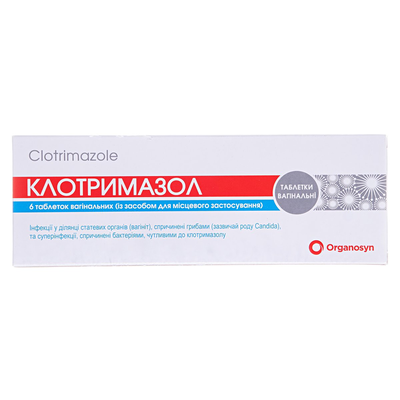

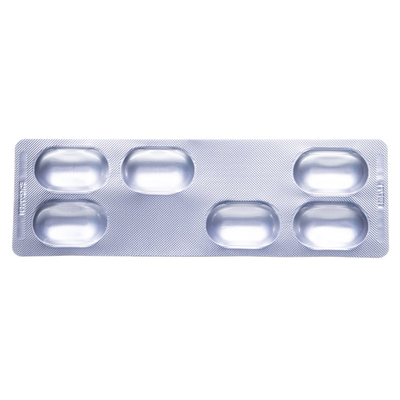
Clotrimazole vaginal tablets, 100 mg each, No. 6 in a strip with an applicator.
Ingredients
Active ingredient: clotrimazole;
1 tablet contains 100 mg of clotrimazole;
inactive ingredients: corn starch, lactose, povidone (K-30), magnesium stearate, colloidal anhydrous silicon dioxide, sodium starch glycolate (type A).
Dosage Form
Vaginal tablets
Main physical and chemical properties: oblong vaginal tablets with a biconvex surface; one end is rounded, the other is flat; white in color.
Pharmacotherapeutic group
Antimicrobial and antiseptic agents used in gynecology, excluding combination products containing corticosteroids. Imidazole derivatives.
ATC code G01A F02.
Pharmacological Properties
Pharmacodynamics.
The mechanism of the antifungal action of imidazole derivatives is associated with the inhibition of ergosterol synthesis, which leads to structural and functional damage to the cytoplasmic membrane.
Clotrimazole has a broad spectrum of antifungal activity. The mechanism of action of clotrimazole involves primary fungistatic or fungicidal activity, depending on the concentration of clotrimazole at the site of infection.
In addition to its antifungal activity, clotrimazole is also effective against Trichomonas vaginalis, Gram-positive microorganisms (streptococci, staphylococci), and Gram-negative microorganisms (Bacteroides, Gardnerella vaginalis).
Clotrimazole inhibits the growth of Corynebacteria and Gram-positive cocci (with the exception of Enterococci).
Pharmacokinetics.
It is known that only a small amount of clotrimazole (3–10%) is absorbed. Absorbed clotrimazole is rapidly metabolized in the liver to inactive metabolites. Therefore, the peak plasma concentration of clotrimazole after vaginal administration of a 500-mg dose is less than 10 ng/mL. This means that the occurrence of measurable systemic effects or adverse reactions following vaginal administration of clotrimazole is unlikely.
Indications
Infections of the genital tract (vaginitis) caused by fungi (usually of the genus Candida) and superinfections caused by bacteria susceptible to clotrimazole.
Contraindications
Hypersensitivity to clotrimazole or to any other components of the medication.
Interactions with Other Medications and Other Types of Interactions
The following interactions are possible when used concomitantly with other medications:
- with oral tacrolimus (FK-506; an immunosuppressant)—increased plasma levels of tacrolimus; when used concomitantly with clotrimazole, the patient’s condition should be closely monitored for symptoms of tacrolimus overdose; if necessary, tacrolimus plasma levels should be checked;
- with nystatin—decreased activity of clotrimazole;
- with amphotericin B and other polyene antibiotics—decreased activity of the latter.
When clotrimazole is used concomitantly with latex contraceptives, the latter may be damaged, which may reduce the effectiveness of these contraceptives. Patients are advised to use alternative methods of contraception for at least 5 days after using this medication.
Special Instructions for Use
Avoid contact with the eyes. Do not swallow.
Patients are advised to consult a doctor:
- at the first signs of illness;
- if symptoms persist for more than 7 days;
- if symptoms recur within 2 months;
- if there is a history of sexually transmitted diseases or a partner with a history of sexually transmitted diseases;
- if there have been more than 2 episodes of candidal vaginitis in the past 6 months;
- in the event of pregnancy or suspected pregnancy;
- if the patient is over 60 years of age;
- if hypersensitivity to any antifungal agents or imidazole derivatives has been identified.
It is not recommended to use Clotrimazole without consulting a doctor in cases of:
- irregular vaginal bleeding, abnormal vaginal bleeding, or vaginal bleeding accompanied by shoulder pain or the presence of blood clots;
- vulvar or vaginal ulcers or open wounds;
- purulent vaginal discharge with an unpleasant odor;
- pain in the lower abdomen, back, or during urination;
- any adverse reactions, such as redness, irritation, or swelling, associated with treatment;
- fever (38 °C or higher);
- nausea or vomiting;
- diarrhea.
Treatment should not be administered during menstruation. Treatment should be completed before the onset of menstruation.
Since both the vagina and the external genitalia (labia and surrounding areas) are usually affected, combined treatment of both areas should be used.
During treatment with Clotrimazole, it is recommended that both partners be treated using the appropriate dosage forms.
Sexual intercourse should be avoided while using this medication, as the infection can be transmitted to a partner.
The effectiveness and safety of latex products (such as condoms and diaphragms) may be reduced.
Do not use tampons, intravaginal douches, spermicides, or other products for vaginal use while undergoing treatment with Clotrimazole.
Use During Pregnancy or Breastfeeding.
No clinical studies have been conducted on the effect of clotrimazole on fertility in women; however, animal studies have not shown any effect of clotrimazole on fertility.
Animal studies have not shown any direct or indirect harmful effects in terms of reproductive toxicity. The number of studies on the use of clotrimazole during pregnancy is limited; therefore, it is recommended to avoid using the drug Clotrimazole during the first trimester of pregnancy.
During pregnancy, vaginal tablets should be used without an applicator.
Breastfeeding should be discontinued while using Clotrimazole.
Effect on reaction time when driving or operating machinery.
No effect.
Dosage and Administration
Take 1 vaginal tablet in the evening. The course of treatment with 100 mg vaginal tablets is 6 days.
For children 12 years of age and older, use Clotrimazole only after consulting a doctor.
Vaginal tablets should be inserted into the vagina as deeply as possible in the evening; it is most convenient to insert them while lying on your back with your legs slightly bent, using an applicator. For children 12 years of age and older, Clotrimazole should be used without an applicator.
Clotrimazole vaginal tablets must dissolve completely in the vagina; otherwise, undissolved pieces of the vaginal tablet may fall out of the vagina. To prevent this, it is important to insert the medication as deeply as possible into the vagina before bedtime. If the vaginal tablets do not dissolve completely overnight, consider using other dosage forms.
Children.
Clotrimazole is not indicated before the onset of menarche.
Do not use in children under 12 years of age.
Children 12 years of age and older should use Clotrimazole only after consulting a doctor; do not use an applicator.
Overdose
There is no risk of acute toxicity, as an overdose is unlikely following a single vaginal dose or topical application (application to large areas of skin under conditions that promote increased absorption), as well as after accidental oral ingestion. There is no specific antidote.
In the event of accidental oral ingestion, gastric lavage may rarely be necessary if a life-threatening dose was ingested within the past hour or if visible symptoms of overdose are present (e.g., dizziness, nausea, or vomiting). Gastric lavage should be performed only if adequate airway protection is available.
Side Effects
Immune system: allergic reactions, including loss of consciousness, hypotension, shortness of breath, and hives.
Reproductive system and mammary glands: peeling of the skin in the genital area, itching, rash, swelling, erythema, discomfort, burning sensation, irritation, pelvic pain, vaginal bleeding.
Gastrointestinal system: abdominal pain.
Shelf life
4 years.
Storage conditions
Store in the original packaging out of the reach of children at a temperature not exceeding 30 °C.
Packaging
6 vaginal tablets per strip, 1 strip with an applicator per cardboard package.
6 vaginal tablets per blister; 1 blister with an applicator per cardboard package.
Dispensing Category
Over-the-counter.
Manufacturer
Evertogen Life Sciences Limited.