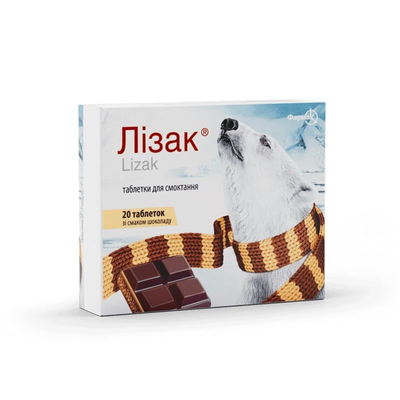
Lizak Sucking Tablets, Chocolate Flavor, No. 20 (10 x 2)
Ingredients
Active ingredients: lysozyme hydrochloride, dequalinium chloride;
1 tablet contains 10 mg of lysozyme hydrochloride (calculated as dry weight) and 0.25 mg of dequalinium chloride (calculated as 100% dry weight);
Inactive ingredients:
for anise- and mint-flavored tablets: lactose monohydrate; mannitol (E 421); povidone; magnesium stearate; flavorings: anise and mint;
for chocolate-flavored tablets: dextrose monohydrate ST; povidone; magnesium stearate; flavorings: cocoa powder, chocolate;
for orange-flavored tablets: dextrose monohydrate ST; povidone; magnesium stearate; flavoring: orange; coloring agents: yellow iron oxide (E 172), red iron oxide (E 172);
for raspberry-flavored tablets: dextrose monohydrate ST; povidone; magnesium stearate; flavorings: raspberry flavor, natural raspberry flavor; colorant: red iron oxide (E 172).
Dosage Form
Suckable tablets.
Main physical and chemical properties: white or almost white tablets with a flat surface, a score line, and a bevel, with an anise and mint flavor.
Tablets ranging in color from gray to brown, with speckles, a flat surface, a score line, and a bevel, with a cocoa flavor. A marbled appearance on the surface of the tablets is permitted.
Pink-orange tablets with speckles, a flat surface, a score line, and a bevel, with an orange flavor. Marbling on the tablet surface is permitted.
The tablets are pink with a reddish tint, speckled, with a flat surface, a score line, and a bevel, and have a raspberry flavor.
Pharmacotherapeutic group
Medications used for throat conditions. Antiseptics. Miscellaneous. ATC code R02A A20.
Pharmacological Properties
Pharmacodynamics.
Lizak® is a combination drug with pronounced local antiseptic, antibacterial, and antifungal effects. The therapeutic effect of the drug is due to its constituent components.
Dequalinium chloride—a topical antiseptic of the quinoline group—exerts an antiseptic effect, primarily local; an antibacterial effect—mainly against Gram-positive and Gram-negative microorganisms; antifungal activity—primarily against Candida albicans, certain species of Trichophyton, and epidermophytes.
The antibacterial action is due to the denaturation of pathogens’ proteins and enzymes through dissolution and depolymerization, as well as glycolysis and the inactivation of dehydrogenases; disruption of protein synthesis at the ribosomal level; cytolysis of the cell membrane. Its cationic surface-active action underlies its bacteriostatic activity, which is stronger against Gram-positive than against Gram-negative microorganisms.
Lysozyme is a mucopolysaccharide that is effective against Gram-positive bacteria by converting insoluble cell wall polysaccharides into soluble mucopeptides. It is also effective against Gram-negative bacteria, viruses, and fungi.
Lysozyme exerts a local anti-inflammatory effect and enhances the body’s nonspecific resistance.
Pharmacokinetics.
Dequalinium chloride is absorbed in very small amounts.
Lysozyme is well absorbed from the gastrointestinal tract. Peak blood concentrations of lysozyme are reached within 1–1.5 hours. Lysozyme is widely distributed throughout the body’s tissues and accumulates particularly in the mucous membranes. It is hydrolyzed by intestinal enzymes and excreted as a metabolite in the urine.
Indications
- Topical antiseptic treatment of inflammatory processes in the oral cavity and throat caused by pathogens sensitive to the drug (catarrhal, ulcerative, and fibrotic gingivitis; aphthous stomatitis; oral and pharyngeal candidiasis; pharyngitis; tonsillitis; laryngitis; and glossitis).
- Prevention of infections before and after surgical procedures in the oral cavity and throat.
Contraindications
Hypersensitivity to the active ingredients or to any of the drug’s excipients.
Allergy to quaternary ammonium compounds (e.g., benzalkonium chloride).
Interactions with Other Medications and Other Types of Interactions
When used concomitantly with kayexalate (a treatment for hyperkalemia), there is a risk of developing severe necrotic lesions of the skin and mucous membranes, particularly in the gastrointestinal tract.
The antibacterial activity of dequalinium chloride is reduced when used concomitantly with anionic detergents, such as toothpaste.
This medication should not be used in combination with cholinesterase inhibitors.
Lysozyme enhances the effectiveness of antibacterial drugs such as penicillin and chloramphenicol.
Special Instructions for Use
The anise- and mint-flavored tablets are sugar-free and may therefore be used by patients with diabetes.
One chocolate-, orange-, or raspberry-flavored lozenge contains 0.05 XO, which patients with diabetes should take into account.
If major clinical symptoms of generalized infection are present, systemic antibiotic therapy should be initiated. If any side effects occur, treatment with Lizak® should be discontinued and another medication prescribed.
Concomitant use with other medications for topical treatment should be approached with caution.
The anise- and mint-flavored tablets contain lactose; therefore, patients with rare hereditary forms of galactose intolerance, lactase deficiency, or glucose-galactose malabsorption should not take them.
Use during pregnancy or breastfeeding.
No controlled studies have been conducted; therefore, this medication should be used during pregnancy or breastfeeding only after consulting a doctor, if the therapeutic benefit outweighs the potential risk to the fetus or infant.
Effect on reaction time when operating motor vehicles or other machinery.
Lizak® does not affect the performance of tasks requiring increased attention (driving a vehicle or operating moving machinery).
Dosage and Administration
Recommended doses for adults and children 12 years of age and older.
Take 1 lozenge every 2–3 hours (no more than 10 lozenges per day). Once inflammation symptoms have subsided, take 1 lozenge every 4 hours.
Recommended doses for children aged 4 to 12 years.
Take 1 lozenge every 3 hours (no more than 5 lozenges per day). Once inflammation symptoms have subsided, take 1 lozenge every 4 hours.
The tablet should be sucked slowly without chewing.
It is recommended not to eat or drink for 30 minutes after taking the medication.
Treatment should continue for another 1–2 days after the symptoms have disappeared. It is recommended to use Lizak® until the symptoms of the illness disappear. If symptoms have not disappeared after 5–7 days of treatment, consult a doctor to determine the next course of treatment.
Children.
This dosage form should not be used to treat children under 4 years of age due to the risk of aspiration.
Overdose
There are no reports of overdose.
Side Effects
The following adverse reactions may occur:
Gastrointestinal tract: nausea, dry mouth, oral dysbiosis (with long-term use at high doses);
skin and subcutaneous tissue: allergic reactions may occur, including hives, rash, and itching;
local reactions, including a burning sensation and irritation in the throat and on the oral mucosa. In rare cases, specifically with abuse, ulcers and necrosis may occur. If any adverse reactions occur, discontinue use of the medication and be sure to consult a doctor regarding further treatment.
Shelf life
2 years.
Do not use the medication after the expiration date printed on the package.
Storage Conditions
Store at a temperature not exceeding 25°C.
Keep out of reach of children.
Packaging
6 tablets per blister pack, 2 blister packs per package (for anise- and mint-flavored tablets, chocolate-flavored tablets, and orange-flavored tablets).
10 tablets per blister pack, 1, 2, or 4 blister packs per package.
Dispensing Category
Available without a prescription.
Manufacturer
JSC “Farmak.”