
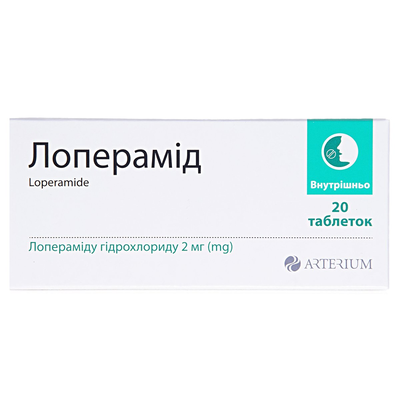
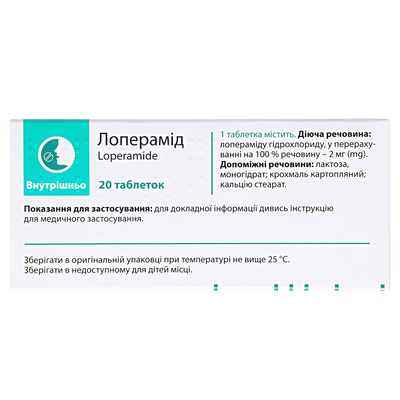
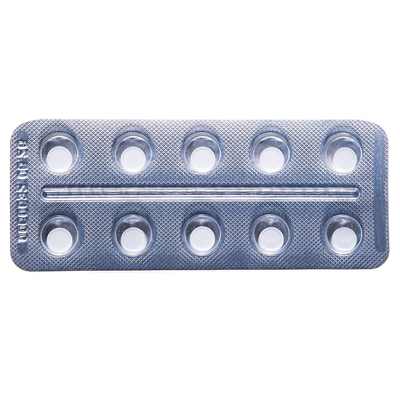
Loperamide 2 mg tablets, No. 20 (10 x 2)
Ingredients
Active ingredient: loperamide hydrochloride;
1 tablet contains 2 mg of loperamide hydrochloride, calculated as 100% active ingredient;
Excipients: lactose monohydrate; potato starch; calcium stearate.
Dosage Form
Tablets.
Main physical and chemical properties: white or almost white, round tablets with a flat surface and a beveled edge.
Pharmacotherapeutic group
Antispasmodics.
ATC code A07D A03.
Pharmacological properties
Pharmacodynamics.
Loperamide hydrochloride binds to opioid receptors in the intestinal wall, thereby inhibiting the release of acetylcholine and prostaglandins. In this way, loperamide slows down propulsive intestinal peristalsis, increases the transit time of intestinal contents through the digestive tract, and enhances the intestinal wall’s ability to absorb fluid.
Loperamide hydrochloride increases the tone of the anal sphincter, thereby reducing fecal incontinence and the urge to defecate.
Pharmacokinetics.
Absorption: Most of the loperamide taken orally is absorbed from the intestine, but due to extensive first-pass metabolism, systemic bioavailability is approximately only 0.3%.
Distribution: Data indicate that loperamide has a high affinity for the intestinal wall, with predominant binding to receptors in the longitudinal layer of the muscularis in rats. Loperamide is 95% protein-bound, primarily to albumin. Data indicate that loperamide is a substrate for P-glycoprotein.
Metabolism: Loperamide is almost completely extracted by the liver, where it is predominantly metabolized, conjugated, and excreted in bile. Oxidative N-demethylation is the primary metabolic pathway for loperamide; this process is mediated primarily by the CYP3A4 and CYP2C8 isoforms. As a result of this very intense first-pass effect in the liver, plasma concentrations of the unchanged drug remain very low.
Elimination: The half-life of loperamide in humans is approximately 11 hours, with a range of 9–14 hours. Unchanged loperamide and its metabolites are excreted primarily in the feces.
Pediatric population: No information is available regarding pharmacokinetic parameters in pediatric patients. The pharmacokinetic behavior of loperamide and drug interactions with loperamide are expected to be similar to those observed in adults.
Indications
Symptomatic treatment of acute diarrhea in adults and children 12 years of age and older.
Symptomatic treatment of acute episodes of diarrhea caused by irritable bowel syndrome in adults 18 years of age and older following an initial diagnosis by a physician.
Contraindications
Loperamide is contraindicated:
- patients with known hypersensitivity to loperamide hydrochloride or to any of the drug’s components;
- children under 12 years of age;
- patients with acute dysentery characterized by the presence of blood in the stool and a fever;
- patients with acute ulcerative colitis or pseudomembranous colitis associated with the use of broad-spectrum antibiotics;
- patients with bacterial enterocolitis caused by microorganisms of the Salmonella, Shigella, and Campylobacter families.
Loperamide should not be used at all if suppression of peristalsis must be avoided due to the potential risk of serious complications, including intestinal obstruction, megacolon, and toxic megacolon.
Treatment should be discontinued immediately if constipation, abdominal distension, or intestinal obstruction develops.
Drug Interactions and Other Interactions
There are reports of interactions between loperamide and medications with similar pharmacological properties. Medications that have a depressant effect on the central nervous system should not be administered concomitantly with loperamide in children.
There is evidence that loperamide is a substrate of P-glycoprotein. Concomitant administration of loperamide (at a dose of 16 mg) with P-glycoprotein inhibitors (quinidine, ritonavir) resulted in a 2- to 3-fold increase in plasma loperamide levels. The clinical significance of this pharmacokinetic interaction when loperamide is used at the recommended doses is unknown.
Concomitant administration of loperamide (4 mg as a single dose) and itraconazole, an inhibitor of CYP3A4 and P-glycoprotein, resulted in a 3- to 4-fold increase in loperamide plasma concentrations. The CYP2C8 inhibitor gemfibrozil increases loperamide levels by approximately 2-fold. Concomitant use of itraconazole and gemfibrozil results in a 4-fold increase in the maximum plasma concentration of loperamide and a 13-fold increase in total plasma exposure. This increase was not associated with any effects on the central nervous system (CNS), as assessed by psychomotor tests (i.e., subjective drowsiness and the digit-substitution test).
Concomitant administration of loperamide (16 mg as a single dose) and ketoconazole, an inhibitor of CYP3A4 and P-glycoprotein, resulted in a 5-fold increase in loperamide plasma concentrations. This increase was not associated with an increase in pharmacodynamic effects, as assessed by pupillometry.
Concomitant treatment with oral desmopressin resulted in a threefold increase in desmopressin plasma concentrations, likely due to slower gastrointestinal motility.
It is expected that medications with similar pharmacological properties may enhance the effect of loperamide, while medications that accelerate the passage of food through the gastrointestinal tract may reduce its effect.
Special Considerations for Use
Treatment of diarrhea is symptomatic. If the cause of the condition can be determined (or if it is indicated that this should be done), specific treatment should be administered whenever possible.
Patients with diarrhea, especially children, debilitated patients, and the elderly, may experience dehydration and electrolyte imbalance. In such cases, the most important measure is to administer replacement therapy to replenish fluids and electrolytes.
Use of this medication does not replace the administration of an adequate amount of fluids and the restoration of electrolyte balance.
Since persistent diarrhea may indicate potentially more serious conditions, this medication should not be used for an extended period until the cause of the diarrhea has been determined.
In cases of acute diarrhea, if no clinical improvement is observed within 48 hours, treatment with loperamide hydrochloride should be discontinued and a doctor should be consulted.
Patients with acquired immunodeficiency syndrome (AIDS) who are taking loperamide for diarrhea must immediately discontinue treatment at the first signs of abdominal distension. There are reports of cases of intestinal obstruction with an increased risk of toxic megacolon in patients with AIDS who have infectious colitis of both viral and bacterial origin during treatment with loperamide.
Abuse of loperamide or its misuse as an opioid substitute has been reported in individuals with opioid dependence.
Although pharmacokinetic data for patients with hepatic impairment are lacking, loperamide should be used with caution in such patients due to slowed first-pass metabolism. This medication should be prescribed with caution to patients with hepatic impairment, as it may lead to a relative overdose, which could result in toxic CNS damage.
Medications that prolong transit time may lead to the development of toxic megacolon in patients in this group.
Given the rapid metabolism of loperamide, as well as the excretion of loperamide and its metabolites in the feces, it is generally not necessary to adjust the dose in patients with renal impairment.
Since the drug contains lactose, it should not be used in patients with rare hereditary forms of galactose intolerance, Lapp lactase deficiency, or glucose-galactose malabsorption syndrome.
Loperamide is not associated with significant cardiac complications within the therapeutic concentration range. However, when these concentrations are substantially exceeded (up to 47 times), loperamide has been shown to cause cardiac complications: inhibition of potassium (hERG) and sodium currents and arrhythmias in in vivo and in vitro animal models.
Cardiac abnormalities, including QT interval prolongation, QRS complex prolongation, and torsade de pointes, have been reported in association with overdose. Fatal cases have also been reported (see the “Overdose” section). Overdose may exacerbate pre-existing Brugada syndrome. Patients should not exceed the recommended dose and/or the recommended duration of treatment.
If the drug is taken to control episodes of diarrhea caused by irritable bowel syndrome that has been previously diagnosed by a physician, and no clinical improvement is observed within 48 hours, stop taking loperamide hydrochloride and consult a doctor. You should also consult a doctor if the nature of your symptoms changes or if recurrent episodes of diarrhea last longer than 2 weeks.
For the treatment of acute episodes of diarrhea caused by irritable bowel syndrome, loperamide should be taken only if a doctor has previously diagnosed this condition.
In the cases listed below, the medication should not be used without first consulting a doctor, even if the patient is known to have irritable bowel syndrome (IBS):
- the patient is 40 years of age or older and some time has passed since the last IBS episode;
- the patient is 40 years of age or older and the IBS symptoms are different this time;
- recent intestinal bleeding;
- severe constipation;
- nausea or vomiting;
- loss of appetite or weight loss;
- difficulty or pain when urinating;
- fever;
- recent travel abroad.
If new symptoms develop, your condition worsens, or if your clinical condition has not improved within two weeks, consult a doctor.
Use during pregnancy or while breastfeeding.
This medication is not recommended during pregnancy. Therefore, pregnant women and women who are breastfeeding should be advised to consult their doctor for appropriate treatment.
Effect on reaction time when driving or operating machinery.
Increased fatigue, dizziness, or drowsiness may occur with diarrhea syndrome during treatment with loperamide hydrochloride. Therefore, caution is advised when taking this medication while driving or operating machinery.
Dosage and Administration
Loperamide is not intended for the initial treatment of severe diarrhea accompanied by fluid and electrolyte depletion. In children, in particular, it is advisable to compensate for this loss through parenteral or oral replacement therapy.
The tablets should be swallowed whole with water.
Symptomatic treatment of acute diarrhea in adults and children 12 years of age and older
The initial dose is 2 tablets (4 mg), followed by 1 tablet (2 mg) after each subsequent loose stool. The usual dose is 3–4 tablets (6–8 mg) per day. The maximum daily dose for acute diarrhea should not exceed 6 tablets (12 mg).
Symptomatic treatment of acute episodes of diarrhea caused by irritable bowel syndrome in adults 18 years of age and older following an initial diagnosis by a physician
The initial dose is two tablets (4 mg); thereafter, take 1 tablet (2 mg) after each episode of loose stools or as previously recommended by a doctor. The maximum daily dose should not exceed 6 tablets (12 mg).
In cases of acute diarrhea, if no clinical improvement is observed within 48 hours, loperamide should be discontinued.
Use in Elderly Patients
No dose adjustment is required for elderly patients.
In patients with renal impairment
No dose adjustment is required for patients with renal impairment.
In patients with hepatic impairment
Although there are no pharmacokinetic data on the drug’s effects in patients with hepatic impairment, loperamide should be administered with caution to such patients due to their slowed first-pass metabolism (see the “Special Considerations” section).
Children
This drug is indicated for children 12 years of age and older for the symptomatic treatment of acute diarrhea.
Overdose
Symptoms.
In the event of an overdose (including a relative overdose due to impaired liver function), central nervous system depression may occur (stupor, impaired coordination, drowsiness, miosis, muscle hypertonicity, respiratory depression), urinary retention, and a complex of symptoms similar to those of intestinal obstruction.
Children and patients with impaired liver function may be more sensitive to the effects on the central nervous system.
In individuals who have taken excessive doses of loperamide, cardiac abnormalities have been observed, such as prolongation of the QT interval and QRS complex, torsade de pointes, other serious ventricular arrhythmias, cardiac arrest, and loss of consciousness.
In individuals who intentionally took higher doses of loperamide (doses ranging from 40 to 792 mg per day have been reported), cardiac arrest and syncope have been observed. Fatalities have also been reported. An overdose may exacerbate an existing Brugada syndrome.
Treatment.
In case of overdose, the patient should seek immediate medical attention. ECG monitoring should be initiated in the event of an overdose. If symptoms of overdose appear, naloxone may be used as an antidote. Since the duration of action of loperamide is longer than that of naloxone (1–3 hours), repeated administration of naloxone may be necessary. To detect possible central nervous system depression, the patient should remain under close observation for at least 48 hours.
Side Effects
Adults and children 12 years of age and older
Adverse reactions in patients with acute diarrhea occurring at a frequency of 1% or higher, as reported in safety studies of loperamide hydrochloride:
Nervous system: headache.
Gastrointestinal system: constipation, bloating, nausea.
Side effects occurring at a frequency of less than 1% in safety studies of loperamide hydrochloride:
Nervous system: dizziness.
Gastrointestinal system: dry mouth, flatulence, abdominal pain and discomfort, vomiting, upper abdominal pain, dyspepsia.
Skin and subcutaneous tissue disorders: rash.
Postmarketing experience with loperamide hydrochloride
The following adverse reactions have been observed, classified by frequency as follows:
| Very common (≥ 1/10); |
| Common (≥ 1/100, < 1/10); |
| Uncommon (≥ 1/1,000, < 1/100); |
| Rare (≥ 1/10,000, < 1/1,000); |
| Very rare (< 1/10,000), including isolated reports. |
Immune system disorders: very rare—hypersensitivity reactions, anaphylactic reactions (including anaphylactic shock), and anaphylactoid reactions.
Nervous system disorders: very rare—impaired coordination, loss of consciousness, impaired consciousness, hypertonia, drowsiness, stupor.
Eye disorders: very rare—miosis.
Gastrointestinal system: very rare—intestinal obstruction (including paralytic ileus), megacolon (including toxic megacolon).
Skin and appendages: very rare—angioedema, bullous eruptions, including Stevens-Johnson syndrome, erythema multiforme, and toxic epidermal necrolysis, urticaria, and pruritus.
Renal and urinary system disorders: very rare—urinary retention.
General disorders: very rare—increased fatigue.
Shelf life
4 years.
Storage conditions
Store in the original packaging at a temperature not exceeding 25 °C.
Keep out of reach of children.
Packaging
10 tablets per blister pack, 2 blister packs per package.
Dispensing Category
Over-the-counter.
Manufacturer
Kyivmedpreparat PJSC.







