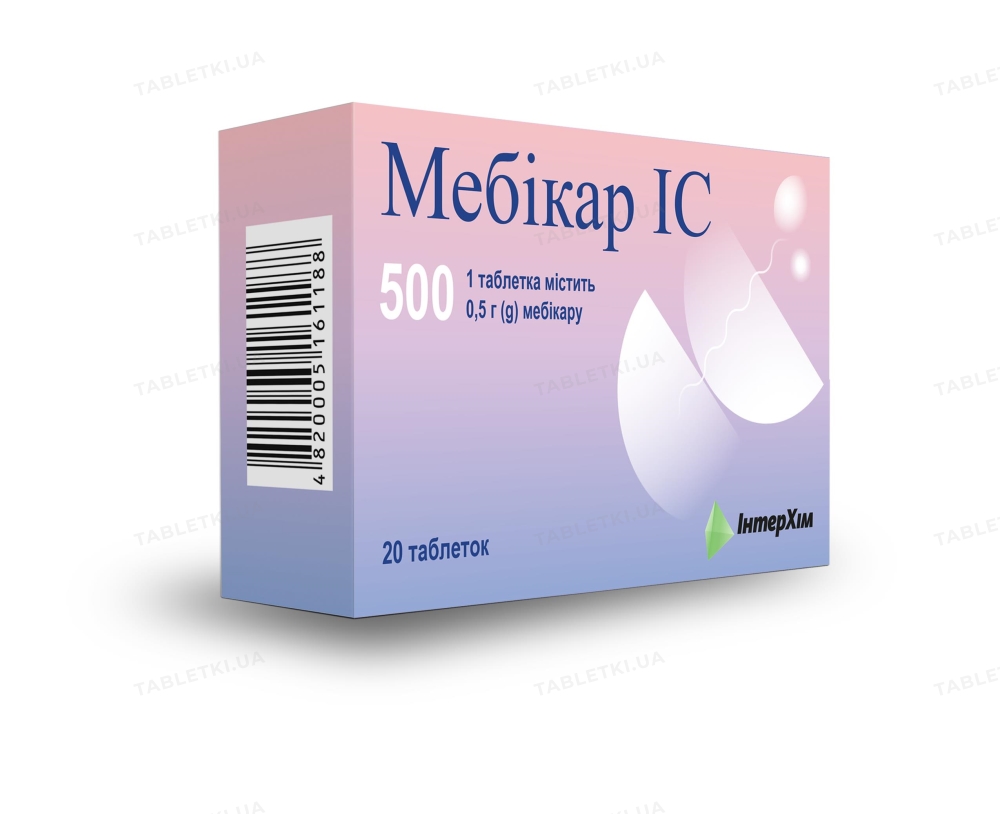
Mebicar IC tablets, 0.3 g each, No. 20 (10 x 2)
Composition
Active ingredient: temgicoluril;
1 tablet contains 300 mg (0.3 g) of temgicoluril;
excipients: methylcellulose, calcium stearate.
Dosage Form
Tablets.
Main physical and chemical properties: white, flat-cylindrical tablets with a bevel; the company’s trademark is imprinted on one side of the tablet, and a score line is imprinted on the other side.
Pharmacotherapeutic group
Psychostimulants, agents used for attention-deficit/hyperactivity disorder (ADHD), and nootropic agents. Other psychostimulants and nootropic agents. Temgicoluril.
ATC code N06B X21.
Pharmacological Properties
Pharmacodynamics.
The active ingredient in the drug temgicoluril is chemically similar to the body’s natural metabolites: the temgicoluril molecule consists of two methylated urea fragments that form a bicyclic structure.
Mebicar IC affects the activity of the limbic-reticular complex, particularly the emotogenic zones of the hypothalamus, and also influences all four major neurotransmitter systems — the GABAergic, cholinergic, serotonergic, and adrenergic systems — thereby promoting their balance and integration, but without exerting a peripheral adrenonegative effect. Mebicar IC exhibits antagonistic activity against the excitation of the adrenergic and glutamatergic systems and enhances the functioning of the brain’s inhibitory serotonergic and GABAergic mechanisms. The drug’s neurotransmitter profile includes a dopamine-positive component.
The drug has normostenic properties.
Mebicar IC has moderate tranquilizing (anxiolytic) activity; it relieves or reduces feelings of restlessness, anxiety, fear, internal emotional tension, and irritability. The drug’s anxiolytic effect is not accompanied by muscle relaxation or impaired coordination. The drug does not impair mental or motor activity, so it can be used during the workday or while studying. For this reason, Mebicar IS is classified as a daytime tranquilizer. The drug does not have a sedative effect, but it enhances the effect of sedatives and improves sleep in cases of sleep disturbance.
In addition to its anxiolytic effect, the drug has a nootropic effect. Mebicar IC improves cognitive functions, enhances attention and mental performance, without stimulating symptoms of productive psychopathological disorders, such as delusions or pathological emotional activity.
The drug reduces the severity of side effects (emotional suppression, hypersedation, muscle weakness) caused by neuroleptics and benzodiazepine tranquilizers.
The drug has an anti-alcohol effect. In patients with alcoholism, one of the causes of increased craving for alcohol is a reduced level of endogenous ethyl alcohol in the blood plasma. Mebicar IC, by increasing the level of endogenous ethyl alcohol (to a greater extent than other tranquilizers), reduces the craving for alcohol.
Mebicar IC alleviates nicotine withdrawal.
The drug does not cause a heightened mood or a feeling of euphoria.
Pharmacokinetics.
When administered orally, bioavailability is 77–80%; up to 40% of temgicoluril binds to red blood cells; the remaining 60% does not bind to blood proteins and is present in blood plasma in a free state; as a result, temgicoluril distributes freely throughout the body and readily crosses membranes. The volume of distribution is 0.9 L/kg. The maximum concentration of temgicoluril in serum is reached within 30 minutes; high levels are maintained for 3–4 hours, after which they gradually decline. Temgicoluril is completely eliminated from the body: 55–70% of the administered dose is excreted in the urine, and the remainder is excreted unchanged in the feces within 24 hours. Temgicoluril does not accumulate in the body and is not subject to biochemical transformation.
Indications
This medication is intended for use in adults.
Neuroses and neurosis-like conditions accompanied by feelings of anxiety and fear, emotional lability, and restlessness.
Cardiac pain of various origins (not related to ischemic heart disease).
To improve tolerance of neuroleptics and tranquilizers.
To be used as part of a comprehensive treatment regimen for nicotine dependence as a means of reducing the urge to smoke.
Contraindications
Hypersensitivity to temgicoluril or to any of the drug’s excipients.
Interactions with Other Medications and Other Types of Interactions
Mebicar IC may be combined with neuroleptics, tranquilizers (benzodiazepines), hypnotics, antidepressants, and psychostimulants.
Special Considerations for Use
No evidence of habituation, dependence, or withdrawal syndrome has been established with the use of temgicoluril.
This medication should be used with caution in patients with hypotension, liver dysfunction, or renal impairment.
There have been isolated reports of acute hypersensitivity reactions.
Use during pregnancy or breastfeeding.
Temgicoluril penetrates well into all tissues and body fluids.
There are insufficient data on the safety of temgicoluril during pregnancy and breastfeeding; therefore, it is not recommended to prescribe this medication to pregnant or breastfeeding women.
Effect on reaction time when operating motor vehicles or other machinery.
Caution should be exercised when operating vehicles, as the use of temgicoluril may cause a decrease in blood pressure and weakness.
Dosage and Administration
Take the medication orally, regardless of meals. The dosage depends on the patient’s individual characteristics and the therapeutic goal of treatment.
The usual dose for adults is 300–600 mg 2–3 times daily. The dose may be increased if necessary. The maximum single dose is 3 g; the maximum daily dose is 10 g. The duration of treatment ranges from a few days to 2–3 months.
As part of a comprehensive treatment regimen for nicotine dependence, the drug should be administered at a dose of 600–900 mg per day daily for 5–6 weeks.
No dose reduction is necessary for elderly patients or patients with hepatic insufficiency.
Dose adjustment in patients with renal insufficiency has not been studied. This medication should be prescribed with caution to such patients.
If one or more scheduled doses are missed, treatment should continue according to the previously prescribed regimen.
Children.
This medication is not intended for use in children.
Overdose
This medication is low-toxicity. In the event of a significant overdose, side effects may be exacerbated (including allergic reactions, dyspeptic disorders, weakness, and a temporary decrease in blood pressure and body temperature).
Treatment: Gastric lavage should be performed, and standard detoxification methods and symptomatic therapy should be administered.
There is no known specific antidote.
Side Effects
Mebicar IC, like other medications, may cause adverse reactions, although they do not occur in all patients.
Adverse reactions associated with the use of this medication are classified by organ system and frequency. Frequency is defined as follows: very common (≥ 1/10), common (≥ 1/100 to < 1/10), uncommon (≥ 1/1,000 to < 1/100), rare (≥ 1/10,000 to < 1/1,000), very rare (< 1/10,000), frequency unknown (cannot be estimated from the available data).
Nervous system disorders: rarely—dizziness.
Cardiovascular system: rarely—decreased blood pressure.
Gastrointestinal system: rare—dyspeptic disorders (including nausea, vomiting, diarrhea). In such cases, the dose of the medication should be reduced.
Respiratory system: rare—bronchospasm.
Skin and subcutaneous tissue disorders: rare—allergic reactions (including skin rash, itching, hives, angioedema). If an allergic reaction occurs, discontinue use of the drug.
General disorders: rarely—decreased body temperature, weakness. If blood pressure and/or body temperature decreases (body temperature may drop by 1–1.5 °C), it is not necessary to discontinue the medication. Blood pressure and body temperature return to normal after completion of the treatment course.
Reporting Suspected Adverse Reactions
Reporting adverse reactions after the drug’s approval is of great importance. This allows for monitoring the benefit-risk ratio when using this drug. Healthcare and pharmaceutical professionals, as well as patients or their legal representatives, should report all cases of suspected adverse reactions and lack of efficacy of the drug through the Automated Pharmacovigilance Information System at the following link: https://aisf.dec.gov.ua.
Shelf life
4 years.
Storage conditions
Store in the original packaging at a temperature not exceeding 25 °C.
Keep out of reach of children.
Packaging
10 tablets per blister; 2 blisters per pack.
Manufacturer
INTERCHIM Limited Liability Company.
Address
Ukraine, 65025, Odesa, 40-A, 21st km of Starokyivska Road.