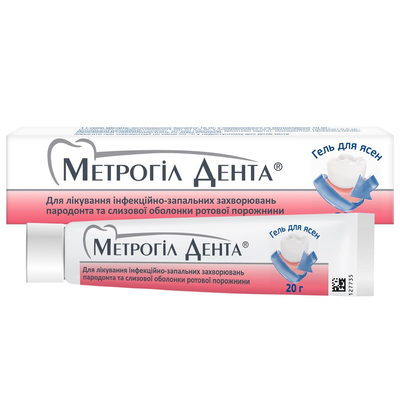
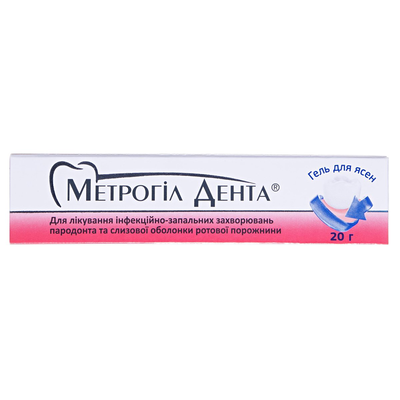
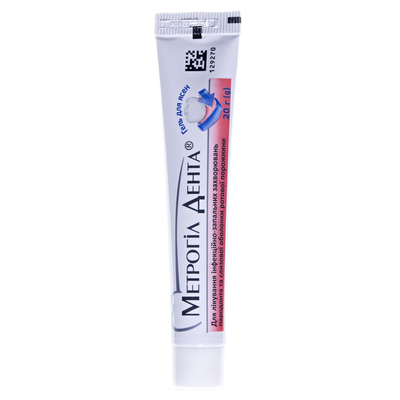
Metrogil Denta Gum Gel, 20 g tubes
Ingredients
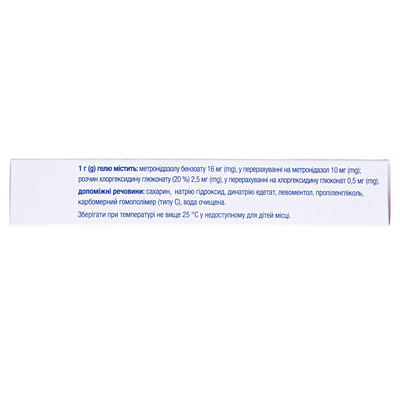
Active ingredients: metronidazole benzoate, chlorhexidine gluconate;
1 gram of gel contains: 16 mg of metronidazole benzoate, equivalent to 10 mg of metronidazole; 2.5 mg of chlorhexidine gluconate solution (20%), equivalent to 0.5 mg of chlorhexidine gluconate;
excipients: saccharin, sodium hydroxide, disodium edetate, levomenthol,
propylene glycol, carbomer homopolymer (type C), purified water.
Dosage Form
Gum gel.
Main physical and chemical properties: a white or nearly white, opalescent, soft gel.
Pharmacotherapeutic group
Products for use in dentistry. Antimicrobial and antiseptic agents for topical use in dentistry.
ATC code A01A B.
Pharmacological properties
Pharmacodynamics.
A combined antimicrobial preparation for the comprehensive treatment and prevention of certain infectious and inflammatory diseases of the oral cavity.
The drug’s efficacy is due to the presence of two antibacterial components—metronidazole and chlorhexidine.
Metronidazole is a nitroimidazole derivative with antiprotozoal and antibacterial effects. It is active against anaerobic bacteria that cause periodontal disease: Porphyromonas gingivalis, Prevotella intermedia, Prevotella denticola, Fusobacterium fusiformis, Wolinella recta, Eikenella corrodens, Borrelia vincenti, Bacteroides melaninogenicus, Selenomonas spp.
Chlorhexidine is a bactericidal antiseptic. It works by increasing the permeability of bacterial cell walls, allowing chlorhexidine to penetrate the bacterial cytoplasm, which leads to cell death. It is active against a wide range of vegetative forms of Gram-negative bacteria (Treponema spp., Neisseria gonorrhoeae, Trichomonas spp., Chlamydia spp., Ureaplasma spp., Bacteroides fragilis) and Gram-positive microorganisms, as well as yeasts, dermatophytes, and lipophilic viruses.
Some strains of Pseudomonas spp. and Proteus spp. have low susceptibility to chlorhexidine, while acid-fast bacteria and bacterial spores are not susceptible to this substance. Chlorhexidine does not impair the functional activity of lactobacilli.
Pharmacokinetics.
The minimum inhibitory concentration (MIC50) of metronidazole for anaerobic bacteria is less than 1 μg/mL. When the drug is applied topically (to the gums), the concentration of metronidazole in the gum area is significantly higher than with oral administration, and the level of systemic absorption of metronidazole following topical application is significantly lower than that following oral administration. The drug is well absorbed from the gastrointestinal tract and can be detected at bactericidal levels in the blood and saliva within 1 hour after administration. Metronidazole is metabolized primarily in the liver. The kidneys are the main route of excretion for metronidazole and its metabolites. Impaired renal function does not alter the pharmacokinetics of a single dose of metronidazole.
If an excess of chlorhexidine is swallowed during its topical application as part of a dental gel, approximately 1% of the dose that enters the stomach is absorbed from the gastrointestinal tract. Chlorhexidine does not accumulate in the body and is minimally metabolized.
Indications
For the treatment of infectious and inflammatory diseases of the periodontium and oral mucosa.
Catarrhal and hypertrophic gingivitis, both acute and chronic forms.
Acute ulcerative-necrotic gingivitis (Vincent’s gingivitis).
Generalized periodontitis, both chronic and acute forms.
Trauma to the oral mucosa caused by dental prostheses.
Alveolitis (inflammation of the socket following tooth extraction).
For the prevention of exacerbations of chronic gingivitis and periodontitis.
Contraindications
Hypersensitivity to metronidazole, chlorhexidine, as well as to nitroimidazole derivatives and any components of the medication.
Contraindicated in patients with confirmed blood dyscrasia or a history of blood dyscrasia.
Contraindicated in patients with diseases of the peripheral and central nervous systems.
Special Safety Precautions
Avoid contact with the eyes.
Interactions with Other Medications and Other Types of Interactions
When applied topically at the recommended doses, no systemic interactions between Metrogil Denta® gel and other medications have been identified. However, caution should be exercised when prescribing Metrogil Denta® gel with certain medications.
Warfarin and other coumarin anticoagulants. Metronidazole potentiates the anticoagulant effect, leading to a prolongation of prothrombin time.
Disulfiram. Concomitant use increases the toxicity of these drugs, which may lead to the development of neurological symptoms.
Phenobarbital, phenytoin, and hydantoin-based anticonvulsants. When used concomitantly with metronidazole, the antimicrobial activity of metronidazole is reduced. The reason is accelerated metabolism of metronidazole.
Cimetidine. It inhibits the metabolism of metronidazole, which may lead to increased serum concentrations of metronidazole.
Alcohol. Metronidazole causes alcohol intolerance. Concomitant use of alcohol and metronidazole may cause symptoms of toxic psychosis, nausea, hypotension, tachycardia, diaphoresis, or shortness of breath; in rare cases, severe hypotension and shock may occur. These reactions usually occur within 24 hours but may occur up to 2 weeks after alcohol consumption.
Special Instructions for Use
Use of Metrogil Denta® does not replace proper dental hygiene.
Do not consume alcohol while using this medication, as it may cause stomach cramps, nausea, vomiting, headache, and flushing.
Metronidazole should not be used concurrently with disulfiram, as it may cause psychotic reactions and confusion.
Prolonged use may cause brown discoloration of the teeth and tongue.
Use of Metrogil Denta® gel may cause temporary changes in taste perception.
Use during pregnancy or breastfeeding.
Do not use this medication during pregnancy.
Breastfeeding should be discontinued during treatment with this medication.
Effect on reaction time when operating motor vehicles or other machinery.
Use of this medication at the recommended dose does not affect the ability to operate vehicles or potentially hazardous machinery.
Directions for Use and Dosage
For topical use only, for dental use!
Use this medication only after consulting a dentist.
For adults with gum inflammation (gingivitis), apply Metrogil Denta® gel to the gums using a finger massage or a cotton swab twice daily. Do not rinse your mouth, drink, or eat for 30 minutes after applying the gel. The average duration of treatment is 7–10 days.
For periodontitis: after removing dental plaque, treat the periodontal pockets with Metrogil Denta® gel and also apply the gel to the gums. Leave the gel on for 30 minutes. The number of treatments depends on the severity of the condition. Subsequently, the patient applies the gel independently. Apply Metrogil Denta® to the gum area twice daily for 7–10 days.
To prevent flare-ups of chronic gingivitis and periodontitis, apply Metrogil Denta® gel to the gums twice daily for 7–10 days. Conduct preventive treatment courses 2–3 times a year.
To treat post-extraction alveolitis after tooth extraction, treat the socket with Metrogil Denta® gel; the patient should then apply the gel independently 2–3 times a day for 7–10 days.
To prevent flare-ups of chronic gingivitis and periodontitis, apply Metrogil Denta® gel twice daily to the affected areas for 7–10 days. Conduct preventive treatment courses 2–3 times a year.
To prevent flare-ups of chronic gingivitis and periodontitis, as well as bleeding gums and bad breath, apply Metrogil Denta® gel in the evening after brushing your teeth should be rubbed into the gum area for 2–3 minutes using a finger massage or a cotton swab; after rubbing, spit it out—do not rinse your mouth.
To prevent flare-ups in patients with catarrhal gingivitis and mild generalized periodontitis, in the morning and evening after brushing your teeth, use a finger massage or a cotton swab to rub MetrogilGil Denta® gel into the gums for 2–3 minutes; after the procedure, refrain from rinsing your mouth or drinking any liquids for one hour. Conduct preventive treatment courses lasting 2 weeks 2–3 times a year.
Children
This medication is not recommended for children under 18 years of age.
Overdose
There are no known cases of overdose with Metrogil Denta® gel when used topically.
Accidental or intentional ingestion of a large amount of the gel may lead to an exacerbation of the side effects initially caused by metronidazole (chlorhexidine is practically not absorbed from the gastrointestinal tract). These reactions include nausea, vomiting, and dizziness. In more severe cases, paresthesia and convulsions may occur. High doses and prolonged systemic treatment with metronidazole are associated with the development of leukopenia, neutropenia, and an increased risk of peripheral neuropathy and central nervous system toxicity. To treat an overdose, gastric lavage should be performed and symptomatic therapy administered as needed.
Side Effects
When Metrogil Denta® gel is applied topically, the risk of systemic side effects is minimal; however, the reactions described below may occasionally occur.
Immune system: allergic reactions, including skin rash, itching, hives, angioedema, and anaphylaxis, including anaphylactic shock. One case of eyelid swelling as a manifestation of an angioedema reaction has been reported.
Nervous system: headache.
Ophthalmic disorders: If the gel comes into contact with the area near the eyes, tearing, dryness of the mucous membrane, and transient redness may occur.
Gastrointestinal system: metallic taste in the mouth, bitter taste in the mouth, nausea; plaque may form in the oral cavity, on the surface of the teeth, and on the tongue.
Reactions at the application site: burning sensation at the application site, irritation at the application site.
Data from postmarketing studies.
With oral use of chlorhexidine, hypersensitivity may occur, including symptoms of anaphylaxis, mouth irritation, discoloration of the teeth and tongue, increased tartar formation, changes in taste perception, a bitter aftertaste in the mouth, as well as a burning sensation, numbness, dryness, and soreness of the oral mucosa.
In postmarketing use, there have been reports of hives with swelling of the face, lips, mouth, and throat, accompanied by itching, difficulty breathing, hoarseness, loss of consciousness, as well as allergic reactions (anaphylaxis) in the oral cavity on open wounds.
If these or other adverse effects occur, discontinue treatment and consult a doctor.
Shelf life
3 years.
Storage conditions
Store at a temperature not exceeding 25 °C, out of reach of children.
Packaging
20 g per tube made of aluminum or laminated plastic. One tube per cardboard box.
Dispensing Category
Available without a prescription.