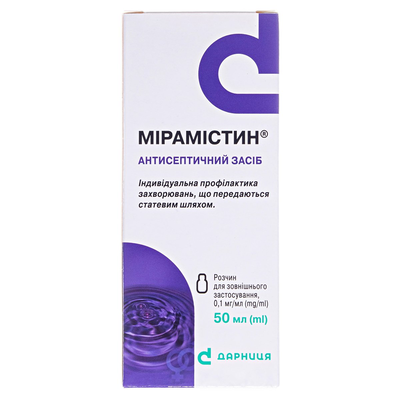
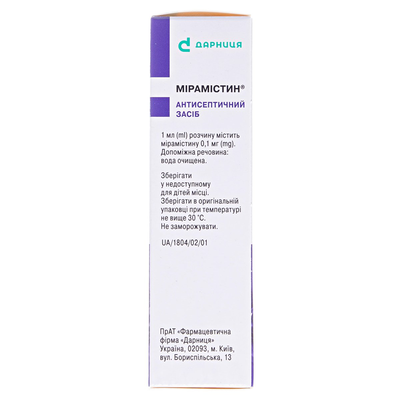
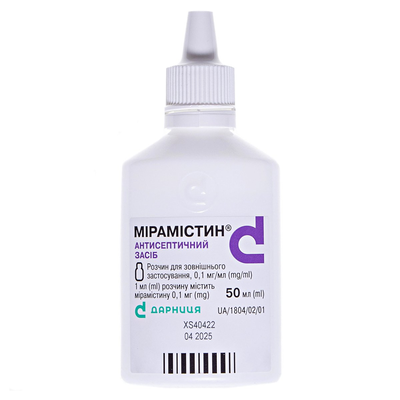
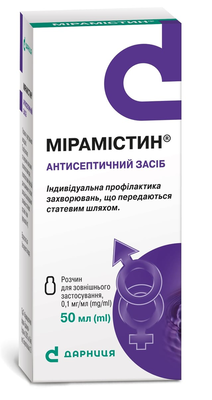
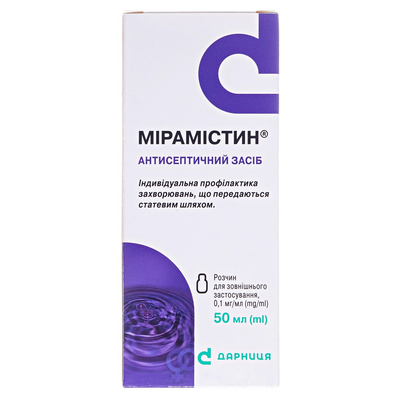
Miramistin solution for external use, 0.1 mg/mL, 50 mL per bottle with a urethral applicator.
Ingredients
Active ingredient: myramistin;
1 mL of solution contains 0.1 mg of myramistin;
excipient: purified water.
Dosage Form
Solution for external use.
Main physical and chemical properties: a colorless or slightly yellowish clear liquid that foams when shaken.
Pharmacotherapeutic group
Antiseptics and disinfectants. ATC code D08A J.
Pharmacological properties
Pharmacodynamics.
Miramistin exerts a pronounced bactericidal effect against Gram-positive and Gram-negative, aerobic and anaerobic bacteria in the form of monocultures and microbial associations, including hospital strains, resistant to antibiotics. The drug is effective against Gram-positive bacteria (Staphylococcus spp., Streptococcus spp., Streptococcus pneumoniae, etc.) and Gram-negative bacteria (Pseudomonas aeruginosa, Escherichia coli, Klebsiella spp. , etc.), acts against pathogens causing sexually transmitted diseases (Chlamydia spp., Treponema spp., Trichomonas vaginalis, Neisseria gonorrhoeae), as well as herpes viruses, human immunodeficiency viruses, and others. It exerts antifungal activity against ascomycetes of the genera Aspergillus and Penicillium, yeasts (Rhodotorula rubra, Torulopsis gabrata, etc.) and yeast-like fungi (Candida albicans, Candida tropicalis, Candida krusei, etc.), as well as dermatophytes (Trichophyton rubrum, Trichophyton mentagrophytes, Trichophyton verrucosum, Trichophyton schoenleini, Trichophyton violacent, Epidermophyton Kaufinan-Wolf, Epidermophyton floccosum, Microsporum gypseum, Microsporum canis, etc.), as well as other pathogenic fungi, such as Pityrosporum orbiculare (Malassezia furfur), in the form of monocultures and microbial associations, including fungal microflora resistant to chemotherapeutic agents. Effectively prevents infection of wounds and burns and stimulates regeneration processes. It stimulates defensive responses at the site of application by activating the phagocytic and digestive functions of phagocytes and potentiates the activity of the monocyte-macrophage system. It possesses pronounced hyperosmolar activity, which helps to alleviate wound and perifocal inflammation and absorb purulent exudate, thereby promoting the formation of a dry scab. It does not damage granulation tissue or viable skin cells and does not inhibit marginal epithelialization.
It has no allergenic properties and does not cause local irritation.
Pharmacokinetics.
When applied topically, it is not absorbed through the skin or mucous membranes.
Indications
Surgery, traumatology: topical treatment of infected wounds of various locations and etiologies; prevention of secondary infection in granulating wounds.
Burns: treatment of second- and third-degree burns; preparation of burn wounds for dermatoplasty.
Obstetrics and Gynecology: prevention and treatment of suppuration of postpartum wounds, postpartum infections, and wounds of the perineum and vagina; inflammatory diseases of the external genitalia and vagina (vulvovaginitis).
Dermatology: comprehensive treatment of candidiasis of the skin and mucous membranes, as well as fungal infections of the feet and large skin folds.
Venereology: individualized prevention of sexually transmitted diseases (syphilis, gonorrhea, genital herpes).
Otolaryngology: comprehensive treatment of acute and chronic otitis, sinusitis, and tonsillitis.
Dentistry: treatment of periodontitis and stomatitis; hygienic cleaning of removable dentures; prevention of microbial complications following surgical procedures on the oral mucosa.
Contraindications
Individual sensitivity to miramistin.
Interactions with Other Medications and Other Types of Interactions
When used concomitantly with antibiotics, an increase in their antibacterial and antifungal properties has been observed.
Special Considerations for Use
Venereology. After treating the urethra, vagina, inner thighs, pubic area, and external genitalia with Miramistin®, urination is not recommended for 2 hours.
Use During Pregnancy or Breastfeeding.
Since absorption of the drug is virtually nonexistent, Miramistin® may be used during pregnancy or breastfeeding.
Effect on reaction time when driving or operating machinery.
Miramistin® does not affect the ability to drive or engage in other potentially hazardous activities that require increased concentration and rapid psychomotor reactions.
Directions for Use and Dosage
The solution is ready for use. For topical use in adults.
Surgery, traumatology, and burn treatment. For prophylactic and therapeutic purposes, irrigate the surface of wounds and burns with Miramistin®, loosely tamponade the wound and fistula tracts, and secure gauze tampons moistened with the antiseptic. Repeat the treatment 2–3 times daily for 3–5 days. Active drainage of wounds and cavities is effective, with a daily usage of up to 1 liter of the medication.
Obstetrics and Gynecology. For the prevention of postpartum infection, use as vaginal irrigations prior to delivery (5–7 days), during labor after each vaginal examination, and in the postpartum period as intravaginal tampons moistened with 50 mL of the medication, left in place for 2 hours for 5 days.
For women delivering by cesarean section, the vagina is treated immediately before surgery; during surgery, the uterine cavity and the incision on it are treated; and in the postoperative period, tampons moistened with the medication are inserted into the vagina with a 2-hour exposure time for 7 days. Treatment of inflammatory diseases of the female genital organs should be conducted as a 2-week course involving intravaginal insertion of medicated tampons, treatment of the skin of the external genitalia, and electrophoresis.
Dermatology. Treat candidiasis of the skin and mucous membranes, as well as fungal infections of the feet and deep skin folds, by applying the solution 2–4 times daily.
Venereology. For individual prevention of sexually transmitted diseases, miramistin solution is effective if applied no later than 2 hours after sexual intercourse. Using the urethral applicator, instill the contents of the vial into the urethra—2–3 mL (for men), 1–2 mL (for women)—and into the vagina—5–10 mL for 2–3 minutes. It is not recommended to empty the bladder for 2 hours after the procedure. Treat the skin of the inner thighs, pubic area, and external genitalia.
Otolaryngology. In cases of purulent sinusitis, flush the maxillary sinus with a sufficient amount of the medication during puncture. For the treatment of tonsillitis, pharyngitis, and laryngitis, gargle with a Miramistin® solution 3–4 times a day. The amount of medication per rinse is 10–15 mL. For otitis, insert a tampon moistened with the medication into the external auditory canal 4–6 times a day for 10–14 days.
Dentistry. For the treatment of periodontitis, a Miramistin® solution is administered into periodontal pockets using turundas, followed by applications to the gums for 15 minutes. During exacerbations, rinse the periodontal pockets with Miramistin® using a syringe and insert turundas soaked in the medication into the abscess cavity. After vestibuloplasty and frenulectomy, use the medication as mouthwashes on an outpatient basis. For stomatitis and gingivitis, it is recommended to rinse the oral cavity with 10–15 mL of the medication 3–4 times a day. For hygienic cleaning of removable dentures, soak them overnight in a miramistin solution; rinse the dentures thoroughly with running water before use.
Children.
Since there is insufficient experience with the use of miramistin solution for the treatment of children, it should not be used in pediatric practice.
Overdose
No cases of overdose have been observed.
Side Effects
In isolated cases, a brief burning sensation may occur, which resolves spontaneously within 15–20 seconds and does not require discontinuation of the medication.
Hypersensitivity reactions, including local skin irritation: itching, redness, a burning sensation, and dry skin.
Reporting Suspected Adverse Reactions.
Reporting suspected adverse reactions after a drug’s approval is an important procedure. It allows for continued monitoring of the “benefit-risk” ratio for the drug in question. Healthcare professionals should report any suspected adverse reactions through the national reporting system.
Shelf life
3 years.
Storage Conditions
Store in the original packaging at a temperature not exceeding 30 °C.
Do not freeze. Keep out of reach of children.
Packaging
50 mL per bottle; 1 bottle with a urethral applicator per package.
Dispensing Category
Over-the-counter.
Manufacturer
PJSC “Darnitsa Pharmaceutical Company.”