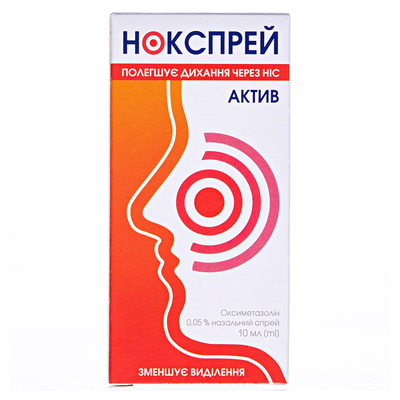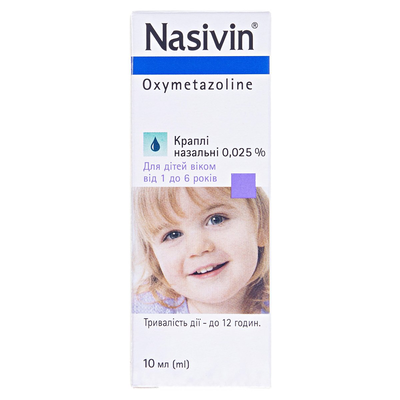
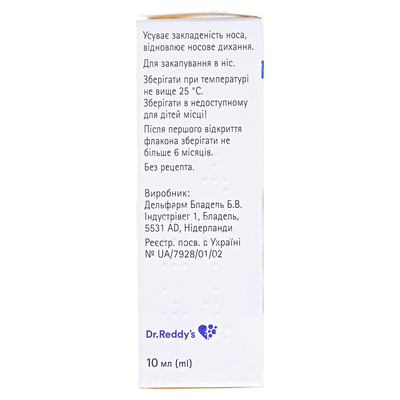
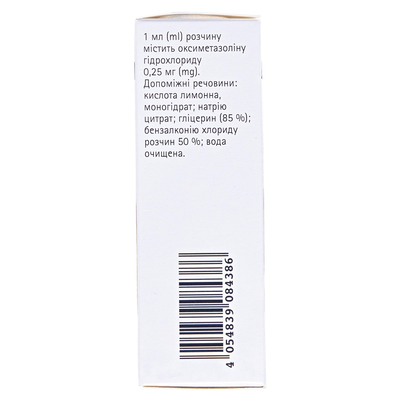
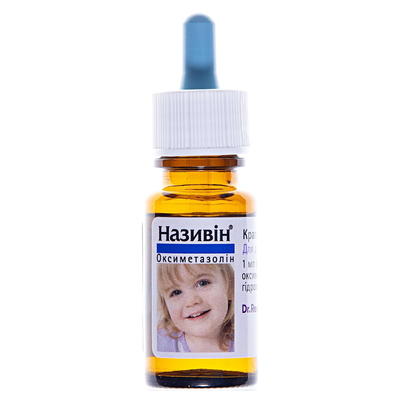
Nazyvin eye drops, 0.025%, 10 mL per bottle.
Ingredients
Active ingredient: oxymetazoline;
1 mL of solution contains:
Nazivin® 0.01% oxymetazoline hydrochloride 0.1 mg;
Nazivin® 0.025% oxymetazoline hydrochloride 0.25 mg;
Nazivin® 0.05% oxymetazoline hydrochloride 0.5 mg;
excipients: citric acid monohydrate; sodium citrate; glycerin (85%); 50% benzalkonium chloride solution; purified water.
Dosage Form
Nasal drops.
Main physical and chemical properties: an almost transparent solution, ranging from colorless to a slightly yellowish tint.
Pharmacotherapeutic group
Decongestants and other preparations for topical use in diseases of the nasal cavity. Sympathomimetics, simple preparations. ATC code R01A A05.
Pharmacological properties
Pharmacodynamics.
Nazivin® belongs to the group of topical vasoconstrictors. Oxymetazoline exerts sympathomimetic and vasoconstrictive effects, reducing swelling of the nasal mucosa. It constricts blood vessels at the site of application, reduces swelling of the nasal mucosa and upper respiratory tract, and reduces nasal discharge. It restores nasal breathing. Relief of nasal mucosal edema helps restore ventilation of the paranasal sinuses and the middle ear cavity, thereby preventing the development of bacterial complications.
Oxymetazoline has antiviral, anti-inflammatory, immunomodulatory, and antioxidant effects. Thanks to this combined mechanism of action, clinical studies have demonstrated faster and more effective relief of acute rhinitis symptoms (nasal congestion, rhinorrhea, sneezing, and general malaise).
Nazivin® 0.05%, nasal drops
A double-blind, parallel-group, controlled study involving 247 patients demonstrated faster and greater improvement in typical symptoms of acute rhinitis (nasal congestion, runny nose, sneezing, general malaise) (p < 0.05) due to the combination of the vasoconstrictive, antiviral, anti-inflammatory, and antioxidant effects of oxymetazoline. Thus, treatment with 0.05% oxymetazoline nasal drops, compared with saline, significantly shortens the duration of the common cold, on average from 6 to 4 days (p < 0.001).
Pharmacokinetics.
When using Nazivin®, 0.01% and 0.025% nasal drops, the effects of oxymetazoline become apparent within a few minutes after instillation.
When applied topically to the nose at therapeutic concentrations, it does not irritate the nasal mucosa or cause hyperemia. The half-life is approximately 35 hours after administration. 2.1% of the drug is excreted by the kidneys, and approximately 1.1% is excreted in the feces.
The drug’s effect lasts several hours (on average 6–8 hours), with a maximum duration of up to 12 hours.
Indications
- Acute respiratory diseases accompanied by nasal congestion.
- Allergic rhinitis.
- Vasomotor rhinitis.
- To restore drainage and nasal breathing in cases of diseases of the paranasal sinuses and eustachitis.
- To reduce swelling prior to diagnostic procedures in the nasal passages.
Contraindications
Hypersensitivity to any component of the medication. Dry rhinitis.
Nazivin® 0.025%: children under 1 year of age.
Nazivin® 0.05%: children under 6 years of age.
Interactions with Other Medications and Other Types of Interactions
Concomitant use of oxymetazoline and:
- tricyclic antidepressants;
- monoamine oxidase inhibitors such as tranylcypromine;
- antihypertensive drugs
may lead to an increase in blood pressure. These medications should not be combined if possible.
In the event of an oxymetazoline overdose, or if the medication is swallowed, or when used concurrently with or immediately after tricyclic antidepressants and/or MAO inhibitors, an increase in blood pressure is possible.
Special Considerations for Use
In the following cases, the drug should be used only after a careful benefit-risk assessment:
- elevated intraocular pressure, especially in angle-closure glaucoma;
- severe cardiovascular diseases (e.g., ischemic heart disease) and hypertension;
- pheochromocytoma;
- metabolic disorders (e.g., hyperthyroidism, diabetes mellitus, porphyria);
- benign prostatic hyperplasia;
- when using monoamine oxidase (MAO) inhibitors and other medications that may potentially increase blood pressure.
Long-term use, as well as exceeding the recommended dose, should be avoided, especially when prescribing to children. Doses exceeding the recommended ones should be used only under a doctor’s supervision.
The preservative (benzalkonium chloride) contained in the product may cause swelling of the nasal mucosa, especially with prolonged use.
Medical supervision is recommended for premature newborns or low-birth-weight infants to avoid the risk of overdose.
Prolonged use and overdose of a nasal decongestant may lead to a decrease in the drug’s effectiveness and result in a clinical picture similar to that of vasomotor rhinitis. Abuse of this product may cause medication-induced rhinitis, mucosal atrophy, and reactive hyperemia of the nasal mucosa (rebound effect).
Use During Pregnancy or Breastfeeding
Pregnancy.
During pregnancy or breastfeeding, the drug should be used with extreme caution, taking into account a careful assessment of the benefit-risk ratio. Exceeding the recommended dosage is not recommended.
Breastfeeding.
It is unknown whether oxymetazoline passes into breast milk. Therefore, the drug should be used only after a careful assessment of the benefit-risk ratio. Exceeding the recommended dosage is not recommended, as it may reduce breast milk production.
Effect on reaction time when driving or operating machinery
When used at the recommended doses, no effect on reaction time while driving or operating machinery is expected. After prolonged use of the drug at doses exceeding the recommended ones, a general effect on the cardiovascular system cannot be ruled out. In such cases, the ability to drive a vehicle may be impaired.
Directions and Dosage
Nazivin® 0.01%, 0.025%, 0.05% nasal drops are intended for intranasal use.
Adults and children 6 years of age and older.
Apply Nazivin® 0.05% 1–2 drops into each nostril 2–3 times daily.
A single dose should be administered no more than 3 times a day.
The effect of the medication is achieved within 25 seconds after application and lasts for several hours (on average 6–8 hours, up to a maximum of 12 hours).
Children aged 1 to 6 years.
Administer Nazivin® 0.025% at a dose of 1–2 drops in each nostril 2–3 times a day.
A single dose should be administered no more than 3 times a day.
The effect of the medication is achieved within a few minutes after administration and lasts for several hours (on average 6–8 hours, up to 12 hours).
Infants.
Infants under 4 weeks of age are prescribed 1 drop of Nazivin® 0.01% in each nostril 2–3 times a day. From the 5th week of life through 1 year of age: 1–2 drops in each nostril 2–3 times a day.
A single dose should be administered no more than 3 times a day.
The effect of the medication is achieved within a few minutes after administration and lasts for several hours (on average 6–8 hours, up to a maximum of 12 hours).
Doses higher than those recommended should be used only under a doctor’s supervision.
Nazivin® nasal drops 0.01%, 0.025%, and 0.05% should be used for no longer than 5–7 days.
Children
Do not use Nazivin® 0.025% in children under 1 year of age; do not use Nazivin® 0.05% in children under 6 years of age.
Overdose
Overdose is possible following nasal administration or accidental ingestion. The clinical picture caused by intoxication with imidazole derivatives may be diffuse, as hyperreactive phases may alternate with phases of depression of the central nervous system, cardiovascular system, and respiratory system.
Central nervous system stimulation manifests as anxiety, agitation, hallucinations, and seizures. Central nervous system depression manifests as a decrease in body temperature, lethargy, drowsiness, and coma.
The following may also occur: hypertension, tachycardia, bradycardia, miosis, mydriasis, convulsions, increased body temperature, spasms, sweating, pallor, lethargy, decreased body temperature, cyanosis, palpitations, arrhythmia, cardiac arrest, shock-induced hypotension, nausea and vomiting, respiratory depression and apnea, and psychogenic disorders.
In children, overdose often leads to predominant central nervous system effects, including seizures and coma, bradycardia, apnea, as well as hypertension, which may follow hypotension.
Therapeutic measures: indicated in cases of severe overdose. Administration of activated charcoal (adsorbent), sodium sulfate (laxative), or gastric lavage (if a large amount of the drug has been ingested) should be performed immediately, as oxymetazoline can be rapidly absorbed. Vasopressor agents are contraindicated. Non-selective alpha-blockers may be used as an antidote. If necessary, measures for anticonvulsant therapy, mechanical ventilation, and fever reduction should be initiated.
Side Effects
The frequency of occurrence is classified as follows: very common: ≥ 10%, common (≥ 1% – < 10%), uncommon: (≥ 0.1% – < 1%), rare: ≥ 0.01% – <0.1%, very rare or isolated cases: < 0.01%.
Respiratory, thoracic, and mediastinal disorders.
Common: burning or dryness of the nasal mucosa, sneezing.
Uncommon: increased mucosal edema, nosebleeds after discontinuation.
Very rare: apnea in newborns and young children.
Musculoskeletal system.
Very rare: convulsions (predominantly in children).
Nervous system disorders.
Very rare: restlessness, insomnia, fatigue (drowsiness, sedative effect), headache, hallucinations (especially in children).
Cardiovascular system.
Rare: palpitations, tachycardia, hypertension.
Very rare: arrhythmia.
Immune system disorders.
Uncommon: hypersensitivity reactions (rash, itching, angioedema).
Shelf life
3 years.
Do not store for more than 6 months after first opening the vial.
Storage conditions
Store at a temperature not exceeding 25 °C. Keep out of reach of children!
Packaging
10 mL of 0.025% and 0.05% solutions; 5 mL of 0.01% solution per vial. One vial per cardboard box.
Dispensing Category
Available without a prescription.