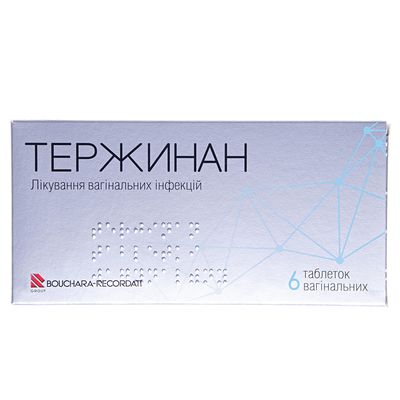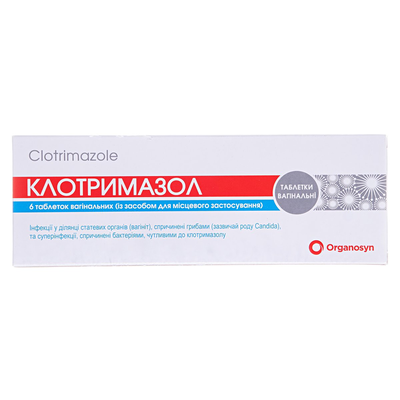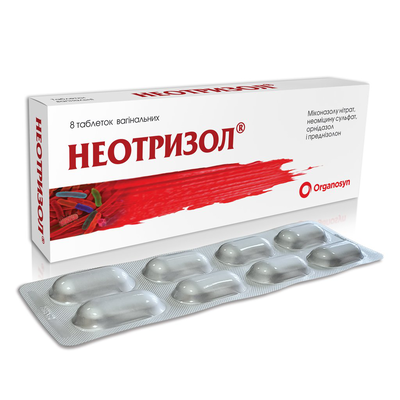
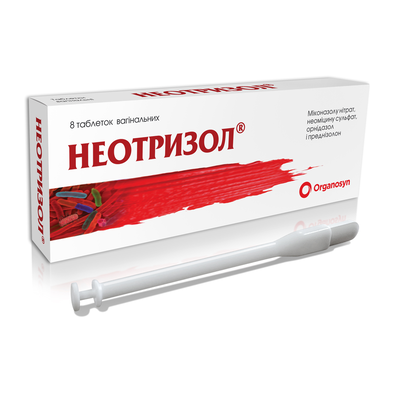
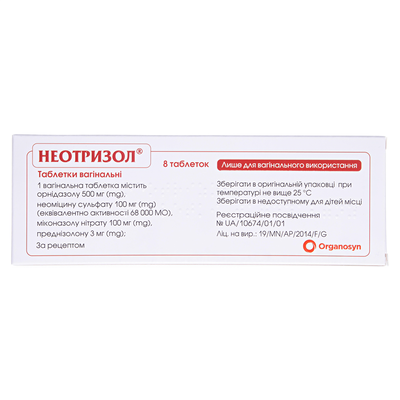

Neotrizol vaginal tablets, No. 8 (8 x 1) in a blister pack with applicator.
Ingredients
active ingredients: ornidazole, neomycin, miconazole, prednisolone;
1 vaginal tablet contains 500 mg of ornidazole, 100 mg of neomycin sulfate (equivalent to 68,000 IU), 100 mg of miconazole nitrate, and 3 mg of prednisolone;
Inactive ingredients: lactose monohydrate, povidone K-30, corn starch, talc, colloidal anhydrous silicon dioxide, sodium starch glycolate (type A), magnesium stearate, croscarmellose sodium.
Dosage Form
Vaginal tablets.
Main physical and chemical properties: oblong, biconvex, uncoated tablets, almost white in color, with a rounded edge on one side and a flat edge on the other.
Pharmacotherapeutic group
Antimicrobial/antiseptic agents in combination with corticosteroids. Imidazole derivatives and corticosteroids. ATC code G01B F.
Pharmacological Properties
Pharmacodynamics.
Ornidazole. The mechanism of action of ornidazole involves disruption of the DNA structure in microorganisms sensitive to it. The drug easily penetrates the microbial cell and, by binding to DNA, disrupts the replication process. Ornidazole is active against Trichomonas vaginalis, Entamoeba histolytica, Giardia lamblia (Giardia intestinalis), as well as certain anaerobic bacteria, such as Bacteroides and Clostridium spp., Fusobacterium spp., and anaerobic cocci.
Miconazole. Miconazole is an antifungal agent indicated for the topical treatment of vulvovaginal candidiasis (moniliasis); it is active only against Candida vulvovaginitis.
Neomycin. Neomycin is an antibiotic belonging to the aminoglycoside group. Aminoglycosides are highly active against Gram-negative bacteria and are also effective against Gram-positive bacteria. It penetrates the bacterial cell by inducing the production of abnormal proteins. These proteins block the synthesis of proteins necessary for bacterial survival.
Prednisolone. Prednisolone is a synthetic corticosteroid used to reduce the symptoms of inflammation. Prednisolone inhibits the secretion and release of inflammatory mediators and proliferative processes in inflammatory diseases and reduces the likelihood of scar formation.
Pharmacokinetics.
Despite the drug’s topical application, systemic absorption is possible, especially in cases of vaginal inflammation. Systemic effects of the components are not expected, but the possibility of minor systemic absorption should be considered.
The concentration of ornidazole in vaginal tissues significantly exceeds the concentration achieved with oral or intravenous administration.
Systemic absorption of miconazole upon topical application is limited. It exhibits selective toxicity toward yeast-like fungi of the genus Candida.
Neomycin hardly penetrates the body through intact skin. It penetrates the bacterial cell structure by inducing the production of abnormal proteins. These proteins block the synthesis of proteins necessary for bacterial survival.
Prednisolone reduces the manifestations of inflammatory symptoms, including hyperemia.
Indications
- Treatment of combined gynecological conditions, including bacterial vaginosis and vaginitis (caused by Candida albicans), as well as mixed infections (caused by Trichomonas, anaerobic infections, including Gardnerella and yeast-like fungi).
- Prevention of gynecological conditions prior to surgical treatment.
- Vaginal sanitation: before childbirth or abortion, before and after the insertion of intrauterine contraceptives, before and after diathermocoagulation of cervical erosions, and before intrauterine examinations.
Contraindications
- Hypersensitivity to the active ingredients, to other imidazole derivatives, or to any other components of the medication.
- Systemic and local infectious diseases, until specific therapy has been prescribed.
Interactions with Other Medications and Other Types of Interactions
No clinically significant interactions of the drug with other medications have been identified. However, the potential for systemic absorption of the drug should be taken into account, especially in the presence of inflammation.
Interactions related to prednisolone
Undesirable combinations:
- with acetylsalicylic acid: increased risk of bleeding when used concomitantly with an anti-inflammatory dose of acetylsalicylic acid (≥ 1 g per dose or ≥ 3 g per day).
Combinations requiring caution:
- with anticonvulsants and enzyme inducers: reduced plasma concentrations and efficacy of corticosteroids due to increased hepatic metabolism. The consequences of this are particularly severe (or significant) for patients with Addison’s disease who are being treated with hydrocortisone, and in cases of organ transplantation. Monitoring of clinical and laboratory parameters is necessary, as is dose adjustment of corticosteroids during therapy and after discontinuation of enzyme-inducing agents;
- with isoniazid: a decrease in plasma isoniazid concentrations due to increased hepatic metabolism of isoniazid and decreased hepatic metabolism of glucocorticosteroids;
- with rifampicin: decreased plasma concentrations and efficacy of corticosteroids due to increased hepatic metabolism following interaction with rifampicin. The consequences of this are particularly severe (or significant) for patients with Addison’s disease who are being treated with hydrocortisone, and in cases of organ transplantation. Monitoring of clinical and laboratory parameters is required, as well as dose adjustment of corticosteroids during therapy and after discontinuation of rifampicin treatment;
- with other hypokalemic medications: increased risk of hypokalemia. Serum potassium levels should be monitored and corrected as necessary;
- with digitalis preparations: hypokalemia exacerbates the toxic effects of digitalis preparations. Before treatment with this drug, assess for hypokalemia, determine serum potassium levels, and perform an electrocardiogram;
- with drugs that cause polymorphic ventricular tachycardia of the “pirouette” type: increased risk of ventricular arrhythmias, including polymorphic ventricular tachycardia of the “pirouette” type. Before treatment with this drug, assess for hypokalemia, determine serum potassium levels, and perform an electrocardiogram.
Combinations requiring caution:
- with cyclosporine: potentiation of prednisolone effects, including Cushing-like conditions, and reduced carbohydrate tolerance (decreased prednisolone clearance);
- with acetylsalicylic acid: increased risk of bleeding with antipyretic or analgesic doses of ≥ 500 mg per dose or < 3 g per day;
- with nonsteroidal anti-inflammatory drugs (NSAIDs): increased risk of peptic ulcer disease and gastrointestinal bleeding;
- with fluoroquinolones: a possible increased risk of tendinitis or even tendon rupture (rare), particularly in patients who have been treated with corticosteroids for a prolonged period.
Special Considerations for Use
Simultaneous treatment of the sexual partner is necessary to prevent the risk of reinfection.
Use the drug with caution under constant medical supervision by specialists in patients who are concurrently taking systemic corticosteroids, or who have osteoporosis, hypertension, heart failure, in cases of current or past serious emotional disorders, tuberculosis, diabetes mellitus, glaucoma, corticosteroid-induced myopathy, hepatic insufficiency, epilepsy, peptic ulcer, hypothyroidism, or a recent myocardial infarction.
Use the drug with caution in patients with severe pseudoparalytic myasthenia gravis, nonspecific colitis, diverticulitis, and recent intestinal anastomoses.
Despite topical application, systemic absorption is possible, especially in cases of vaginal inflammation.
Despite topical application, minor absorption of various components is possible (see “Adverse Reactions”).
Hypersensitivity upon topical application may indicate that these or related antibiotics should not be used.
Adverse reactions can be minimized by using the drug for the shortest possible treatment period and under constant medical supervision.
Neotrizol® may damage latex contraceptives and reduce the effectiveness of topical contraceptives; therefore, during treatment with this medication, patients should refrain from sexual intercourse and avoid using topical contraceptives (diaphragms, latex condoms, spermicides).
Patients should use separate personal hygiene items (washcloths, towels, etc.), wear natural cotton underwear, and use panty liners instead of tampons.
Precautions for Use.
The duration of treatment should be limited to reduce the risk of resistant microorganisms or superinfection caused by these microorganisms.
This medication contains lactose; therefore, patients with rare hereditary forms of galactose intolerance, lactase deficiency, or glucose-galactose malabsorption should not use Neotrizol®.
Use during pregnancy or breastfeeding.
This medication is contraindicated during the first trimester of pregnancy. When deciding whether to prescribe this medication to pregnant women during the second and third trimesters, the physician should weigh the benefit-risk ratio. When deciding whether to use this medication during breastfeeding, the physician should weigh the benefit-risk ratio.
Since small amounts of corticosteroids may pass into breast milk, monitor for possible signs of adrenal suppression. If this medication is used as part of combination therapy with oral ornidazole, breastfeeding should be discontinued.
Effect on the ability to drive or operate machinery.
No data available.
Dosage and Administration
Insert 1 tablet deeply into the vagina at night. Lie down for at least 15 minutes after insertion. Do not interrupt treatment during menstruation. Continue using the tablets even after all symptoms of the disease have disappeared.
The average duration of treatment and prophylaxis with this medication is 8 days. If symptoms have not resolved after an 8-day course of therapy, treatment should be repeated.
Administration Instructions
Place the vaginal tablet into the applicator.
Immerse the applicator with the tablet in warm (30–40 °C) boiled water for a few seconds.
Carefully insert the applicator with the tablet as deeply as possible into the vagina (preferably while lying on your back).
Leave the tablet in the vagina after removing it from the applicator; then wash the applicator with warm soapy water, rinse it, and dry it.
Children.
Do not use this medication in children.
Overdose
Due to the local action of the medication, no cases of overdose have been observed; however, side effects may be more pronounced. Treatment is symptomatic.
Side Effects
With topical application, minor absorption of the drug’s components may occur, leading to systemic effects.
Immune system: hypersensitivity, allergic reactions, including allergic dermatitis, allergic stomatitis, itching, rash, and hives.
If hypersensitivity reactions or irritation develop, discontinue use of the drug.
Nervous system: headache.
Skin and subcutaneous tissue disorders: delayed healing of wounds and cracks.
Reproductive system and mammary glands: reactions at the application site, including irritation, itching, cramps, burning, pain, erosions, mucosal atrophy, vaginal edema, vulvovaginal erythema, vulvovaginal pain, vulvovaginal itching.
Reporting adverse reactions after the drug’s registration is of great importance. This allows for monitoring the benefit-risk ratio when using this drug. Healthcare and pharmaceutical professionals, as well as patients or their legal representatives, should report all cases of suspected adverse reactions and lack of efficacy of the drug through the automated pharmacovigilance information system at the following link: https://aisf.dec.gov.ua
Shelf Life
3 years.
Storage conditions
Store in the original packaging, out of the reach of children, at a temperature not exceeding 25 °C.
Packaging
4 tablets per strip; 2 strips per cardboard box, complete with an applicator.
8 tablets per blister; 1 blister per cardboard box, complete with an applicator.
Manufacturer
Evertogen Life Sciences Limited.
Manufacturer’s location and address of its place of business.
Plot No.: S-8, S-9, S-13/Pi, and S-14/Pi Ti Ec AAI C, Pharma SEZ, Green Industrial Park, Polepally (V), Jadcherla (M), Mahabubnagar, Telangana, IN-509 301, India /
Plot No.: S-8, S-9, S-13/P & S-14/P TSIIC, Pharma SEZ, Green Industrial Park, Polepally (V), Jadcherla (M), Mahabubnagar,