
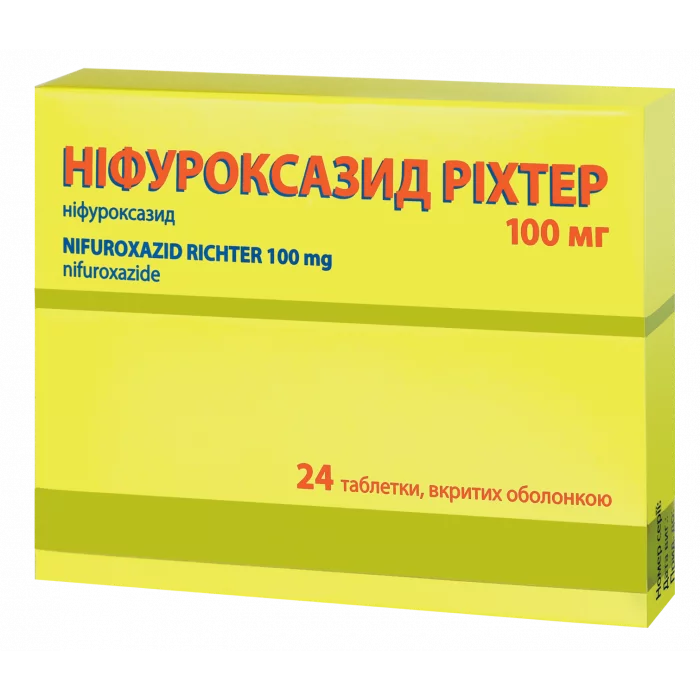
Nifuroxazide Richter 100 mg tablets, No. 24
Instructions
Nifuroxazid Richter: Instructions for Use
Composition
Active ingredient: nifuroxazide;
1 tablet contains:
- 100 mg of nifuroxazide;
Excipients: anhydrous colloidal silicon dioxide, potato starch, gelatin, talc, magnesium stearate; Coating: hypromellose (E 464), polyethylene glycol quinoline yellow (E 104), titanium dioxide (E 171), talc.
Dosage Form
Film-coated tablets.
Main physical and chemical properties: film-coated tablets, round, convex on both sides, yellow in color. Diameter approximately 9 mm.
Pharmacotherapeutic group
Antimicrobial agents used to treat intestinal infections.
ATC code A07A X03.
Pharmacological properties
Pharmacodynamics.
Nifuroxazide is a nitrofuran-derived antimicrobial agent. Its mechanism of action has not been fully elucidated. It is believed that nifuroxazide inhibits the activity of dehydrogenases and disrupts protein synthesis in pathogenic bacteria. The antimicrobial and antiparasitic properties of nifuroxazide may be due to the presence of an amino group. Its local activity and lack of penetration into the body’s organs and tissues make nifuroxazide unique compared to other nitrofuran derivatives, as this antidiarrheal drug has no systemic effect.
Nifuroxazide is effective against most pathogens (including mutant strains resistant to other antimicrobial drugs). It exerts a local antibacterial effect in the intestinal lumen against certain species of Gram-positive bacteria from the Staphylococcus family and certain species of Gram-negative bacteria from the Enterobacteriaceae family: Yersinia sp., Escherichia sp., Citobacter sp., Enterobacter sp., Klebsiella sp., Salmonella sp.
At moderate therapeutic doses, it exhibits bacteriostatic activity, and at higher doses, bactericidal activity. At therapeutic doses, it has virtually no effect on the balance of the saprophytic bacterial flora of the large intestine, does not cause the development of resistant strains of pathogenic microorganisms or cross-resistance of bacteria to other antimicrobial agents, which allows it to be prescribed, if necessary, as part of combination therapy with systemic antibacterial drugs for generalized infections. In cases of viral intestinal infections, it prevents the development of bacterial superinfection. The drug’s efficacy does not depend on the pH in the intestinal lumen. The therapeutic effect is achieved within the first few hours of treatment.
Pharmacokinetics.
After oral administration, it is hardly absorbed from the gastrointestinal tract and does not enter organs or tissues, resulting in a high concentration of the active ingredient in the intestine (more than 99% of the drug remains in the intestine). Biotransformation of nifuroxazide occurs in the intestine; more than 20% is excreted unchanged. Nifuroxazide and its metabolites are excreted in the feces. The rate of elimination depends on the dose administered and on gastrointestinal motility. In general, nifuroxazide is eliminated slowly and remains in the gastrointestinal tract for a long time.
Clinical Characteristics.
Indications
Acute diarrhea of infectious origin.
Contraindications for Richter’s Nifuroxazide
Hypersensitivity to nifuroxazide and other nitrofuran derivatives or to any of the drug’s excipients.
Interactions with other medications and other forms of interaction.
- Concomitant use of other oral medications should be avoided due to the strong adsorption properties of nifuroxazide.
- Concomitant use of nifuroxazide with sorbents, alcohol-containing medications, medications capable of causing antabuse-like reactions, and medications that depress the central nervous system is not recommended.
- Consumption of alcoholic beverages during treatment with nifuroxazide is strictly prohibited due to the possibility of a disulfiram-like reaction, which manifests as worsening diarrhea, vomiting, abdominal pain, a sensation of heat in the face and upper body, flushing, ringing in the ears, difficulty breathing, and tachycardia.
Special Considerations for Use
- Nifuroxazide should not be used for more than 7 days. There are no indications for long-term therapy. If diarrhea persists for more than 3 days after the start of treatment, further diagnostic testing is necessary to determine the cause of the symptoms. Antibiotic therapy may be required.
- In cases of severe invasive diarrhea with clinical manifestations of general weakness, fever, and symptoms of intoxication, the use of a systemic antibiotic is advisable, as nifuroxazide is not absorbed from the gastrointestinal tract.
- If a hypersensitivity reaction occurs (shortness of breath, swelling of the face, lips, or tongue, skin rash, itching), nifuroxazide should be discontinued immediately.
- During treatment for diarrhea, continuous supplemental oral rehydration is required to compensate for fluid loss caused by diarrhea: It is necessary to consume large amounts of beverages containing salt and sugar (based on an adult’s average daily requirement of 2 liters of water). In cases of severe and prolonged diarrhea, severe vomiting, or anorexia, intravenous rehydration is necessary, depending on the patient’s age and condition. For both oral and intravenous rehydration, follow the instructions for diluting and administering the solutions intended for this purpose.
- Patients should not consume alcoholic beverages during treatment with nifuroxazide due to the risk of developing a disulfiram-like reaction, which manifests as worsening diarrhea, vomiting, abdominal pain, a sensation of heat in the face and upper torso, flushing, ringing in the ears, shortness of breath, and tachycardia.
- It is recommended to continue eating, but during episodes of diarrhea, dietary recommendations should be followed: avoid fresh fruits and vegetables, spicy foods, frozen foods, and cold beverages. Baked meat and rice are recommended.
Pregnancy and Lactation
Pregnancy
There are no clinical data on the use of nifuroxazide during pregnancy. No teratogenic effects were observed in animal studies. In the absence of such effects in animals, teratogenic effects in humans are not expected. To date, the teratogenicity of substances causing birth defects in two animal species has been demonstrated in well-controlled studies. During clinical use, there are no relevant data to assess any malformative or fetotoxic effects of nifuroxazide when administered during pregnancy. Therefore, as a precautionary measure, it is advisable to avoid the use of nifuroxazide during pregnancy.
Breastfeeding
Nifuroxazide is not absorbed in the gastrointestinal tract. Breastfeeding remains possible during short-term treatment with this medication.
Effects on the Ability to Drive and Operate Machinery
Nifuroxazide does not affect reaction time when driving or operating machinery.
Directions for Use and Dosage of Richter Nifuroxazide
The tablets should be taken orally, whole, with a sufficient amount of water, regardless of meals. The maximum daily dose is 800 mg.
Adults and children over 15 years of age: 200 mg (2 tablets of 100 mg each) 4 times daily.
Children over 6 years of age: 200 mg (2 tablets of 100 mg each) 3–4 times daily.
The duration of treatment should not exceed 7 days. If symptoms persist, consult a doctor.
Children
Nifuroxazide Richter in the form of 100 mg tablets may be used in children over 6 years of age. For children under 6 years of age, it is recommended to use Nifuroxazide Richter in suspension form.
Overdose
There is no specific information regarding the symptoms of nifuroxazide overdose.
One case of overdose with nifuroxazide oral suspension has been reported in a 2-year-old child who ingested an unknown amount of the medication. The child developed drowsiness and diarrhea, and the symptoms later resolved. If an overdose of nifuroxazide is suspected, the patient should be kept under close observation and receive symptomatic and supportive treatment.
Adverse Reactions to Richter’s Nifuroxazide
- Blood and lymphatic system: One case of granulocytopenia has been reported.
- Immune system: allergic reactions, including anaphylactic shock, angioedema, urticaria, and pruritus.
- Gastrointestinal disorders: Isolated cases of hypersensitivity to nifuroxazide manifest as abdominal pain, nausea, vomiting, and worsening diarrhea. If these symptoms are mild, no special treatment or discontinuation of nifuroxazide is necessary, as the symptoms resolve quickly. If the exacerbation is severe, nifuroxazide should be discontinued. In the future, the patient should avoid taking nifuroxazide and other nitrofuran derivatives.
- Skin and subcutaneous connective tissue disorders: Skin reactions in the form of a rash rarely occur.
One case of pustulosis in the elderly and one case of nodular pruritus have been reported in patients with a history of contact allergy to nifuroxazide.
Shelf life
4 years.
Storage conditions
Store at a temperature not exceeding 25°C.
Keep out of reach of children.
Packaging
24 (24×1) tablets per blister pack; 1 blister pack per cardboard box.







