
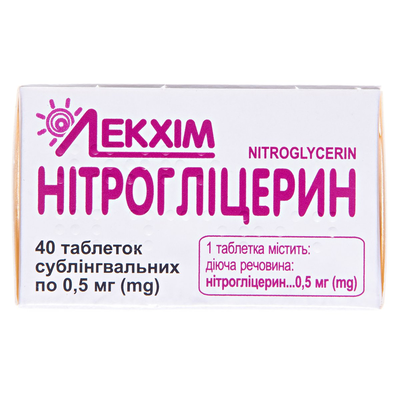
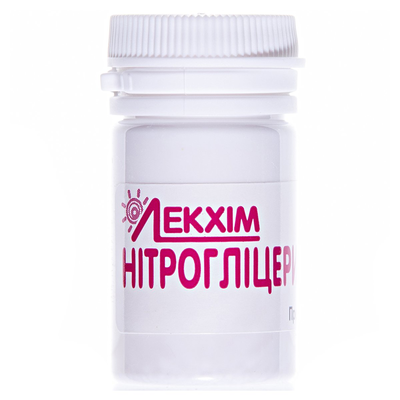
Nitroglycerin sublingual tablets, 0.5 mg each, No. 40 in a container.
Composition
Active ingredient: 1 sublingual tablet contains 2% nitroglycerin (based on lactose), equivalent to 0.5 mg of nitroglycerin;
Excipients: lactose monohydrate, pregelatinized starch, microcrystalline cellulose, croscarmellose sodium, calcium stearate.
Dosage Form
Sublingual tablets.
Main physical and chemical properties: single-layer, round tablets with flat upper and lower surfaces and beveled edges, scored, white or white with a cream tint. A marbled appearance on the tablet surface is permissible. When viewed under a magnifying glass, a relatively uniform structure is visible on the fracture surface.
Pharmacotherapeutic group
Vasodilators used in cardiology. Organic nitrates.
ATX code C01D A02.
Pharmacological Properties
Pharmacodynamics.
Nitroglycerin is a peripheral vasodilator with a predominant effect on peripheral blood vessels.
Nitroglycerin acts directly on the smooth muscle, primarily of venous and arterial vessels, via a nitrate receptor located in the smooth muscle membrane of the vascular wall. In smooth muscle, nitroglycerin is enzymatically converted to form nitric oxide (NO), which stimulates soluble guanylate cyclase, responsible for the formation of cyclic guanosine-3',5'-monophosphate (cGMP), which acts as a mediator of relaxation.
It influences the processes of central regulation of vascular tone and cardiac function. It promotes the release of catecholamines in the brain and heart, which leads to central inhibition of sympathetic and vasomotor tone, as well as a mediated sympathomimetic effect on the myocardium, and a change in the conformation of the troponin-tropomyosin complex. The nature and intensity of nitroglycerin’s effect on the heart and peripheral vessels depend on the interaction of central and peripheral processes. Inhibition of reflex vasoconstrictors in the coronary vessels—which results from the central inhibition of pain impulses—contributes to the relief of pain attacks in angina. The antianginal effect of nitroglycerin is due to its normalizing effect on electrolyte metabolism and myocardial energy, specifically: key indicators of the respiratory chain—the ratio of oxidized to reduced forms of nicotinamide coenzymes and the activity of NAD-dependent dehydrogenases. It affects cardiac function and systemic hemodynamics. Under the influence of nitroglycerin, retrograde blood flow increases due to the dilation and increased number of functioning collaterals. An indirect sympathomimetic effect, as well as the accumulation of cyclic AMP in the myocardium, leads to an increase in its contractility. In addition, nitric oxide effectively inhibits both platelet aggregation and adhesion. A decrease in peripheral resistance and a reduction in venous return are effects associated with the relaxation of the smooth muscle of the S3 vessels, leading to a reduction in preload and afterload on the heart. Varicose veins lead to a decrease in the amount of blood flowing to the heart and a reduction in preload, while arterial dilation leads to a decrease in total peripheral resistance and a reduction in afterload, which ultimately results in a reduction in the heart’s workload and improved coronary circulation.
There is a redistribution of blood flow in the myocardium toward the ischemic focus, and the myocardial inotropic function increases. Left ventricular end-diastolic pressure and heart size decrease, which improves blood supply to the subendocardial region of the myocardium, the area most vulnerable to ischemia. A reduction in peripheral venous and arterial resistance and in cardiac arterial pressure helps lower the left ventricle’s energy expenditure and the myocardium’s oxygen demand. Pressure in the pulmonary capillaries decreases, which leads to the prescription of nitroglycerin in cases of myocardial infarction with pulmonary edema, as well as in heart failure. In cases of ischemic hypokinesis of specific areas of the myocardium, its contractile function is restored. Meningeal vessels dilate, while the vessels of the internal organs constrict; pressure in the pulmonary arterial system decreases due to vasodilation and the systemic effects of nitroglycerin. Nitroglycerin relaxes the smooth muscles of the bronchi, biliary tract, digestive tract, and urinary tract. Experimental studies have not revealed any teratogenic or toxic effects on the embryo.
Pharmacokinetics.
After sublingual administration, the effect occurs within 0.5–2 minutes; 75% of patients report improvement within the first 3 minutes, and another 15% within 4–15 minutes.
Nitroglycerin taken sublingually is absorbed through the mucous membrane and enters primarily the systemic circulation. 60–75% of the dose is absorbed. Maximum plasma concentration—2.3 μg/L—is reached 2–4 minutes after administration; by the 8th minute, it has decreased by 50%, and after 20 minutes, nitroglycerin is almost undetectable in the blood. It is rapidly metabolized in the liver. Nitroesters of polyhydric alcohols are rapidly denitrated. Denitrated metabolites, such as 1,2- and 3,4-dinitrates, have a weaker effect and a longer half-life than nitroglycerin. The half-life of nitroglycerin is nearly 30 minutes. The cleavage of nitro groups occurs sequentially, both through the formation of inorganic nitrites and through the formation of nitrates. Alcohols, aldehydes, and organic acids are formed from the organic portion of the nitroester molecule. Four hours after administration of the drug, nitro ethers (the parent compound) are virtually undetectable. They are metabolized most actively in the liver, kidneys, and blood. Nitroethers are broken down in two ways: by glutathione-dependent reductase, which is localized primarily in the soluble fraction of hepatocytes, and by an enzyme that does not require reduced glutathione. The drug is metabolized primarily in the arteriovenous circulation, diffuses into smooth muscle cells, where it is converted to nitric oxide. A small portion of the drug, primarily under the influence of glutathione-S-reductase, is biotransformed in the liver into di- and mononitrates and glycerol. When taken orally, most of the drug is metabolized in the liver (the “first-pass” effect). A significant portion of the dinitrate and mononitrate is conjugated with glucuronic acid. The excretion of nitroglycerin metabolites occurs primarily via the kidneys; some metabolites are excreted through the lungs in exhaled air. The total clearance of nitroglycerin is 25–30 liters.
The half-life is 4–5 minutes. The half-life of the metabolites is 4 hours.
Indications
Angina pectoris (for the relief of angina attacks and short-term prevention).
Contraindications
Hypersensitivity to nitrates and the drug’s excipients; cerebral ischemia, hemorrhagic stroke, intracerebral hemorrhage, increased intracranial pressure, recent head trauma, bradycardia (less than 50 beats per minute), hypotension (systolic blood pressure below 90 mm Hg), shock, collapse, hypertrophic obstructive cardiomyopathy, aortic stenosis, conditions accompanied by a decrease in left ventricular filling pressure (acute myocardial infarction, isolated mitral stenosis, constrictive pericarditis), cardiac tamponade, toxic pulmonary edema, angle-closure glaucoma with high intraocular pressure, concomitant use of phosphodiesterase-5 (PDE-5) inhibitors (sildenafil, tadalafil, vardenafil),
Drug Interactions and Other Forms of Interaction
Concomitant use with other vasodilators, antihypertensive drugs, ACE inhibitors, calcium channel blockers, diuretics, tricyclic antidepressants, MAO inhibitors, ethanol and ethanol-containing medications, beta-blockers, procainamides, quinidine, and novocainamide enhances the antihypertensive effect of nitroglycerin.
Phosphodiesterase inhibitors (sildenafil, tadalafil, vardenafil)—the concurrent use of nitroglycerin with these drugs is contraindicated, as there is a potential risk of uncontrolled hypotension and life-threatening cardiovascular complications.
Atropine and other drugs with M-cholinergic effects may reduce the effect of nitroglycerin by decreasing the drug’s secretion and bioavailability.
Concomitant use with dihydroergotamine may lead to increased plasma concentrations of dihydroergotamine and elevated blood pressure (due to increased bioavailability of dihydroergotamine).
Concomitant use with heparin may reduce the anticoagulant effect of the latter (after discontinuation of the drug, a significant decrease in blood clotting may occur, which may require a reduction in the heparin dose).
Phenobarbital enhances the metabolism of nitrates in the liver. Alpha-adrenergic agents, histamine, pituitrin, corticosteroids, central nervous system stimulants, bee venom, snake venom, and sunlight reduce the antianginal effect of nitroglycerin. Salicylates increase the level of nitroglycerin in the blood, while barbiturates accelerate its metabolism. Sulfhydryl group donors (captopril, acetylcysteine, unitiol) restore reduced sensitivity to nitroglycerin.
Special Considerations for Use
This medication should be used with caution, weighing the risks against the benefits, in cases of: uncontrolled hypovolemia, patients with heart failure and normal or reduced pulmonary artery pressure, severe anemia, hyperthyroidism, severe renal and/or hepatic insufficiency (risk of methemoglobinemia).
Use with caution in patients with severe cerebral atherosclerosis and in elderly patients. Alcohol consumption is not permitted during treatment; visiting a bathhouse, sauna, or taking a hot shower is contraindicated.
Do not chew the tablet, as an excessive amount of the active ingredient may enter the systemic circulation through the oral mucosa.
Nitroglycerin, like other organic nitrates, can lead to tolerance with frequent use, which may require an increase in dosage. With long-term use of nitroglycerin, to prevent tolerance, it is recommended to take the medication intermittently throughout the day (at 10–12-hour intervals) or to take it concurrently with calcium channel blockers, ACE inhibitors, or diuretics. If necessary, when tolerance develops, it may be necessary to temporarily discontinue nitroglycerin (for several days) and replace it with antianginal agents from other pharmacotherapeutic classes.
Consult your doctor before using this medication for the first time!
Be sure to inform your doctor of any previous reactions to medications in this class.
When taking nitroglycerin, a significant drop in blood pressure and dizziness may occur upon a sudden change from a lying or sitting position to a standing position; this may also happen when consuming alcohol or engaging in physical activity in hot weather.
If blurred vision or dry mouth persists or is severe, treatment should be discontinued.
The severity of headaches while taking this medication can be reduced by lowering the dose and/or taking Validole concurrently.
The risk of developing methemoglobinemia, manifested by cyanosis and a change in blood color, increases with prolonged, unmonitored use of nitroglycerin or with high doses of the drug in patients with hepatic insufficiency. If methemoglobinemia develops, nitroglycerin must be discontinued immediately and the antidote—methylthioninium chloride (methylene blue)—administered. If continued use of nitrates is necessary, methemoglobin levels must be monitored.
This medication contains lactose; therefore, patients with rare hereditary forms of galactose intolerance, lactase deficiency, or glucose-galactose malabsorption should not take this medication.
Pregnancy and Lactation
The use of nitroglycerin during pregnancy or lactation is contraindicated.
Effects on the Ability to Drive and Operate Machinery
When operating vehicles or machinery that require increased attention, keep in mind that taking nitroglycerin may slow reaction time.
Dosage and Administration
Use in Adults.
When prescribing the drug for the first time, its effect on blood pressure must be assessed. The effectiveness of nitroglycerin should be monitored by measuring heart rate and blood pressure.
It should be taken immediately at the first symptoms of an angina attack.
Immediately after the onset of pain, place 1 tablet under the tongue and hold it in the mouth until it is completely absorbed, without swallowing. The usual dose is 1 tablet under the tongue. If there is no antianginal effect within 3–5 minutes, take another 1 nitroglycerin tablet.
If there is no therapeutic effect after taking 2–3 tablets, call a doctor.
For frequent angina attacks, it is advisable to use long-acting medications.
Tolerance to sublingual forms of nitroglycerin rarely develops; however, if it does occur in some patients, the dose should be gradually increased to 2–3 tablets.
Children
There is no experience with the use of this medication in children; therefore, its use in this age group is not recommended.
Overdose
Symptoms: decreased blood pressure (below 90 mmHg) with orthostatic dysregulation, headache, severe dizziness, fainting, rapid heartbeat, nausea, and vomiting, shortness of breath, severe weakness, drowsiness, fever, hypotension, sweating, and chills.
At high doses (more than 20 μg/kg)—collapse, cyanosis of the lips, nails, or palms, methemoglobinemia, shortness of breath, and tachypnea.
Treatment: Place the patient in a horizontal position, elevate the legs; in severe cases, administer plasma substitutes, sympathomimetics, oxygen, and methylene blue for methemoglobinemia.
Side Effects
Central nervous system: blurred vision, “nitrate” headache (especially at the start of treatment; decreases with prolonged therapy), dizziness and weakness, anxiety, psychotic reactions, lethargy, disorientation.
Cardiovascular system: decreased blood pressure, reflex tachycardia, rarely (especially with overdose)—orthostatic collapse, cyanosis, methemoglobinemia, facial flushing.
Gastrointestinal disorders: dry mouth, nausea, vomiting, abdominal pain.
Immune system: allergic reactions, including skin rashes, hives, itching; skin flushing, pallor, anaphylactic shock.
Other: agitation, visual disturbances, exacerbation of glaucoma, hypothermia, feeling of heat, respiratory disturbances, weakness.
Isolated cases of the following adverse reactions have also been reported: exacerbation of ischemic heart disease due to hypoxia, complete heart block, asystole, and angioedema.
Occasionally, a sharp drop in blood pressure may lead to an exacerbation of angina symptoms (paradoxical “nitrate” reactions).
Shelf life
2.5 years.
Storage conditions
Store in the original packaging at a temperature not exceeding 25 °C. Keep out of the reach of children.
Packaging
20 or 40 sublingual tablets per package; 1 package per carton.
Sales Conditions
Available without a prescription.
Manufacturer
PJSC “Technolog.”







