
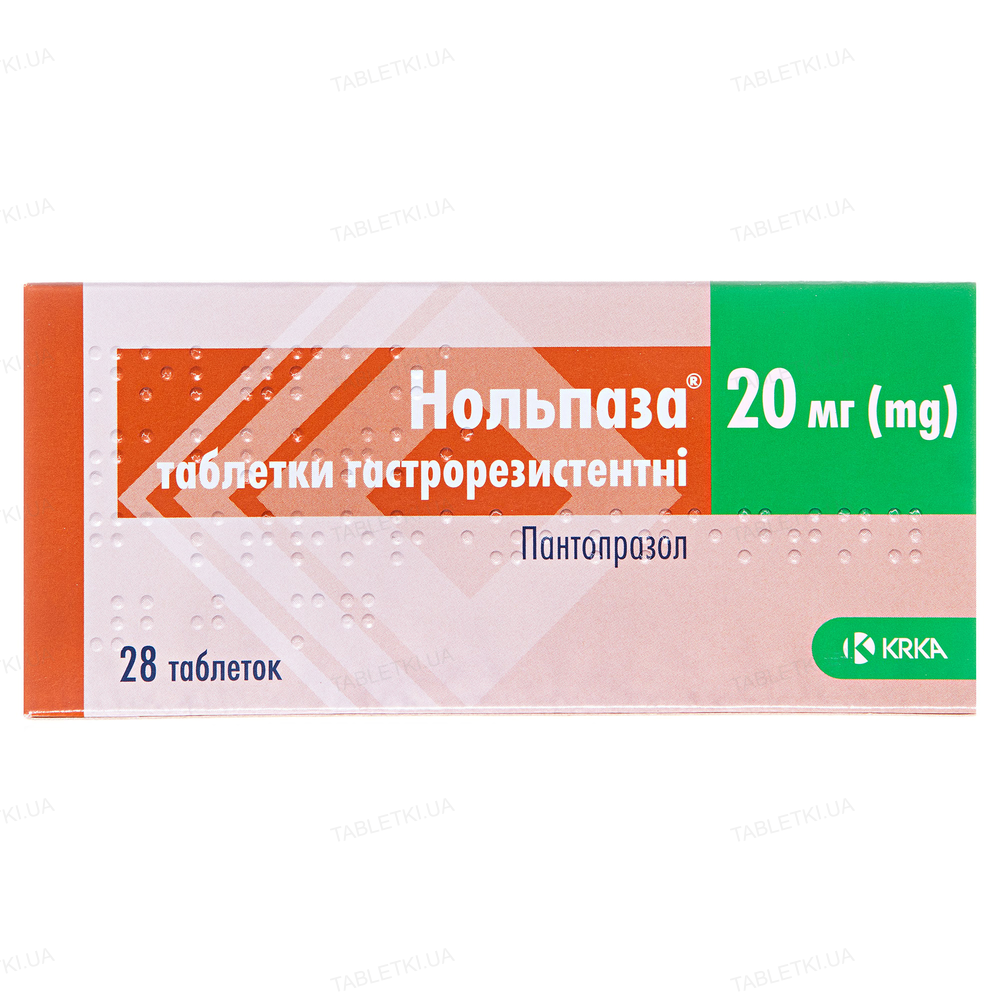
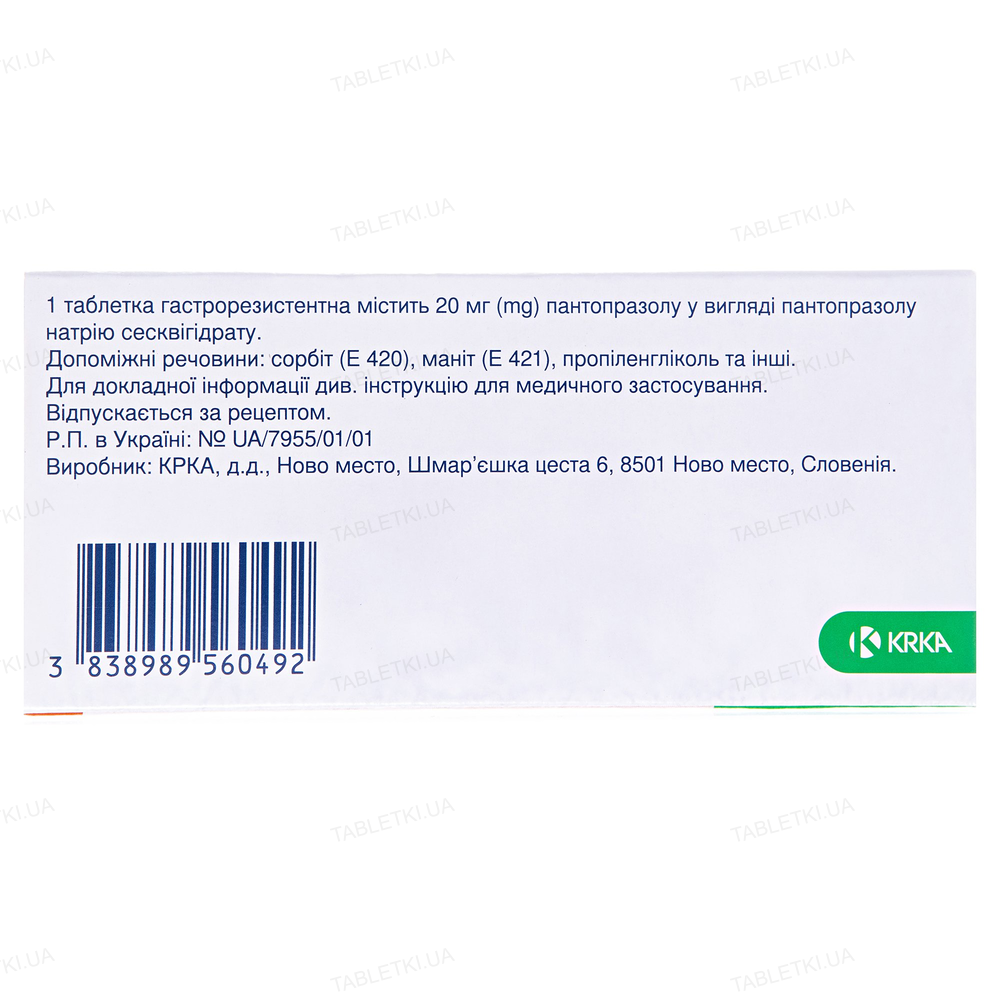

Nolpaza gastro-resistant tablets, 20 mg each, No. 28 (14 x 2)
1 enteric-coated tablet contains 20 mg of pantoprazole in the form of pantoprazole sodium sesquihydrate;
Excipients: mannitol (E 421), crospovidone (type A), crospovidone (type B), anhydrous sodium carbonate, sorbitol (E 420), calcium stearate, hypromellose, povidone, titanium dioxide (E 171), iron(III) oxide (E 172), propylene glycol, methacrylate copolymer dispersion, sodium lauryl sulfate, polysorbate 80, talc, macrogol 6000.
Dosage Form
Gastro-resistant tablets.
Main physical and chemical properties: light yellow-brown, oval, slightly biconvex tablets, film-coated.
Pharmacotherapeutic group
Proton pump inhibitors. ATX code A02B C02.
Pharmacological properties
Pharmacodynamics.
Pantoprazole is a substituted benzimidazole that blocks gastric hydrochloric acid secretion by specifically acting on the proton pump of parietal cells.
Pantoprazole is converted to its active form in an acidic environment, specifically in parietal cells, where it inhibits the enzyme H+-K+-ATPase, thereby blocking the final stage of hydrochloric acid production in the stomach. This inhibition is dose-dependent and affects both basal and stimulated acid secretion.
Treatment with pantoprazole, like other proton pump inhibitors (PPIs) and H2-receptor antagonists, reduces gastric acidity and, consequently, increases gastrin secretion in proportion to the reduction in acidity. The increase in gastrin secretion is reversible. Since pantoprazole binds to the enzyme distally from the cellular receptor, it can inhibit hydrochloric acid secretion regardless of stimulation by other substances (acetylcholine, histamine, gastrin). The drug’s efficacy is the same whether administered orally or intravenously.
When pantoprazole is used, fasting gastrin levels rise. With short-term use, these levels do not exceed the upper limit of normal in most cases. With long-term treatment, gastrin levels double in most cases. Excessive increases occur only in isolated cases. As a result, in a small number of cases during long-term treatment, a mild or moderate increase in the number of enterochromaffin-like cells (ECL cells) in the stomach (adenomatoid hyperplasia) is observed. Nevertheless, according to studies conducted to date, the formation of precursor cells for neuroendocrine tumors of the stomach—which have been observed in animal experiments—has not been observed in humans. However, with long-term (more than 1 year) treatment, the effect of pantoprazole on thyroid endocrine parameters cannot be ruled out.
During treatment with antisecretory drugs, serum gastrin levels rise in response to reduced acid secretion. In addition, due to reduced gastric acidity, chromogranin A (CgA) levels increase. Elevated CgA levels may affect test results in the diagnosis of neuroendocrine tumors. Available published data indicate that treatment with proton pump inhibitors should be discontinued 5 days to 2 weeks prior to CgA measurements. This allows CgA levels to return to normal values, which may be falsely elevated following PPI treatment.
Pharmacokinetics.
Pantoprazole is rapidly absorbed, and peak plasma concentrations are reached even after a single 40-mg dose. On average, a maximum plasma concentration of 2–3 μg/mL is reached within 2.5 hours after administration and remains constant even after repeated doses. The volume of distribution is approximately 0.15 L/kg, and clearance is approximately 0.1 L/h/kg.
The half-life is approximately 1 hour. In some cases, the elimination half-life was prolonged. Due to the specific binding of pantoprazole to the proton pump of parietal cells, the half-life does not correlate with a longer duration of action.
Pharmacokinetics remain unchanged following single or multiple doses. At doses ranging from 10 to 80 mg, the plasma pharmacokinetics of pantoprazole are linear following both oral and intravenous administration.
Panto-prazole binds to plasma proteins at approximately 98%. The drug is almost completely metabolized in the liver. The primary route of elimination is via the kidneys—approximately 80% of panto-prazole metabolites; the remainder is excreted in the feces. The major metabolite in both plasma and urine is dismethylpantoprazole, which is conjugated with sulfate. The half-life of the major metabolite (approximately 1.5 hours) is not much longer than that of pantoprazole.
Bioavailability. After oral administration, pantoprazole is completely absorbed. The absolute bioavailability of the tablet is approximately 77%. Food intake does not affect the area under the “concentration-time” pharmacokinetic curve (AUC), the maximum plasma concentration, or bioavailability; there is only a delay in the onset of action.
Characteristics of Specific Patient Groups
Slow metabolizers. About 3% of Europeans have low functional activity of the CYP2C19 enzyme; they are referred to as slow metabolizers. In these individuals, the metabolism of pantoprazole is likely catalyzed primarily by the CYP3A4 enzyme. Following a single 40-mg dose of pantoprazole, the mean area defined by the pharmacokinetic “plasma concentration-time” curve, was approximately 6 times greater in slow metabolizers than in individuals with a functionally active CYP2C19 enzyme (rapid metabolizers). The mean peak plasma concentration increased by approximately 60%. These results do not affect the dosing of pantoprazole.
No dose reduction is required for patients with renal impairment (including those on hemodialysis). As in healthy individuals, the half-life of pantoprazole is short. Only very small amounts of pantoprazole are removed by dialysis. Although the half-life of the major metabolite increases slightly (2–3 hours), it is rapidly eliminated from the body and therefore does not accumulate.
In patients with liver cirrhosis (Child-Pugh classes A and B), the half-life increases to 7–9 hours and, accordingly, the AUC increases 5–7-fold and the maximum plasma concentration of pantoprazole increases 1.5-fold compared with healthy subjects.
A slight increase in AUC and the maximum plasma concentration of pantoprazole in elderly volunteers compared with younger volunteers is also not clinically significant.
Elderly patients. A slight increase in AUC and Cmax in elderly volunteers compared with the corresponding values in younger volunteers is also not clinically significant.
Children. Following a single oral dose of 20 or 40 mg of pantoprazole, the AUC and Cmax in children aged 5 to 16 years were within the adult range. Following a single intravenous administration of 0.8 or 1.6 mg/kg of pantoprazole in children aged 2 to 16 years, no significant relationship was observed between pantoprazole clearance and age or body weight. The AUC and volume of distribution are consistent with those observed in studies of adults.
Indications
Adults and children over 12 years of age.
- Symptomatic treatment of gastroesophageal reflux disease.
- Long-term treatment and prevention of relapses of reflux esophagitis.
Adults.
- Prevention of gastric and duodenal ulcers caused by nonselective nonsteroidal anti-inflammatory drugs (NSAIDs) in at-risk patients requiring long-term use of NSAIDs.
Contraindications
Hypersensitivity to pantoprazole, benzimidazole derivatives, or any other ingredient in the medication.
Drug Interactions and Other Interactions
Drugs whose absorption depends on pH. Due to its complete and prolonged inhibition of hydrochloric acid secretion, pantoprazole may affect the absorption of drugs for which gastric pH is an important factor in their bioavailability (for example, certain antifungal drugs such as ketoconazole, itraconazole, posaconazole, or other drugs such as erlotinib).
HIV protease inhibitors. Concomitant use of pantoprazole with HIV protease inhibitors (such as atazanavir), whose absorption depends on intragastric pH, is not recommended due to a significant reduction in their bioavailability (see the “Special Instructions and Precautions for Use” section).
If concomitant use of HIV protease inhibitors with proton pump inhibitors cannot be avoided, close clinical monitoring (e.g., of viral load) is recommended. The daily dose of pantoprazole should not exceed 20 mg. A dose adjustment of HIV protease inhibitors may be required.
Coumarin anticoagulants (fenprocoumon and warfarin).
Concomitant use of pantoprazole with warfarin or fenprocoumon did not affect the pharmacokinetics of warfarin, fenprocoumon, or the INR (International Normalized Ratio). However, increases in the INR and prolongation of prothrombin time have been reported in patients receiving both a PPI and warfarin or fenprocoumon. An increase in the INR and prolongation of prothrombin time may lead to pathological bleeding and even death. In cases of such concomitant use, the INR and prothrombin time should be monitored.
Methotrexate. It has been reported that the concomitant use of high doses of methotrexate (e.g., 300 mg) and proton pump inhibitors increases blood levels of methotrexate in some patients. Patients receiving high doses of methotrexate—such as those with cancer or psoriasis—are advised to temporarily discontinue treatment with pantoprazole.
Study of Other Interactions
Pantoprazole is extensively metabolized in the liver via the cytochrome P450 enzyme system. The primary metabolic pathway is demethylation by CYP2C19, and other metabolic pathways include oxidation by CYP3A4.
Studies with drugs that are also metabolized via these pathways—such as carbamazepine, diazepam, glibenclamide, nifedipine, phenprocoumon, as well as oral contraceptives containing levonorgestrel and ethinyl estradiol, have not revealed any clinically significant interactions.
Interactions between pantoprazole and other drugs metabolized via the same enzyme system cannot be ruled out.
The results of studies on potential interactions indicate that pantoprazole does not affect the metabolism of active substances metabolized by CYP1A2 (e.g., caffeine and theophylline), CYP2C9 (e.g., piroxicam, diclofenac, naproxen), CYP2D6 (e.g., metoprolol), CYP2E1 (e.g., ethanol), or on P-glycoprotein, which mediates the absorption of digoxin.
No interactions with concomitantly administered antacids have been identified.
Specific studies have been conducted on the interaction of pantoprazole with certain antibiotics (clarithromycin, metronidazole, amoxicillin) when the drugs are administered concomitantly. No clinically significant interactions between these drugs have been identified.
Drugs that inhibit or induce CYP2C19. CYP2C19 inhibitors, such as fluvoxamine, may increase the systemic exposure of pantoprazole. A dose reduction should be considered for patients receiving long-term therapy with high doses of pantoprazole and for patients with hepatic impairment. Enzyme inducers affecting CYP2C19 and CYP3A4, such as rifampicin and St. John’s wort (Hypericum perforatum), may reduce plasma concentrations of PPIs that are metabolized via these enzyme systems.
Special Considerations
Patients with hepatic impairment
In cases of severe hepatic impairment during treatment with this medication, especially with long-term use, regular monitoring of liver enzyme levels is necessary. If liver enzyme levels rise, treatment should be discontinued.
Concomitant use with NSAIDs.
The use of Nolpaza®, 20 mg enteric-coated tablets, for the prevention of gastric and duodenal ulcers caused by long-term NSAID use should be limited in patients prone to frequent exacerbations of gastric and duodenal ulcers.
Risk assessment is based on individual risk factors, including age (> 65 years), a history of gastric or duodenal ulcers, and gastrointestinal bleeding.
HIV protease inhibitors. Concomitant use of pantoprazole with HIV protease inhibitors (such as atazanavir), whose absorption depends on intragastric pH, is not recommended due to a significant decrease in their bioavailability (see the section “Interactions with Other Medications and Other Forms of Interaction”).
Effect on Vitamin B12 Absorption
Pantoprazole may reduce the absorption of vitamin B12 (cyanocobalamin) due to the development of hypo- or achlorhydria. This should be taken into account if patients are underweight or have risk factors for reduced absorption of vitamin B12 (cyanocobalamin), especially during long-term treatment or in the presence of relevant clinical symptoms.
Long-term treatment
If treatment lasts longer than 1 year, the patient should be under constant medical supervision.
Malignant tumors of the stomach. A symptomatic response to pantoprazole may mask the symptoms of malignant tumors of the stomach and delay their diagnosis. If alarming symptoms are present (e.g., significant weight loss, recurrent vomiting, dysphagia, vomiting blood, anemia, melena), or if a gastric ulcer is suspected or confirmed, the presence of a malignant process should be ruled out.
If symptoms persist despite adequate treatment, further evaluation should be conducted.
Hypomagnesemia. Cases of severe hypomagnesemia have been observed in patients receiving PPIs, such as pantoprazole, for at least three months, and in most cases for one year. The following serious clinical manifestations of hypomagnesemia may occur and develop initially without noticeable symptoms: fatigue, tetany, delirium, seizures, dizziness, and ventricular arrhythmia. In cases of hypomagnesemia, patients’ condition improved in most cases following corrective replacement therapy with magnesium supplements and discontinuation of PPIs.
For patients requiring long-term therapy, or patients taking PPIs concomitantly with digoxin or medications that may cause hypomagnesemia (e.g., diuretics), should have their magnesium levels measured before starting PPI therapy and periodically during treatment.
Bone fractures. Long-term treatment (more than 1 year) with high-dose proton pump inhibitors may slightly increase the risk of hip, wrist, and spinal fractures, primarily in the elderly or in the presence of other risk factors. Observational studies suggest that the use of proton pump inhibitors may increase the overall risk of fractures by 10–40%. Some of these increases may be attributable to other risk factors. Patients at risk for osteoporosis should be treated in accordance with current clinical guidelines and should ensure adequate intake of vitamin D and calcium.
Gastrointestinal infections caused by bacteria
Treatment with this medication may slightly increase the risk of gastrointestinal infections caused by bacteria such as Salmonella, Campylobacter, or C. difficile.
Subacute cutaneous lupus erythematosus. The use of proton pump inhibitors has been associated with very rare cases of subacute cutaneous lupus erythematosus. If a rash develops, especially on areas exposed to sunlight, and is accompanied by arthralgia, the patient should immediately consult a doctor, who will consider whether to discontinue Nolpaza®. The occurrence of subacute cutaneous lupus erythematosus in patients who have previously received proton pump inhibitor therapy may increase the risk of its development when using other proton pump inhibitors.
Effect on laboratory test results.
Elevated levels of chromogranin A (CgA) may affect test results used to diagnose neuroendocrine tumors. To avoid this effect, treatment with Nolpaza® should be temporarily discontinued at least 5 days prior to CgA level assessment (see the “Pharmacodynamics” section). If, after the initial measurement, CgA and gastrin levels have not returned to the normal range, repeat measurements should be performed 14 days after discontinuation of proton pump inhibitor therapy.
Information on Excipients
Nolpaza contains sorbitol. Patients with rare hereditary disorders of fructose intolerance should not take this medication.
Pregnancy and lactation. Available data on the use of Nolpaza® in pregnant women indicate no embryonic or fetal/neonatal toxicity. Reproductive toxicity has been observed in animals. As a precaution, the use of Nolpaza®® should be avoided in pregnant women.
Breastfeeding. Animal studies have shown that pantoprazole is excreted into breast milk. There are insufficient data on the excretion of pantoprazole into human breast milk, but such excretion has been reported. A risk to newborns/infants cannot be ruled out. The decision to discontinue breastfeeding or to discontinue or refrain from treatment with Nolpaza®® should be made by weighing the benefits of breastfeeding for the infant against the benefits of treatment with Nolpaza®® for the woman.
Fertility. Pantoprazole did not impair fertility in animal studies.
Effects on the ability to drive and operate machinery.
Pantoprazole has no or only a very minor effect on reaction time when driving or operating machinery. Possible side effects, such as dizziness and visual disturbances, should be taken into account (see the “Side Effects” section). In such cases, you should not drive or operate machinery.
Dosage and Administration
Nolpaza®, 20 mg enteric-coated tablets, should be taken 1 hour before a meal, whole, without chewing or crushing, with water.
Recommended dosage.
Adults and children over 12 years of age.
Symptomatic treatment of gastroesophageal reflux disease.
The recommended dose is 20 mg (1 tablet) of Nolpaza® per day. Heartburn symptoms usually resolve within 2–4 weeks. If this period is insufficient, treatment should be continued for the next 4 weeks. Once symptoms have resolved, recurrences can be managed with 20 mg of the medication as needed.
Long-term treatment and prevention of reflux esophagitis relapses.
For long-term treatment, the maintenance dose is 20 mg (1 tablet) of Nolpaza® per day; in the event of a flare-up, the dose may be increased to 40 mg per day. In this case, it is recommended to take 40 mg Nolpaza® tablets. Once the relapse has resolved, the dose can be reduced again to 20 mg of the medication per day.
Adults.
Prevention of gastric and duodenal ulcers caused by nonselective nonsteroidal anti-inflammatory drugs (NSAIDs) in at-risk patients who must take NSAIDs for an extended period.
The recommended dose is 20 mg (1 tablet) of Nolpaza® per day.
Hepatic dysfunction. Patients with severe hepatic insufficiency should not exceed a dose of 20 mg (1 tablet) per day.
Renal impairment. No dose adjustment is required for patients with renal impairment.
No dose adjustment is required for elderly patients.
Children.
This medication should not be used in children under 12 years of age.
Overdose
Symptoms of overdose are unknown.
Doses up to 240 mg administered intravenously over 2 minutes were well tolerated. Since pantoprazole is extensively bound to plasma proteins, it is not a drug that can be readily removed by dialysis.
In the event of an overdose with the appearance of clinical signs of intoxication, symptomatic and supportive therapy should be administered. There are no recommendations for specific therapy.
Side Effects
Adverse reactions occurred in approximately 5% of patients. The most common adverse reactions are diarrhea and headache (about 1%).
Adverse effects are classified by frequency into the following categories: very common (≥ 1/10), common (≥ 1/100 and < 1/10), uncommon (≥ 1/1,000 and < 1/100), rare (≥ 1/10,000 and < 1/1,000), very rare (< 1/10,000), unknown (frequency cannot be estimated from the available data).
Disorders of the blood and lymphatic system.
Rare: agranulocytosis.
Very rare: leukopenia, thrombocytopenia, pancytopenia.
Immune system disorders.
Rare: hypersensitivity reactions (including anaphylactic reactions, anaphylactic shock).
Metabolism and metabolic disorders.
Rare: hyperlipidemia and elevated lipid levels (triglycerides, cholesterol), changes in body weight.
Frequency unknown: hyponatremia, hypomagnesemia (see “Special Instructions and Precautions”), hypocalcemia¹, hypokalemia.
Psychiatric disorders.
Uncommon: sleep disturbances.
Rare: depression (including exacerbation).
Very rare: disorientation (including exacerbation).
Frequency unknown: hallucinations, confusion (especially in patients predisposed to these disorders, as well as exacerbation of these symptoms if they are pre-existing).
Nervous system disorders.
Uncommon: headache, dizziness.
Rare: taste disturbances.
Frequency unknown: paresthesia.
Eye disorders.
Rare: visual disturbances/blurred vision.
Gastrointestinal disorders.
Common: polyps at the base of the gland (benign).
Uncommon: diarrhea, nausea, vomiting, bloating, constipation, dry mouth, abdominal pain, and discomfort.
Hepatobiliary disorders.
Uncommon: elevated liver enzyme levels (transaminases, γ-GT).
Rare: elevated bilirubin.
Frequency unknown: hepatocyte damage, jaundice, hepatocellular failure.
Skin and subcutaneous tissue disorders.
Uncommon: skin rash, exanthema, pruritus.
Rare: urticaria, angioedema.
Frequency unknown: Stevens-Johnson syndrome, Lyell’s syndrome, erythema multiforme, photosensitivity, subacute cutaneous lupus erythematosus (see Section 4.4).
Musculoskeletal and connective tissue disorders.
Uncommon: fractures of the hip, wrist, or spine (see section “Special Instructions and Precautions for Use”).
Rare: arthralgia, myalgia.
Frequency unknown: muscle spasm2.
Disorders of the kidneys and urinary system.
Frequency unknown: interstitial nephritis (with possible renal failure).
Disorders of the reproductive system and mammary glands.
Rare: gynecomastia.
General disorders.
Uncommon: asthenia, rapid fatigue, malaise.
Rare: fever, peripheral edema.
- Hypocalcemia accompanied by hypomagnesemia.
- Muscle spasms resulting from electrolyte imbalance.
Shelf life
5 years.
Storage conditions
Store at a temperature not exceeding 30 °C in the original packaging to protect from moisture. Keep out of reach of children.
Packaging
14 tablets per blister pack; 1, 2, or 4 blister packs per cardboard box.
Manufacturer
KRKA, d.d., Novo Mesto, Slovenia/
KRKA, d.d., Novo Mesto, Slovenia.
Address
Tel.: +385 (0)85 660 000
Smarjeska cesta 6, 8501 Novo Mesto, Slovenia.







