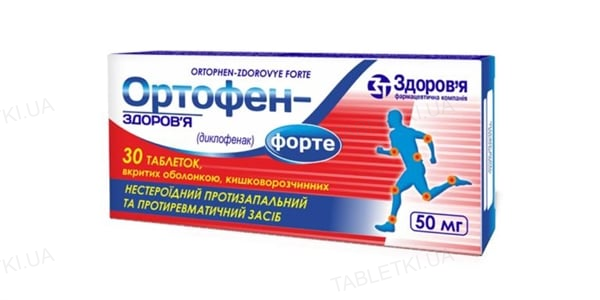
Orthofen-Zdorovye Forte Tablets, enteric-coated, 50 mg, No. 30 (10 x 3)
Composition
Active ingredient: Each tablet contains 50 mg of diclofenac sodium;
inactive ingredients: lactose monohydrate; crospovidone; microcrystalline cellulose; croscarmellose sodium; magnesium stearate; anhydrous colloidal silicon dioxide; “Acryl-eze white” dry mixture containing talc, titanium dioxide (E 171), methacrylate copolymer (type C), sodium lauryl sulfate, sodium bicarbonate, silicon dioxide; polyethylene glycol 6000; Ponceau 4R (E 124); azorubine (E 122).
Dosage Form
Enteric-coated tablets.
Main physical and chemical properties: film-coated tablets, ranging in color from pink to pink with a reddish tint. Two layers are visible on cross-section.
Pharmacotherapeutic group
Nonsteroidal anti-inflammatory and antirheumatic agents.
ATC code M01A B05.
Pharmacological properties
Pharmacodynamics. The drug contains diclofenac sodium—a nonsteroidal compound that exerts a pronounced analgesic and anti-inflammatory effect.
It is an inhibitor of prostaglandin synthase (cyclooxygenase).
In vitro, diclofenac sodium at concentrations equivalent to those achieved during treatment of patients does not inhibit the biosynthesis of cartilage proteoglycans.
Pharmacokinetics. Although absorption is complete, the onset of action may be delayed as a result of passage through the stomach, which may be influenced by food intake, as it slows gastric emptying. Mean peak plasma concentrations of 1.48 ± 0.65 μg/mL (1.5 μg/mL = 5 μmol/L) are reached on average 2 hours after administration of a 50-mg tablet.
Approximately half of the administered diclofenac is metabolized during first-pass metabolism in the liver (first-pass effect); the area under the concentration-time curve (AUC) following oral administration is approximately half that obtained with an equivalent parenteral dose.
The pharmacokinetic characteristics of the drug do not change with repeated administration. No accumulation occurs provided the recommended dosage is followed.
The binding of diclofenac to serum proteins is 99.7%, and to albumin, 99.4%.
Diclofenac penetrates into the synovial fluid, where its Cmax is reached 2–4 hours later than in blood plasma. The half-life (T½) in synovial fluid is 3–6 hours. Two hours after Cmax is reached in plasma, the concentration of diclofenac in synovial fluid remains higher; this phenomenon persists for 12 hours.
Diclofenac was detected at a low concentration (100 ng/mL) in the breast milk of one woman. The estimated amount of the drug entering the infant’s body via breast milk is equivalent to a dose of 0.03 mg/kg/day.
Diclofenac is metabolized in part by glucuronidation of the unchanged molecule, but primarily through single and multiple hydroxylation and methoxylation, leading to the formation of several phenolic metabolites, most of which form conjugates with glucuronic acid. Two of these phenolic metabolites are biologically active, but to a much lesser extent than diclofenac.
The total systemic clearance of diclofenac from plasma is 263 ± 56 mL/min (mean ± SD). The terminal half-life (T½) in plasma is 1–2 hours. The half-life (T½) in plasma of the four metabolites, including the two pharmacologically active ones, is also short, ranging from 1 to 3 hours. Approximately 60% of the administered dose is excreted in the urine as a glucuronide conjugate of the intact molecule and as metabolites, most of which are also converted to glucuronide conjugates. Less than 1% of diclofenac is excreted unchanged. The remainder of the administered dose is excreted as metabolites in the feces.
No effect of the patient’s age on the absorption, metabolism, or excretion of the drug was observed, except for the fact that in five elderly patients, a 15-minute intravenous infusion resulted in a 50% higher plasma concentration of the drug than expected in young, healthy individuals.
In patients with impaired renal function receiving therapeutic doses, accumulation of the unchanged active substance is not expected, based on the drug’s kinetics following a single administration. In patients with creatinine clearance less than 10 mL/min, the calculated steady-state plasma concentrations of hydroxylated metabolites were approximately 4 times higher than in healthy individuals. However, ultimately, all metabolites were excreted in the bile.
In patients with chronic hepatitis or compensated liver cirrhosis, the pharmacokinetic parameters and metabolism of diclofenac are similar to those in patients without liver disease.
Indications
- Inflammatory and degenerative forms of rheumatic diseases (rheumatoid arthritis, ankylosing spondylitis, osteoarthritis, spondyloarthropathies);
- pain syndromes involving the spine;
- rheumatic diseases of extra-articular soft tissues;
- acute gout attacks;
- post-traumatic and postoperative pain syndromes accompanied by inflammation and swelling, such as those following dental and orthopedic procedures;
- gynecological conditions accompanied by pain and inflammation, such as primary dysmenorrhea or adnexitis;
- as an adjunctive treatment for severe inflammatory diseases of the ENT organs accompanied by pronounced pain, such as pharyngotonsillitis or otitis.
- In accordance with general therapeutic principles, the underlying disease should be treated with standard therapy. Fever alone is not an indication for the use of this medication.
Contraindications
- Hypersensitivity to any component of the drug.
- Acute gastric or intestinal ulcer; gastrointestinal bleeding or perforation.
- History of gastrointestinal bleeding or perforation associated with prior treatment with nonsteroidal anti-inflammatory drugs (NSAIDs).
- Active peptic ulcer disease/bleeding or a history of recurrent peptic ulcer disease/bleeding (two or more separate episodes of diagnosed ulcer or bleeding).
- Inflammatory bowel diseases (e.g., Crohn’s disease or ulcerative colitis).
- Liver failure.
- Renal insufficiency.
- Congestive heart failure (NYHA Class II–IV).
- Ischemic heart disease in patients with angina or a history of myocardial infarction.
- Cerebrovascular diseases in patients who have had a stroke or have episodes of transient ischemic attacks.
- Peripheral arterial disease.
- Treatment of perioperative pain during aortocoronary bypass surgery (or use of a heart-lung machine).
- Like other NSAIDs, this medication is contraindicated in patients who experience bronchial asthma attacks, angioedema, urticaria, acute rhinitis, nasal polyps, or other allergic symptoms.
Interactions with Other Medications and Other Types of Interactions
The following interactions have been observed with the use of diclofenac in tablet form and/or other dosage forms.
Lithium. When used concomitantly, diclofenac may increase plasma lithium concentrations. Monitoring of serum lithium levels is recommended.
Digoxin. When used concomitantly, diclofenac may increase digoxin concentrations in plasma. Monitoring of serum digoxin levels is recommended.
Diuretics and antihypertensive agents. As with other NSAIDs, concomitant use of diclofenac with diuretics and antihypertensive agents (e.g., β-blockers, angiotensin-converting enzyme (ACE) inhibitors)) may reduce their antihypertensive effect by inhibiting the synthesis of vasodilatory prostaglandins. Therefore, this combination should be used with caution, and patients, especially the elderly, should be closely monitored for blood pressure. Patients should be adequately hydrated; monitoring of renal function is also recommended after initiation of concomitant therapy and on a regular basis thereafter, particularly with diuretics and ACE inhibitors, due to an increased risk of nephrotoxicity.
Drugs known to cause hyperkalemia. Concomitant treatment with potassium-sparing diuretics, cyclosporine, tacrolimus, or trimethoprim may be associated with increased serum potassium levels; therefore, patients should be monitored more frequently.
Anticoagulants and antithrombotic agents. Concomitant use may increase the risk of bleeding; therefore, precautionary measures are recommended. Although existing clinical trial data do not indicate that diclofenac affects the activity of anticoagulants, there are isolated reports of an increased risk of bleeding in patients taking diclofenac and anticoagulants concurrently. Therefore, to ensure that no adjustments to anticoagulant dosing are necessary, close monitoring of such patients is recommended. Like other NSAIDs, diclofenac in high doses may temporarily inhibit platelet aggregation.
Other NSAIDs, including selective cyclooxygenase-2 inhibitors, and corticosteroids. Concomitant use of diclofenac and other NSAIDs or corticosteroids may increase the risk of gastrointestinal bleeding or ulcers. Concomitant use of two or more NSAIDs should be avoided.
Selective serotonin reuptake inhibitors (SSRIs). Concomitant use of NSAIDs and SSRIs may increase the risk of gastrointestinal bleeding.
Antidiabetic drugs. Diclofenac may be used concomitantly with oral antidiabetic agents without altering their therapeutic effect. However, there have been some reports of both hypoglycemia and hyperglycemia in such cases, which necessitated an adjustment of the dose of antidiabetic agents during diclofenac therapy. For this reason, as a precautionary measure, it is recommended to monitor blood glucose levels during combination therapy.
Methotrexate. Diclofenac may inhibit the clearance of methotrexate in the renal tubules, leading to increased methotrexate levels. Caution should be exercised when prescribing NSAIDs, including diclofenac, less than 24 hours before methotrexate administration, as this may increase methotrexate concentrations in the blood and exacerbate its toxic effects. Cases of serious toxicity have been reported when the interval between administration of methotrexate and NSAIDs, including diclofenac, was within 24 hours. This interaction is mediated by the accumulation of methotrexate resulting from impaired renal excretion in the presence of NSAIDs.
Cyclosporine. The effect of diclofenac, as well as other NSAIDs, on prostaglandin synthesis in the kidneys may increase the nephrotoxicity of cyclosporine; therefore, diclofenac should be administered at lower doses than in patients not taking cyclosporine.
Tacrolimus. When NSAIDs are used with tacrolimus, there may be an increased risk of nephrotoxicity, which may be mediated by the renal antiprostaglandin effects of NSAIDs and the calcineurin inhibitor.
Antibacterial quinolones. Seizures may occur in patients who are taking quinolone derivatives and NSAIDs concurrently. This may occur in patients with or without a history of epilepsy or seizures. Therefore, caution should be exercised when deciding whether to administer a quinolone to patients already receiving NSAIDs.
Phenytoin. When phenytoin is used concomitantly with diclofenac, it is recommended to monitor plasma phenytoin concentrations due to the expected increase in phenytoin’s effects.
Colestipol and cholestyramine. These drugs may delay or reduce the absorption of diclofenac. Therefore, it is recommended to administer diclofenac at least 1 hour before or 4–6 hours after administration of colestipol/cholestyramine.
Cardiac glycosides. Concomitant use of cardiac glycosides and NSAIDs may exacerbate heart failure, reduce glomerular filtration rate (GFR), and increase plasma levels of cardiac glycosides.
Mifepristone. NSAIDs should not be used for 8–12 days after mifepristone administration, as NSAIDs may reduce the effect of mifepristone.
Potent CYP2C9 inhibitors. Caution is advised when diclofenac is co-administered with potent CYP2C9 inhibitors (e.g., voriconazole), as this may lead to a significant increase in plasma Cmax and exposure to diclofenac due to inhibition of diclofenac metabolism.
Special Considerations for Use
To minimize adverse effects, treatment should be initiated at the lowest effective dose for the shortest duration necessary to control symptoms. The patient’s need for diclofenac should be periodically reassessed to alleviate symptoms and enhance the response to therapy.
Concomitant use of this medication with systemic NSAIDs, such as selective cyclooxygenase-2 inhibitors, should be avoided due to the lack of any evidence of a synergistic effect and because of potential additive side effects. Caution is advised in elderly patients. In particular, it is recommended to use the lowest effective dose in frail elderly patients or those with low body weight. Use the drug with caution in patients aged 65 years and older.
As with other NSAIDs, allergic reactions, including anaphylactic/anaphylactoid reactions, may occur even in the absence of prior exposure to diclofenac. Hypersensitivity reactions may also progress to Kounis syndrome, a serious allergic reaction that can lead to myocardial infarction. Symptoms of such reactions may include chest pain occurring in conjunction with an allergic reaction to diclofenac.
Due to its pharmacodynamic properties, this medication, like other NSAIDs, may mask the signs and symptoms of infection.
This medication contains lactose; therefore, if a patient has been diagnosed with an intolerance to certain sugars, they should consult a doctor before taking this medication.
Ponso 4 R (E 124) and azorubine (E 122) may cause allergic reactions.
Effects on the Gastrointestinal Tract (GIT). With the use of all NSAIDs, including diclofenac, cases of gastrointestinal bleeding (such as vomiting blood, melena), ulcer formation, or perforation have been reported; these can be fatal and may occur at any time during treatment, with or without warning symptoms or a prior history of serious gastrointestinal events. These events usually have more serious consequences in elderly patients. If gastrointestinal bleeding or ulceration occurs in patients receiving diclofenac, the drug must be discontinued.
The use of NSAIDs, including diclofenac, may be associated with an increased risk of “anastomotic failure.” As with other NSAIDs, including diclofenac, patients with symptoms suggestive of upper gastrointestinal tract disorders must be under medical supervision and require special caution when using the drug following surgical procedures on the gastrointestinal tract. The risk of bleeding, ulceration, or perforation in the gastrointestinal tract increases with higher doses of NSAIDs, including diclofenac.
Elderly patients have a higher incidence of adverse reactions to NSAIDs, particularly gastrointestinal bleeding and perforation, which can be fatal.
To reduce the risk of such adverse effects, treatment should be initiated and maintained at the lowest effective doses. For such patients, as well as those requiring concomitant use of medications containing low doses of acetylsalicylic acid (ASA) or other medications that are likely to increase the risk of adverse effects on the GI tract, the use of combination therapy with protective agents (e.g., proton pump inhibitors or misoprostol) should be considered. Patients with a history of gastrointestinal toxicity, especially the elderly, should report any unusual abdominal symptoms (particularly upper gastrointestinal bleeding). Caution is also warranted in patients receiving concomitant medications that may increase the risk of ulcers or bleeding, such as systemic corticosteroids, anticoagulants (e.g., warfarin), antithrombotic agents (e.g., ASA), or selective serotonin reuptake inhibitors (SSRIs).
Effects on the liver. Close medical supervision is required when prescribing this medication to patients with impaired liver function, as their condition may worsen. As with other NSAIDs, including diclofenac, levels of one or more liver enzymes may increase.
During long-term treatment with this medication, regular monitoring of liver function and liver enzyme levels is recommended as a precaution. If liver dysfunction persists or worsens, or if clinical signs or symptoms may be associated with progressive liver disease, or if other manifestations (e.g., eosinophilia, rash) are observed, the drug should be discontinued. Diseases such as hepatitis may progress without prodromal symptoms. Caution is required when administering the drug to patients with hepatic porphyria, due to the potential to trigger an attack.
Effects on the kidneys. Since cases of fluid retention and edema have been reported with NSAIDs, including diclofenac, special attention should be given to patients with impaired heart or kidney function, a history of hypertension, elderly patients, patients receiving concomitant therapy with diuretics or drugs that significantly affect kidney function, as well as patients with a significant reduction in extracellular fluid volume for any reason, for example, before or after major surgery. In such cases, monitoring of renal function is recommended as a precautionary measure. Discontinuation of therapy usually results in a return to the pre-treatment state.
Skin Reactions. In very rare cases, serious skin reactions (some of which were fatal, including exfoliative dermatitis, Stevens-Johnson syndrome, and Lyell’s syndrome). Patients are at the highest risk of developing these reactions at the start of treatment: in most cases, the reaction occurs within the first month of treatment. Treatment must be discontinued at the first sign of a skin rash, mucosal lesions, or any other signs of hypersensitivity.
SLE and mixed connective tissue diseases. Patients with systemic lupus erythematosus (SLE) and mixed connective tissue diseases may be at increased risk of developing aseptic meningitis.
Cardiovascular and cerebrovascular effects. For patients with a history of hypertension and/or mild to moderate congestive heart failure, appropriate monitoring and guidance are necessary, as cases of fluid retention and edema have been reported in association with the use of NSAIDs, including diclofenac.
Available data suggest that diclofenac, especially at high doses (150 mg/day) and with long-term use, may slightly increase the risk of arterial thrombotic events (such as myocardial infarction or stroke).
Diclofenac is not recommended for patients with uncontrolled hypertension, congestive heart failure, stable ischemic heart disease, peripheral arterial disease, and/or cerebrovascular disease; if use is necessary, it is permitted only after a thorough risk-benefit assessment and only at a dosage not exceeding 100 mg per day, as the cardiovascular risks associated with diclofenac may increase with higher doses and longer duration of treatment (it should be used for the shortest possible period and at the lowest effective dose). A similar assessment should be conducted before initiating long-term treatment in patients with significant risk factors for cardiovascular events (e.g., hypertension, hyperlipidemia, diabetes mellitus, and in patients who smoke)—diclofenac should be prescribed only after a thorough clinical evaluation.
Patients should be informed of the possibility of serious ischemic events (chest pain, shortness of breath, weakness, slurred speech), which may occur at any time. In such cases, they should seek medical attention immediately.
Effects on hematological parameters. With long-term use of this drug, as with other NSAIDs, monitoring of a complete blood count is recommended.
The drug may temporarily inhibit platelet aggregation. Patients with coagulation disorders, hemorrhagic diathesis, or hematological disorders should be closely monitored.
History of asthma. In patients with asthma, seasonal allergic rhinitis, nasal mucosal edema (i.e., nasal polyps), chronic obstructive pulmonary disease, or chronic respiratory tract infections (especially those associated with allergic, rhinitis-like symptoms) are more likely to experience reactions to NSAIDs, such as asthma exacerbations (so-called analgesic intolerance/analgesic asthma), angioedema, or hives. Therefore, special precautions are recommended for such patients (readiness to provide emergency care). This also applies to patients with allergic reactions to other substances, such as rashes, itching, or hives.
Like other drugs that inhibit prostaglandin synthase activity, diclofenac sodium and other NSAIDs may trigger bronchospasm when used in patients with bronchial asthma or a history of bronchial asthma.
Use During Pregnancy or Breastfeeding
Pregnancy. During the first and second trimesters of pregnancy, the drug may be prescribed only when the expected benefit to the mother outweighs the potential risk to the fetus and only at the lowest effective dose; the duration of treatment should be as short as possible. As with other NSAIDs, the drug is contraindicated during the last 3 months of pregnancy (possible inhibition of uterine contractility and premature closure of the fetal ductus arteriosus).
Inhibition of prostaglandin synthesis may adversely affect the course of pregnancy and/or the development of the embryo/fetus. Epidemiological studies indicate an increased risk of miscarriage and/or the risk of developing heart defects and gastroschisis following the use of a prostaglandin synthesis inhibitor in early pregnancy. The absolute risk of cardiovascular defects increased from less than 1% to approximately 1.5%.
It cannot be ruled out that the risk increases with dose and duration of treatment. In animals, administration of a prostaglandin synthesis inhibitor has been shown to lead to an increase in pre- and post-implantation loss and embryo/fetal mortality.
In addition, animals treated with a prostaglandin synthesis inhibitor during organogenesis exhibited an increased incidence of various developmental abnormalities, including those affecting the cardiovascular system. If the drug is used by a woman trying to conceive or during the first trimester of pregnancy, the dose should be as low as possible, and the duration of treatment should be as short as possible.
During the third trimester of pregnancy, all prostaglandin synthesis inhibitors may affect the fetus in the following ways:
- cardiopulmonary toxicity (with premature closure of the ductus arteriosus and pulmonary hypertension);
- impaired renal function, which may progress to renal failure with oligohydramnios.
For the mother and newborn, as well as late in pregnancy:
- prolonged bleeding time and an antiplatelet effect, which may occur even at very low doses;
- inhibition of uterine contractions, leading to delayed or prolonged labor.
Therefore, the drug is contraindicated during the third trimester of pregnancy.
Breastfeeding. Like other NSAIDs, diclofenac is excreted in breast milk in small amounts. For this reason, the drug should not be used by women who are breastfeeding to avoid adverse effects on the infant.
Female Fertility. Like other NSAIDs, this medication may negatively affect female fertility; therefore, it is not recommended for women planning to become pregnant. For women who have difficulty conceiving or are undergoing infertility testing, consideration should be given to discontinuing the drug.
Effect on reaction time when driving or operating machinery
Patients who experience visual disturbances, dizziness, vertigo, drowsiness, central nervous system disturbances, lethargy, or fatigue during treatment with this medication should not drive or operate complex machinery.
Dosage and Administration
To minimize adverse effects, the drug should be used at the lowest effective dose for the shortest period of time necessary to control symptoms, taking into account the treatment goals for each individual patient. It is recommended to take the tablets before meals with liquid; they should not be split or chewed.
The initial dose is usually 100–150 mg per day. For mild symptoms, as well as for long-term therapy, a dose of 75–100 mg per day is sufficient. Divide the daily dose into 2–3 doses. To prevent nighttime pain or morning joint stiffness, treatment with this medication may be supplemented with rectal suppositories taken before bedtime. The daily dose should not exceed 150 mg.
For primary dysmenorrhea, the daily dose should be determined on an individual basis; it is usually 50–150 mg. The initial dose may be 50–100 mg per day, but if necessary, it may be increased over the course of several menstrual cycles to a maximum of 200 mg per day. Treatment should begin upon the onset of the first pain symptoms and continue for several days, depending on the rate of symptom resolution.
For children aged 14 to 18 years, the drug should be administered at a dose of 75 to 150 mg per day, divided into 2 or 3 doses.
The daily dose should not exceed 150 mg.
If diclofenac sodium 75 mg is required, use the drug in the appropriate dosage or dosage form.
Elderly patients: Although the pharmacokinetics of the drug are not impaired to any clinically significant degree in elderly patients, NSAIDs should be used with particular caution in elderly patients, who are generally more prone to developing adverse reactions. In particular, for frail elderly patients or those with a low body mass index, the lowest effective doses are recommended; patients should also be monitored for gastrointestinal bleeding during NSAID therapy.
Children
Do not administer this medication to children under 14 years of age due to its high active ingredient content.
Overdose
There is no typical clinical picture characteristic of diclofenac overdose. Overdose may cause symptoms such as headache, nausea, vomiting, epigastric pain, gastrointestinal bleeding, diarrhea, dizziness, disorientation, agitation, coma, drowsiness, tinnitus, or seizures. Acute renal failure and liver damage are possible in cases of severe intoxication.
Treatment. Treatment of acute NSAID poisoning, including diclofenac, consists of supportive and symptomatic therapy. This includes treating manifestations such as hypotension, renal failure, seizures, gastrointestinal disturbances, and respiratory depression. It is unlikely that specific therapeutic measures such as forced diuresis, dialysis, or hemoperfusion will be effective in removing NSAIDs, including diclofenac, since the active ingredients of these drugs are extensively bound to blood proteins and undergo intensive metabolism. After ingestion of potentially toxic doses, activated charcoal may be administered; after ingestion of potentially life-threatening doses, gastric decontamination should be performed (e.g., inducing vomiting, gastric lavage).
Side Effects
The adverse effects listed below include those reported with short-term or long-term use of diclofenac.
Blood and lymphatic system disorders: thrombocytopenia, leukopenia, anemia (including hemolytic anemia and aplastic anemia), agranulocytosis.
Immune system disorders: hypersensitivity, anaphylactic and anaphylactoid reactions (including hypotension and shock), angioedema (including facial swelling).
Psychiatric disorders: disorientation, depression, insomnia, irritability, nightmares, psychotic disorders.
Nervous system disorders: headache, dizziness, drowsiness, fatigue, paresthesia, memory impairment, convulsions, anxiety, tremor, aseptic meningitis, taste disturbances, stroke, confusion, hallucinations, sensory disturbances, general malaise.
Ocular disorders: visual disturbances, blurred vision, diplopia, optic neuritis.
Ear and labyrinth disorders: vertigo, tinnitus, hearing impairment.
Cardiovascular system: palpitations, chest pain, heart failure, myocardial infarction, hypertension, hypotension, vasculitis, Kounis syndrome.
Respiratory system, thoracic organs, and mediastinum: asthma (including shortness of breath), pneumonitis.
Gastrointestinal system: nausea, vomiting, diarrhea, dyspepsia, abdominal pain, flatulence, anorexia, gastritis, gastrointestinal bleeding (bloody vomiting, melena, bloody diarrhea), gastric and intestinal ulcers, with or without bleeding or perforation (sometimes fatal, especially in elderly patients), colitis (including hemorrhagic colitis and exacerbation of ulcerative colitis or Crohn’s disease), constipation, stomatitis (including ulcerative stomatitis), glossitis, esophageal dysfunction, diaphragmatic-like intestinal stenosis, pancreatitis.
Hepatobiliary system: elevated transaminase levels, hepatitis, jaundice, liver disorders, fulminant hepatitis, liver necrosis, liver failure.
Skin and subcutaneous tissue disorders: rash, hives, blistering rash, eczema, erythema, erythema multiforme, Stevens-Johnson syndrome, Lyell’s syndrome, exfoliative dermatitis, hair loss, photosensitivity reactions, purpura (including allergic purpura), pruritus.
Renal and urinary system: edema, acute renal failure, hematuria, proteinuria, interstitial nephritis, nephrotic syndrome, papillary necrosis of the kidney.
Reproductive system and mammary glands: impotence.
Available data indicate an increased risk of thrombotic complications (such as myocardial infarction or stroke) associated with the use of diclofenac, particularly at high therapeutic doses (150 mg per day) and with long-term use.
Shelf life
3 years.
Storage conditions
Store in the original packaging at a temperature not exceeding 25 °C.
Keep out of reach of children.
Packaging
Tablets No. 10 (10×1) and No. 30 (10×3) in blister packs inside a box.
Manufacturer
Limited Liability Company “Pharmaceutical Company ‘Zdorov’ya’”.
Address
Ukraine, 61013, Kharkiv Oblast, Kharkiv, Shevchenko Street, Building 22.