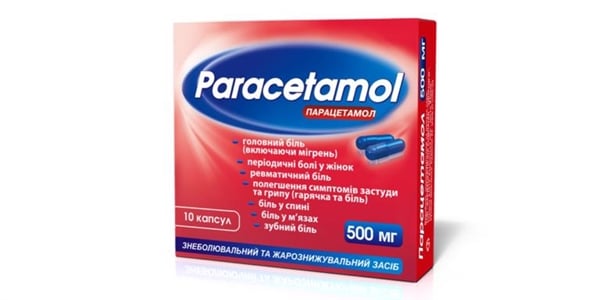
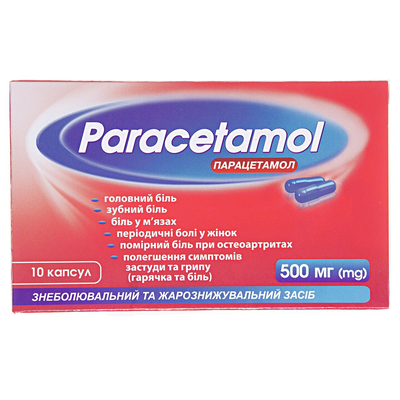
Paracetamol 500 mg Capsules, No. 10
Ingredients
Active ingredient: acetaminophen;
1 capsule contains 500 mg of acetaminophen;
Excipients: potato starch, povidone, magnesium stearate; the capsule shell contains indigo carmine (E 132), titanium dioxide (E 171), and gelatin.
Dosage Form
Capsules.
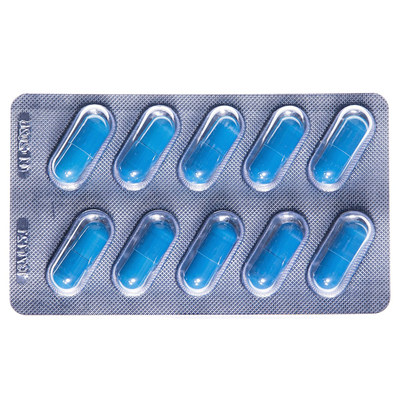
Main physical and chemical properties: hard gelatin capsules ranging in color from blue to light blue. The capsule contents consist of a mixture containing granules and powder ranging in color from white to off-white. The presence of agglomerated particles is permitted.
Pharmacotherapeutic group
Analgesics and antipyretics. Paracetamol.
ATX code N02B E01.
Pharmacological Properties
Pharmacodynamics.
The drug contains paracetamol, which is an analgesic and antipyretic (pain reliever and fever reducer).
Pharmacokinetics.
Paracetamol is rapidly and almost completely absorbed in the gastrointestinal tract. Maximum plasma concentration is reached within 30–60 minutes. The half-life ranges from 1 to 4 hours. It is evenly distributed throughout all body fluids. Binding to plasma proteins is variable. It is excreted primarily by the kidneys in the form of conjugated metabolites.
Indications
Treatment of short-term headaches, toothaches, muscle aches, menstrual cramps, moderate pain associated with osteoarthritis, and symptoms of fever, the common cold, and the flu.
Contraindications
Hypersensitivity to any component of the drug; severe liver and/or kidney dysfunction; congenital hyperbilirubinemia; glucose-6-phosphate dehydrogenase deficiency; alcoholism; blood disorders; Gilbert’s syndrome, severe anemia, leukopenia. Children under 6 years of age.
Interactions with Other Medications and Other Forms of Interaction
The rate of paracetamol absorption may increase when taken with metoclopramide and domperidone and may decrease when taken with cholestyramine. The anticoagulant effect of warfarin and other coumarins, which carry an increased risk of bleeding, may be enhanced with concomitant long-term use of paracetamol. Intermittent use has no significant effect.
Barbiturates reduce the antipyretic effect of acetaminophen.
Anticonvulsants (including phenytoin, barbiturates, carbamazepine), which stimulate the activity of hepatic microsomal enzymes, may enhance the hepatotoxic effects of acetaminophen by increasing the extent to which the drug is converted into hepatotoxic metabolites. Concomitant use of paracetamol with hepatotoxic drugs enhances the toxic effects of these drugs on the liver.
Concomitant use of high doses of paracetamol with isoniazid increases the risk of developing hepatotoxic syndrome. Paracetamol reduces the effectiveness of diuretics.
Do not use concurrently with alcohol.
Special Considerations
This medication contains acetaminophen; therefore, it should not be used in combination with other acetaminophen-containing medications or used, for example, to reduce fever, treat pain, or alleviate flu and cold symptoms or insomnia. Concomitant use with other medications containing acetaminophen may lead to an overdose. An acetaminophen overdose can cause liver failure, which may result in the need for a liver transplant or death.
If you have liver or kidney disease, consult your doctor before using this medication.
It should be noted that patients with liver disease are at increased risk of paracetamol-induced hepatotoxicity.
Cases of liver failure have been reported in patients with low glutathione levels, such as those with severe malnutrition, anorexia, low body mass index, chronic alcoholism, or sepsis.
Patients with low glutathione levels are at increased risk of metabolic acidosis when taking paracetamol. Symptoms of metabolic acidosis include deep, rapid, or labored breathing, nausea, vomiting, and loss of appetite. If these symptoms occur, seek medical attention immediately.
If symptoms persist, consult a doctor. Prolonged use without medical supervision can be dangerous.
Use this medication only when clearly necessary.
Keep this medication out of the reach of children.
Pregnancy and breastfeeding.
As with other medications, consult a doctor before taking acetaminophen during pregnancy.
Extensive data on pregnant women indicate neither teratogenicity nor fetal/neonatal toxicity. Epidemiological studies on the development of the nervous system in children exposed to paracetamol in utero have not yielded conclusive results. If clinically necessary, acetaminophen may be used during pregnancy, but it should be administered at the lowest effective dose for the shortest possible duration and with the lowest possible frequency.
Paracetamol passes into breast milk, but in clinically insignificant amounts when used at recommended doses. Available published data do not indicate any contraindications to breastfeeding.
It affects the ability to operate vehicles and machinery.
It has no effect.
Directions for Use and Dosage
This medication is intended for oral use.
Do not exceed the recommended dose. Use the lowest dose necessary to achieve the therapeutic goal.
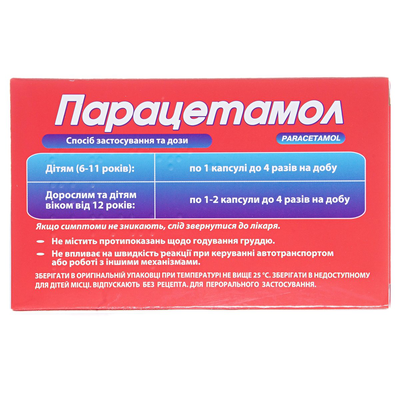
Adults and children over 12 years of age: 1–2 capsules up to 4 times a day (every 4–6 hours) as needed.
The interval between doses should be at least 4 hours.
Do not take more than 8 capsules (4,000 mg) within a 24-hour period.
Children (ages 6–11): 1 capsule up to 4 times a day (every 4–6 hours) as needed.
The maximum duration of use without consulting a doctor is 3 days.
Do not take more than 4 doses within 24 hours.
Allow at least 4 hours between doses.
Children.
Not recommended for children under 6 years of age.
Overdose
A paracetamol overdose can cause liver failure, which may lead to the need for a liver transplant or death. Experience has shown that clinical signs of liver damage following a paracetamol overdose usually appear 24–48 hours after the overdose and peak after 4–6 days.
There is an increased risk of paracetamol poisoning, especially in elderly patients, children, and patients with liver disease, chronic alcoholism, or chronic malnutrition.
Symptoms of overdose in the first 24 hours include pallor, nausea, vomiting, loss of appetite, and abdominal pain. Asymptomatic overdose is also possible.
A single-dose paracetamol overdose in adults or children can cause reversible or irreversible liver cell necrosis, which may lead to impaired glucose metabolism, metabolic acidosis, hepatocellular failure, encephalopathy, hemorrhage, hypoglycemia, coma, and death. At the same time, elevated levels of liver transaminases (AST, ALT), lactate dehydrogenase, and bilirubin, as well as prothrombin levels, are observed 12–48 hours after ingestion.
Liver damage is possible in adults who have taken more than the recommended amounts of acetaminophen. It is believed that elevated levels of a paracetamol metabolite (which is normally neutralized by glutathione at normal doses of paracetamol) irreversibly bind to liver tissue.
Acute renal failure with acute tubular necrosis may manifest as severe lower back pain, hematuria, and proteinuria and may develop even in the absence of severe liver damage. Cardiac arrhythmias and pancreatitis have also been reported, usually accompanied by liver failure and hepatotoxicity.
With long-term use of the drug in high doses, hematopoietic disorders such as aplastic anemia, pancytopenia, agranulocytosis, neutropenia, leukopenia, and thrombocytopenia may develop. When taking high doses, the central nervous system may be affected, causing dizziness, psychomotor agitation, and disorientation; the urinary system may be affected, leading to nephrotoxicity (renal colic, interstitial nephritis, capillary necrosis).
Symptoms may be limited to nausea and vomiting or may not reflect the severity of the overdose or the risk of organ damage.
Risk factors for acetaminophen overdose include:
- long-term use of carbamazepine, phenobarbital, phenytoin, primidone, rifampin, St. John’s wort, or other drugs that induce liver enzymes;
- regular alcohol abuse;
- decreased glutathione levels, such as those caused by malnutrition, starvation, physical exhaustion, cystic fibrosis, or HIV infection.
In case of an overdose, emergency medical care is required. Treatment for an overdose—or even a suspected overdose—should begin immediately; the patient must be taken to a hospital, even if there are no early symptoms of an overdose, as liver damage may not develop immediately. Plasma paracetamol concentrations should be measured 4 hours or more after oral administration (earlier measurements are unreliable).
Treatment with activated charcoal should be considered if an excessive dose of acetaminophen exceeding 150 mg/kg was taken within the past 1 hour. Treatment with N-acetylcysteine or methionine should be considered. Symptomatic treatment is also necessary.
Side Effects
Immune system: (rare: ˂ 1/10,000) – anaphylaxis, hypersensitivity reactions, including skin rash, angioedema, Stevens-Johnson syndrome, and Lyell’s syndrome.
Blood and lymphatic system disorders: (rare: ˂ 1/10,000) — thrombocytopenia.
Respiratory, thoracic, and mediastinal disorders: (rare: ˂ 1/10,000) — bronchospasm in patients sensitive to acetylsalicylic acid and other nonsteroidal anti-inflammatory drugs.
Hepatobiliary disorders: (rare: < 1/10,000) — liver dysfunction.
The following adverse reactions may also occur after taking medications containing paracetamol: skin itching, erythema multiforme, nausea, epigastric pain, hypoglycemia (up to hypoglycemic coma), agranulocytosis, anemia, sulfhemoglobinemia, and methemoglobinemia (cyanosis, shortness of breath, chest pain), hemolytic anemia, bruising or bleeding, and elevated liver enzyme levels, usually without the development of jaundice.
Shelf life
5 years.
Storage conditions
Store in the original packaging at a temperature not exceeding 25 °C.
Keep out of reach of children.
Packaging
Capsules No. 10, No. 10×2 in blister packs in a box.
Sales Conditions
Available without a prescription.
Manufacturer
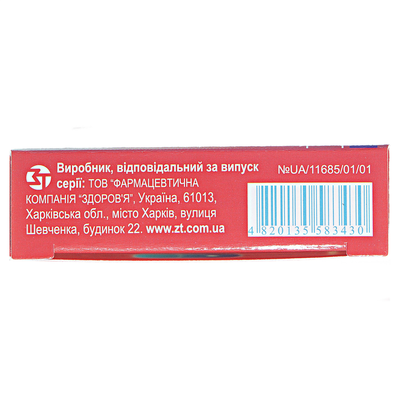
Limited Liability Company “Pharmaceutical Company ‘Zdorovye’”.