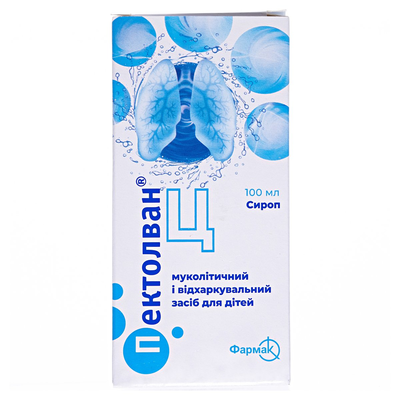
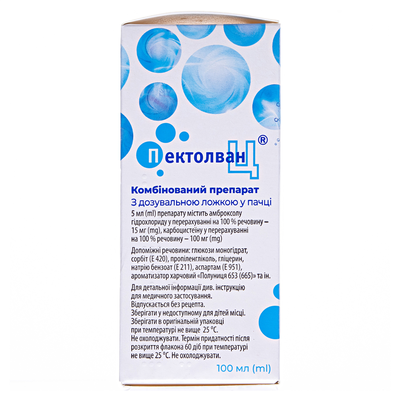
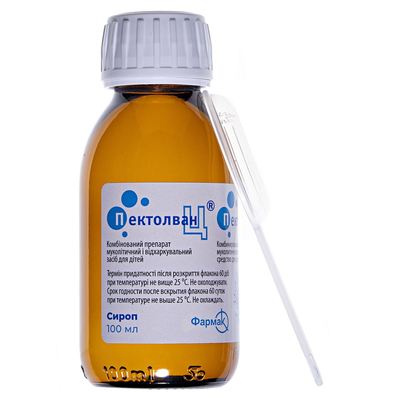
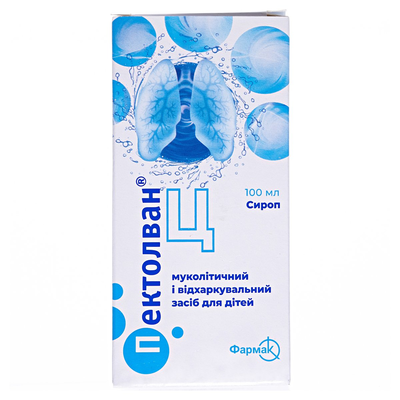
Pektolvan C syrup, 100 ml per bottle.
Composition
Active ingredients: ambroxol hydrochloride, carbocysteine;
5 mL of the product contains 15 mg of ambroxol hydrochloride (calculated as 100% active ingredient) and 100 mg of carbocysteine (calculated as 100% active ingredient);
Excipients: glucose monohydrate; sorbitol (E 420); propylene glycol; glycerin; meglumine; disodium edetate; citric acid monohydrate; sodium benzoate (E 211); aspartame (E 951); food flavoring “Strawberry 653 (665)”; purified water.
Dosage Form
Syrup.
Main physical and chemical properties: a clear, colorless, viscous liquid with a strawberry flavor.
Pharmacotherapeutic group
Mucolytics. Combinations. ATC code R05C B10.
Pharmacological properties
Pharmacodynamics.
Pektolvan® C is a combined mucolytic and expectorant agent containing a balanced combination of two components—ambroxol and carbocysteine.
Ambroxol is an active metabolite of bromhexine, but is more effective. It increases secretion from the airway glands, helps thin viscous bronchial secretions, and facilitates their removal by increasing mucociliary clearance; it also alters the ratio of serous to mucous components in sputum. It stimulates Clara cells and activates hydrolyzing enzymes, which also leads to a reduction in sputum viscosity. Ambroxol has secretomotor properties—it stimulates the ciliated epithelium of the bronchi and restores the drainage function of the small bronchi and bronchioles. The drug stimulates the production of endogenous surfactant, does not cause excessive secretion, and reduces bronchial spastic hyperreactivity. Cough and sputum volume are significantly reduced. Ambroxol hydrochloride has demonstrated anti-inflammatory effects in vitro. In vitro studies have shown that ambroxol hydrochloride significantly reduces cytokine release from the blood and the tissue adhesion of mononuclear and polymorphonuclear cells.
Carbocysteine has mucolytic and expectorant effects; by breaking the disulfide bonds of glycoproteins, it thins excessively viscous bronchial secretions, which facilitates the removal of sputum. The mucoregulatory effect of carbocysteine is associated with the activation of sialyltransferase—an enzyme found in the goblet cells of the bronchial mucosa. It normalizes the ratio of acidic to neutral sialomucins, which helps reduce the viscosity of bronchial secretions. It facilitates sputum clearance by increasing mucociliary clearance and possesses antioxidant and pneumoprotective properties, which are due to the ability of sulfhydryl groups to scavenge free radicals. It also promotes the regeneration of the mucous membrane, normalizes its structure, and reduces goblet cell hyperplasia, thereby decreasing mucus production. It activates the activity of the ciliated epithelium, restores IgA secretion (specific protection), and increases the number of sulfhydryl groups in mucus components (nonspecific protection). It exhibits an anti-inflammatory effect due to the kinin-inhibiting activity of sialomucins, which leads to a reduction in edema and bronchial obstruction.
Pharmacokinetics.
After administration, ambroxol is almost completely absorbed in the gastrointestinal tract and penetrates well into lung tissue. Absolute bioavailability following oral administration is 70–80%. Maximum plasma concentration is reached approximately 2 hours after oral administration. The half-life is 7–12 hours. It is excreted primarily in the urine (up to 90%). It crosses the blood-brain barrier and enters breast milk but does not accumulate.
When taken orally, carbocysteine is rapidly absorbed. Peak plasma concentration of the active ingredient is reached after 2 hours. Bioavailability is low—less than 10% of the administered dose (due to extensive metabolism in the gastrointestinal tract and the first-pass effect in the liver). Carbocysteine is excreted almost entirely as inactive metabolites (inorganic sulfates, diacetylcystine) in the urine. Only a small amount is excreted unchanged in the feces. It can cross the placental barrier and accumulate in amniotic fluid.
Indications
Acute and chronic respiratory tract diseases accompanied by the formation of difficult-to-clear secretions:
- chronic obstructive pulmonary disease;
- pneumonia;
- bronchial asthma with severe sputum production;
- bronchiectasis;
- respiratory distress syndrome;
- treatment of complications following lung surgery;
- for tracheostomy care before and after bronchoscopy.
Inflammatory diseases of the middle ear and paranasal sinuses.
Contraindications
Hypersensitivity to any component of the drug. In cases of rare hereditary conditions that may cause incompatibility with the drug’s excipients (see the “Special Considerations for Use” section), use of the drug is contraindicated.
Peptic ulcer of the stomach and duodenum during an acute phase. First trimester of pregnancy due to insufficient data on teratogenic and embryotoxic effects.
Interactions with Other Medications and Other Types of Interactions
Enhances the efficacy of glucocorticoid and antibacterial therapy in the treatment of inflammatory diseases of the upper and lower respiratory tracts. However, it is not recommended to use it concurrently with tetracycline-class antibiotics (with the exception of doxycycline); the interval between doses should be at least 2 hours.
Concomitant use of ambroxol and cough suppressants may lead to excessive mucus accumulation due to suppression of the cough reflex. Therefore, such a combination is possible only after a physician has carefully assessed the balance between the expected benefits and the potential risks of use.
During treatment with carbocysteine, antitussives and agents that suppress bronchial secretion should not be used.
Special Considerations for Use
A productive cough is a fundamental defense mechanism of the bronchopulmonary system and, as such, should not be suppressed. It is not advisable to combine medications that modify bronchial secretion with cough suppressants and/or substances that reduce secretion (such as atropine).
The use of mucolytic agents may lead to impaired bronchial patency in children under 2 years of age. In infants under one year of age, the ability to clear the airways of bronchial secretions is limited due to age-related anatomical and physiological characteristics. No mucolytic agents should be used in children under 2 years of age.
Treatment should be reevaluated if there is no improvement or if symptoms worsen.
There are reports of severe skin reactions: erythema multiforme, Stevens–Johnson syndrome, toxic epidermal necrolysis (Lyell’s syndrome), and acute generalized exanthematous pustulosis have been associated with the use of ambroxol. In most cases, these can be attributed to the severity of the underlying disease and/or concomitant use of another medication. Therefore, if new skin or mucosal lesions appear, seek medical attention immediately and discontinue treatment with ambroxol hydrochloride.
Additionally, in the early stages of Stevens–Johnson syndrome or Lyell’s syndrome, patients may experience nonspecific symptoms similar to those of early-stage influenza, such as fever, body aches, rhinitis, cough, and sore throat. Such nonspecific symptoms, resembling the onset of the flu, may lead to the mistaken use of symptomatic treatment with cough and cold medications.
In cases of impaired bronchial motility and increased mucus secretion (for example, in a rare condition such as primary ciliary dyskinesia), the drug should be used with caution, as ambroxol may increase mucus secretion.
Patients with impaired renal function or severe hepatic insufficiency should take this medication only after consulting a doctor. When ambroxol is used—as with any active ingredient that is metabolized in the liver and then excreted by the kidneys—metabolites formed in the liver accumulate in patients with severe renal insufficiency.
Close medical supervision is required in cases of purulent sputum or high fever.
This medication should be used with caution in patients with a history of gastric or duodenal ulcers.
The drug contains sorbitol; therefore, patients with rare hereditary fructose intolerance should not take it.
The drug contains aspartame, a phenylalanine derivative that poses a risk to patients with phenylketonuria; therefore, this drug should not be used in this patient population.
The drug contains glucose; therefore, patients with hereditary glucose intolerance or glucose-galactose malabsorption should avoid taking this drug.
Use during pregnancy or breastfeeding.
Contraindicated during the first trimester of pregnancy. During the second and third trimesters of pregnancy, the drug should be used only after a careful assessment of the benefit to the mother versus the risk to the fetus (infant), as determined by the physician. Use during breastfeeding is not recommended.
Preclinical studies do not indicate any direct or indirect adverse effects on fertility.
Effect on reaction time when driving or operating machinery.
No studies have been conducted on the effect on reaction time when driving or operating machinery. If dizziness occurs, refrain from driving or operating machinery.
Dosage and Administration
Take orally.
For children aged 6 to 12 years: 5 mL (1 measuring spoon) 2–3 times daily; for children aged 2 to 6 years: 2.5 mL (1/2 measuring spoon) 2–3 times daily.
The duration of treatment should generally not exceed 7–10 days.
The duration of use in children should be as short as possible, not exceeding 5 days.
Children.
The medication may be used in children aged 2 years and older. Treatment of children should be conducted under a doctor’s supervision.
Overdose
Symptoms: stomach pain, nausea, vomiting, diarrhea.
Treatment: symptomatic and supportive.
Side Effects
Immune system: hypersensitivity reactions, including angioedema, anaphylactic reactions, and anaphylactic shock.
Skin and subcutaneous tissue disorders: skin rashes (including fine-spotted, maculopapular, and confluent plaques), hives, itching, dermatitis, severe skin lesions, including erythema multiforme, Stevens–Johnson syndrome, toxic epidermal necrolysis (Lyell’s syndrome), and acute generalized exanthematous pustulosis.
Nervous system: dysgeusia (taste disturbance), dizziness, headache, restlessness.
Gastrointestinal system: nausea, decreased sensation in the mouth, vomiting, diarrhea, dyspepsia, heartburn, stomach pain, abdominal pain, indigestion, dry mouth, constipation, hypersalivation, gastrointestinal bleeding.
Respiratory, thoracic, and mediastinal disorders: decreased sensation in the pharynx, rhinorrhea, dyspnea (as a symptom of a hypersensitivity reaction), dry throat.
Urinary system: dysuria.
Cardiac: palpitations.
General disorders: general weakness, fever, mucosal reactions.
Shelf life
1 year and 6 months.
Do not use this medication after the expiration date printed on the package.
Storage conditions
Store in the original packaging at a temperature not exceeding 25 °C. Do not refrigerate.
Shelf life after opening the vial: 60 days at a temperature not exceeding 25 °C. Do not refrigerate.
Keep out of the reach of children.
Packaging
100 mL per vial. One vial with a dosing spoon per package.
Dispensing Category
Available without a prescription.
Manufacturer
Farmak JSC.