
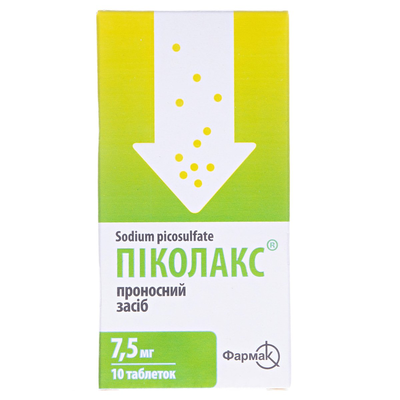
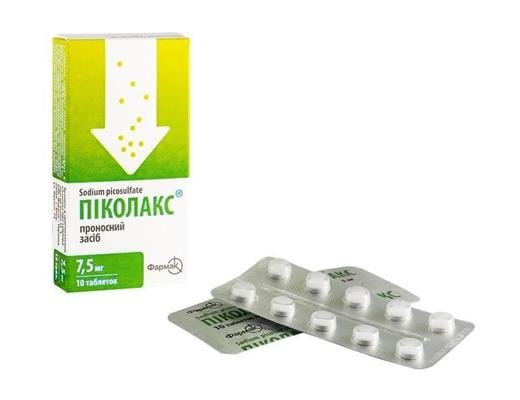
Picolax 7.5 mg tablets, No. 10
Ingredients
Active ingredient: sodium picosulfate,
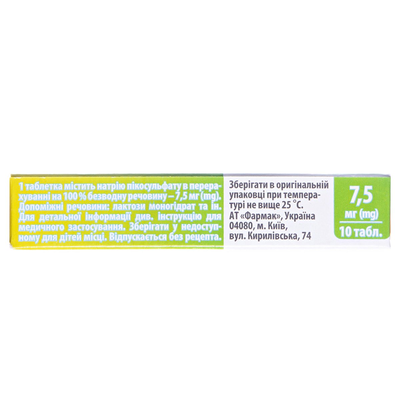
1 tablet contains 5 mg or 7.5 mg of sodium picosulfate, calculated as 100% anhydrous substance;
excipients: lactose monohydrate, corn starch, pregelatinized starch 1500, colloidal anhydrous silicon dioxide, magnesium stearate.
Dosage Form
Tablets.
Main physical and chemical properties: white or almost white, flat-cylindrical tablets with a score line and a bevel.
Pharmacotherapeutic group
Contact laxatives. ATC code A06A B08.
Pharmacological properties
Pharmacodynamics.
Sodium picosulfate, the active ingredient in Picolax®, is a locally acting laxative of the triarylmethane group. After bacterial hydrolysis in the large intestine, sodium picosulfate stimulates the intestinal mucosa, accelerating peristalsis and promoting the accumulation of water and electrolytes in the lumen of the large intestine. This results in stimulation of defecation, a reduction in transit time, and softening of the stool.
Pharmacokinetics.
Absorption and Distribution.
After oral administration, sodium picosulfate reaches the large intestine without significant absorption.
Biotransformation.
The active metabolite, bis-(p-hydroxyphenyl)-pyridyl-2-methane (BHPM), is formed following bacterial degradation in the large intestine.
Elimination
After metabolism, only a small amount of BGP is absorbed. After oral administration of 10 mg of sodium picosulfate, 10.4% of the total dose is excreted as BGP-glucuronide in the urine within 48 hours. In addition, BGP is excreted as a glucuronide in the bile.
Relationship between pharmacokinetics and pharmacodynamics.
The onset of action of Picolax® usually occurs 6–12 hours after administration, depending on the release of the active metabolite (BGP). The laxative effect of the drug does not correlate with the plasma concentration of the active metabolite.
Indications
Constipation or conditions requiring relief of defecation.
Contraindications
- Hypersensitivity to the active ingredient, other triarylmethanes, or any of the drug’s excipients.
- Intestinal obstruction.
- Severe, painful, and/or febrile abdominal conditions (e.g., appendicitis) potentially associated with nausea and vomiting.
- Acute inflammatory bowel diseases.
- Severe dehydration.
- Rare hereditary intolerance to any of the drug’s excipients; for example, there is a possibility of undiagnosed lactose intolerance (see the “Special Precautions for Use” section).
Interactions with Other Medications and Other Types of Interactions
Concomitant use of high doses of Picolax® with diuretics or corticosteroids may increase the risk of electrolyte imbalance, which may lead to increased sensitivity to cardiac glycosides.
Concomitant use with antibiotics may weaken the laxative effect of Picolax®.
Special Considerations for Use
Like other laxatives, Picolax® should not be used daily or for an extended period without determining the cause of constipation.
Patients suffering from chronic constipation should undergo a thorough evaluation to determine the cause of their constipation.
Prolonged use of the drug may lead to disturbances in water and electrolyte balance and to hypokalemia.
Discontinuation of Picolax® may lead to a recurrence of symptoms. If Picolax® has been used for chronic constipation over a long period, any recurrence of symptoms may be more pronounced.
Cases of dizziness and/or syncope have been reported, coinciding with the use of sodium picosulfate. Available information suggests that these events correspond to syncope during defecation (associated with the Valsalva maneuver) or are related to a vasovagal response to abdominal pain.
Like other laxatives, this medication should not be used daily or for an extended period without determining the cause of constipation.
This medication should be taken under medical supervision in conditions associated with disturbances in water and electrolyte balance (e.g., severe renal impairment).
This medication contains lactose, which patients with hereditary lactose intolerance should keep in mind.
Use During Pregnancy or Breastfeeding
There are insufficient studies on the use of sodium picosulfate in pregnant women. For safety reasons, Picolax® should not be used during pregnancy if possible.
Clinical data indicate that neither the active metabolite bis-(p-hydroxyphenyl)-pyridyl-2-methane (BHPM) nor its glucuronides are excreted into breast milk. Therefore, Picolax® may be used during breastfeeding.
No studies have been conducted to assess the effect on fertility.
Effect on reaction time when driving or operating machinery
No studies have been conducted to assess the effect on the ability to drive or operate machinery.
However, patients should be warned about the possibility of developing, as a result of a vasovagal reaction
(particularly abdominal cramps) may lead to side effects such as dizziness and/or syncope. If abdominal cramps occur, the patient should avoid potentially hazardous activities such as driving or operating machinery.
Dosage and Administration
Adults: 5–10 mg once daily.
Children 4 years of age and older (only as prescribed by a doctor): 2.5–5 mg once daily.
It is recommended to start with the lowest dose. The dose may be adjusted up to the maximum recommended dose to achieve regular bowel movements. The maximum daily dose of 10 mg (for adults) or 5 mg (for children 4 years of age and older) must not be exceeded.
Picolax® should be taken at night. After taking Picolax®, a bowel movement occurs within 10–12 hours.
Picolax® should not be used daily or for an extended period without determining the cause of constipation.
Children
This medication should be used in children aged 4 years and older only as directed by a doctor.
Overdose
Overdose may lead to loose stools (diarrhea), intestinal cramps, and clinically significant loss of fluids, potassium, and other electrolytes.
In cases of acute overdose, the effects can be minimized or eliminated by inducing vomiting or performing gastric lavage shortly after taking Picolax®. Fluid replacement and correction of electrolyte balance may be necessary. Antispasmodic agents may be used.
Cases of ischemia of the large bowel mucosa have been reported with the use of high doses of Picolax®, significantly higher than those typically recommended for constipation.
Picolax®, like other laxatives, may lead to chronic diarrhea and abdominal pain, hypokalemia, secondary hyperaldosteronism, and possibly kidney stones if taken in excess over a prolonged period. With prolonged misuse of laxatives, cases of renal tubular damage, metabolic alkalosis, and muscle weakness resulting from hypokalemia have been reported.
Side Effects
Skin and subcutaneous tissue: angioedema, toxicoderma, rash, itching.
Immune system: hypersensitivity reactions.
Nervous system: dizziness, syncope. The likelihood of dizziness and syncope is associated with a vasovagal reaction (such as abdominal spasm or defecation) (see the “Special Considerations for Use” section).
Gastrointestinal system: diarrhea, abdominal colic, abdominal pain, abdominal discomfort, vomiting, nausea.
Prolonged and excessive use of the drug may lead to loss of fluid, potassium, and other electrolytes. This, in turn, may lead to muscle weakness and impaired cardiac function, especially when the drug is used concomitantly with diuretics or corticosteroids.
Shelf life
4 years.
Do not use the medication after the expiration date printed on the package.
Storage Conditions
Store in the original packaging at a temperature not exceeding 25°C.
Keep out of reach of children.
Packaging
10 tablets per blister pack.
5 mg tablets: 1 blister pack per package.
7.5 mg tablets: 1 or 3 blisters per package.
Dispensing Category
Available without a prescription.
Manufacturer
Farmak JSC.







