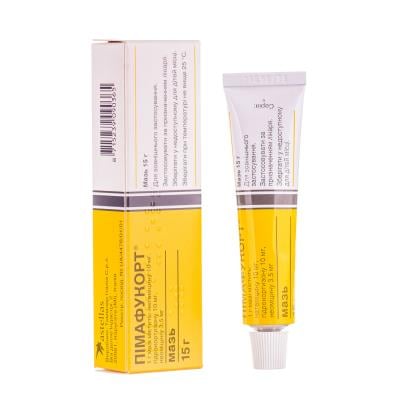
Pimafucort ointment, 15 g tubes
Ingredients
Active ingredients: natamycin, hydrocortisone, neomycin;
1 g of ointment contains 10 mg of natamycin, 10 mg of hydrocortisone, and 3.5 mg of neomycin;
Excipients: polyethylene oleogel.
Dosage Form
Ointment.
Main physical and chemical properties: the ointment is white to light yellow in color.
Pharmacotherapeutic group
Corticosteroids for dermatological use. Corticosteroids in combination with antibiotics. ATC code D07C A01.
Pharmacological properties
Pharmacodynamics.
Pimafucort® is a combination drug containing the active ingredients hydrocortisone, neomycin, and natamycin.
Hydrocortisone is a corticosteroid with anti-inflammatory and vasoconstrictive effects. Hydrocortisone suppresses the inflammatory response and reduces the severity of symptoms of various skin conditions that often cause itching, but it does not cure the underlying disease that caused them.
Neomycin is a broad-spectrum antibiotic active against certain Gram-positive (staphylococci, enterococci) and Gram-negative (Klebsiella spp., Proteus spp., Escherichia coli) bacteria. Pseudomonas aeruginosa is resistant to neomycin in vitro.
Natamycin belongs to the polyene antibiotics of the macrolide group and has fungicidal activity against fungal infections, particularly those caused by Candida spp. It is unknown whether other fungal species are resistant to natamycin.
Cross-resistance between neomycin and other aminoglycoside antibiotics may occur due to the development of plasmids whose enzymes inactivate aminoglycosides and reduce cell membrane permeability, resulting in a reduced effect of aminoglycosides due to impaired energy metabolism or ribosomal mutation, although the latter mechanism is rare.
Pharmacokinetics.
Absorption
Natamycin and neomycin are practically not absorbed through intact skin and mucous membranes. Minor absorption of neomycin through damaged skin, wounds, and ulcers is possible. Approximately 1–3% of hydrocortisone is absorbed through intact skin; in cases of eczema, the amount of hydrocortisone absorbed doubles, and in cases of infectious skin lesions, it increases fivefold. In children, the rate of absorption decreases with age.
Indications
Short-term treatment of superficial dermatoses responsive to corticosteroid therapy, complicated by secondary bacterial and/or fungal infections (especially those caused by fungi of the genus Candida), that are susceptible to neomycin and natamycin.
Contraindications
Since Pimafucort® contains hydrocortisone (a mild corticosteroid), the following contraindications apply:
- skin diseases caused by primary bacterial infections; primary infections caused by fungi and yeasts; parasitic infections (including extensive and severe skin lesions);
- viral infections;
- skin wounds and ulcers, trophic ulcers, burns;
- adverse reactions caused by corticosteroids (perioral dermatitis, striae);
- ichthyosis, juvenile plantar dermatosis, acne vulgaris, rosacea, fragility of skin blood vessels, skin atrophy.
Pimafucort® should not be applied to the external auditory canal in cases of tympanic membrane perforation.
In addition, Pimafucort® should not be used in cases of hypersensitivity to neomycin, natamycin, aminoglycosides, corticosteroids (which occurs very rarely), or to any of the excipients.
Drug Interactions and Other Interactions
There are no data on drug interactions with Pimafucort®.
Special Considerations for Use
The risk of local adverse reactions increases with prolonged treatment. The use of an occlusive dressing (cellophane) or application in skin folds increases this risk.
The skin of the face, scalp, and genital area is particularly sensitive to local reactions.
Application to the face, skin folds, and other areas with thin skin may lead to skin atrophy and increased absorption of the medication.
Topical corticosteroids may be dangerous for patients with psoriasis for a number of reasons, including “rebound syndrome” due to the development of tolerance, the risk of generalized pustular psoriasis or local systemic toxicity due to impairment of the skin’s barrier function. Steroids may be used for scalp psoriasis or chronic scaly psoriasis of the hands and feet. It is important to monitor patients closely.
If used improperly, bacterial, parasitic, fungal, and viral infections may be masked and/or exacerbated.
Do not apply the medication to the eyelids due to the possibility of contact with the conjunctiva and an increased risk of developing glaucoma or subcapsular cataracts.
When applying Pimafucort® to large areas of skin, when used in children, or when an occlusive dressing is used (i.e., in situations where experience with use is limited), patients should be informed of the potential for adrenal suppression.
Visual Disturbances
Visual disturbances may occur with systemic and topical use of corticosteroids. If a patient experiences symptoms such as blurred vision or other visual disturbances, they should consult an ophthalmologist to evaluate possible causes, which may include cataracts, glaucoma, or rare diseases such as central serous chorioretinopathy (CSCR), which have been reported following systemic or topical use of corticosteroids.
There is a possibility of both cross-sensitization between neomycin and chemically related antibiotics such as kanamycin, paromycin, and gentamicin, as well as cross-resistance between neomycin and other aminoglycosides.
Therefore, to maintain the necessary levels of aminoglycosides during systemic administration, the indications for use and duration of treatment must be strictly adhered to.
Long-term treatment and application to wounds or damaged skin should be avoided due to the theoretical risk of ototoxicity and nephrotoxicity resulting from the absorption of neomycin.
The use of a combination of corticosteroids, antifungal agents, and antibiotics is indicated only under exceptional circumstances. An accurate diagnosis must be made to rule out the possibility of microbial resistance. In some cases, the use of two or more active ingredients may be necessary. However, the desired result can often be achieved using a product containing a single active ingredient.
In the event of superinfections or excessive growth of a fungal infection, treatment with the drug should be discontinued and appropriate measures taken.
Special caution should be exercised when administering medications containing aminoglycosides to patients with renal insufficiency.
Use during pregnancy or breastfeeding.
Pregnancy
According to limited data, no increased risk of congenital abnormalities has been observed with the use of natamycin during pregnancy. When applied topically to small areas, systemic absorption of natamycin is minimal. There are no data on the use of natamycin in animal studies.
Cases of ototoxicity have been reported with systemic use of aminoglycosides during pregnancy. When applied topically to small areas, systemic absorption of aminoglycosides is minimal. In animal studies, neomycin was found to have a toxic effect on reproductive function following administration.
In animals, nephrotoxicity to the fetus was observed following the administration of aminoglycosides during the prenatal period. Hearing loss was observed in the offspring of rats exposed to neomycin during the prenatal period. Topical application of corticosteroids to pregnant animals in high doses may cause fetal malformations such as cleft palate and intrauterine growth restriction. Data from preclinical studies do not add new information to the existing experience with the use of the drug in clinical practice.
Corticosteroids are capable of crossing the placenta. To date, no teratogenic effects observed in animal studies have been reported in humans. Systemic use of high-dose glucocorticosteroids has been shown to affect the fetus or newborn (intrauterine growth restriction, adrenosuppression). Data on the topical use of glucocorticosteroids in humans during pregnancy are limited. Their minimal systemic absorption must be taken into account. Weak- and moderate-potency glucocorticosteroids (Classes I and II), such as hydrocortisone, may be used in short courses on limited areas of the skin. The effects described above cannot be ruled out with prolonged use or application to large areas of damaged skin.
Pimafucort® may be used during pregnancy in short courses on small areas of skin. Prolonged use or application to large areas of damaged skin is permitted only in extreme cases.
Breastfeeding
There is no information available on the possible secretion of natamycin into breast milk. When used in short courses on small areas of skin, glucocorticosteroids and neomycin are excreted into breast milk only in small amounts.
Pimafucort® may be used during breastfeeding in short courses on small areas of skin. Breastfeeding is not recommended during prolonged use or when applied to large areas of damaged skin.
Effect on reaction time when driving or operating machinery.
There are no data on the effect of Pimafucort® on the ability to drive or operate machinery, and such an effect is not expected.
Directions for Use and Dosage
Apply a thin layer of the medication to the affected areas of the skin 2–4 times daily. The duration of treatment is determined individually by the physician depending on the nature of the condition. The course of treatment should generally not exceed 14 days.
Pimafucort® in this dosage form is primarily used to treat chronic skin conditions characterized by lesions accompanied by scaling, dryness, and cracking, as well as seborrhea.
Children
The drug should be used in children aged 1 year and older, under a doctor’s supervision.
Overdose
There are no reports of overdose. There is a theoretical possibility of neomycin-induced ototoxicity if the medication is applied to the external auditory canal in the presence of a perforated eardrum and neomycin comes into direct contact with the middle ear. In isolated cases of accidental ingestion of the entire contents of a Pimafucort® package, the drug is likely to be tolerated without the development of toxic effects.
Side Effects
Rare (≥ 1/10,000 to < 1/1,000)
Endocrine system
Adrenocortical suppression resulting from the topical application of corticosteroid-containing medications is rarely observed in adults. It is not expected to occur as a result of using Pimafucort®. The risk of systemic effects increases with the use of occlusive dressings, application to large areas of skin, prolonged use, and in children.
Skin and Subcutaneous Tissue
When using Pimafucort®, a slight initial exacerbation of skin symptoms may occur. This does not require discontinuation of treatment.
- Hypersensitivity reactions, burning and skin irritation, dermatitis, eczema, contact dermatitis;
- contact allergic reactions, especially to neomycin;
- side effects of corticosteroids may occur, but the likelihood of their occurrence with hydrocortisone is lower than with more potent corticosteroids:
- skin atrophy, often irreversible, accompanied by thinning of the skin, telangiectasias, purpura, and stretch marks;
- rosacea-like and perioral dermatitis, with or without skin atrophy;
- a “rebound” effect, which may lead to steroid dependence;
- delayed wound healing;
- depigmentation, hypertrichosis.
The risk of local adverse reactions increases with longer duration of treatment. The use of an occlusive dressing (cellophane) or application in skin folds increases this risk. The skin of the face, scalp, and genital area is particularly sensitive to local reactions.
If used improperly, bacterial, parasitic, fungal, and viral infections may be masked and/or exacerbated.
Very rare (<1/10,000)
Ocular: increased intraocular pressure, increased risk of cataracts.
Frequency unknown (cannot be estimated from the available data)
Ocular: blurred vision.
Skin and subcutaneous tissue disorders: skin rashes, itching, pustular acne.
The risk of systemic effects increases in the following cases: use with a dressing (cellophane dressing) or in skin folds; application to large areas of skin; long-term treatment; use in children (children are extremely sensitive because they have thinner skin and a relatively large skin surface area); the presence of components or excipients that enhance penetration through the stratum corneum and/or potentiate the effect of the active ingredient.
The risk of developing local adverse reactions increases with the potency of the drug and the duration of treatment. Use with a dressing (cellophane dressing) or in skin folds increases this risk. The skin of the face, scalp, and genital area is particularly sensitive. If used improperly, or in the presence of bacterial, parasitic, fungal, or viral infections, the symptoms of these conditions may be masked and/or exacerbated.
Shelf life
5 years.
Storage Conditions
Store at a temperature not exceeding 25 °C. Keep out of reach of children.
Packaging
15 g of ointment per tube; 1 tube per cardboard box.
Dispensing Category
By prescription.