
Regidron powder, 18.9 g per dose, No. 10 per package
Ingredients
Active ingredients:
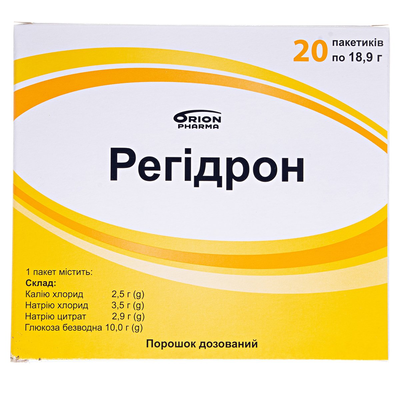
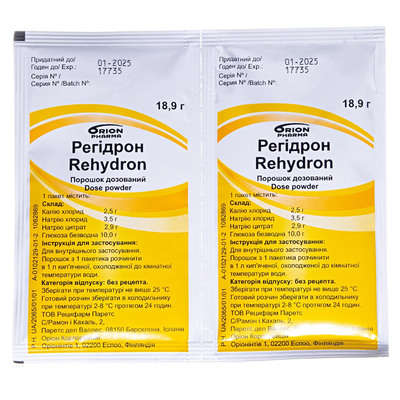
1 packet contains: potassium chloride 2.5 g; sodium chloride 3.5 g; sodium citrate 2.9 g; anhydrous glucose 10 g.
Dosage Form
Pre-measured powder.
Main physical and chemical properties: a white, odorless crystalline powder.
Pharmacotherapeutic group
Electrolyte preparations with carbohydrates. Saline solutions for oral rehydration.
ATC code A07C A.
Pharmacological properties
Pharmacodynamics.
Regidron solution is used to compensate for electrolyte and fluid loss associated with diarrhea and vomiting. Glucose promotes the absorption of salts, while citrates help correct the balance in cases of metabolic acidosis. The osmolarity of the Regidron solution is 235–255 mOsm/L, and the pH is slightly alkaline at 8.2.
The Regidron solution contains (per 1 L of solution):
|
Sodium chloride
|
59.9 mmol
|
|
Potassium chloride
|
33.5 mmol
|
|
Sodium citrate
|
9.9 mmol
|
|
Glucose
|
55.5 mmol
|
|
Na+
|
89.5 mmol
|
|
K+
|
33.5 mmol
|
|
Cl-
|
93.4 mmol
|
|
Citrate ions
|
9.9 mmol
|
Compared to standard oral rehydration solutions recommended by the WHO, the osmolarity of Regidron is slightly lower (it has been proven that rehydration solutions with reduced osmolarity are more effective), and its potassium content is higher (to accelerate the restoration of potassium levels).
Pharmacokinetics.
The pharmacokinetics of the water, electrolytes, and glucose contained in Regidron correspond to the natural pharmacokinetics of these substances in the body.
Indications
Restoration of water-electrolyte balance and correction of acidosis in acute diarrhea with mild to moderate dehydration (e.g., a loss of 3–9% of body weight in children), in cases of heat-related illnesses accompanied by disturbances in water and electrolyte metabolism.
For prophylactic purposes: during heat exposure and physical exertion leading to profuse sweating.
Contraindications
Hypersensitivity to any component of the drug, severe dehydration, hemodynamic shock, uncontrollable vomiting, loss of consciousness, intestinal obstruction, or ileus.
Interactions with Other Medications and Other Types of Interactions
There is no information regarding interactions between Regidron and other medications. The solution has a slightly alkaline pH, so it may affect medications whose absorption depends on the pH of the intestinal contents. Drug absorption may also be altered by diarrhea, particularly for drugs absorbed in the small or large intestine or those subject to enterohepatic circulation.
Special Considerations for Use
Severe dehydration (weight loss exceeding 9% of body weight in children, anuria) should be treated primarily with intravenous rehydration solutions. Afterward, Regidron may be prescribed to continue therapy.
The recommended doses should not be exceeded unless the patient’s need for additional electrolyte replacement is confirmed by laboratory tests.
Administer the medication orally, using water to dissolve it. Dissolve the contents of 1 Regidron packet in 1 L of water. Do not add sugar to the solution. Food may be consumed immediately after rehydration. If vomiting occurs, wait 10 minutes and then have the patient drink the solution slowly, in small sips.
If the dose is exceeded, the patient may develop hypernatremia.
Patients whose dehydration has developed against a background of renal failure, diabetes mellitus, or other chronic conditions that disrupt acid-base, electrolyte, or carbohydrate balance, require careful monitoring during treatment with Regidron and may require hospitalization.
Caution should be exercised when treating patients with liver disease or those on a diet restricted in sodium or potassium with Regidron. Diarrhea can significantly affect fluid and glucose balance in patients with diabetes, renal insufficiency, or certain other chronic conditions. Therefore, as long as symptoms of diarrhea persist, such patients require more careful monitoring with laboratory tests and inpatient rehydration therapy in a hospital setting.
Regidron should be used with caution in cases of renal insufficiency during periods of oliguria or anuria, or during parenteral rehydration therapy.
Do not administer this medication to children under 6 months of age without consulting a doctor.
In infants, acute diarrhea can cause dehydration and electrolyte imbalances, leading to a rapid deterioration of the patient’s condition. All cases of diarrhea and dehydration in infants must be reported to a doctor as soon as possible.
Situations during the use of Regidron that require medical intervention:
- the patient’s mental state has changed (irritability, apathy, lethargy);
- the patient’s speech becomes slurred, drowsiness sets in, the patient tires quickly, and does not respond to questions;
- persistent vomiting;
- temperature rises above 39 °C;
- urination stops;
- the patient has watery, bloody stools;
- diarrhea lasts more than 2 days;
- severe abdominal pain;
- diarrhea suddenly stops, and severe pain begins;
- home treatment is unsuccessful or impossible.
1 Regidron packet contains 1.3 g of potassium (33.5 mmol of potassium per 1 L of solution) and 2.1 g of sodium (89.5 mmol of sodium per 1 L of solution), which must be taken into account when administering the solution to patients with impaired renal function who are on a diet restricting potassium or sodium intake. 17 mmol (391 mg) is approximately 20% of the WHO-recommended maximum daily dietary sodium intake for adults (2 g) and is considered a high sodium dose.
One Regidron packet contains 10.0 g of glucose. Patients with rare hereditary disorders such as glucose-galactose malabsorption should not take this medication.
Use During Pregnancy or Breastfeeding.
This medication is approved for use at the recommended doses during pregnancy or breastfeeding. Breastfeeding may be continued for as long as necessary, even during oral rehydration, or may be resumed immediately after rehydration.
Effect on reaction time when operating motor vehicles or other machinery.
This medication does not affect reaction time when driving or operating machinery.
Directions for Use and Dosage
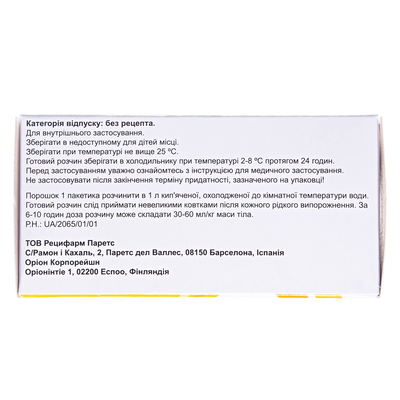
Dissolve the powder from 1 sachet of Regidron in 1 liter of boiled water cooled to room temperature. Do not add any other ingredients to the solution, as this may impair the drug’s effectiveness. Administer the solution orally or via a nasogastric tube under medical supervision.
Before starting treatment, the patient must be weighed to determine weight loss and the degree of dehydration.
Fatty foods and foods high in simple sugars should be avoided.
Treatment with Regidron should begin as soon as diarrhea starts.
The prepared solution should be taken in small sips after each loose stool. Over a period of 6–10 hours, the dose of Regidron solution may be 30–60 mL/kg of body weight. Usually, the medication should be taken for no longer than 3–4 days; treatment should be discontinued once diarrhea has stopped. In case of nausea or vomiting, it is advisable to take the chilled solution in small, repeated doses.
Rehydration: To correct dehydration, the medication should be taken during the first 6–10 hours in an amount twice the weight loss due to diarrhea; that is, if the weight loss is 400 g, the dose should be 800 mL. During treatment with Regidron, there is no need to consume other fluids.
Continued Use: If diarrhea persists, after correcting dehydration, Regidron and other fluids may be taken over the next 24 hours according to the table below:
|
Body weight (kg)
|
Total fluid volume (mL)
|
Regidron (mL)
|
Water (mL)
|
Other fluids (mL)
|
|
5
|
830
|
350
|
210
|
270
|
|
6
|
1,000
|
420
|
250
|
330
|
|
7
|
1,050
|
440
|
260
|
350
|
|
8
|
1,100
|
460
|
280
|
360
|
|
9
|
1,150
|
480
|
290
|
380
|
|
10
|
1,200
|
500
|
300
|
400
|
|
12
|
1,300
|
540
|
320
|
440
|
|
14
|
1,400
|
580
|
350
|
470
|
|
16
|
1,500
|
620
|
370
|
510
|
|
18
|
1,600
|
660
|
400
|
540
|
|
20
|
1,700
|
700
|
420
|
580
|
|
25
|
1,800
|
750
|
450
|
600
|
|
30
|
1,900
|
800
|
480
|
620
|
|
40
|
2,100
|
900
|
540
|
660
|
|
50
|
2,300
|
1,000
|
600
|
700
|
|
70
|
2,700
|
1,200
|
720
|
780
|
Children.
Regidron can be used in children. There are no age restrictions on the use of this medication in children.
Overdose
If a very large amount or a highly concentrated solution of Regidron is administered, hypernatremia may occur. In patients with impaired renal function, metabolic alkalosis and hyperkalemia may occur. Symptoms of hypernatremia include weakness, neuromuscular excitability, drowsiness, confusion, coma, and sometimes even respiratory arrest. Metabolic alkalosis may manifest as decreased pulmonary ventilation, neuromuscular excitability, and tetanic convulsions.
In the event of a severe overdose with pronounced consequences, administration of Regidron must be discontinued. Medical consultation is required. Correction of electrolyte and fluid balance should be based on laboratory test results.
Side Effects
When the recommended doses are followed, the development of side effects is unlikely. Allergic reactions are a potential risk. In patients with normal renal function, the risk of hypernatremia or hyperhydration when using Regidron is low. Vomiting may occur, indicating that the medication was administered too rapidly.
Shelf Life
3 years.
Storage conditions
Store at a temperature not exceeding 25 °C. Keep out of the reach of children.
Store the prepared solution in the refrigerator at 2–8 °C for up to 24 hours.
Packaging
18.9 g of powder per packet; 20 packets per cardboard box.
Dispensing Category
Over-the-counter.







