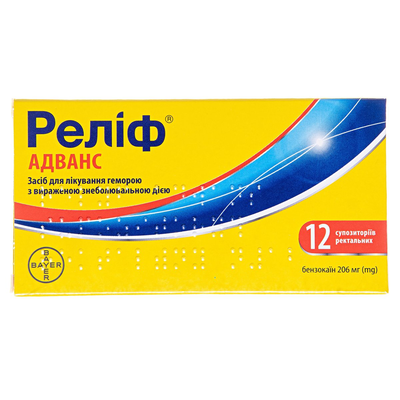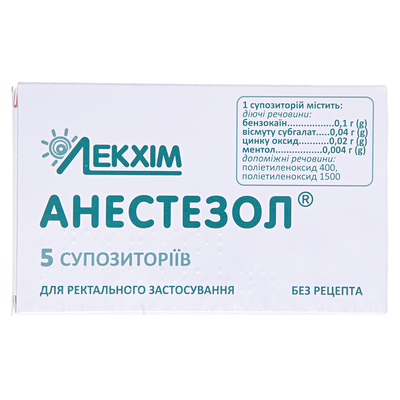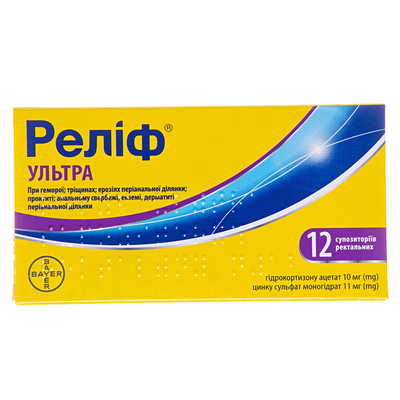
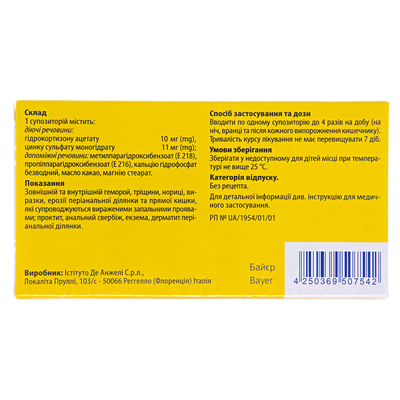
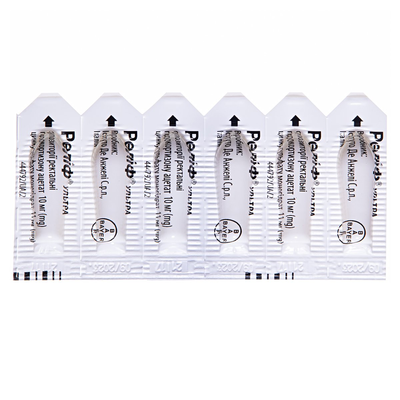
Relief Ultra Rectal Suppositories No. 12 (6 x 2) in a strip.
Ingredients
Active ingredients: hydrocortisone acetate, zinc sulfate monohydrate;
1 suppository contains 10 mg of hydrocortisone acetate and 11 mg of zinc sulfate monohydrate;
Excipients: methyl parahydroxybenzoate (E 218), propyl parahydroxybenzoate (E 216), calcium hydrophosphate, cocoa butter, magnesium stearate.
Dosage Form
Rectal suppositories.
Main physical and chemical properties: opaque, torpedo-shaped suppositories ranging in color from pale white to light yellow.
Pharmacotherapeutic group
Agents for the treatment of hemorrhoids and anal fissures for topical use. ATX code C05A A.
Pharmacological properties
Pharmacodynamics.
Hydrocortisone acetate is a glucocorticosteroid that, when applied topically, exerts anti-inflammatory, antiallergic, vasoconstrictive, and antipruritic effects. It inhibits the release of inflammatory mediators and blocks the metabolism of arachidonic acid.
Zinc sulfate monohydrate promotes the healing of wounds and erosions and normalizes skin hydration.
Pharmacokinetics.
When applied topically, the drug’s ingredients are excreted in mucus or in extremely small amounts in urine and bile. No signs of systemic absorption are observed when the drug is used at the recommended doses. The drug’s components do not pass into breast milk.
Indications
External and internal hemorrhoids, fissures, fistulas, ulcers, and erosions of the perianal region and rectum accompanied by pronounced inflammatory manifestations; proctitis, anal itching, eczema, and dermatitis of the perianal region.
Contraindications
Hypersensitivity to any component of the drug (allergic reactions), specific (bacterial, fungal, viral, tuberculous) lesions of the anorectal region, neoplasms in the anal region, thromboembolic disease, intestinal obstruction, abscesses, risk of perforation, peritonitis, widespread fistulas, recent intestinal anastomoses, or fistulous tracts.
Drug Interactions and Other Interactions
Use with caution during concomitant treatment with anticoagulants, hypoglycemic agents, barbiturates, diuretics, or cardiac glycosides.
Concomitant use with other corticosteroids (both topical and oral) may increase the likelihood of systemic effects.
Concomitant use with CYP3A inhibitors (including cobicistat-containing medications) may increase the risk of systemic side effects, including adrenal suppression. Concomitant use should be avoided unless the benefits of the drug outweigh the risks of systemic corticosteroid effects, and the patient’s condition must be closely monitored.
Special Considerations
In cases of significant bloody discharge from the anus, if symptoms persist for 7 days of treatment, or if the patient’s condition worsens, the patient should consult a proctologist. Avoid accidental contact with the eyes.
Rectal corticosteroids should be used with caution in patients with severe peptic ulcer disease and only after a proctological examination due to the risk of intestinal perforation.
When using any topical steroids, be aware of the possibility of systemic absorption.
To minimize systemic effects, do not exceed the recommended dose unless otherwise directed by a doctor.
Pregnancy and lactation.
The safety of Relief® Ultra (hydrocortisone acetate, zinc sulfate) during pregnancy has not been studied.
Current data on the safety of topical corticosteroids during pregnancy indicate no association between their use during pregnancy and the development of cleft palate, preterm birth, or fetal death.
Currently available data suggest that the topical application of strong/very strong topical corticosteroids during pregnancy may not be associated with placental insufficiency or low birth weight. However, these findings come from one large and one small cohort study. A large population-based cohort study (involving 84,133 pregnant women from a general practice research database) found a significant association between fetal growth restriction and a pregnant woman’s use of strong/very strong topical corticosteroids, but not with weak/moderate topical corticosteroids. No associations were found between a pregnant woman’s use of topical corticosteroids of any strength and the development of cleft palate, preterm birth, or fetal death. In addition, another cohort study conducted in Denmark found no causal relationship between the use of topical corticosteroids and the development of cleft lip.
It is unknown whether the active ingredients in Relief® Ultra (hydrocortisone acetate, zinc sulfate) pass into breast milk. Trace amounts of endogenous hydrocortisone (cortisol) are excreted in breast milk. The amount of corticosteroids in milk ranges from 0.2 to 32 ng/mL, with a higher average concentration (25.5 ng/mL) detected in colostrum at the end of pregnancy. The concentration of hydrocortisone in colostrum averages 7.5% of the plasma level.
There are no reports of exogenous hydrocortisone or cortisone being excreted into breast milk. It is unlikely that these substances could have a negative effect on a breastfed newborn. Prednisolone, a stronger corticosteroid than hydrocortisone, is excreted into breast milk in minimal amounts and is considered compatible with breastfeeding.
During pregnancy and lactation, the medication may be used if, in the doctor’s opinion, the potential benefit to the woman outweighs the potential risk to the fetus. Medications in this class should not be used extensively in pregnant women, especially in high doses or for prolonged periods.
Consult your doctor before using this medication.
No studies have been conducted on the effect of Relief® Ultra (hydrocortisone acetate, zinc sulfate) on fertility in humans.
Effects on the ability to drive and operate machinery: No data available.
Directions for Use and Dosage
First, wash the skin around the anus with warm water, clean the affected area with a damp, soft cloth, and gently pat dry with toilet paper or a soft cloth. Before inserting the suppository, remove the protective plastic wrapper. Insert the suppository into the rectum as deeply as possible. Administer one suppository up to 4 times a day (at night, in the morning, and after each bowel movement). The duration of treatment should not exceed 7 days.
Do not use the product if the protective plastic coating is damaged or missing.
Children. The safety and efficacy of Relief® Ultra in children under 12 years of age have not been established. No data are available. The medication may be used in children 12 years of age and older.
Overdose
Prolonged use at high doses increases absorption and raises the risk of systemic effects of hydrocortisone, such as menstrual cycle irregularities, high blood pressure, delayed wound healing, muscle weakness, insomnia, elevated blood sugar levels, hirsutism, glaucoma, and others.
Accidental ingestion may cause gastrointestinal disturbances (nausea, abdominal pain).
Side Effects
Immune system disorders. In rare cases, allergic reactions may occur, including erythema (redness), swelling, itching, and dryness of the mucous membranes.
Although no systemic effects have been reported with the use of Relief® Ultra, endocrine disorders may occur with long-term use at high doses: adrenal cortex suppression, Cushing’s syndrome, hyperglycemia, glucosuria, growth retardation, and intracranial hypertension.
Gastrointestinal system: rectal bleeding.
Skin and subcutaneous tissue disorders: perianal dermatitis, with or without skin atrophy; irritation, pain at the application site, burning sensation, rash, dry skin, pustular acne; “rebound effect,” which may lead to steroid dependence; delayed wound healing.
Methyl parahydroxybenzoate and propyl parahydroxybenzoate may cause allergic reactions (possibly delayed) and, in rare cases, bronchospasm.
Shelf life
2 years.
Storage conditions
Store out of the reach of children at a temperature not exceeding 25 °C.
Packaging
2 plastic strips, each containing 6 suppositories, in a cardboard box.
Sales Conditions
Available without a prescription.