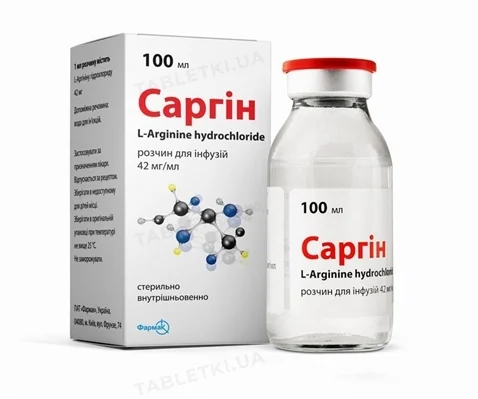
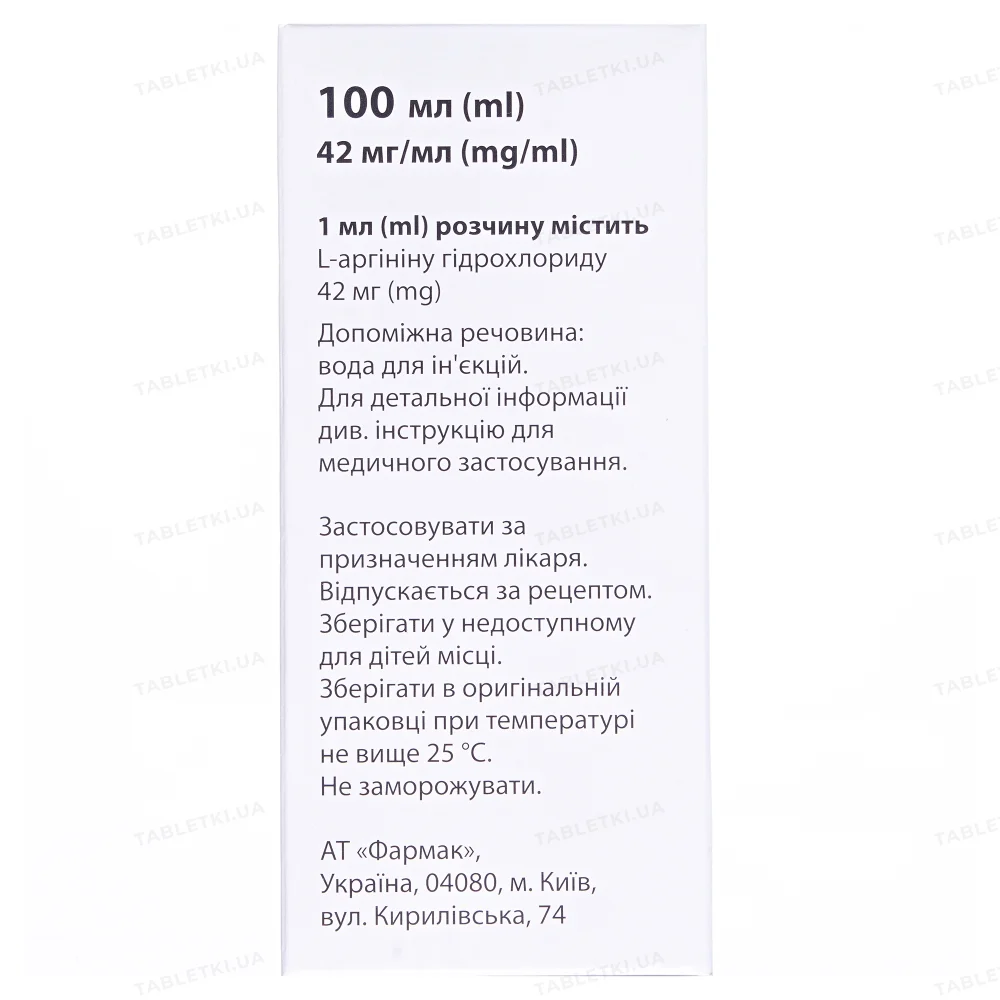
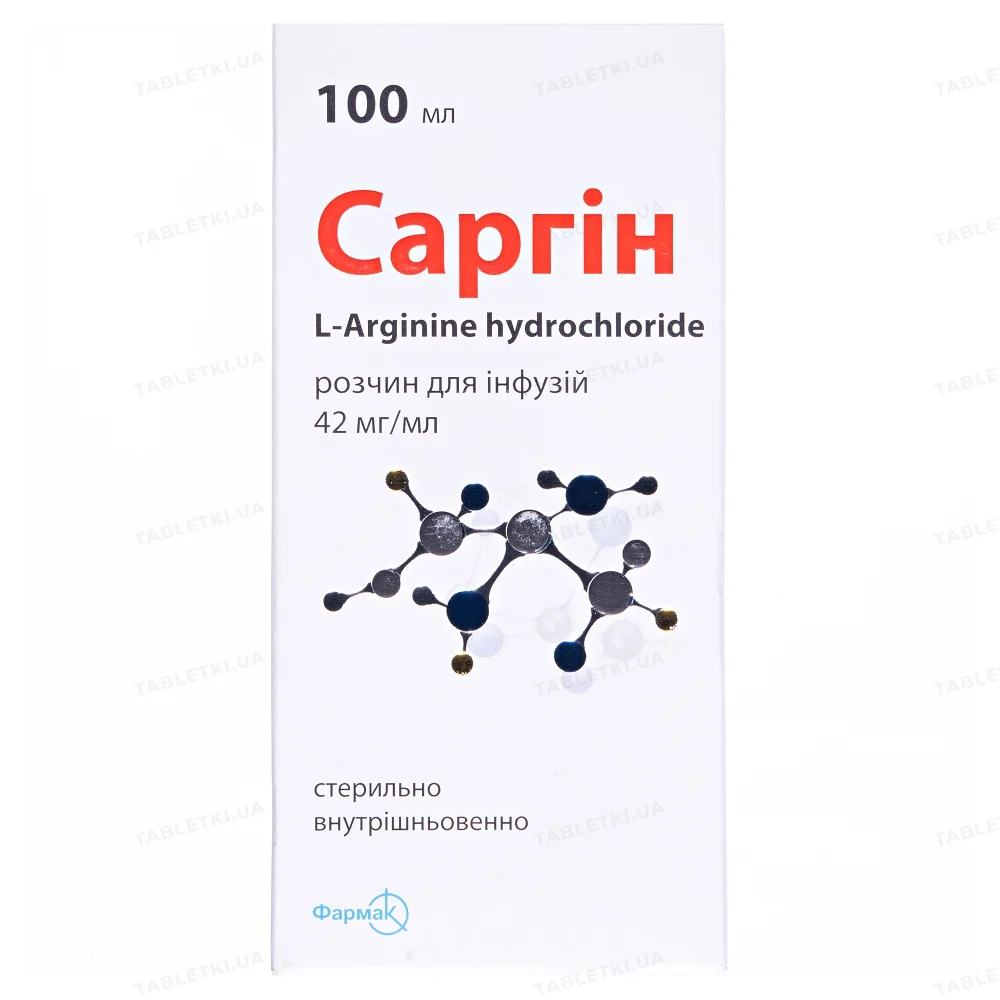
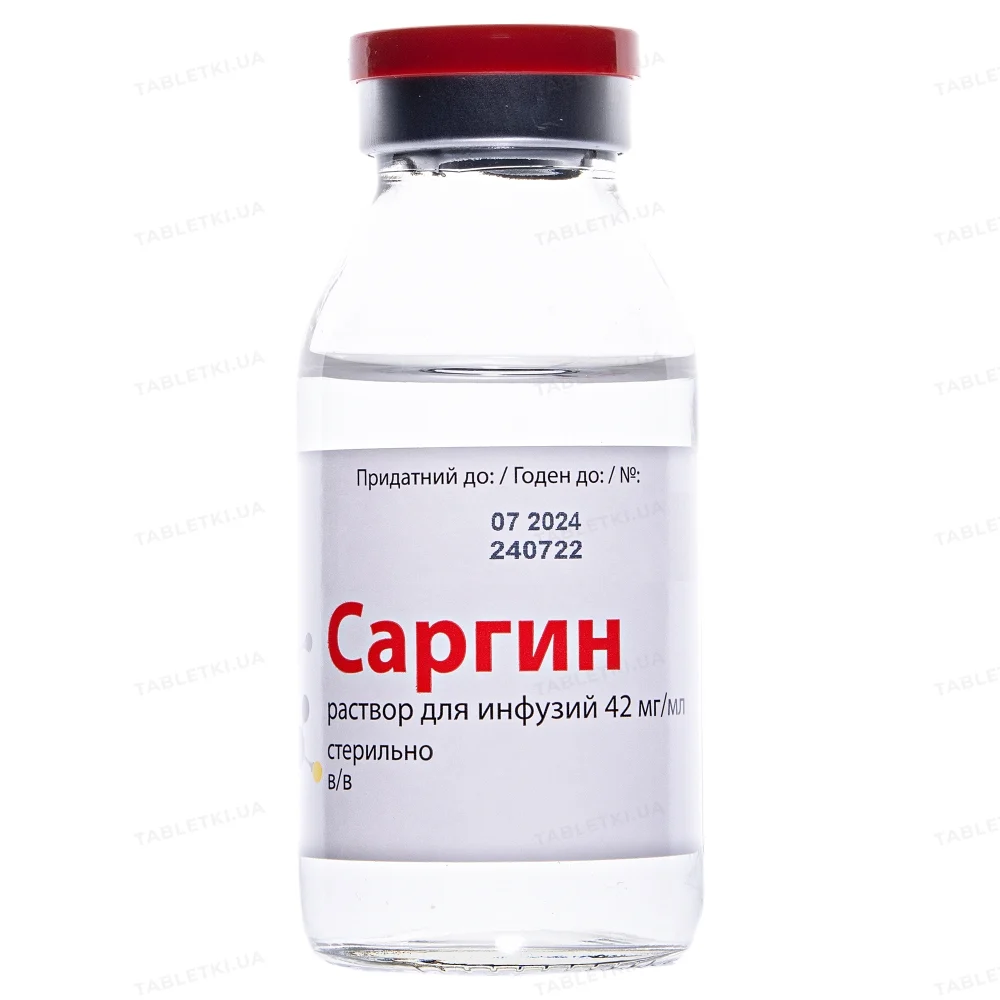
Sargin solution for infusion, 42 mg/mL, 100 mL per vial.
Composition
Active ingredient: L-arginine hydrochloride (L-arginini hydrochloridum);
1 mL of solution contains 42 mg of L-arginine hydrochloride;
excipient: water for injection.
Dosage Form
Solution for infusion.
Main physical and chemical properties: a clear, colorless, or slightly yellowish-brown liquid.
Pharmacotherapeutic group
Blood substitutes and perfusion solutions. Additional solutions for intravenous administration. Amino acids. Arginine hydrochloride. ATC code B05X B01.
Pharmacological properties
Pharmacodynamics.
Arginine (α-amino-D-guanidinovaleric acid) is an amino acid which belongs to the class of conditionally essential amino acids and acts as an active and multifaceted cellular regulator of numerous vital bodily functions, exhibiting important protective effects in critical conditions.
Sargin exhibits antihypoxic, membrane-stabilizing, cytoprotective, antioxidant, antiradical, and detoxifying activity; acts as an active regulator of intermediate metabolism and energy supply processes, and plays a role in maintaining hormonal balance in the body. It is known that arginine increases blood levels of insulin, glucagon, somatotropin, and prolactin; it participates in the synthesis of proline, polyamine, and agmatine; it is involved in the processes of fibrinolysis and spermatogenesis; and it exerts a membrane-depolarizing effect.
Arginine is one of the main substrates in the urea cycle in the liver. The drug’s hypoammonemic effect is achieved by activating the conversion of ammonia to urea. It exerts a hepatoprotective effect due to its antioxidant, antihypoxic, and membrane-stabilizing activity, and positively influences energy metabolism in hepatocytes.
Sargine is a substrate for NO synthase—an enzyme that catalyzes the synthesis of nitric oxide in endothelial cells. The drug activates guanylate cyclase and increases the level of cyclic guanidine monophosphate (cGMP) in the vascular endothelium, reduces the activation and adhesion of leukocytes and platelets to the vascular endothelium, inhibits the synthesis of the adhesion proteins VCAM-1 and MCP-1, thereby preventing the formation and progression of atherosclerotic plaques, inhibits the synthesis of endothelin-1, which is a potent vasoconstrictor and a stimulator of the proliferation and migration of vascular smooth muscle cells. Sargin also inhibits the synthesis of asymmetric dimethylarginine—a potent endogenous stimulator of oxidative stress. The drug stimulates the activity of the thymus, which produces T-cells, and regulates blood glucose levels during physical exertion. It has an acid-forming effect and helps restore acid-base balance.
Pharmacokinetics.
With continuous intravenous infusion, the maximum concentration of arginine hydrochloride in blood plasma is observed 20–30 minutes after the start of administration. Sargin crosses the placental barrier, is filtered by the renal glomeruli, but is almost completely reabsorbed in the renal tubules.
Indications
Metabolic alkalosis, hyperammonemia, atherosclerosis of the coronary and cerebral arteries, atherosclerosis of the peripheral arteries (including cases with intermittent claudication), diabetic angiopathy, hypertension, chronic heart failure, hypercholesterolemia, chronic obstructive pulmonary disease, pulmonary hypertension, fetal growth restriction, and preeclampsia—as part of a comprehensive treatment regimen.
Contraindications
Hypersensitivity to the drug. Severe renal impairment, hyperchloremic acidosis; history of allergic reactions; use of potassium-sparing diuretics, as well as spironolactone. Myocardial infarction (including a history thereof).
Drug Interactions and Other Interactions
When using Sargin, it is important to note that the drug may cause severe and persistent hyperkalemia in patients with renal insufficiency who are taking or have taken spironolactone. Prior use of potassium-sparing diuretics may also cause an increase in serum potassium levels. When used concomitantly with aminophylline, an increase in serum insulin levels is possible.
Arginine is incompatible with thiopental.
Special Instructions for Use
100 mL contains 20 mmol of arginine and 20 mmol of chloride.
In patients with renal insufficiency, urine output and plasma potassium levels must be checked before starting the infusion, as the drug may cause hyperkalemia.
Use with caution in patients with endocrine disorders. The drug may stimulate the secretion of insulin and growth hormone.
If dry mouth occurs, blood glucose levels should be checked.
Use with caution in cases of electrolyte imbalances or kidney disease. If symptoms of asthenia worsen while taking this medication, treatment should be discontinued.
Use with caution in patients with angina.
Use during pregnancy or breastfeeding.
The drug crosses the placenta; therefore, it may be used during pregnancy only if the expected benefit to the mother outweighs the potential risk to the fetus.
There are no data on the use of this medication during breastfeeding.
Effect on reaction time when driving or operating machinery.
Caution should be exercised when driving or operating machinery, as the drug may cause dizziness.
Dosage and Administration
The drug is administered intravenously by drip at a rate of 10 drops per minute for the first 10–15 minutes; thereafter, the rate of administration may be increased to 30 drops per minute.
The daily dose is 100 mL of solution.
In cases of severe circulatory disorders in the central and peripheral vessels, as well as in cases of pronounced intoxication, hypoxia, or asthenic conditions, the dose may be increased to 200 mL per day.
The maximum infusion rate should not exceed 20 mmol/hour.
For children under 12 years of age, the dose is 5–10 mL per 1 kg of body weight per day.
For the treatment of metabolic alkalosis, the dose can be calculated as follows:
arginine hydrochloride (mmol)
--------------------------------------- × 0.3 × kg body weight
base excess (BE) (mmol/L)
Administration should begin with half the calculated dose. Any necessary additional adjustment should be made after receiving the results of the updated acid-base balance.
Children. The drug is indicated for children aged 3 years and older.
Overdose
Symptoms: renal failure, hypoglycemia, metabolic acidosis.
Treatment. In case of overdose, the infusion of the drug must be discontinued. Physiological responses should be monitored, and vital functions should be supported. If necessary, administer alkalinizing agents and diuretics (saluretics), as well as electrolyte solutions (0.9% sodium chloride solution, 5% glucose solution). Treatment is symptomatic.
Side Effects
General disorders: hyperthermia, sensation of heat, body aches.
Musculoskeletal system: joint pain.
Gastrointestinal: dry mouth, nausea, vomiting.
Skin and subcutaneous tissue disorders: changes at the injection site, including erythema, itching, pallor, and even acrocyanosis.
Immune system: anaphylactic shock, hypersensitivity reactions, including rash, hives, and angioedema.
Respiratory, thoracic, and mediastinal disorders: shortness of breath.
Cardiovascular system: fluctuations in blood pressure, changes in heart rhythm, pain in the heart region.
Nervous system: headache, dizziness, anxiety, weakness, convulsions, tremor—more common when the rate of administration is too fast.
Laboratory parameters: hyperkalemia.
Shelf life
2 years.
Do not use the medication after the expiration date indicated on the packaging.
Storage conditions
Store in the original packaging at a temperature not exceeding 25 °C. Do not freeze.
Keep out of reach of children.
Incompatibility
This medication is incompatible with thiopental.
Packaging
100 mL per vial. 1 vial per pack.
Manufacturer
Farmak JSC.
Manufacturer’s location and business address.
Ukraine, 04080, Kyiv, 74 Kyrylivska St.