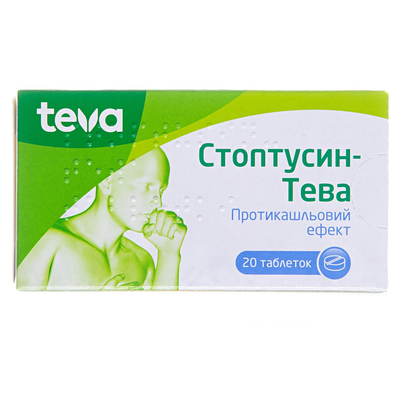
StopTusin-Teva Tablets, No. 20 (10 x 2)
Ingredients
Active ingredients: butamirate citrate, guaifenesin;
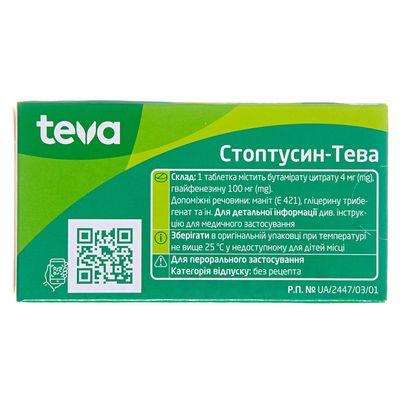
1 tablet contains: 4 mg butamirate citrate, 100 mg guaifenesin;
Inactive ingredients: colloidal anhydrous silicon dioxide, mannitol (E 421), microcrystalline cellulose, glycerol tribehenate, magnesium stearate.
Dosage Form
Tablets.
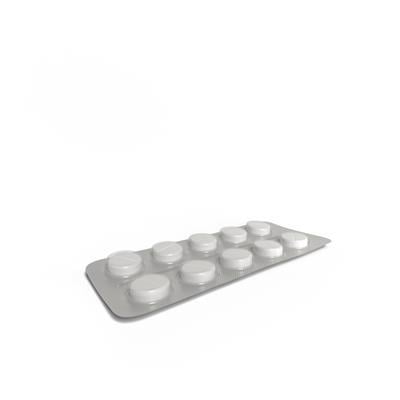
Main physical and chemical properties: round, white tablets with a score line on one side.
Pharmacotherapeutic group
Combination drugs containing antitussives and expectorants. ATC code R05F B02.
Pharmacological properties
Pharmacodynamics.
A combination drug with antitussive, mucolytic, and expectorant effects. Butamirate citrate belongs to the class of non-opioid antitussives with peripheral action. It exerts a local anesthetic effect on nerve endings that transmit ascending signals of irritation from the respiratory tract. Unlike opioid antitussives, it does not exert a central inhibitory effect, does not depress the respiratory center, and is not addictive.
The antitussive effect of butamirate citrate is complemented by the expectorant effect of guaifenesin. Guaifenesin has secretolytic (by directly enhancing the secretion of bronchial glands and stimulating the elimination of acidic glycoproteins from acinar cells) and secretomotor properties (it reduces sputum viscosity and facilitates the evacuation of mucus and its expectoration).
Pharmacokinetics.
Butamirate citrate is rapidly and completely absorbed; 98% of it binds to plasma proteins. It is metabolized to form two metabolites, which also have an antitussive effect. 90% of the metabolites are excreted by the kidneys, and only a small portion is excreted in the feces. The biological half-life is approximately 6 hours.
After oral administration, guaifenesin is rapidly and readily absorbed from the gastrointestinal tract. A small amount binds to plasma proteins. It is excreted by the kidneys, mainly in the form of metabolites, with a small portion excreted unchanged. The biological half-life is 1 hour.
Indications
Dry, irritating, paroxysmal cough of various origins.
Contraindications
Hypersensitivity to any component of the drug, myasthenia gravis, first trimester of pregnancy (see the section “Use During Pregnancy or Breastfeeding”). StopTusin-Teva should not be used in children under 12 years of age.
Interactions with Other Medications and Other Interactions
Since butamirate suppresses the cough reflex, concomitant use of expectorants should be avoided, as this may lead to mucus retention in the airways, increasing the risk of bronchospasm and respiratory tract infections.
Lithium and magnesium enhance the effect of guaifenesin.
Guaifenesin enhances the analgesic effect of acetaminophen and acetylsalicylic acid, intensifies the sedative effects of alcohol, tranquilizers, and hypnotics, general anesthetics on the central nervous system, and also enhances the effects of muscle relaxants. The central nervous system effects of muscle relaxants may increase the adverse effects of guaifenesin, particularly muscle weakness.
Effect on Laboratory Test Results
Guaifenesin may cause false-positive results in diagnostic tests that measure 5-hydroxyindoleacetic acid (photometric method using nitrosonaphthol as a reagent) and vanillylmandelic acid in urine. Therefore, treatment with StopTusin-Teva must be discontinued 48 hours prior to urine collection for these tests.
Special Considerations for Use
Patients should refrain from consuming alcoholic beverages during treatment.
Stoptsusin-Teva should not be used in patients with a productive cough and/or a persistent or chronic cough associated with smoking, asthma, chronic bronchitis, or emphysema.
Use the medication with caution in patients with asthma, tuberculosis, or pneumoconiosis.
If the cough persists or worsens, treatment should be reviewed.
Use during pregnancy or breastfeeding.
Pregnancy
No controlled studies involving pregnant women or animal studies have been conducted.
There have been reports of an increased incidence of inguinal hernias in newborns following the use of guaifenesin during the first trimester of pregnancy. Therefore, this medication is contraindicated during the first trimester of pregnancy.
Use of the drug during the second and third trimesters of pregnancy is possible only after careful consideration of the benefit-risk ratio.
Breastfeeding
It is unknown whether butamirate citrate or guaifenesin is excreted in breast milk. Experience with use in breastfeeding mothers is limited; therefore, the risk of adverse effects in infants cannot be ruled out. It is recommended to discontinue breastfeeding for the duration of treatment with this medication.
Effect on reaction time when driving or operating machinery.
This medication may negatively affect activities requiring increased attention (driving, operating machinery, and working at heights) due to the potential for drowsiness and dizziness.
Dosage and Administration
Administer the dosage based on the patient’s body weight:
up to 50 kg — ½ tablet 4 times daily;
50–70 kg—1 tablet 3 times daily;
70–90 kg — 1½ tablets 3 times daily;
90 kg or more—2 tablets 3 times a day.
The interval between doses should be 4–6 hours. The tablet may be split in half.
It is recommended to take the medication after meals with a sufficient amount of liquid (water, tea, juice).
Children.
This medication should be used in children 12 years of age and older according to the indications (dosage and administration are described in the “Dosage and Administration” section).
Overdose
In case of overdose, symptoms of guaifenesin toxicity predominate: drowsiness, muscle weakness, nausea, vomiting, diarrhea, dizziness, and hypotension. Radiolucent urolithiasis may occur.
There is no specific antidote.
Treatment: gastric lavage, administration of activated charcoal, and symptomatic therapy aimed at maintaining cardiovascular and respiratory function, renal function, and electrolyte balance.
Side Effects
When the recommended dosage is followed, patients tolerate the drug well. Side effects usually resolve after the dose is reduced.
Metabolism and nutrition: anorexia.
Nervous system: headache, drowsiness.
Respiratory system: difficulty breathing.
Ear and labyrinth disorders: dizziness.
Gastrointestinal system: discomfort in the digestive system, nausea, abdominal pain, vomiting, diarrhea. If you experience stomach discomfort or other unusual effects, stop taking the medication and consult a doctor.
Skin and subcutaneous tissue disorders: allergic reactions, including anaphylactic shock, angioedema, skin rashes, itching, hives, and exanthema.
Urinary system: urolithiasis.
Shelf life
3 years.
Storage conditions
Store in the original packaging at a temperature not exceeding 25 °C, out of reach of children.
Packaging
10 tablets per blister pack, 2 blister packs per box.
Dispensing Category
Available without a prescription.
Manufacturer
Teva Czech Industries s.r.o.
Teva Operations Poland, LLC.