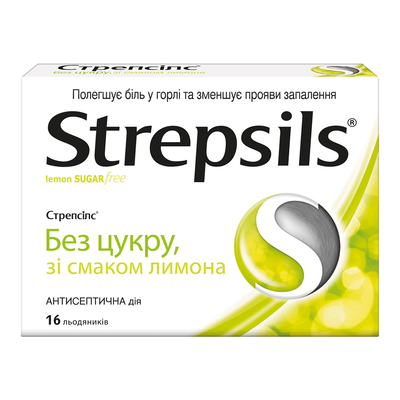
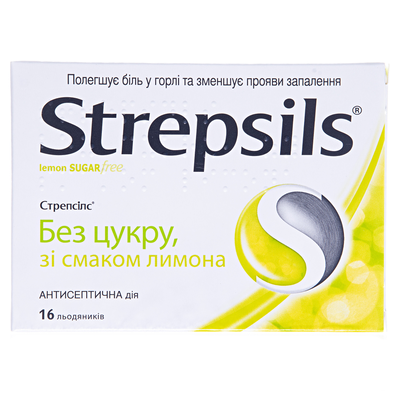
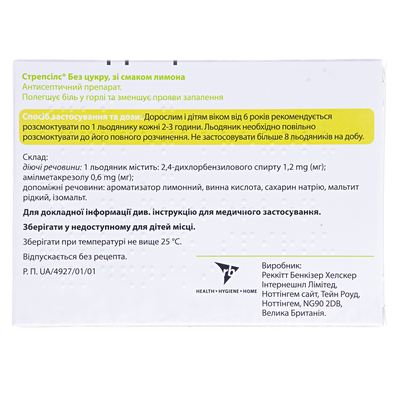
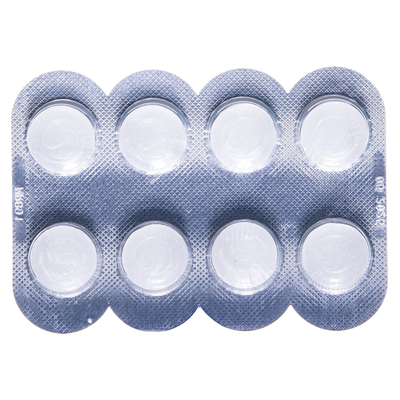
Sugar-Free Lemon-Flavored Strepsils Lozenges No. 16 (8 x 2)
Composition
Active ingredients: 2,4-dichlorobenzyl alcohol, amylmetacresol;
1 lozenge contains: 1.2 mg of 2,4-dichlorobenzyl alcohol; 0.6 mg of amylmetacresol;
inactive ingredients: lemon flavoring, tartaric acid, sodium saccharin, liquid maltitol, isomalt.
Dosage Form
Lozenges.
Main physical and chemical properties: round lozenges ranging in color from white to pale yellow, with an “S” symbol imprinted on both sides.
Pharmacotherapeutic group
Preparations used for throat conditions. Antiseptics. Dichlorobenzyl alcohol. ATC code R02A A03.
Pharmacological properties
Pharmacodynamics.
The drug has antiseptic properties. It is active against a broad spectrum of Gram-positive and Gram-negative microorganisms in vitro; it also has antifungal activity. The drug’s efficacy is due to the presence of two broad-spectrum antibacterial components that relieve sore throat and reduce signs of inflammation. Amylmetacresol disrupts the structure of bacterial proteins, resulting in a bactericidal effect. 2,4-dichlorobenzyl alcohol exerts a bacteriostatic effect by dehydrating the bacterial cell.
Due to the minimal absorption of the drug into the bloodstream, Strepsils® is classified as a topical agent. Consequently, pharmacokinetic parameters have not been determined.
Indications
As an antiseptic to relieve a sore throat.
Contraindications
Hypersensitivity to any component of the drug.
Interactions with Other Medications and Other Types of Interactions
No interaction studies have been conducted.
Special Instructions for Use
Do not exceed the specified maximum dose.
If symptoms persist for 3 days or worsen, or are accompanied by a high fever, headache, or other symptoms, consult a doctor for further adjustment of the treatment regimen.
If you have been diagnosed with an intolerance to certain sugars, consult your doctor before taking this medication.
Isomalt and liquid maltitol, which are components of this medication, may cause a mild laxative effect (after taking several lozenges per day).
This medication is not recommended for patients with hereditary fructose intolerance, glucose-galactose malabsorption, or sucrose-isomaltose insufficiency.
Use during pregnancy or breastfeeding.
Pregnancy: Data on the use of amylmetacresol and 2,4-dichlorobenzyl alcohol are lacking or limited. As with all medications, caution should be exercised when using this product during pregnancy. If necessary, consult a doctor for advice.
Breastfeeding: It is unknown whether amylmetacresol, 2,4-dichlorobenzyl alcohol, or their metabolites are excreted in breast milk. A risk to newborns or breastfed infants cannot be ruled out.
There are no data on the effects on fertility.
Effects on reaction time when driving or operating machinery.
No studies have been conducted on the effects on the ability to drive or operate machinery.
Dosage and Administration
For oral use.
Use the lowest dose for the shortest time necessary to relieve symptoms.
Adults and children 6 years of age and older are recommended to suck on 1 lozenge every 2–3 hours. The lozenge should be sucked slowly until it is completely dissolved. Do not take more than 8 lozenges per day. The maximum recommended duration of use is 3 days. No dose adjustment is necessary for elderly patients.
Children
Due to the dosage form, this medication is contraindicated in children under 6 years of age.
Overdose
Accidental or intentional overdose may manifest only as symptoms of gastrointestinal discomfort. In such cases, discontinue use of the medication and consult a doctor. Treatment is symptomatic.
Side Effects
The side effects listed below have been observed with short-term use of 2,4-dichlorobenzyl alcohol and amylmetacresol at over-the-counter doses. Other adverse reactions may occur during treatment of chronic conditions or with long-term use.
Adverse reactions are classified by organ system and frequency. Frequency is defined as follows: very common: ≥ 1/10; common: ≥ 1/100 and < 1/10; uncommon: ≥ 1/1,000 and < 1/100; rare: ≥ 1/10,000; < 1/1,000; very rare: < 1/10,000; and frequency unknown (cannot be estimated from the available data). Within each frequency group, adverse reactions are listed in order of decreasing severity.
Immune system disorders
Frequency unknown: hypersensitivity reactions, which may include rash, angioedema, urticaria, bronchospasm, and hypotension with loss of consciousness.
Respiratory and mediastinal disorders
Frequency unknown: pharyngeal edema (swelling of the throat).
Gastrointestinal system
Frequency unknown: discomfort in the oral cavity, which may include throat irritation, oral paresthesia (tingling in the mouth), swelling in the oral cavity, and glossodynia (tongue pain).
Frequency unknown: dyspepsia, nausea, stomatitis, abdominal pain.
Skin and subcutaneous tissue disorders.
Frequency unknown: skin rash, itching, erythema.
Shelf life
3 years.
Storage conditions
Store at a temperature not exceeding 25 °C. Keep out of reach of children.
Packaging
8 lozenges per blister pack, 2 blister packs per cardboard box; 12 lozenges per blister pack, 1 or 2 blister packs per cardboard box.
Dispensing Category
Over-the-counter.
Manufacturer
Reckitt Benckiser Healthcare International Limited.