
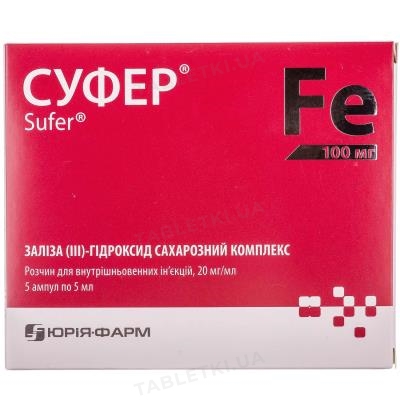
Sufer solution for intravenous injection, 20 mg/mL, 5 mL, No. 1 in an ampoule (1 AMPOULE!)
Composition
Active ingredient: iron (III) hydroxide sucrose complex;
1 mL of solution contains 20 mg of iron in the form of iron (III) hydroxide sucrose complex;
excipient: water for injection.
Dosage Form
Solution for intravenous injection.
Main physical and chemical properties: a brown-colored aqueous solution.
Pharmacotherapeutic group
Antianemic agents for parenteral administration. Iron preparations. ATC code B0ZA C.
Pharmacological properties
Pharmacodynamics.
Mechanism of action
The active ingredient in Sufer®, iron sucrose, consists of polyatomic iron(III) hydroxide centers surrounded by a large number of non-covalently bound sucrose molecules. The molecular weight of the complex corresponds to its average molecular weight (Mr), which is approximately 43 kDa. The polycore iron center has a structure similar to that of the ferritin center, which is a physiological iron-containing protein. The complex is designed so that the absorbed iron is delivered in a controlled manner to the proteins responsible for its transport and storage in the body (transferrin and ferritin, respectively).
Following intravenous administration, the multinuclear iron center from the complex is primarily taken up by the reticuloendothelial system of the liver, spleen, and bone marrow. In the second stage, the iron is used for the synthesis of hemoglobin, myoglobin, and other iron-containing enzymes, or is stored in the liver as ferritin.
Clinical Efficacy
Clinical studies have shown that following intravenous administration of iron(III) hydroxide sucrose complex, a hematologic response is observed more rapidly than with the use of oral soluble forms of iron.
Pharmacokinetics.
Distribution
An assessment of the ferrokinetics of iron (III) hydroxide sucrose complex labeled with 59Fe and 52Fe was conducted in 6 patients with anemia and chronic renal insufficiency. During the first 6–8 hours, 52Fe was taken up by the liver, spleen, and bone marrow. It is believed that the uptake of the radioactive tracer by the macrophage-rich spleen is characteristic of iron uptake by the reticuloendothelial system.
Following intravenous administration of a single dose of the drug Sufer®, containing 100 mg of iron, to healthy volunteers, the maximum iron concentration was observed 10 minutes after administration and reached a mean value of 538 mmol/L. The volume of distribution in the central compartment corresponded to the plasma volume (approximately 3 liters).
Metabolism
After injection, sucrose is almost completely broken down, and the multinuclear iron center is taken up predominantly by the reticuloendothelial system of the liver, spleen, and bone marrow.
Over the course of 4 weeks following administration, the uptake of 59Fe iron by red blood cells ranged from 68% to 97%.
Excretion
The average molecular weight of the complex is approximately 43 kDa, which is sufficiently high to prevent its excretion by the kidneys. Renal excretion of iron during the first 4 hours after injection of 100 mg of iron is less than 5% of the administered dose. After 24 hours, the total serum iron concentration had returned to baseline (pre-administration levels), and renal excretion of sucrose was approximately 75% of the administered dose.
Pharmacokinetics in Specific Patient Populations
It is not yet known whether renal or hepatic insufficiency affects the pharmacological properties of iron (III) hydroxide sucrose complex (see the “Special Considerations for Use” section).
Indications
Iron deficiency in patients who cannot be prescribed oral iron preparations or in cases where such preparations are ineffective, including:
- intolerance to oral iron preparations;
- the presence of inflammatory gastrointestinal diseases (e.g., ulcerative colitis) that may be exacerbated by therapy with oral iron preparations;
- treatment-resistant iron deficiency conditions, where control of these conditions with oral iron supplements is insufficient.
Sufer® should be used only when the indication is based on appropriate laboratory tests. Appropriate laboratory tests include the measurement of parameters such as hemoglobin, serum ferritin, and transferrin iron saturation.
Contraindications
The use of Sufer® is contraindicated in the following conditions:
- hypersensitivity to the active ingredient or to other components of the drug;
- anemia not associated with iron deficiency (e.g., hemolytic anemia, megaloblastic anemia due to vitamin B12 deficiency, erythropoiesis disorders, bone marrow hypoplasia, or anemia caused by lead poisoning);
- iron overload (hemosiderosis, hemochromatosis) or hereditary disorders of iron absorption (e.g., sideroachrestic anemia, cutaneous porphyria, thalassemia);
- First trimester of pregnancy.
Interactions with Other Medications and Other Types of Interactions
Sufer® is indicated for patients who cannot be prescribed oral iron preparations due to intolerance, ineffectiveness, or the presence of gastrointestinal disorders. Sufer® should not be used concomitantly with oral iron-containing medications, as the absorption of orally administered iron is reduced.
Special Considerations for Use
Parenteral forms of iron may cause immediate-type hypersensitivity reactions, including serious anaphylactic/anaphylactoid reactions, which can potentially be fatal. Such reactions have been reported even in cases where previous administration of parenteral iron preparations was uneventful. Hypersensitivity reactions that progressed to Kounis syndrome (acute allergic coronary arteriospasm, which may cause myocardial infarction; see the “Adverse Reactions” section) have been reported. In patients who have experienced hypersensitivity reactions to other parenteral iron preparations (e.g., iron dextran), Sufer® should be used only when absolutely necessary, with all necessary precautions taken.
Treatment with Sufer® should be prescribed by a physician only after the indication has been precisely determined.
Sufer® may be administered only if medical personnel trained in the assessment and treatment of anaphylactic reactions are ready to take immediate action, and if a facility properly equipped for resuscitation is available. Before each administration of the drug, the patient should be asked about any previous adverse reactions associated with the use of intravenous iron preparations.
Typical symptoms of immediate-type hypersensitivity reactions include: a drop in blood pressure, tachycardia (and even anaphylactic shock), respiratory symptoms (including bronchospasm, laryngeal edema, and pharyngeal edema), gastrointestinal symptoms (including abdominal cramps and vomiting), or skin symptoms (including hives, erythema, and itching).
Each patient should be monitored for at least 30 minutes after administration of parenteral iron preparations to ensure timely detection of symptoms of hypersensitivity reactions. If allergic reactions or signs of intolerance occur during treatment, therapy should be discontinued immediately.
For the immediate treatment of acute anaphylactic/anaphylactoid reactions, the use of epinephrine (e.g., 0.3 mg intramuscularly) is recommended first, followed by the administration of antihistamines and/or corticosteroids (which have a delayed onset of action).
There is a high risk of hypersensitivity reactions in patients with a history of allergies, including drug intolerance, severe bronchial asthma, eczema, or other forms of atopy, as well as in patients with immunological and inflammatory diseases (e.g., systemic lupus erythematosus, rheumatoid arthritis).
In patients with impaired liver function, parenteral iron preparations should be used only after a careful assessment of the benefit-risk ratio. Parenteral iron administration should be avoided in patients with impaired liver function when iron overload is a contributing factor. Close monitoring of iron levels is recommended to prevent iron overload.
In patients with elevated ferritin levels, iron preparations for parenteral administration may adversely affect the course of a bacterial or viral infection.
Parenteral iron preparations should be used with caution in cases of acute or chronic infection. In patients with chronic infections, a benefit-risk assessment should be performed. It is recommended to discontinue use of Sufer® in patients with bacteremia.
During administration, special attention must be paid to preventing paravenous leakage. Paravenous leakage of the drug may lead to pain, inflammation, tissue necrosis, and persistent brown discoloration of the skin at the injection site. In the event of paravenous leakage, administration of the drug should be discontinued immediately.
A decrease in blood pressure is commonly observed with the use of intravenous iron preparations. The solution must be administered with caution. Strictly follow the recommendations regarding the rate of administration to prevent the development of hypotension. A higher incidence of adverse reactions (particularly hypotension) is associated with an increase in the dose or rate of administration.
Special caution should be exercised when administering Sufer® to patients with hepatic insufficiency, decompensated liver cirrhosis, epidemic hepatitis, Rendu–Osler - Weber’s disease, infectious kidney diseases in the acute phase, or uncontrolled hyperparathyroidism.
Before use, inspect the ampoule for sediment and damage.
Only a brown-colored aqueous solution free of sediment should be used.
Sufer® should be administered immediately after opening the ampoule.
Use during pregnancy or breastfeeding.
Pregnancy
There are limited data on the use of iron sucrose complex in pregnant women during the first trimester. Data on the use of iron in parenteral form in pregnant women during the second and third trimesters of pregnancy (303 reports on pregnancy outcomes) showed no adverse effects on the health of the mother or child.
It is not yet known whether iron (III) hydroxide sucrose complex crosses the placenta. Iron bound to transferrin crosses the placental barrier. Iron bound to lactoferrin passes into breast milk.
No studies have been conducted on the effect on iron levels in newborns.
The drug is contraindicated during the first trimester of pregnancy (see the “Contraindications” section). Use of the drug during the second and third trimesters of pregnancy is permitted only when strictly indicated.
The benefit-risk ratio should be assessed before using the drug during pregnancy, as hypersensitivity reactions may pose a certain risk to the mother and child (see the “Special Considerations for Use” section).
Following the administration of parenteral iron preparations to a pregnant woman, the fetus may develop bradycardia. This condition is usually transient and results from a hypersensitivity reaction in the mother. During intravenous administration of iron preparations to pregnant women, the condition of the fetus should be carefully monitored.
Pre-pregnancy body weight should be taken into account when calculating the required amount of iron to avoid overdose.
Breastfeeding
Data on the excretion of iron into human breast milk following intravenous administration of iron sucrose are limited. In a clinical study, 10 healthy, iron-deficient women who were breastfeeding received 100 mg of iron in the form of a sucrose complex. After four days of treatment, the iron concentration in breast milk was not elevated and did not differ from that in the control group (n = 5). The effect of iron delivered through the mother’s breast milk on the newborn/infant cannot be ruled out; therefore, the benefit-risk ratio should be evaluated.
Effect on reaction time when driving or operating machinery.
No relevant studies are available. An effect on reaction time while driving or operating machinery is unlikely. However, if side effects such as dizziness, confusion, or drowsiness occur after taking the medication, patients should refrain from driving or operating machinery until the symptoms subside.
Dosage and Administration
Administer Sufer® slowly, intravenously.
The drug is not intended for intramuscular or subcutaneous administration.
During and after administration of Sufer®, patients should be monitored for signs and symptoms of hypersensitivity reactions. Appropriate emergency treatment must be available (see the “Special Considerations for Use” section).
The total cumulative dose of the drug should be calculated individually for each patient and must not be exceeded. The dose is calculated based on the patient’s body weight and hemoglobin level.
If the total required dose exceeds the maximum permitted single dose of 200 mg (for injection) or 500 mg (for infusion), it is recommended to administer the drug in divided doses.
Dose Calculation
The total cumulative dose of Sufer® equivalent to the total iron deficiency (mg) is determined based on the hemoglobin (Hb) level and body weight. The dose is calculated individually based on the patient’s total iron deficiency using the Ganzoni formula:
total iron deficiency (mg) = body weight (kg) × (normal Hb level (g/L) – patient’s Hb level (g/L)) × 0.24* + stored iron (mg).
For patients weighing less than 35 kg: normal Hb level – 130 g/L, amount of stored iron – 15 mg/kg of body weight.
For patients weighing more than 35 kg: normal Hb level – 150 g/L, amount of stored iron – 500 mg.
* The conversion factor 0.24 = 0.0034 × 0.07 × 1000 (iron content in Hb = 0.34%, blood volume = 7% of body weight, factor 1000 = conversion from “g” to “mg”).
Total volume of Sufer® medication to be administered (in mL)
= total iron deficiency (mg)
20 mg/mL
Table 1
Total cumulative dose of Sufer® (mL) to be administered, based on the patient’s body weight and Hb level:
|
Body weight
|
Total cumulative dose of Sufer®
(20 mg iron/mL) for administration
|
|||
|
(kg)
|
Hb 60 g/L
|
Hb 75 g/L
|
Hb 90 g/L
|
Hb 105 g/L
|
|
mL
|
mL
|
mL
|
mL
|
|
|
10
|
15
|
15
|
12.5
|
10
|
|
15
|
25
|
22.5
|
17.5
|
15
|
|
20
|
32.5
|
27.5
|
25
|
20
|
|
25
|
40
|
35
|
30
|
27.5
|
|
30
|
47.5
|
42.5
|
37.5
|
32.5
|
|
35
|
62.5
|
57.5
|
50
|
45
|
|
40
|
67.5
|
60
|
55
|
47.5
|
|
45
|
75
|
65
|
57.5
|
50
|
|
50
|
80
|
70
|
60
|
52.5
|
|
55
|
85
|
75
|
65
|
55
|
|
60
|
90
|
80
|
67.5
|
57.5
|
|
65
|
95
|
82.5
|
72.5
|
60
|
|
70
|
100
|
87.5
|
75
|
62.5
|
|
75
|
105
|
92.5
|
80
|
65
|
|
80
|
112.5
|
97.5
|
82.5
|
67.5
|
|
85
|
117.5
|
102.5
|
85
|
70
|
|
90
|
122.5
|
107.5
|
90
|
72.5
|
Table 2
Required Hb level based on the patient’s body weight:
|
Body weight
|
Required Hb
|
|
< 35 kg
|
130 g/L
|
|
≥ 35 kg
|
150 g/L
|
To convert Hb (mmol) to Hb (g/L), multiply the first value by 16.
Standard Dosage
Adults: 5–10 mL of Sufer® (100–200 mg of iron) 1–3 times per week. See below for duration of use and dilution ratio.
Children aged 3 years and older: There are only limited data on the use of this medication in children. If clinically necessary, it is recommended to administer no more than 0.15 mL of Sufer® (3 mg of iron) per 1 kg of body weight no more than 3 times a week. See below for duration of use and dilution ratio.
Maximum tolerable single or weekly dose
Adults
For injections, the maximum tolerated dose, administered no more than 3 times per week, is 10 mL of Sufer® (200 mg of iron); the duration of administration should be at least 10 minutes.
For infusion, the maximum tolerable dose, administered no more than once a week, is:
- for patients weighing more than 70 kg: 500 mg of iron (25 mL of Sufer®) over at least 3.5 hours;
- for patients weighing 70 kg or less: 7 mg of iron per kg of body weight over at least 3.5 hours.
The infusion duration must be strictly adhered to, even if the patient is not receiving the maximum tolerable single dose.
If no improvement in hematological parameters is observed (an increase in hemoglobin levels of approximately 1 g/L of blood per day or approximately 10–20 g/L 1–2 weeks after the start of treatment), the patient’s initial diagnosis should be reviewed to rule out persistent blood loss.
Administration
Sufer® may only be administered intravenously by slow injection, intravenous infusion, or directly into the venous access site of a dialysis system.
Sufer® must not be administered intramuscularly or subcutaneously.
If the total required dose exceeds the maximum permissible single dose, the total dose should be divided into several administrations.
Intravenous Drip Administration
Immediately before administration, Sufer® must be diluted only in a sterile 0.9% sodium chloride solution according to the schedule specified in Table 3.
Table 3
|
Dose of Sufer®
(mg of iron)
|
Dose of Sufer®
(mL)
|
Maximum volume of sterile 0.9% sodium chloride solution for dilution
|
Minimum administration time
|
|
50 mg
|
2.5 mL
|
50 mL
|
8 minutes
|
|
100 mg
|
5 mL
|
100 mL
|
15 minutes
|
|
200 mg
|
10 mL
|
200 ml
|
30 minutes
|
|
300 mg
|
15 mL
|
300 ml
|
1.5 hours
|
|
400 mg
|
20 mL
|
400 ml
|
2.5 hours
|
|
500 mg
|
25 mL
|
500 ml
|
3.5 hours
|
Intravenous bolus administration
Sufer® may also be administered intravenously as a slow infusion of the undiluted solution at a rate of 1 mL per minute (5 mL of Sufer® (100 mg of iron) is administered over 5 minutes), but the maximum volume of the solution must not exceed 10 mL of Sufer® (200 mg of iron) per injection.
After the injection, the patient should straighten their arm. Paravenous leakage of the drug should be avoided, as it may lead to pain, inflammation, tissue necrosis, and persistent brown discoloration of the skin at the injection site (see the “Special Precautions for Use” section).
Injection into the venous access of a dialysis system
Sufer® may be administered directly into the venous access of the dialysis system during a hemodialysis session, strictly adhering to the guidelines described for intravenous injection.
Children.
Due to insufficient data, the use of Sufer® for the treatment of children under 3 years of age is not recommended.
Overdose
Overdose may lead to acute iron overload, which may manifest as hemosiderosis. In case of overdose, symptomatic treatment is recommended, and, if necessary, iron-binding agents (chelates) should be administered.
Side Effects
The most common adverse reaction observed during clinical trials was dysgeusia, which occurred at a frequency of 4.5 events per 100 patients. Other common adverse reactions include nausea, hypotension, hypertension, and pain at the infusion site, which occurred at a frequency of 1 to 2 events per 100 people.
The most important serious adverse reactions associated with the use of this drug include hypersensitivity reactions, which occurred at a frequency of 0.25 events per 100 patients during clinical trials. Immediate-type hypersensitivity reactions (anaphylactoid/anaphylactic reactions) occurred rarely. In general, anaphylactoid/anaphylactic reactions are very serious adverse reactions that can be fatal (see the “Special Considerations for Use” section). Symptoms include circulatory collapse, hypotension, tachycardia, respiratory symptoms (bronchospasm, laryngeal edema, pharyngeal edema, etc.), gastrointestinal symptoms (abdominal pain, vomiting, etc.), and skin symptoms (urticaria, erythema, pruritus, etc.).
Adverse effects are classified by frequency of occurrence into the following categories: very common (> 1/10), common (> 1/100, < 1/10), uncommon (> 1/1,000, < 1/100), rare (> 1/10,000, < 1/1,000), very rare (1/10,000), unknown (available data do not allow for an estimate of frequency, as these events have been reported exclusively during postmarketing studies rather than clinical trials).
Immune system disorders
Uncommon: hypersensitivity reactions.
Metabolic and nutritional disorders
Uncommon: increased serum ferritin levels.
Neurological disorders
Common: transient taste disturbances, especially a metallic taste (dysgeusia), dizziness.
Uncommon: headache, paresthesia, hypoesthesia.
Rare: loss of consciousness, drowsiness.
Cardiac disorders
Uncommon: hypotension and collapse, tachycardia.
Rare: palpitations.
Frequency unknown: Kounis syndrome.
Vascular disorders
Common: hypotension, hypertension.
Uncommon: sensation of heat, phlebitis.
Frequency unknown: superficial thrombophlebitis at the injection site.
Respiratory, thoracic, and mediastinal disorders
Uncommon: shortness of breath.
Urinary system
Uncommon: hematuria.
Gastrointestinal disorders
Common: nausea.
Uncommon: vomiting, abdominal pain, diarrhea, constipation.
Skin and subcutaneous tissue
Uncommon: itching, rash.
Musculoskeletal and connective tissue disorders
Uncommon: muscle spasms, myalgia, arthralgia, pain in the extremities, back pain.
General disorders and administration site conditions
Common: reactions at the injection/infusion site1.
Uncommon: chest pain, chills, asthenia, fatigue, peripheral edema, pain.
Rare: increased sweating (hyperhidrosis), fever.
Laboratory findings
Uncommon: elevated levels of alanine aminotransferase, aspartate aminotransferase, and gamma-glutamyltransferase.
Rare: elevated blood lactate dehydrogenase levels.
1 The most commonly reported adverse reactions were: pain at the injection/infusion site, extravasation, irritation, skin discoloration, bruising, and itching.
The following adverse reactions have been reported from spontaneous reports in postmarketing studies
Frequency unknown: altered consciousness, bradycardia, thrombophlebitis.
Reporting of Suspected Adverse Reactions
Reporting suspected adverse reactions after a drug’s approval is an important procedure. It allows for continued monitoring of the benefit-risk profile of the drug in question. Healthcare professionals should report any suspected adverse reactions through the national pharmacovigilance system.
Shelf life
3 years.
Do not use the product after the expiration date printed on the package.
Shelf life after opening the ampoule. From a microbiological standpoint, the product should be used immediately.
Shelf life after dilution with saline. Chemical and physical stability after dilution at room temperature is 12 hours.
Storage Conditions
Store in a place protected from light. Store at a temperature not exceeding 25 °C. Do not freeze.
Incompatibility
Sufer® may only be mixed with sterile 0.9% sodium chloride solution. No other intravenous solutions or therapeutic agents may be added, as there is a risk of precipitation and/or other pharmaceutical interactions. Compatibility with polyethylene and polyvinyl chloride containers has not been studied.
Packaging
5-mL glass ampoules No. 5 in blister packs; 1 blister pack per cardboard box.
Manufacturer
Yuria-Pharm LLC.
Address
108 Kobzarska St., Cherkasy, Cherkasy Oblast, 18030, Ukraine. Tel.: (044) 281-01-01.







