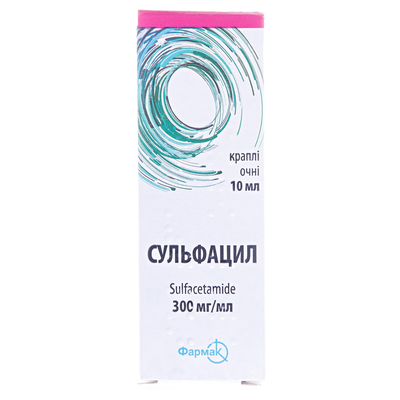
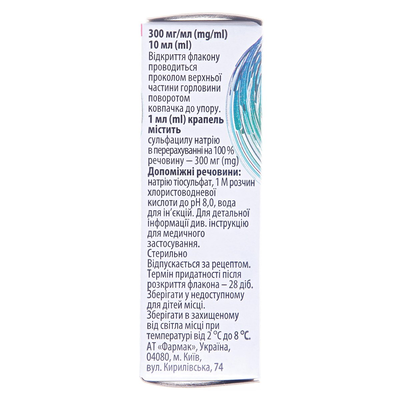
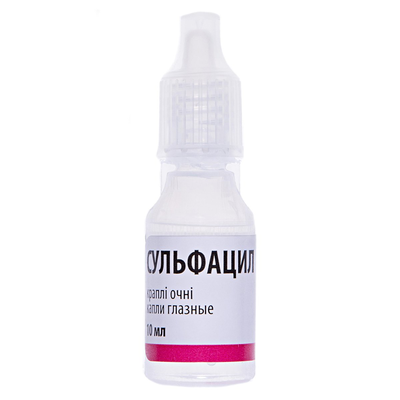
Sulfacil Eye Drops, 300 mg/mL, 10 mL per bottle.
Ingredients
Active ingredient: sulfacetamide;
1 mL of drops contains 200 mg or 300 mg of sodium sulfacetamide, calculated as 100% active ingredient;
excipients: sodium thiosulfate; 1 M hydrochloric acid solution adjusted to pH 8.0; water for injection.
Dosage Form
Eye drops.
Main physical and chemical properties: a clear, colorless or slightly yellowish liquid.
Pharmacotherapeutic group
Agents used in ophthalmology. Sulfanilamides. ATC code S01A B04.
Pharmacological properties
Pharmacodynamics.
Sulfacyl exhibits a bacteriostatic effect against Gram-positive and Gram-negative bacteria—streptococci, pneumococci, gonococci, Escherichia coli, Chlamydia, and actinomycetes. The mechanism of action of the drug is due to competitive antagonism with para-aminobenzoic acid (PABA) and competitive inhibition of dihydropteroate synthase, which leads to disruption of the synthesis of tetrahydrofolic acid, necessary for the synthesis of purine and pyrimidine bases. As a result, the synthesis of nucleic acids (DNA and RNA) in bacterial cells is disrupted, and their reproduction is inhibited.
Pharmacokinetics.
When instilled into the conjunctiva, sulfacyl penetrates the eye tissues. It acts primarily topically, but a portion of the drug is absorbed through the inflamed conjunctiva and enters the systemic circulation.
Indications
Infectious and inflammatory eye diseases caused by bacteria sensitive to the drug: conjunctivitis, blepharitis, and purulent corneal ulcers.
Contraindications
Hypersensitivity to the drug’s components or a history of hypersensitivity to sulfonamides.
Interactions with Other Medications and Other Types of Interactions
When used concomitantly with novocaine, dicaine, or anesthesin, the bacteriostatic effect is reduced; diphenin, PASK, and salicylates increase the toxicity of Sulfacil; when used with indirect-acting anticoagulants, the specific activity of the latter increases. Sulfacil is incompatible with silver salts when used topically.
Special Instructions for Use
For topical use only!
Rare fatal cases have been reported as a result of serious reactions to sulfonamides, including Stevens-Johnson syndrome, toxic epidermal necrolysis, fulminant hepatic necrosis, agranulocytosis, aplastic anemia, and other pathological blood changes.
Sensitization may occur when sulfonamides are administered repeatedly, regardless of the route of administration. Hypersensitivity reactions have been reported in individuals with no history of hypersensitivity to sulfonamides. At the first signs of hypersensitivity, skin rash, or other serious reactions, use of this medication must be discontinued.
Prolonged use of topical antibacterial agents may lead to overgrowth of pathogenic microorganisms, including fungi, as well as to the development of bacterial resistance to sulfonamides. The effectiveness of sulfanilamides is reduced in the presence of high concentrations of para-aminobenzoic acid in purulent exudate.
Sensitization may occur with repeated administration of sulfanilamides or as a result of cross-sensitivity between different sulfanilamides.
At the first signs of hypersensitivity, an increase in purulent discharge, or worsening inflammation or pain, the patient should discontinue use of the drug and consult a doctor.
Use During Pregnancy or Breastfeeding.
No animal studies have been conducted on the ophthalmic use of sulfanilamide preparations. Kernicterus may occur in newborns as a result of a pregnant woman taking oral sulfanilamides. There are no adequate and well-controlled studies on the use of ophthalmic sulfanilamide preparations by pregnant women, and it is unknown whether sulfanilamides can harm the fetus when taken by a pregnant woman. This medication may be used during pregnancy only if the potential benefit outweighs the potential risk to the fetus.
Breastfeeding
Systemic administration of sulfanilamides may cause kernicterus in infants whose mothers take sulfanilamides while breastfeeding. Due to the possibility of kernicterus in newborns, the decision to prescribe sulfanilamides as eye drops to breastfeeding women should be made after weighing the risk-benefit ratio.
Effect on the ability to drive or operate machinery: Not studied.
Dosage and Administration
Adults: Apply 2–3 drops of Sulfacil 300 mg/mL solution to the affected eye 5–6 times daily (every 4–5 hours).
For children aged 2 months and older, administer 1–2 drops of Sulfacil 200 mg/mL solution into the affected eye 4–5 times daily.
The duration of treatment is determined by the doctor depending on the nature and severity of the condition. On average, the course lasts 7–10 days.
Children.
The safety and efficacy of Sulfacil 200 mg/mL eye drops in children under 2 months of age have not been established.
The safety and efficacy of Sulfacil 300 mg/mL eye drops in children have not been established (see “Dosage and Administration”).
Overdose
Frequent use of the drug may cause redness, itching, swelling of the eyelids, and significant irritation of the ocular mucosa. In such cases, treatment should be continued with a lower-concentration Sulfacil solution; if necessary, the drug should be discontinued and symptomatic treatment administered.
Side Effects
Bacterial and fungal corneal ulcers have been reported during treatment with sulfanilamide ophthalmic preparations.
The most commonly reported reactions include local irritation, tingling, and a burning sensation. Less commonly reported reactions include nonspecific conjunctivitis, conjunctival hyperemia, secondary infection, and allergic reactions.
Rare fatal cases have been reported due to severe reactions to sulfanilamides, including Stevens-Johnson syndrome, toxic epidermal necrolysis, fulminant hepatic necrosis, agranulocytosis, aplastic anemia, and other blood disorders.
Shelf life
2 years.
Shelf life after opening the vial: 28 days.
Do not use the drug after the expiration date indicated on the packaging.
Storage Conditions
Store in a place protected from light at a temperature between 2 °C and 8 °C.
Keep out of reach of children.
Packaging
5 or 10 mL per vial. 1 vial per pack.
Dispensing Category
By prescription only.
Manufacturer
JSC “Farmak.”