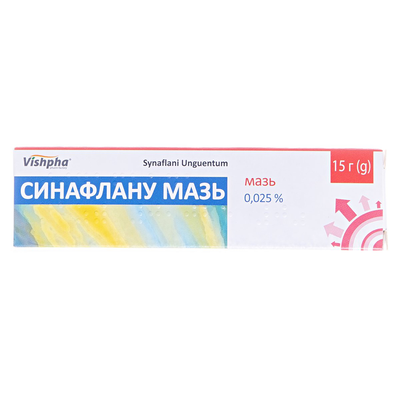
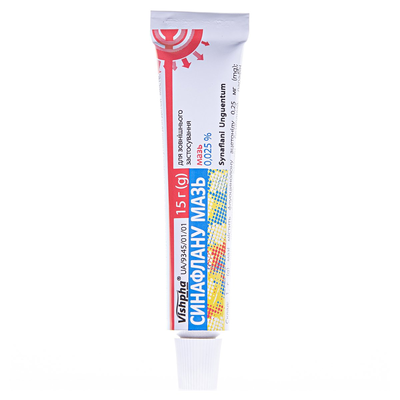
Synaflan ointment, 0.025%, 15 g per tube
In stock: 3
$49.68
Ingredients
Active ingredient: fluocinolone acetonide;
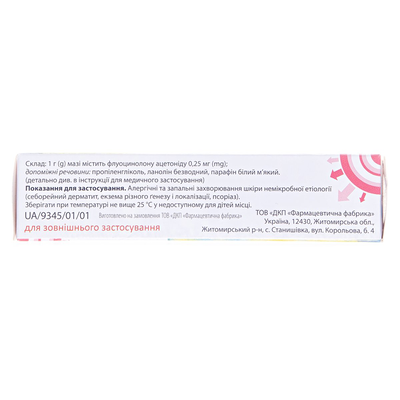
1 g of ointment contains 0.25 mg of fluocinolone acetonide;
excipients: propylene glycol, anhydrous lanolin, white soft paraffin.
Dosage Form
Ointment.
Main physical and chemical properties: a light yellow or yellow ointment with a characteristic odor.
Pharmacotherapeutic group
Corticosteroids for dermatological use. Simple corticosteroid preparations. Active corticosteroids (Group III). Fluocinolone acetonide.
ATC code D07A C04.
Pharmacological Properties
Pharmacodynamics.
The active ingredient is a synthetic fluorinated glucocorticosteroid for topical use—fluocinolone acetonide. The drug has anti-inflammatory, antiallergic, antiexudative, and antipruritic effects. It reduces the manifestations and eliminates the inflammatory reaction of the skin. It inhibits the accumulation of macrophages and leukocytes at the site of inflammation, suppresses the formation of T- and B-lymphocytes, disrupts their interaction, and reduces vascular and tissue permeability, thereby preventing the formation of inflammatory edema. It inhibits phagocytosis and the release of microsomal enzymes and inflammatory mediators.
Pharmacokinetics.
Fluocinolone acetonide readily penetrates the skin through its outer stratum corneum. Absorption of fluocinolone acetonide through the skin is enhanced when applied to sensitive areas of body folds and the face, as well as to skin with a damaged epidermis or an inflammatory process. The use of an occlusive dressing causes an increase in skin temperature and humidity, which also leads to increased absorption of fluocinolone acetonide. In addition, absorption increases with frequent use of the medication and when applied to large areas of skin. Transdermal absorption is higher in adolescents than in adults. The drug is metabolized primarily in the liver. The negligible absorption of the drug does not produce systemic effects and does not suppress adrenal cortex function. The use of occlusive dressings significantly increases bioavailability, which may lead to the development of systemic effects characteristic of fluorinated glucocorticosteroids.
It is excreted in the urine and, in small amounts, in the bile as glucuronide conjugates in an unchanged form.
Indications
Allergic and inflammatory skin diseases of non-microbial etiology (seborrheic dermatitis, eczema of various origins and locations, psoriasis).
Contraindications
Hypersensitivity to the active ingredient, other glucocorticosteroids, or other components of the medication; infectious skin diseases (bacterial, viral, fungal), including cutaneous manifestations of syphilis, cutaneous tuberculosis, pyoderma, chickenpox, herpes, actinomycosis, blastomycosis, sporotrichosis; rosacea and common acne; diaper dermatitis; perioral dermatitis; anogenital pruritus; skin neoplasms, skin tumors, including nevi, atheromas, melanoma, sarcoma, hemangioma, and xanthoma; wounds and ulcerative skin lesions, wounds at application sites, trophic leg ulcers associated with varicose veins; numerous psoriatic plaques; erosive and ulcerative lesions of the gastrointestinal tract. Do not use after preventive vaccinations. The drug is not used in ophthalmology.
Interactions with Other Medications and Other Types of Interactions
This medication may enhance the effects of immunosuppressive drugs and inhibit the effects of immunostimulants, antihypertensives, diuretics, antiarrhythmics, and potassium supplements.
This medication may be used with topical and systemic antimicrobial agents.
Concomitant use with systemic glucocorticosteroids increases the drug’s efficacy but also raises the likelihood of side effects.
Concomitant use of this drug with nonsteroidal anti-inflammatory drugs increases the risk of systemic and local side effects.
Diuretics (except for potassium-sparing diuretics) increase the likelihood of hypokalemia.
The minimal absorption of “Synaflan Ointment” when applied topically does not result in interactions with other medications.
During treatment with this medication, it is not recommended to receive the smallpox vaccine or undergo other types of immunization (especially during prolonged use on large areas of skin) due to the possible absence of an adequate immune response in the form of antibody production.
Special Considerations for Use
Treatment must be conducted under a doctor’s supervision.
The drug should be used only in short courses (do not use continuously for more than 10 days) on small areas of skin. With long-term use on large areas of skin, the frequency of side effects increases, as does the risk of developing edema, hypertension, hyperglycemia, and reduced resistance.
Before each subsequent application, any remaining ointment from the previous application should be washed off with warm soapy water or an antiseptic solution. It is recommended to wear loose-fitting clothing during treatment.
Use with caution on areas of the body with thin skin (face, axillary regions, armpits), as increased absorption and a high risk of side effects (telangiectasia, perioral dermatitis) are possible even after short-term use.
Do not apply to the skin of the breasts.
Do not use the ointment simultaneously with other topical medications.
Vision disturbances may occur with the use of systemic and topical corticosteroids.
If symptoms such as blurred vision or other visual disturbances occur, consult an ophthalmologist to evaluate possible causes, which may include cataracts, glaucoma, or rare conditions such as central serous chorioretinopathy, which has been reported with the use of systemic and topical corticosteroids.
Avoid contact with the eyes.
If skin irritation occurs at the application site, discontinue use of the medication.
If an infection develops at the application site, appropriate antibacterial or antifungal treatment should be administered. If symptoms of infection persist, use of the medication should be discontinued for the duration of infection treatment.
With topical use of the medication, the following may occur: decreased production of adrenocorticotropic hormone by the pituitary gland due to suppression of the hypothalamic-pituitary-adrenal axis, a decrease in blood cortisol levels, and the development of iatrogenic Cushing’s syndrome, which resolves after discontinuation of the medication.
Periodic monitoring of adrenal cortex function should be performed by measuring cortisol levels in blood and urine following adrenocorticotropic hormone stimulation during long-term use.
This drug should be used with particular caution in patients with psoriasis, as topical application of glucocorticosteroids to psoriasis-affected areas may lead to the spread of recurrence caused by the development of tolerance, generalized pustular psoriasis, and systemic toxicity caused by skin dysfunction.
Use this medication with caution in the presence of subcutaneous tissue atrophy, especially in elderly patients.
During treatment, smallpox vaccination and other types of immunization are not recommended.
Since this medication contains propylene glycol, it may cause skin irritation upon application.
Since this medication contains lanolin, its use may cause a local reaction (e.g., contact dermatitis).
Use during pregnancy or breastfeeding.
This medication is contraindicated during pregnancy. Breastfeeding must be discontinued during treatment with this medication.
Effect on reaction time when driving or operating machinery.
No effect.
Directions for Use and Dosage
This medication is intended for topical use only. Apply a small amount of the medication and gently rub it in 1–2 times daily. The duration of treatment is determined by the doctor on an individual basis and depends on the nature of the condition; it is usually 5–10 days, but no longer than 2 weeks.
For children aged 2 years and older, use with caution once daily under a doctor’s supervision. The duration of use in children should not exceed 5 days.
Do not apply the ointment under an occlusive dressing; only in cases of psoriasis is it permitted to apply the product under a closed dressing, which should be changed daily.
Do not apply to the facial skin for more than 1 day.
The ointment is primarily recommended for use in dry forms of dermatosis.
Children.
The product should be used in children aged 2 years and older with caution, under a doctor’s supervision, only once daily, on a small area of skin. Do not apply the ointment to a child’s face.
Overdose
With prolonged use on large areas of skin, symptoms of overdose may occur, manifested by an increase in side effects.
Symptoms: edema, hypertension, hyperglycemia, glucosuria, increased susceptibility to infections, and, in severe cases, Cushing’s syndrome; local symptoms—itching and a burning sensation at the application site.
Treatment: symptomatic, with gradual discontinuation of the drug.
Side Effects
Skin and subcutaneous tissue disorders: urticaria, allergic contact dermatitis, skin irritation, atrophic streaks, maculopapular rash, skin maceration at application sites, skin integrity impairment, hyperkeratosis, perioral dermatitis, furunculosis. Secondary infectious skin lesions and atrophic changes in the skin may develop (burning, itching, dry skin, steroid acne, folliculitis). With prolonged use, skin atrophy, localized hirsutism, telangiectasia, exacerbation of eczema, purpura, pigmentation disorders, hypertrichosis, and alopecia may occur, especially in women.
Ocular disorders: blurred vision, cataracts, or glaucoma may occur.
Gastrointestinal disorders: when applied to large areas of skin, gastritis and steroid-induced gastric ulcers may occur.
Endocrine system disorders: hyperglycemia. When applied to large areas of skin, systemic manifestations may occur: adrenal insufficiency, growth and developmental suppression in children, Cushing’s syndrome, and steroid-induced diabetes mellitus.
Immune system disorders: decreased immune resistance. With prolonged use, the following may occur: secondary immunodeficiency (exacerbation of chronic infectious diseases, generalization of the infectious process, development of opportunistic infections), and slowed healing processes.
Cardiovascular disorders: hypertension; edema may develop.
Shelf life
5 years.
Storage conditions
Store at a temperature not exceeding 25 °C, out of reach of children.
Packaging
10 g or 15 g per tube; 1 tube per pack.
Dispensing Category
By prescription only.
Manufacturer
DKP “Pharmaceutical Factory” LLC.
SKU4820030091948
Форма випускумазь
Дозуванняфлуоцинолону ацетонід: 0,25мг/г
Вага15 г