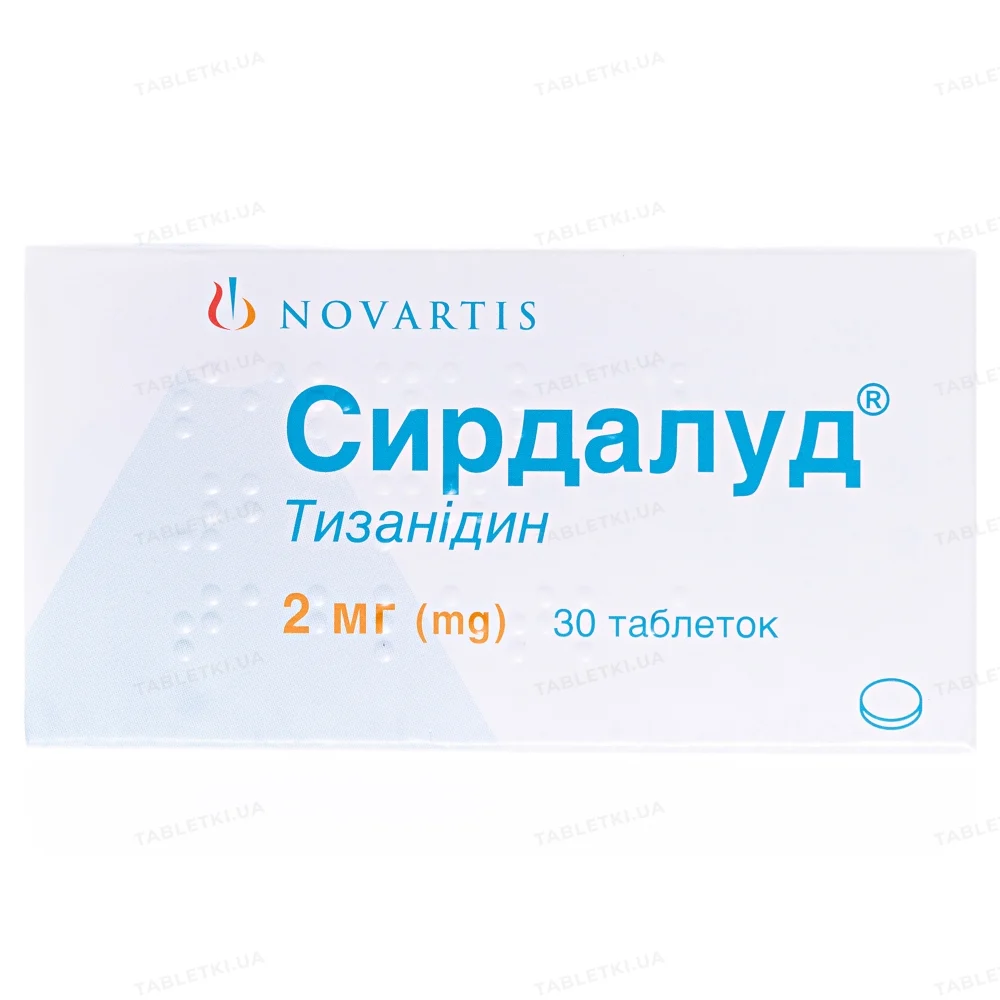

Sirdalud 2 mg tablets, No. 30 (10 x 3)
Composition
Active ingredient: tizanidine;
1 tablet contains 2.288 mg or 4.576 mg of tizanidine hydrochloride, equivalent to 2 mg or 4 mg of tizanidine, respectively;
Excipients: anhydrous lactose, microcrystalline cellulose, stearic acid, colloidal anhydrous silicon dioxide.
Dosage Form
Tablets.
Main physical and chemical properties:
Sirdalud® 2 mg – white or almost white, round, flat tablets with beveled edges, a score line, and the inscription “OZ” on one side of the tablet;
Sirdalud® 4 mg—white or almost white, round, flat tablets with beveled edges, featuring cross-shaped score lines on one side and the inscription “RL” on the other side of the tablet.
Pharmacotherapeutic group
Centrally acting muscle relaxants. ATC code M03B X02.
Pharmacological Properties
Pharmacodynamics.
Tizanidine is a centrally acting skeletal muscle relaxant/antispasmodic. Its primary site of action is the spinal cord. Evidence suggests that by stimulating presynaptic α-2-adrenoreceptors, it inhibits the release of excitatory amino acids that stimulate N-methyl-D-aspartate (NMDA) receptors. As a result, polysynaptic signal transmission at the level of interneuronal connections in the spinal cord—which is responsible for excessive muscle tone—is inhibited, and muscle tone is reduced. Sirdalud® is effective for both acute painful muscle spasms and chronic spasticity of spinal and cerebral origin. It reduces resistance to passive movements, suppresses spasms and clonic convulsions, and improves the strength of active muscle contractions.
Pharmacokinetics.
Absorption and Distribution. Tizanidine is rapidly absorbed. Maximum plasma concentration is reached approximately 1 hour after administration. The mean absolute bioavailability is 34% (CV 38%). The mean steady-state volume of distribution (Vss) following intravenous administration is 160 L. Plasma protein binding is 30%. The relatively low variability of pharmacokinetic parameters (Cmax and AUC) facilitates a reliable preliminary estimation of plasma levels in patients following oral administration.
Metabolism/Excretion. The drug undergoes rapid and extensive (approximately 95%) metabolism in the liver. Tizanidine is metabolized in vitro primarily by CYP1A2. The metabolites are inactive. They are excreted primarily by the kidneys (70%). The elimination of total radioactivity (i.e., the parent compound and metabolites) is biphasic, with a rapid initial phase (half-life t₁/₂ = 2.5 hours) and a slower elimination phase (t₁/₂ = 22 hours). Only a small amount of the parent compound (approximately 2.7%) is excreted by the kidneys. The mean half-life of the parent compound is 2–4 hours.
Linearity.
The pharmacokinetics of tizanidine are linear at doses ranging from 1 to 20 mg.
Pharmacokinetics in Specific Patient Populations. In patients with renal insufficiency (creatinine clearance less than 25 mL/min), the mean maximum plasma concentration is twice that observed in healthy volunteers, and the terminal half-life is prolonged to approximately 14 hours, resulting in an average 6-fold increase in the area under the concentration-time curve (AUC).
No studies have been conducted in patients with hepatic impairment.
Tizanidine is extensively metabolized by the CYP1A2 isoenzyme in the liver. Patients with hepatic impairment may exhibit higher plasma concentrations of the drug.
Sirdalud® is contraindicated in patients with severe hepatic impairment (see the “Contraindications” section).
Pharmacokinetic data in elderly patients are limited.
Gender has no clinically significant effect on the pharmacokinetic properties of tizanidine.
The effect of ethnicity on the pharmacokinetics of tizanidine has not been studied.
Effect of food. Concomitant food intake does not affect the pharmacokinetic profile of Sirdalud® tablets. Although the maximum concentration increases by one-third, this is not clinically significant. No significant effect on absorption was observed.
Indications
- Painful muscle spasm.
- Spasticity due to multiple sclerosis.
- Spasticity resulting from spinal cord injuries.
- Spasticity resulting from brain injury.
Contraindications
- Hypersensitivity to tizanidine or to any of the drug’s excipients.
- Severe liver dysfunction.
- Concomitant use of tizanidine with potent CYP1A2 inhibitors, such as fluvoxamine or ciprofloxacin.
Drug Interactions and Other Interactions
Concomitant use of known CYP1A2 inhibitors may increase plasma levels of tizanidine. Increased plasma levels of tizanidine may lead to symptoms of overdose, such as QT interval prolongation.
Concomitant use of known CYP1A2 inducers may reduce plasma levels of tizanidine. A reduction in plasma levels of tizanidine may lead to a decrease in the therapeutic effect of Sirdalud®.
Concomitant use of potent CYP1A2 inhibitors, such as fluvoxamine or ciprofloxacin, with tizanidine is contraindicated (see the “Contraindications” section). Concomitant use of tizanidine with fluvoxamine increases the AUC of tizanidine by 33-fold, whereas concomitant use of tizanidine with ciprofloxacin increases the AUC of tizanidine by 10-fold. This may lead to a clinically significant and prolonged decrease in blood pressure, accompanied by drowsiness, dizziness, and impaired psychomotor function (see the “Special Considerations” section).
Concomitant use of tizanidine with other CYP1A2 inhibitors, such as antiarrhythmic drugs (amiodarone, mexiletine, propafenone), cimetidine, certain fluoroquinolones (enooxacin, pefloxacin, norfloxacin), rofecoxib, oral contraceptives, and ticlopidine, is not recommended.
Increased plasma levels of tizanidine may manifest as symptoms of overdose, including QT interval prolongation (see the “Overdose” section).
Concomitant use of Sirdalud® with antihypertensive drugs, including diuretics, may occasionally cause hypotension and bradycardia. In some patients receiving concomitant treatment with antihypertensive drugs, rebound hypertension and rebound tachycardia have been observed upon abrupt discontinuation of tizanidine. In isolated cases, rebound hypertension may lead to a stroke (see the sections “Special Considerations for Use” and “Adverse Reactions”).
Caution should be exercised when Sirdalud® is used concomitantly with medications that prolong the QT interval.
Concomitant use of Sirdalud® with rifampicin may result in a 50% reduction in tizanidine concentrations. Consequently, the therapeutic effect may be reduced when rifampicin is used during treatment with Sirdalud®, which may be clinically significant for some patients. Prolonged concomitant use should be avoided; if necessary, dosage adjustments should be made with great caution. Careful dose adjustment (dose increase) is necessary in cases of planned long-term combination therapy.
Use of Sirdalud® results in a 30% reduction in the systemic exposure to tizanidine in men who smoke (more than 10 cigarettes per day). Long-term use of the drug in men who smoke heavily requires the prescription of higher doses.
Concomitant use of Sirdalud® with other centrally acting medications (e.g., sedatives and hypnotics [benzodiazepines or baclofen], certain antihistamines, general anesthetics and analgesics, psychotropic drugs, and narcotic drugs) may potentiate the effects of each drug and enhance the sedative effect of Sirdalud®. This applies, in particular, to the simultaneous consumption of alcohol, which may unpredictably alter or intensify the effects of Sirdalud® and increase the risk of adverse reactions; therefore, alcohol consumption should be avoided. The depressant effect of alcohol on the central nervous system may be potentiated by Sirdalud®.
The use of Sirdalud® in combination with α-2-adrenergic agonists (e.g., clonidine) should be avoided due to their potential additive hypotensive effect.
Special Considerations for Use
Concomitant use of moderate CYP1A2 inhibitors with tizanidine is not recommended (see the sections “Interactions with Other Medications and Other Types of Interactions” and “Contraindications”).
Following abrupt discontinuation of the drug, particularly after long-term use or rapid dose reduction and/or administration of high daily doses, and/or when used concomitantly with antihypertensive medications, patients may experience a rebound phenomenon. Under such circumstances, patients may develop hypertension and tachycardia. In rare cases, such rebound hypertension may lead to a stroke. Treatment with tizanidine should not be discontinued abruptly but only by gradually reducing the dose (see the sections “Interactions with Other Medications and Other Types of Interactions” and “Adverse Reactions”).
In patients with renal impairment (creatinine clearance < 25 mL/min), systemic exposure to tizanidine may be up to six times higher; therefore the recommended starting dose is 2 mg once daily (see the “Dosage and Administration” section). The dose should be increased gradually, in small increments, taking into account efficacy and tolerability. To achieve a more pronounced effect, it is recommended to first increase the once-daily dose and then increase the frequency of administration.
Cases of liver failure associated with tizanidine use have been reported; however, this was rarely observed in patients receiving daily doses up to 12 mg. Therefore, it is recommended to monitor liver function once a month during the first four months of therapy in patients receiving tizanidine at a dose of 12 mg or higher and in patients with clinical symptoms suggestive of liver failure (such as nausea, loss of appetite, or excessive fatigue of unknown etiology). Treatment with Sirdalud® should be discontinued if serum ALT or AST levels exceed the upper limit of normal by 3 times or more for a prolonged period.
Hypersensitivity reactions, including anaphylaxis, angioedema, dyspnea, dermatitis, rashes, urticaria, pruritus, and erythema, have been reported with the use of tizanidine. Close monitoring of patients is recommended for one or two days after the first dose of tizanidine. If anaphylaxis or angioedema with anaphylactic shock or shortness of breath develops, treatment with Sirdalud® should be discontinued immediately and the patient should receive appropriate treatment.
Hypotension may occur during treatment with tizanidine, as well as a result of drug interactions with CYP1A2 inhibitors and/or antihypertensive medications (see the sections “Interactions with Other Medications and Other Types of Interactions” and “Adverse Reactions”). Severe manifestations of hypotension, such as loss of consciousness and circulatory collapse, have been reported.
Caution should be exercised when this drug is used concomitantly with agents that prolong the QT interval (such as cisapride, amitriptyline, and azithromycin) (see the “Interactions with Other Medications and Other Types of Interactions” section).
Caution is warranted in patients with ischemic heart disease and/or heart failure. ECG monitoring should be performed regularly at the start of treatment with Sirdalud® in such patients.
Before administering this medication to patients with myasthenia gravis, the risk-benefit ratio must be carefully evaluated.
Experience with children and adolescents is limited; therefore, the use of Sirdalud® is not recommended for this patient population.
Caution should be exercised when administering this medication to elderly patients.
Sirdalud® tablets contain lactose. Sirdalud® tablets are not recommended for patients with rare hereditary disorders—galactose intolerance, severe lactase deficiency, or glucose-galactose malabsorption syndrome.
Use during pregnancy or breastfeeding.
Women of childbearing age.
Women of childbearing age who are sexually active should take a pregnancy test before starting treatment with Sirdalud®.
Women of childbearing age should be informed that animal studies indicate that Sirdalud® is harmful to the fetus. Women of reproductive age who are sexually active must use effective methods of contraception (methods that result in pregnancy in less than 1% of cases) throughout the entire period of treatment with Sirdalud® and for one day after discontinuing treatment with Sirdalud®.
Pregnancy.
Data on the use of Sirdalud® in pregnant women are limited; therefore, it should not be prescribed during pregnancy, except in cases where the potential benefit to the mother outweighs the possible risk to the fetus. Sirdalud® has no teratogenic effects in rats and rabbits; however, it causes difficult labor, increased prenatal and postnatal mortality, and fetal growth retardation in rats.
Breastfeeding.
No teratogenic effects were observed when tizanidine was administered to rats and rabbits. The risk to a breastfed infant should be considered. Animal studies have shown that tizanidine passes into breast milk in small amounts. Therefore, this medication should not be prescribed to women who are breastfeeding.
Fertility.
No impairment of fertility was observed in male rats administered the drug at a dose of 10 mg/kg per day or in female rats administered the drug at a dose of 3 mg/kg per day. A decrease in fertility was observed in male rats receiving a dose of 30 mg/kg per day and in female rats receiving a dose of 10 mg/kg per day. Sedation, weight loss, and ataxia were also observed at these doses.
Effect on the ability to drive or operate machinery.
Even when administered according to recommendations, tizanidine may cause drowsiness, dizziness, and/or hypotension, thereby impairing the patient’s ability to drive or operate machinery. These risks increase with concurrent alcohol use.
Therefore, patients should refrain from activities requiring high concentration and quick reactions, such as driving or operating machinery.
Dosage and Administration
Sirdalud® has a narrow therapeutic range and high variability in plasma tizanidine concentrations among different patients. Therefore, it is important to use optimal doses tailored to the patient’s needs. Treatment should begin with a low dose—2 mg—to minimize the risk of adverse effects. If necessary, the dose may be gradually increased while observing all necessary precautions. Adults
Relief of painful muscle spasms
Take 2–4 mg 3 times a day. In severe cases, an additional dose of 2 or 4 mg may be taken before bedtime.
Spasticity associated with neurological disorders
The dose should be individualized for each patient.
The initial daily dose should not exceed 6 mg divided into 3 doses. The daily dose may be gradually increased by 2–4 mg at intervals of 3–7 days. The optimal therapeutic effect is usually achieved with a daily dose of 12–24 mg, divided into 3 or 4 doses. The total daily dose should not exceed 36 mg.
Special Patient Populations
Use in Children and Adolescents
Experience with the use of Sirdalud® in children and adolescents is limited; therefore, the drug is not recommended for use in children and adolescents.
Use in Elderly Patients
Experience with the use of this medication in elderly patients is limited; therefore, caution should be exercised when administering Sirdalud® to this patient population. It is recommended to start treatment with the lowest dose and gradually increase it in small increments with caution until the optimal balance between individual tolerability and therapeutic efficacy is achieved.
Use in Patients with Renal Impairment For patients with renal impairment (creatinine clearance < 25 mL/min), the recommended initial once-daily therapeutic dose is 2 mg. The dose should be increased gradually and with caution, in small increments, until the optimal balance between individual tolerability and the drug’s therapeutic efficacy is achieved. To enhance therapeutic efficacy, the single dose should be increased first before switching to more frequent daily dosing (see the “Special Considerations for Use” section). Use in Patients with Impaired Liver Function
Treatment of patients with severe hepatic impairment is contraindicated (see the “Contraindications” section). Sirdalud® is extensively metabolized in the liver. There are limited data on the use of Sirdalud® in patients with hepatic impairment (see the “Pharmacokinetics” section). Use of Sirdalud® is associated with reversible abnormalities in liver function tests (see sections “Special Considerations” and “Adverse Reactions”). Sirdalud® should be used with caution when treating patients with moderate hepatic impairment. Treatment should be initiated at the lowest dose; any dose increase should be made with caution and based on the patient’s individual tolerance of Sirdalud®.
Discontinuation of Treatment
If it becomes necessary to discontinue treatment with the drug, the dose should be reduced slowly and gradually. This is particularly important for patients who have been receiving a high dose of the drug for an extended period. This reduces the risk of rebound hypertension and tachycardia (see the “Special Considerations for Use” section).
Children.
Experience with the use of this medication in pediatrics is limited. Sirdalud® is not recommended for use in children.
Overdose
Very few reports of Sirdalud® overdose have been received. In all patients in whom isolated cases of overdose with this drug were reported—including one patient who took 400 mg of Sirdalud®—recovery occurred without complications.
Symptoms: nausea, vomiting, hypotension, bradycardia, QT interval prolongation, dizziness, miosis, respiratory distress, coma, agitation, drowsiness.
Treatment: Repeated administration of high doses of activated charcoal is recommended to remove the drug from the body. Forced diuresis may accelerate drug elimination. Subsequently, provide symptomatic treatment.
Side Effects
Adverse reactions—such as drowsiness, increased fatigue, dizziness, dry mouth, low blood pressure, nausea, gastrointestinal disturbances, and elevated serum transaminase levels—are usually mild and transient in patients taking the low doses recommended for relieving painful muscle spasms.
When doses higher than those recommended for the treatment of spasticity are taken, the above-mentioned adverse reactions occur more frequently and are more pronounced; however, they are rarely severe enough to warrant discontinuation of treatment. The following adverse reactions are also possible: hypotension, bradycardia, muscle weakness, sleep disturbances, hallucinations, and hepatitis.
The onset of such symptoms has been reported following abrupt discontinuation of tizanidine, particularly after long-term treatment and/or administration of high daily doses and/or concomitant therapy with antihypertensive medications. Under such circumstances, patients may develop hypertension and tachycardia. In rare cases, such rebound hypertension may lead to a stroke. Therefore, treatment with tizanidine should not be discontinued abruptly but only by gradually reducing the dose (see the sections “Special Considerations for Use” and “Interactions with Other Medications and Other Types of Interactions”).
The following classification is used to assess the frequency of various adverse reactions: very common (≥ 1/10); common (≥ 1/100, < 1/10); uncommon (≥ 1/1,000, < 1/100); rare (≥ 1/10,000, < 1/1,000); very rare (< 1/10,000).
Mental disorders: common—insomnia, sleep disturbances.
Nervous system disorders: very common—drowsiness, weakness, dizziness.
Cardiac disorders: uncommon – bradycardia.
Vascular disorders: common—hypertension, slight decrease in blood pressure.
Gastrointestinal system: very common—gastrointestinal disorders, dry mouth; common—nausea.
Hepatobiliary disorders: common—elevated serum transaminase levels.
Musculoskeletal system: very common—muscle weakness.
General disorders: very common—increased fatigue.
Postmarketing Studies
Additional adverse reactions to the drug have been reported in postmarketing studies. Reports of these adverse reactions came from an unknown number of patients; therefore, it is not possible to reliably estimate their frequency.
Immune system disorders: hypersensitivity reactions (including anaphylaxis, angioedema, dyspnea, and urticaria).
Psychiatric disorders: hallucinations, confusion.
Nervous system disorders: vertigo
Cardiovascular disorders: syncope.
Eye disorders: blurred vision.
Hepatobiliary disorders: hepatitis, liver failure.
Skin and subcutaneous tissue disorders: rashes, erythema, pruritus, dermatitis. General disorders: asthenia, withdrawal syndrome.
Shelf life
5 years.
Storage conditions
Store at a temperature not exceeding 25 °C, out of reach of children.
Packaging
10 tablets per blister pack; 3 blister packs per cardboard box.
Manufacturer
1) Novartis Saglik, Gida ve Tarim Urunleri San. ve Tic. A.S.
2) Novartis Pharma GmbH.
Locations of the manufacturers and addresses of their places of business.
1) Yenisehir Neighborhood, Ihlara Valley Street No. 2, Pendik, Istanbul, TR 34912, Turkey / Yenisehir Mahallesi, Ihlara Vadisi Sokak No. 2, Pendik, Istanbul, TR 34912, Turkey.
2) Roonstrasse 25 and Obere Turnstrasse 8, Nuremberg, 90429, Germany / Roonstrasse 25 und Obere Turnstrasse 8, 90429, Nuremberg, Germany.