
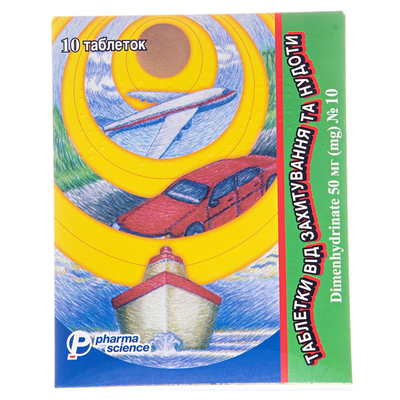
Tablets for Coughing and Nausea, 50 mg tablets, No. 10
Ingredients
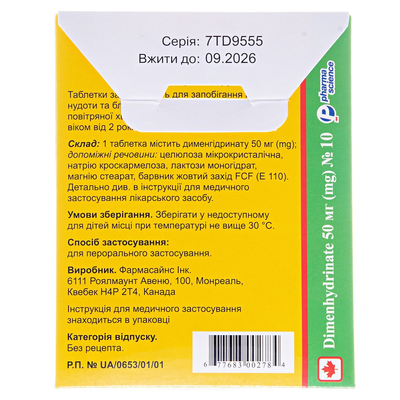
Active ingredient: dimenhydrinate;
1 tablet contains 50 mg of dimenhydrinate;
Excipients: microcrystalline cellulose, croscarmellose sodium, lactose monohydrate, magnesium stearate, Sunset Yellow FCF (E 110).
Dosage Form
Tablets.
Main physical and chemical properties: orange-colored, round, flat tablets. One side of the tablet may or may not bear the imprint “APO 50”; the other side has two cross-scored lines.
Pharmacotherapeutic group
Agents used in vestibular disorders. ATC code N07C A.
Pharmacological properties
Pharmacodynamics.
Dimenhydrinate is the chloro-theophylline salt of the well-known antihistamine diphenhydramine, which blocks H1 receptors and contains approximately 55% diphenhydramine and 45% 8-chloro-theophylline. The pharmacological activity of dimenhydrinate is due to diphenhydramine, which depresses the central nervous system (CNS) and has anticholinergic, antiemetic, antihistamine, and local anesthetic effects.
Anticholinergic effect: inhibition of vestibular stimulation in cases of dizziness (Ménière’s disease, motion sickness, and airsickness). Dimenhydrinate inhibits labyrinthine stimulation for 3 hours after administration.
Antiemetic effect: suppression of the vomiting reflex. The exact mechanism has not been established. Dimenhydrinate suppresses the vomiting reflex following apomorphine administration; however, it is ineffective against vomiting caused by emetogenic chemotherapy. With prolonged use, the antiemetic effect may diminish.
Antihistamine effect: A significant sedative effect results from its central M-cholinergic blocking action. The inhibitory effect on the central nervous system persists for several days following dimenhydrinate administration.
Pharmacokinetics.
After oral administration, it is well absorbed in the gastrointestinal tract. The antiemetic effect begins approximately 30 minutes after administration, and the duration of action is 3–6 hours. It is widely distributed throughout the body, including the central nervous system. The degree of binding to plasma proteins is 78%.
The active ingredient in dimenhydrinate, diphenhydramine, is metabolized in the liver and excreted primarily as metabolites within 24 hours. A minimal amount of unchanged drug is excreted in the urine.
The half-life is approximately 3.5 hours.
Indications
- Prevention and relief of nausea and vomiting associated with motion sickness (sea and air sickness), during radiation therapy, when taking medications (except for those used in chemotherapy for cancer), and after surgery.
- Symptomatic treatment of Meniere’s disease and other disorders of the vestibular system.
Contraindications
Hypersensitivity to dimenhydrinate and other structurally similar antihistamines, or to any of the excipients contained in the product.
Closed-angle glaucoma, increased intracranial pressure, pheochromocytoma, porphyria, prostatic hyperplasia with urinary retention, epilepsy, eclampsia, acute asthma attack, severe hepatic insufficiency, severe renal insufficiency (creatinine clearance ≤ 25 mmol/min).
Interactions with Other Medications and Other Types of Interactions
Concomitant use of alcohol with dimenhydrinate should be avoided, as it may alter or potentiate the effects of dimenhydrinate.
Diphenhydramine may enhance the anticholinergic effects of other medications (e.g., atropine, antiparkinsonian drugs, tricyclic antidepressants) and the central nervous system (CNS)-depressant effects of agents such as barbiturates, hypnotics, sedatives, tranquilizers, antidepressants, morphine (analgesics, antitussives, replacement therapy medications), benzodiazepines, neuroleptics, centrally acting antihypertensive agents, baclofen, and thalidomide.
This medication may enhance the CNS-depressant effects of antiepileptic drugs.
Concomitant use with monoamine oxidase (MAO) inhibitors may enhance the anticholinergic effects of diphenhydramine; In isolated cases, reports have been made of paralytic syndrome (sometimes life-threatening), urinary retention, increased intraocular pressure, as well as possible decreases in blood pressure, sedative effects on the central nervous system, and respiratory depression.
This medication potentiates the effects of diazepam and has an effect opposite to that of amphetamines and their derivatives. Taking dimenhydrinate reduces the efficacy of corticosteroids and oral anticoagulants.
Concomitant use with bismuth preparations, analgesics, psychotropic drugs, and scopolamine may cause visual impairment.
Particular caution should be exercised when prescribing this medication to patients taking drugs that prolong the QT interval (Class I and II antiarrhythmics: certain antibiotics, such as erythromycin; antimalarial agents; antihistamines; and neuroleptic drugs), or drugs that cause hypokalemia (e.g., certain specific diuretics).
Dimenhydrinate may mask the side effects of ototoxic drugs, such as aminoglycosides.
Treatment with dimenhydrinate should be discontinued at least three days before allergy testing, as its use may lead to a false-negative result.
Special Considerations for Use
This medication should be prescribed with particular caution to patients suffering from liver or kidney disease, hyperthyroidism, bradycardia, hypertension, chronic respiratory diseases, bronchial asthma, hypokalemia, hypomagnesemia, pyloric stenosis and pyloroduodenal obstruction, gastric ulcer, intestinal obstruction, have congenital long QT syndrome, or other clinically significant cardiac disorders (cardiovascular diseases, circulatory disorders, arrhythmias), or are concurrently taking other medications that cause QT prolongation or hypokalemia.
This medication should be prescribed with caution to elderly patients, as they are more prone to orthostatic hypotension, obesity, chronic constipation (risk of paralytic ileus), benign prostatic hyperplasia, Parkinson’s disease, and are also more likely to take sedatives. Such patients should receive the lowest recommended adult dose, as they are sensitive to the drug’s anticholinergic effects.
This medication contains lactose.
If you have been diagnosed with an intolerance to certain sugars, consult your doctor before taking this medication.
Patients with rare hereditary galactose intolerance, Lapp lactase deficiency, or glucose-galactose malabsorption should not take this medication.
This medication contains the dye Sunset Yellow FCF (E 110), which may cause allergic reactions.
Use During Pregnancy or Breastfeeding.
This medication is contraindicated during pregnancy. Small amounts of dimenhydrinate pass into breast milk; therefore, breastfeeding should be discontinued during treatment.
Effect on reaction time when driving or operating machinery.
Taking this medication may cause drowsiness, impaired coordination, dizziness, and prolonged reaction time; therefore, patients should refrain from driving or operating machinery that poses an increased risk of injury while taking this medication.
Dosage and Administration
Take orally, regardless of meals. The tablet may be taken with a small amount of water.
Prevention and treatment of nausea and vomiting associated with motion sickness (sea and air sickness), during radiation therapy, while taking other medications, and after surgery
To prevent motion sickness (sea and air sickness), take the recommended dose at least half an hour before boarding a vehicle (airplane or ship).
For adults and children 12 years of age and older:
The recommended dose is 50 mg (1 tablet) 30–60 minutes before the start of the trip; the dose may be repeated as needed at 50–100 mg every 4–6 hours.
The maximum daily dose should not exceed 400 mg.
For children aged 6–12 years:
The recommended dose is 25–50 mg (1/2–1 tablet); the dose may be repeated as needed every 6–8 hours. The maximum daily dose should not exceed 150 mg.
Children aged 2–6 years:
The recommended dose is 25 mg (1/2 tablet); the dose may be repeated every 6–8 hours as needed. The maximum daily dose should not exceed 75 mg.
The maximum daily dose in pediatric practice should not exceed 5 mg/kg.
Elderly patients should start with an initial dose of 25 mg (1/2 tablet).
For Meniere’s disease and other disorders of the vestibular system
Adults: 50–100 mg (1–2 tablets) every 4–6 hours as needed, not exceeding a maximum daily dose of 400 mg.
Use with caution in patients with renal and/or hepatic insufficiency.
In cases of hepatic insufficiency, the dose should be reduced by half.
In renal insufficiency, the usual dose may be used.
Children.
The efficacy and safety of this medication in children under 2 years of age have not been established. The medication may be used in children 2 years of age and older.
Overdose
Symptoms. The first symptoms of overdose appear 0.5–2 hours after ingestion of a toxic dose (25 mg/kg body weight), primarily in the form of headache, dizziness, fatigue, and drowsiness.
After some time, additional symptoms appear: itching, constriction of skin blood vessels, dilated pupils with a slowed pupillary reflex, cycloplegia, nystagmus, decreased muscle strength, tendon reflexes, and urinary retention. The heart rate increases significantly, and blood pressure may rise or fall.
Symptoms of central nervous system (CNS) (slurred speech, disorientation in time and space, ataxia, coma) or CNS excitation (convulsions, psychosis with hallucinations) may also be observed, which gradually intensify.
Treatment: gastric lavage, administration of enterosorbents, symptomatic therapy.
Side Effects
Neurological: dizziness, headache, drowsiness, agitation, insomnia, lethargy, prolonged reaction time, muscle weakness, impaired coordination, tremor, anxiety, impaired concentration and memory, seizures, hallucinations.
Ocular: glaucoma, visual disturbances, increased intraocular pressure, possible blurred vision, diplopia.
Ear disorders: tinnitus.
Cardiovascular system: palpitations, tachycardia, arrhythmia, angina attacks, hypotension, including orthostatic hypotension.
Gastrointestinal system: stomach pain, diarrhea, constipation, dry mouth, nausea, vomiting, increased or decreased appetite, weight gain.
Skin and subcutaneous tissue disorders: allergic reactions, photosensitivity, exfoliative dermatitis, rash, hives.
Lymphatic and hematopoietic system: hemolytic anemia.
Immune system disorders: angioedema; rarely, anaphylactic shock.
Urinary system: urinary dysfunction (urinary retention due to anticholinergic effects), difficulty urinating.
Hepatobiliary system: liver function abnormalities, cholestatic jaundice.
Respiratory system: nasal congestion, increased viscosity of bronchial secretions.
Other: arthralgia, decreased sweating, dry mucous membranes.
Long-term use of dimenhydrinate may lead to drug dependence.
Shelf life
5 years.
Storage conditions
Store out of the reach of children at a temperature not exceeding 30 °C.
Packaging
25 or 10 tablets per blister pack; 1 blister pack per cardboard box.
Dispensing Category
Available without a prescription.







