
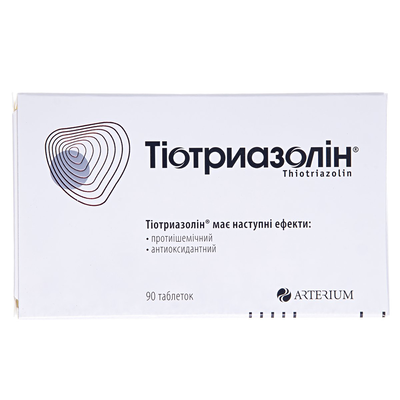
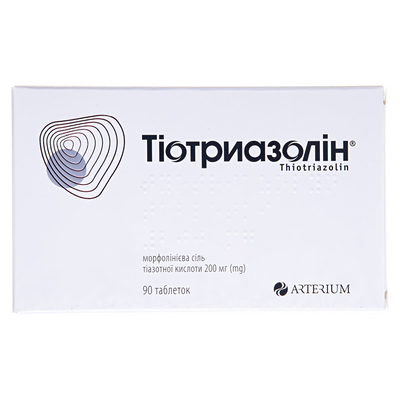
Thiotriazoline 200 mg tablets, No. 90 (15 x 6)
Composition
Active ingredient(s): tiazotic acid;
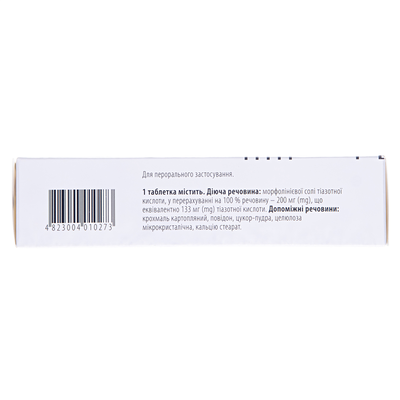
1 tablet contains 200 mg of the morpholine salt of thiazotic acid on a 100% active ingredient basis, equivalent to 133 mg of thiazotic acid;
Excipients: potato starch, povidone, powdered sugar, microcrystalline cellulose, calcium stearate.
Dosage Form
Tablets.
Main physical and chemical properties: white or almost white, round tablets with a flat surface, a bevel, and a score line.
Pharmacotherapeutic group
Cardiovascular drugs. Other cardiovascular drugs. Thiazonic acid.
ATC code C01E B23.
Pharmacological properties
Pharmacodynamics.
The pharmacological effect of thiazonic acid is due to its anti-ischemic, membrane-stabilizing, antioxidant, and immunomodulatory actions.
The drug’s effect is achieved by enhancing the compensatory activation of anaerobic glycolysis and the activation of oxidative processes in the Krebs cycle while preserving intracellular ATP reserves. The presence in the thiazonic acid molecule of a sulfur thiol, which has redox properties, and tertiary nitrogen, which binds excess hydrogen ions, leads to the activation of the antioxidant system. The strong reducing properties of the thiol group cause it to react with reactive oxygen species and lipid radicals. The reactivation of antiradical enzymes—superoxide dismutase, catalase, and glutathione peroxidase—prevents the initiation of reactive oxygen species.
The effect of thiazonic acid leads to the inhibition of lipid oxidation processes in ischemic areas of the myocardium, a reduction in myocardial sensitivity to catecholamines, the prevention of progressive suppression of cardiac contractile function, and stabilizes and reduces, respectively, the areas of myocardial necrosis and ischemia. The improvement in blood rheological properties is achieved through the activation of the fibrinolytic system. Improvement of myocardial metabolic processes, enhancement of its contractile capacity, and promotion of normal heart rhythm make it appropriate to recommend thiazotic acid for the treatment of patients with various forms of ischemic heart disease.
In addition to its use in cardiology, thiazotic acid is used in the treatment of liver diseases and other internal organ disorders, given its potent hepatoprotective properties. The drug prevents the destruction of hepatocytes, reduces the degree of fatty infiltration and the spread of centrilobular necrosis in the liver, promotes the reparative regeneration of hepatocytes, and normalizes protein, carbohydrate, lipid, and pigment metabolism in them. It increases the rate of bile synthesis and secretion and normalizes its chemical composition.
Pharmacokinetics.
After oral administration, the drug is rapidly absorbed; its absolute bioavailability is 53%. Maximum plasma concentration is reached 1.6 hours after a single 200-mg dose. The half-life is approximately 8 hours.
Indications
In the comprehensive treatment of ischemic heart disease: angina pectoris, myocardial infarction, post-infarction cardiosclerosis; cardiac arrhythmias.
For the comprehensive treatment of chronic hepatitis of various etiologies, including alcoholic hepatitis; and liver cirrhosis.
Contraindications
Hypersensitivity to thiazotic acid or any other components of the drug;
acute renal failure.
Interactions with Other Medications and Other Types of Interactions
Thiotriazolin® can be used as a cardioprotective agent in combination with standard therapies for ischemic heart disease.
As a hepatoprotective agent, it may be combined with conventional treatments for hepatitis.
Special considerations for use
None.
Use During Pregnancy or Breastfeeding
The efficacy and safety of this drug during pregnancy or breastfeeding have not been studied.
Effect on reaction time when driving or operating machinery
There are currently no reports, but the possibility of dizziness should be considered.
Dosage and Administration
For stable exertional angina, Tiotriazolin® should be administered at a dose of 200 mg orally 3 times daily. The course of treatment is 8 weeks.
For angina at rest, myocardial infarction, or post-infarction cardiosclerosis, Tiotriazolin® should be administered at a dose of 200 mg orally three times daily for 20–30 days.
For cardiac arrhythmias, Tiotriazolin® should be administered at a dose of 200 mg orally or sublingually three times daily.
For liver diseases, Tiotriazolin® should be administered orally at a dose of 200 mg three times daily for 20–30 days.
The duration of treatment is determined by the physician on an individual basis, depending on the severity and course of the disease.
Children
There is insufficient experience with the use of this medication in children.
Overdose
In case of overdose, the concentration of sodium and potassium in the urine increases. In such cases, the drug should be discontinued.
Treatment is symptomatic.
Side Effects
The drug is generally well tolerated.
In patients with increased individual sensitivity, the following may occur:
skin and subcutaneous tissue reactions: itching, skin redness, rash, hives, angioedema.
When used as part of combination therapy, primarily in elderly patients, the following may occur:
Immune system: anaphylactic shock;
Central and peripheral nervous system: dizziness, tinnitus;
Gastrointestinal system: symptoms of dyspepsia, including dry mouth, nausea, and vomiting; abdominal bloating;
Respiratory system, thoracic organs, and mediastinum: shortness of breath, difficulty breathing;
General disorders: general weakness, fever.
During postmarketing surveillance, the following reactions were also observed, although their association with the use of Tiotriazolin® has not been established:
Cardiovascular system: hypertension, tachycardia.
Shelf life
2 years.
Storage conditions
Store in the original packaging at a temperature not exceeding 25 °C. Keep out of reach of children.
Packaging
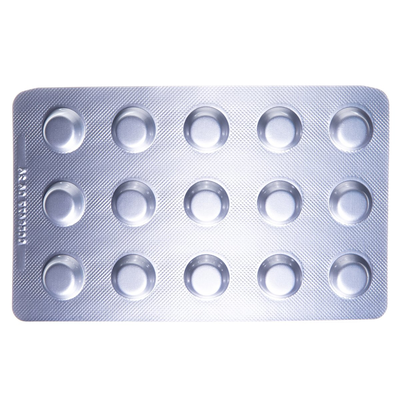
200 mg tablets, 10 tablets per blister, 3 or 9 blisters per pack; 15 tablets per blister, 6 blisters per pack.
Dispensing Category
By prescription only.
Manufacturer
Kyivmedpreparat PJSC.







